SE423 · Chapter 3 · Annotated SlidesTeam
PDF
Overview

Team

The most examined chapter in SE423: both 251 midterms took most of their short questions from it, and both finals have a whole team-based collaboration question. It has three parts. Team development: Tuckman’s stages, team objectives and structures, and the team needs pyramid (trust → managed conflict → commitment → accountability → results) with RACI and skills matrices as the accountability tools. Team models: business, democratic, chief-programmer, skunk works, SWAT, and why large teams need hierarchy (n(n−1)/2 channels). Managing people: motivation and personality types, cohesiveness and groupthink, staff selection, working environments, shaping project culture, technical vs. adaptive leadership, and reaching consensus.

The instructor’s style: questions ask you to apply an idea to a team situation (“team members disagree: how do you encourage collaboration?”). Saying one word (“negotiation”) is not enough; explain what you do, how, and why.

Team pyramid

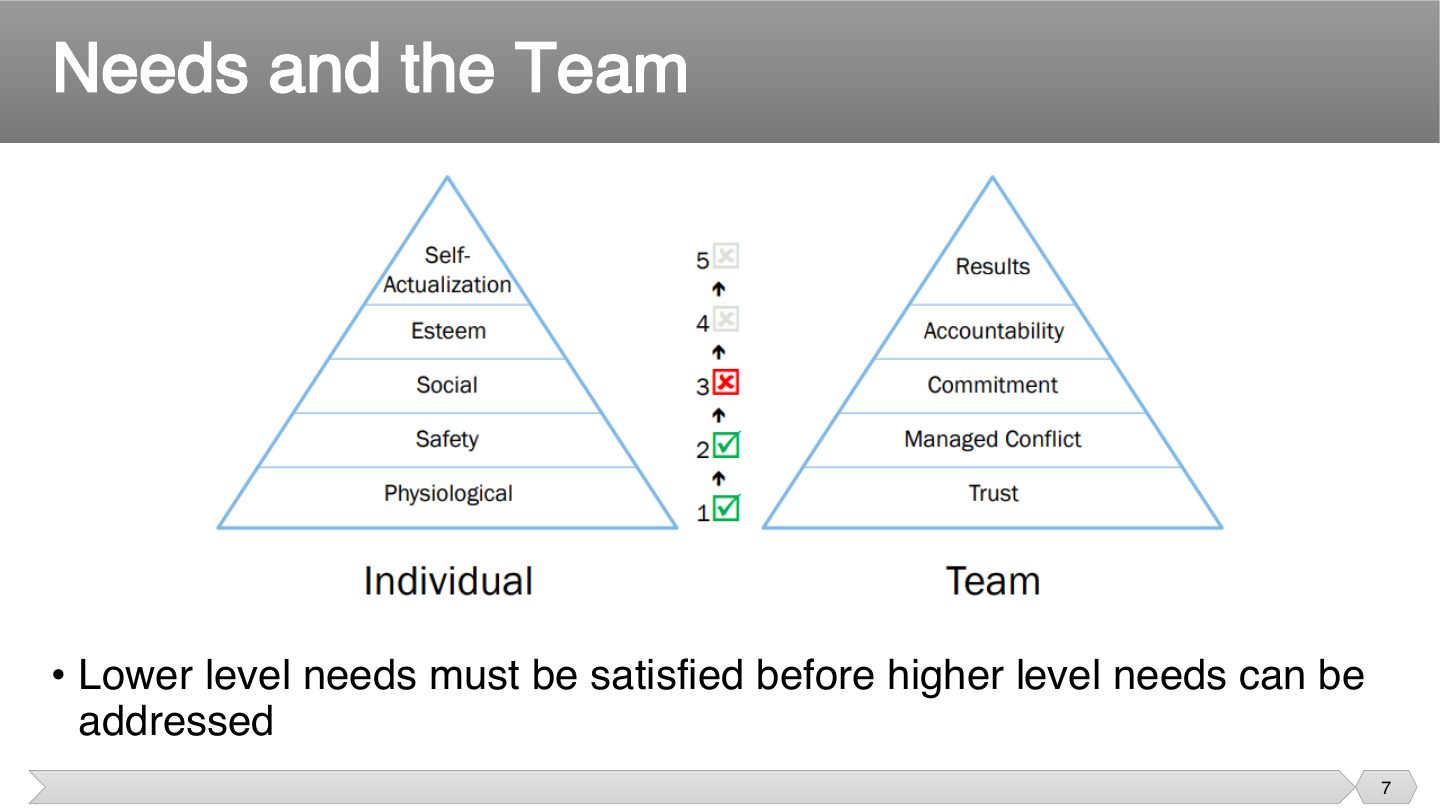
Trust → managed conflict → commitment → accountability → results. Each layer needs the one below; trust is the foundation.

Tuckman

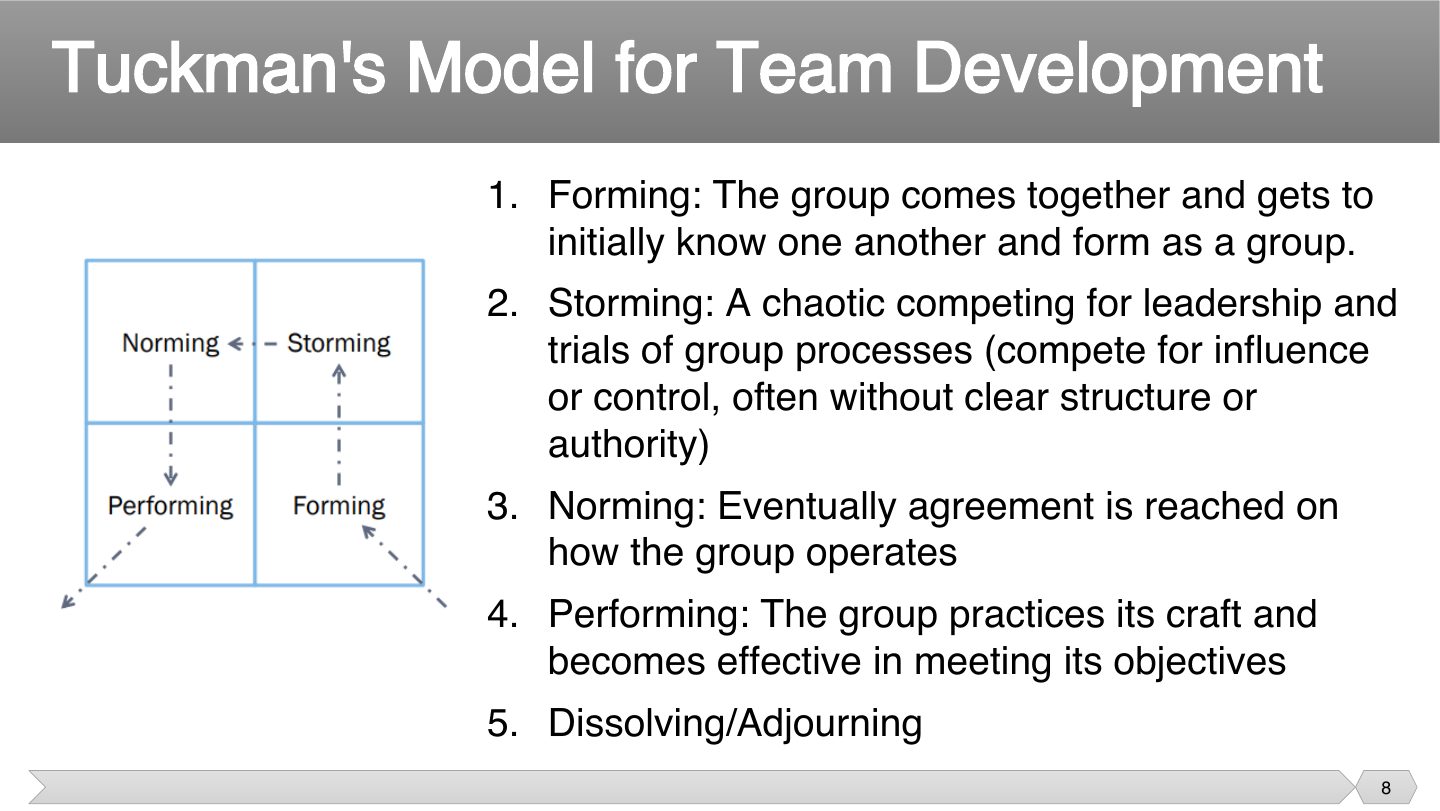
Forming → storming (competing for leadership) → norming (agree how to work) → performing → adjourning.

RACI

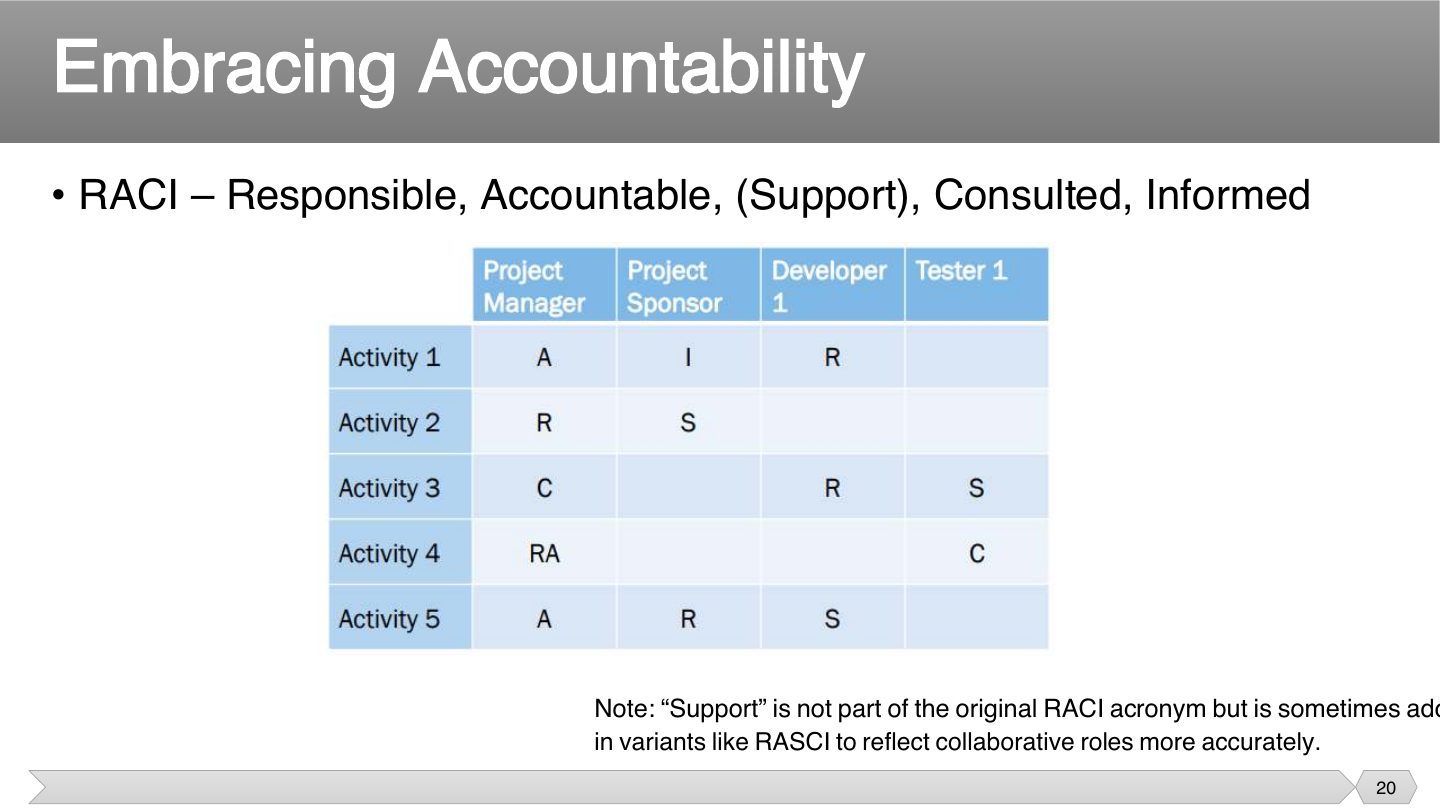
R does the work, A owns the outcome (exactly one per task), C gives input (two-way), I is kept updated (one-way).

Team models

Business (tech lead + equals, most common), democratic (whole team decides), chief-programmer (surgical), skunk works, SWAT.

Leadership

Technical leadership for problems solvable by known means; adaptive leadership for new or complex ones. Most IT projects need both.

Consensus

Not unanimous agreement: everyone feels heard and the group moves forward committed. Persuade, don’t dictate.

How the lecture is organized

  • Slides 1–9Team development: influence, the pyramid, Tuckman, team objectives
  • Slides 10–24The pyramid layer by layer: trust, conflict, commitment, accountability (RACI, RAM, skills matrix), results
  • Slides 25–34Team models and team size
  • Slides 35–56Managing people: motivation, personality types, cohesiveness, communication, selection, environment
  • Slides 57–70Project culture, managing thought workers, making people better
  • Slides 71–77Leadership, consensus and key points

Exam focus

Midterm 251 (both versions): MCQs on Tuckman’s storming stage, the foundation of teamwork and the advantage of a cohesive team; short questions on good-team characteristics, vulnerability-based trust, healthy conflict, the best time to reinforce accountability, business vs. democratic teams, technical vs. adaptive leadership and a RACI table; a case on accountability after an untested release. Finals: commitment, trust and conflict, accountability and transparency (Final 242 Q5), the communication-channel formula (Final 242), a CI/CD consensus decision and a milestone celebration (Final 251 Q5). The instructor’s 2026 midterm asked how a PM encourages collaboration when members disagree.

How to read this page

Every original slide is shown unchanged. Yellow marks on a slide point to a numbered note: hover or tap a mark to jump to its note, and hover a note to see its marks. Questions tagged Past exam appeared on a real paper; Prediction questions are likely angles, not confirmed. Pick an answer to each question: a wrong pick tells you why it is wrong, so you can try again.

All 77 slides
  1. 1 Slide 1
  2. 2 Outline
  3. 3 Slide 3
  4. 4 Team Development - Introduction
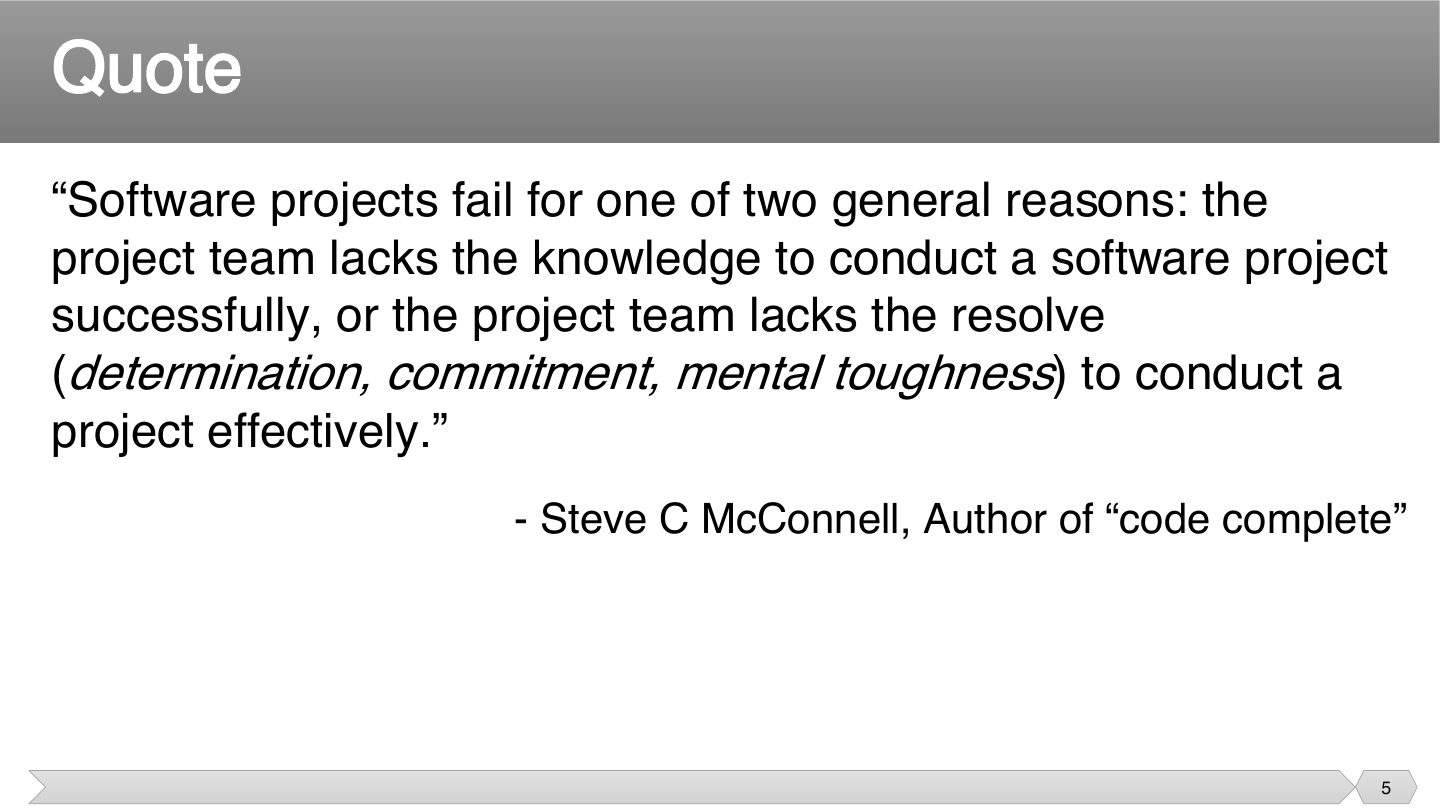
  5. 5 Quote
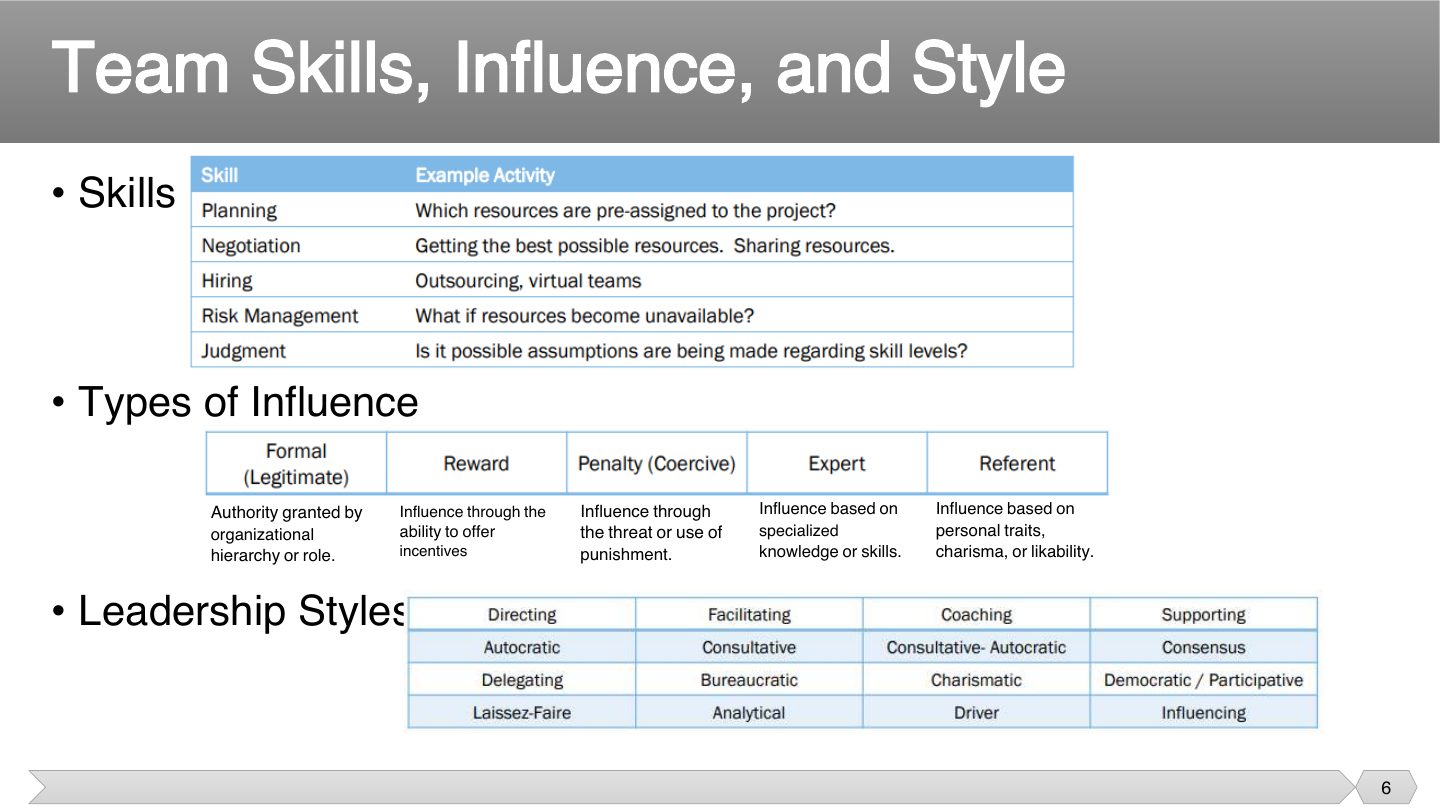
  6. 6 Team Skills, Influence, and Style
  7. 7 Needs and the Team
  8. 8 Tuckman's Model for Team Development
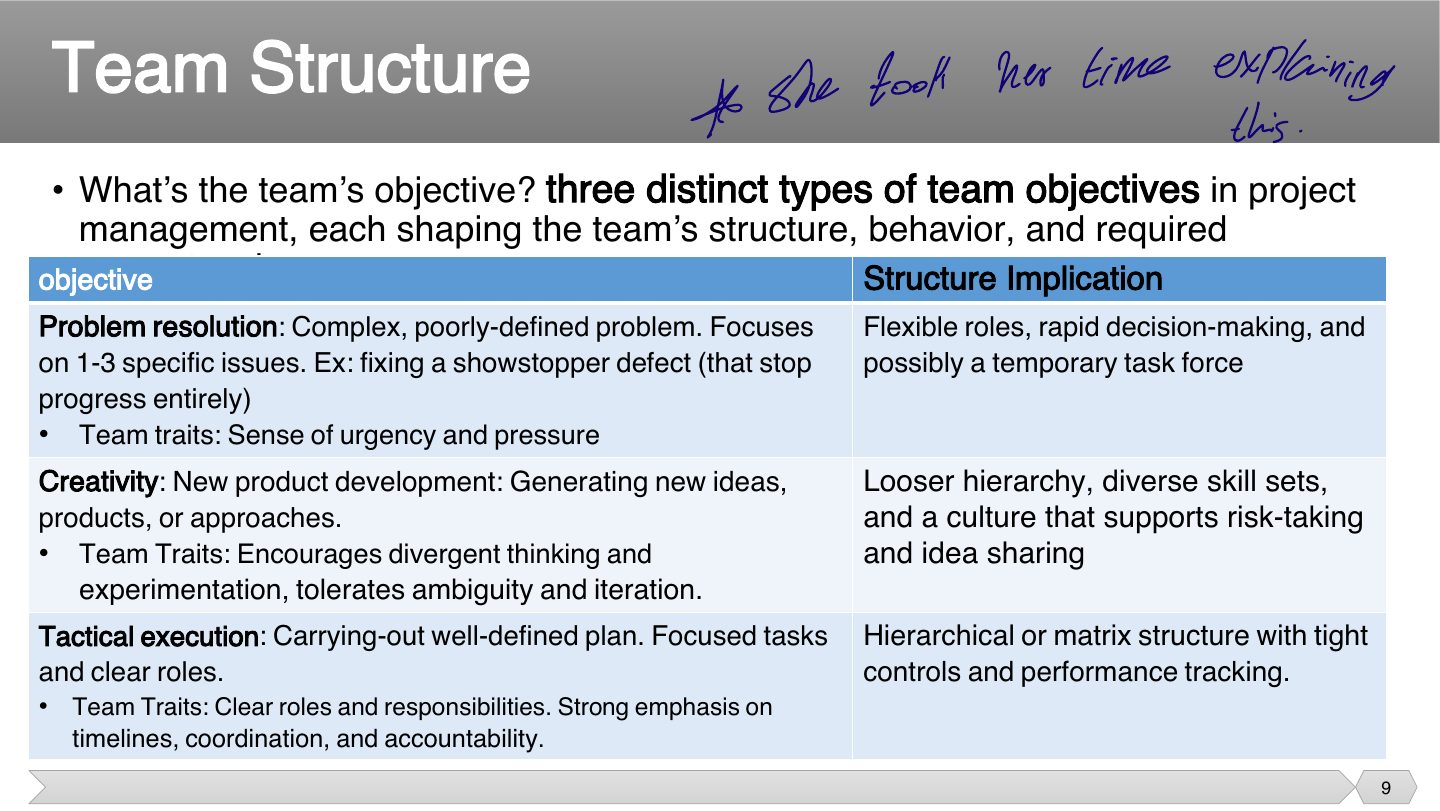
  9. 9 Team Structure
  10. 10 Slide 10
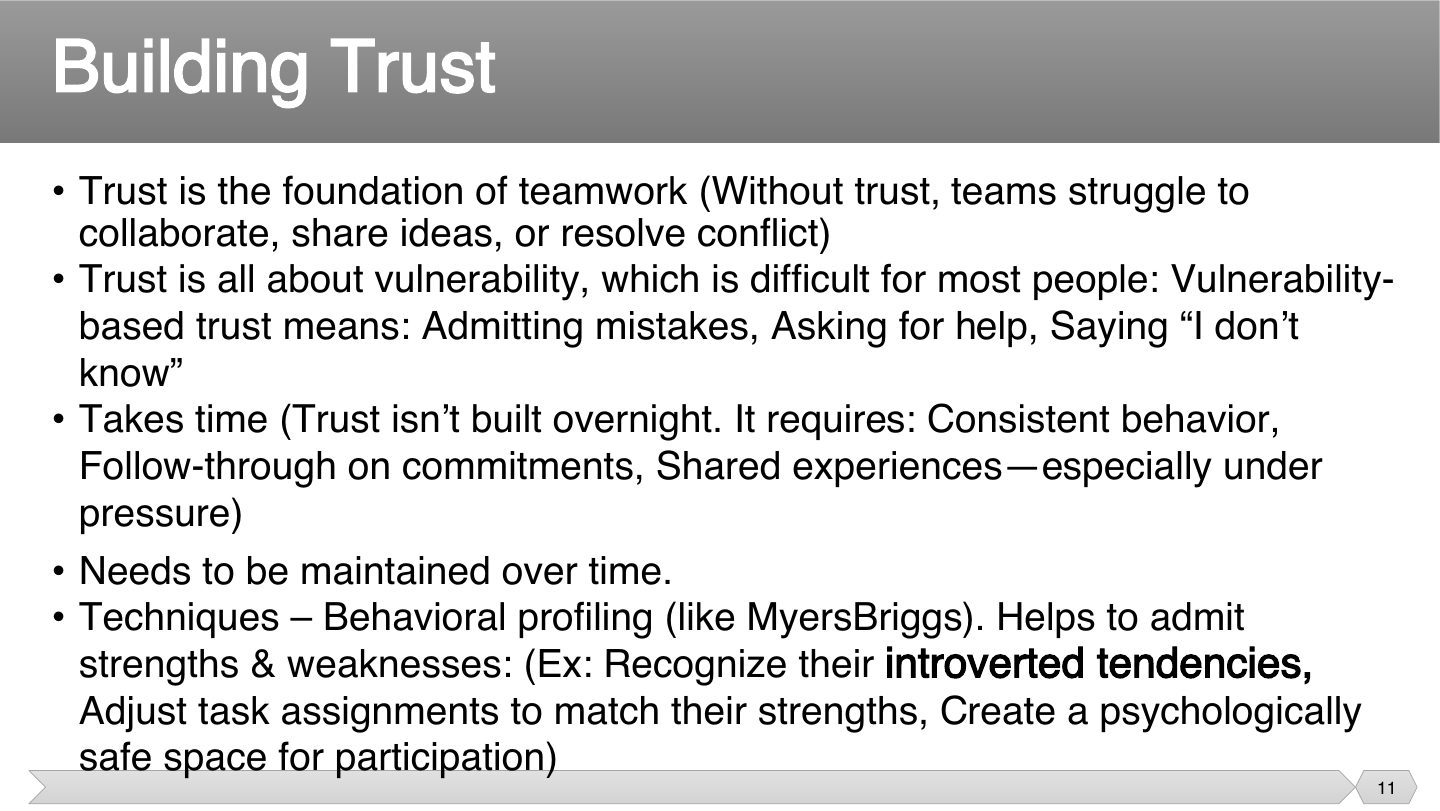
  11. 11 Building Trust
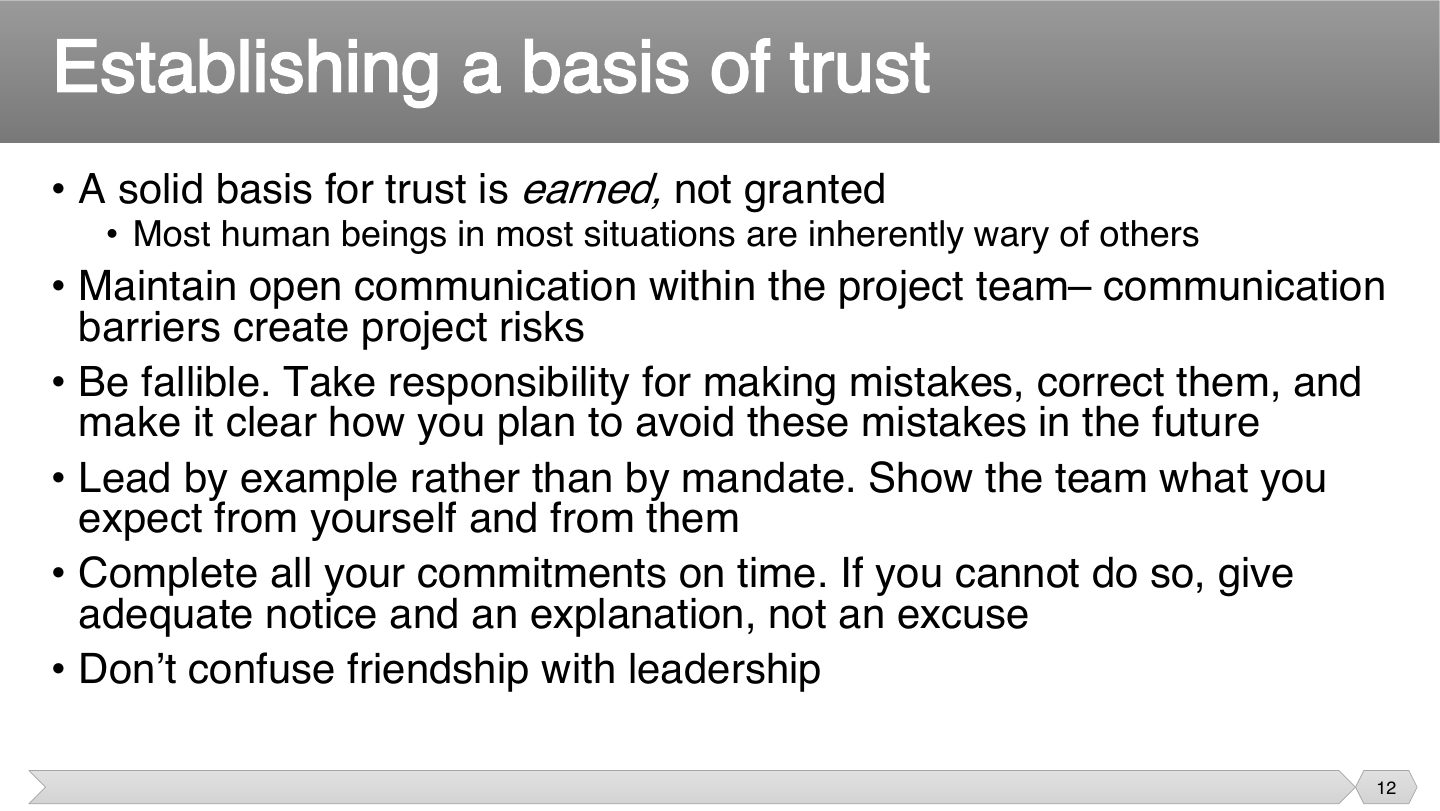
  12. 12 Establishing a basis of trust
  13. 13 Slide 13
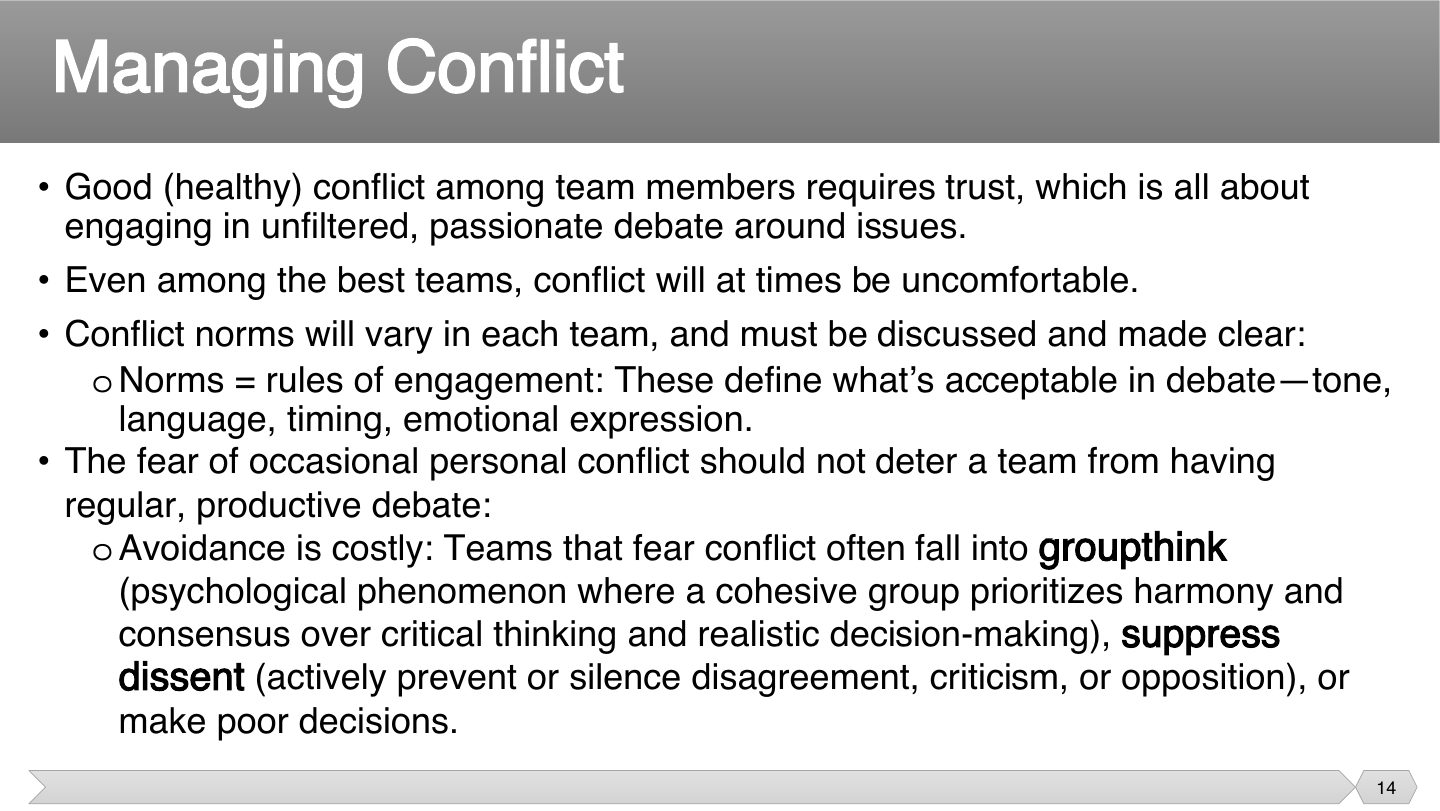
  14. 14 Managing Conflict
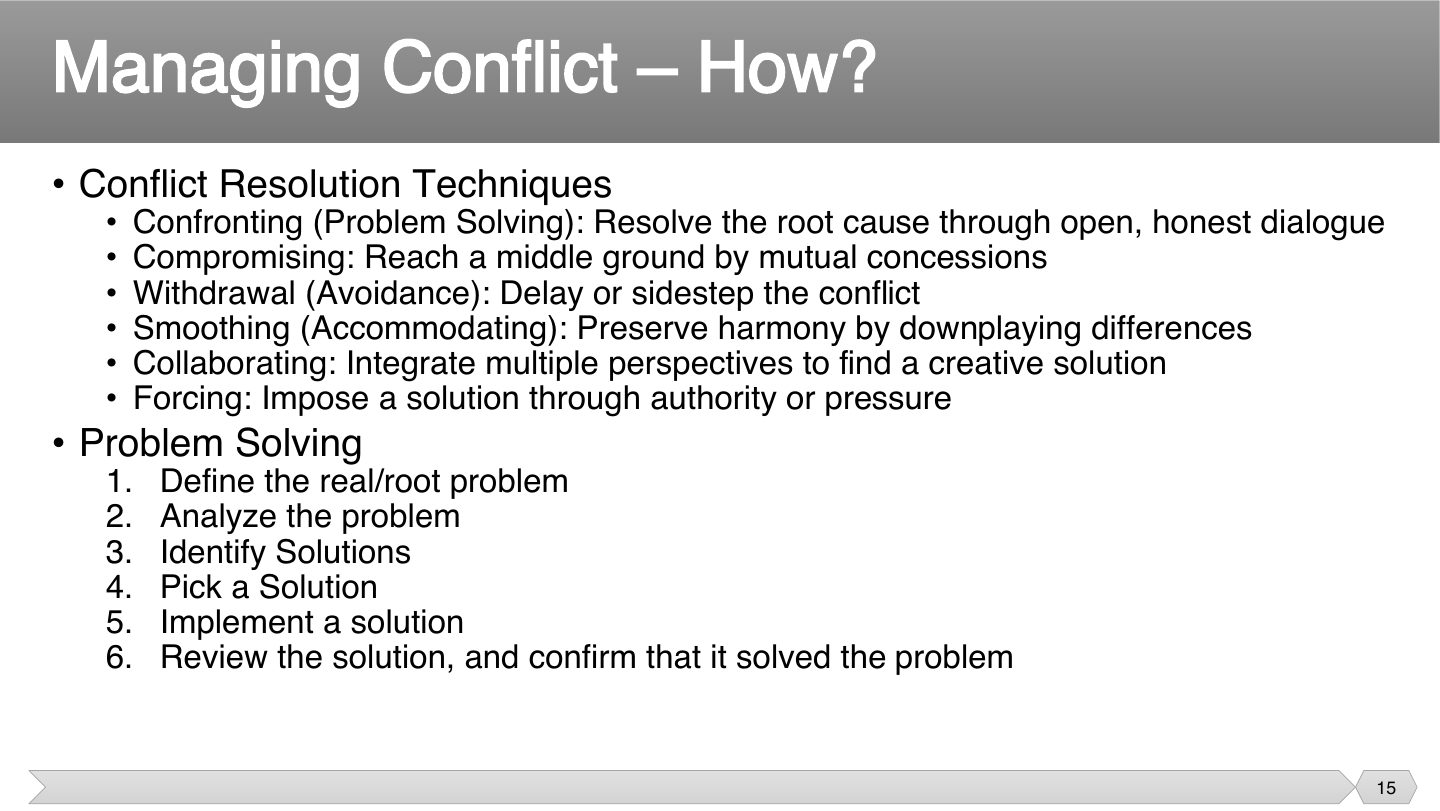
  15. 15 Managing Conflict – How?
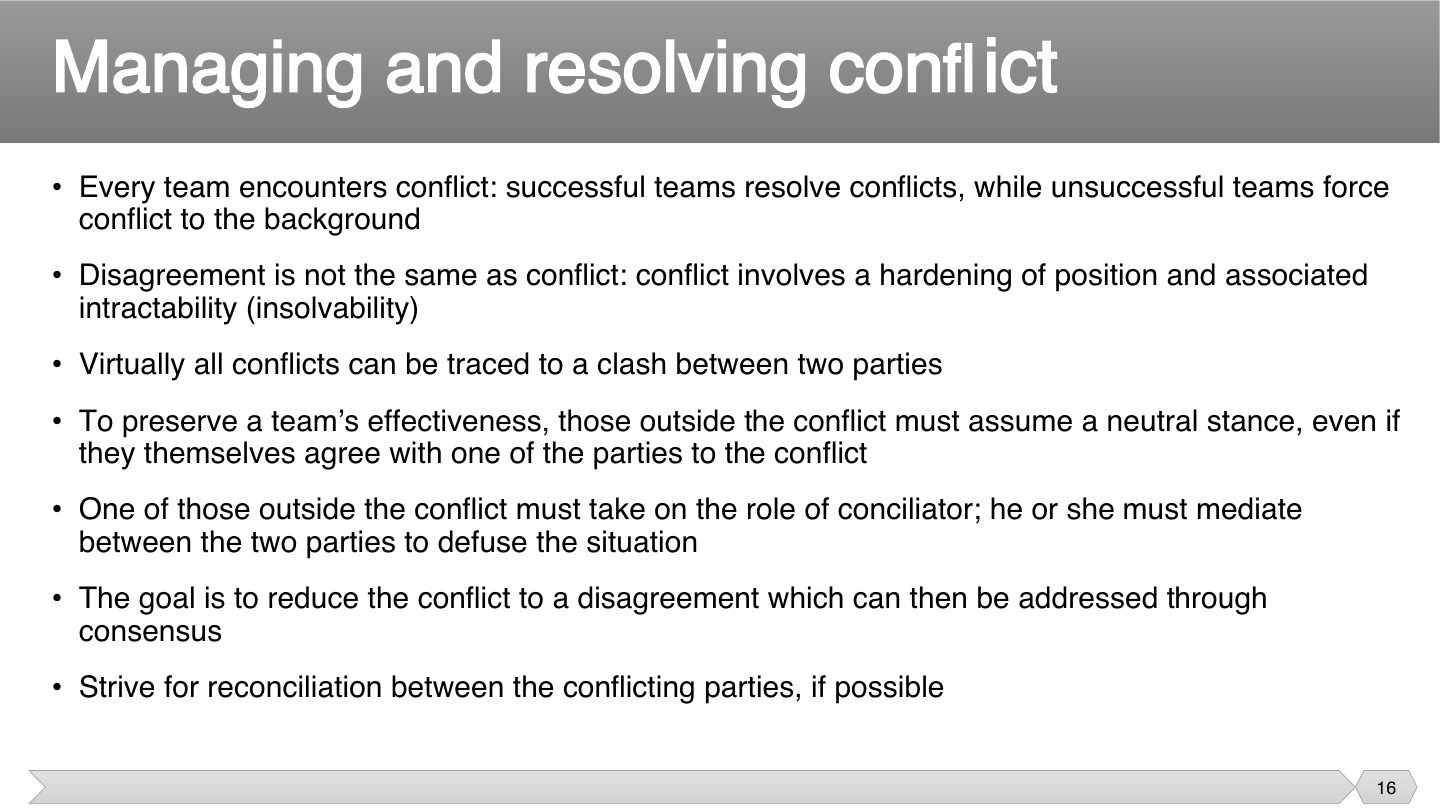
  16. 16 ict
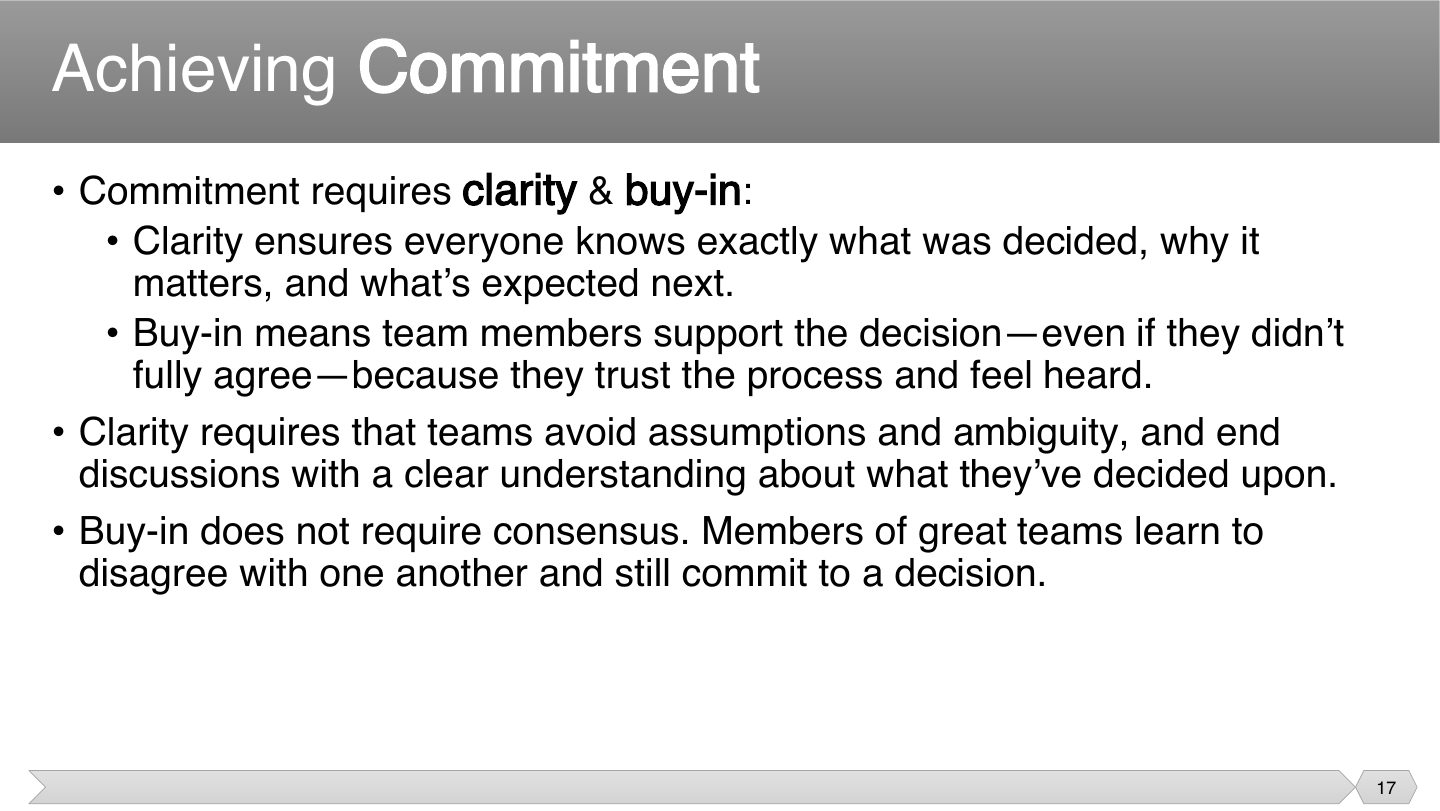
  17. 17 Commitment
  18. 18 Slide 18
  19. 19 Embracing Accountability
  20. 20 Embracing Accountability
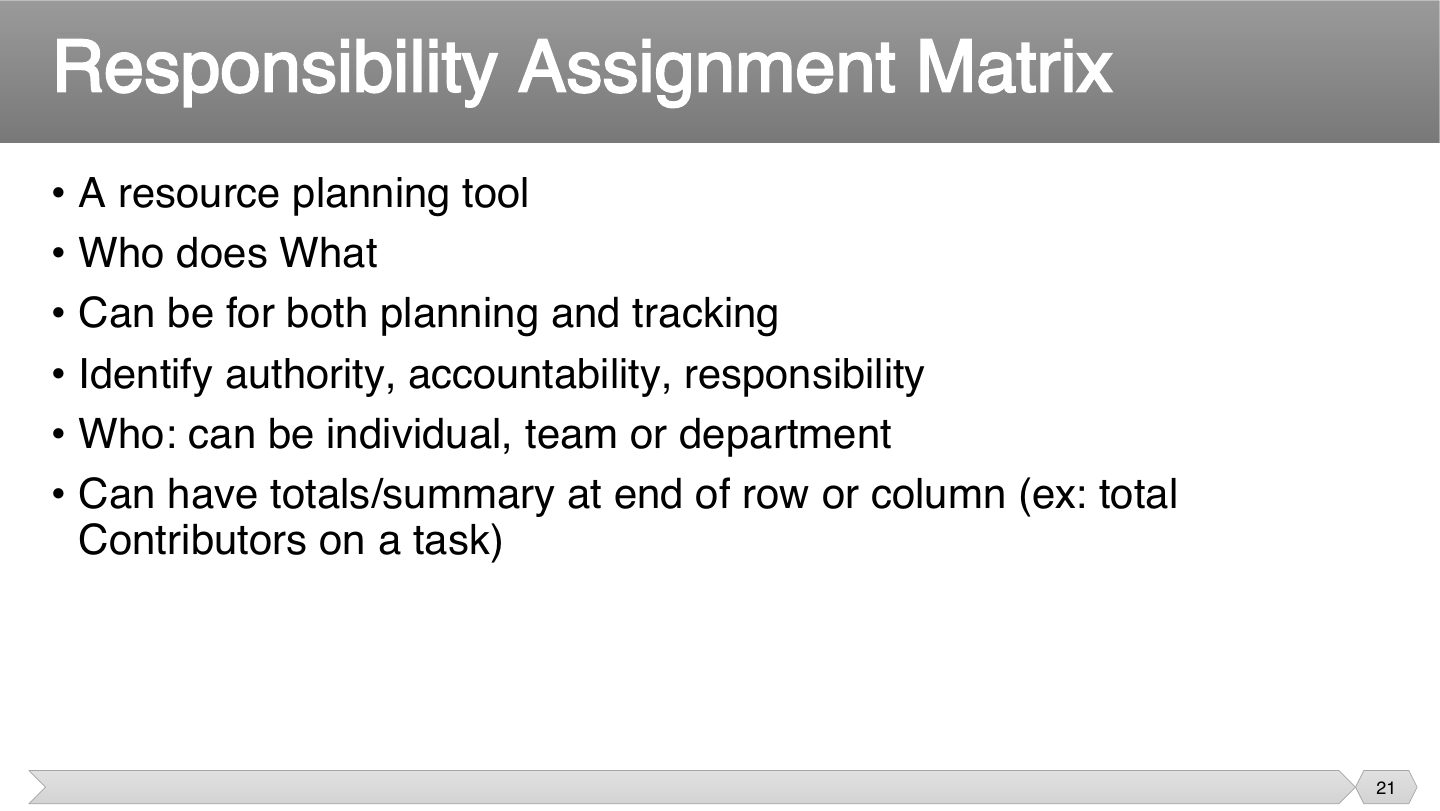
  21. 21 Responsibility Assignment Matrix
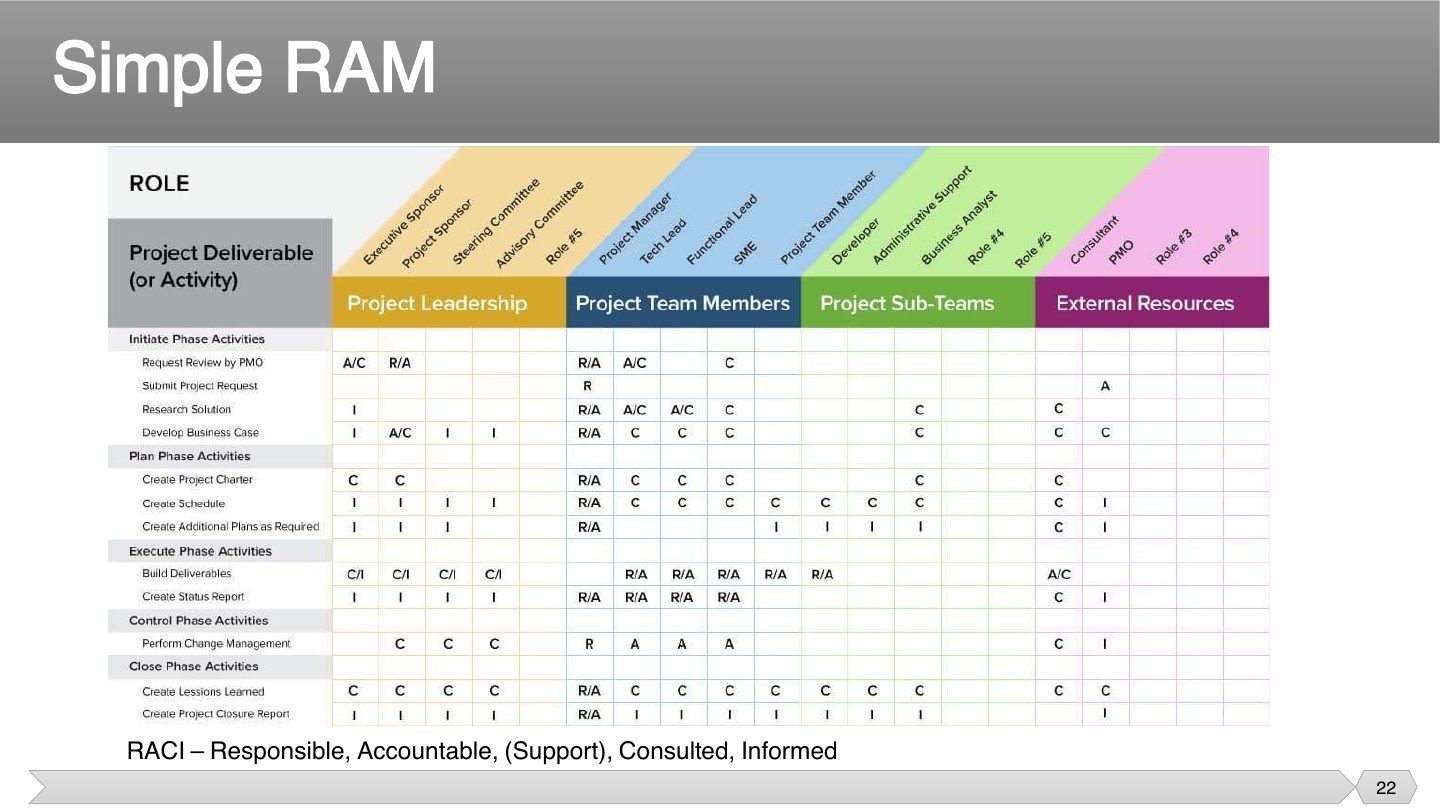
  22. 22 Simple RAM
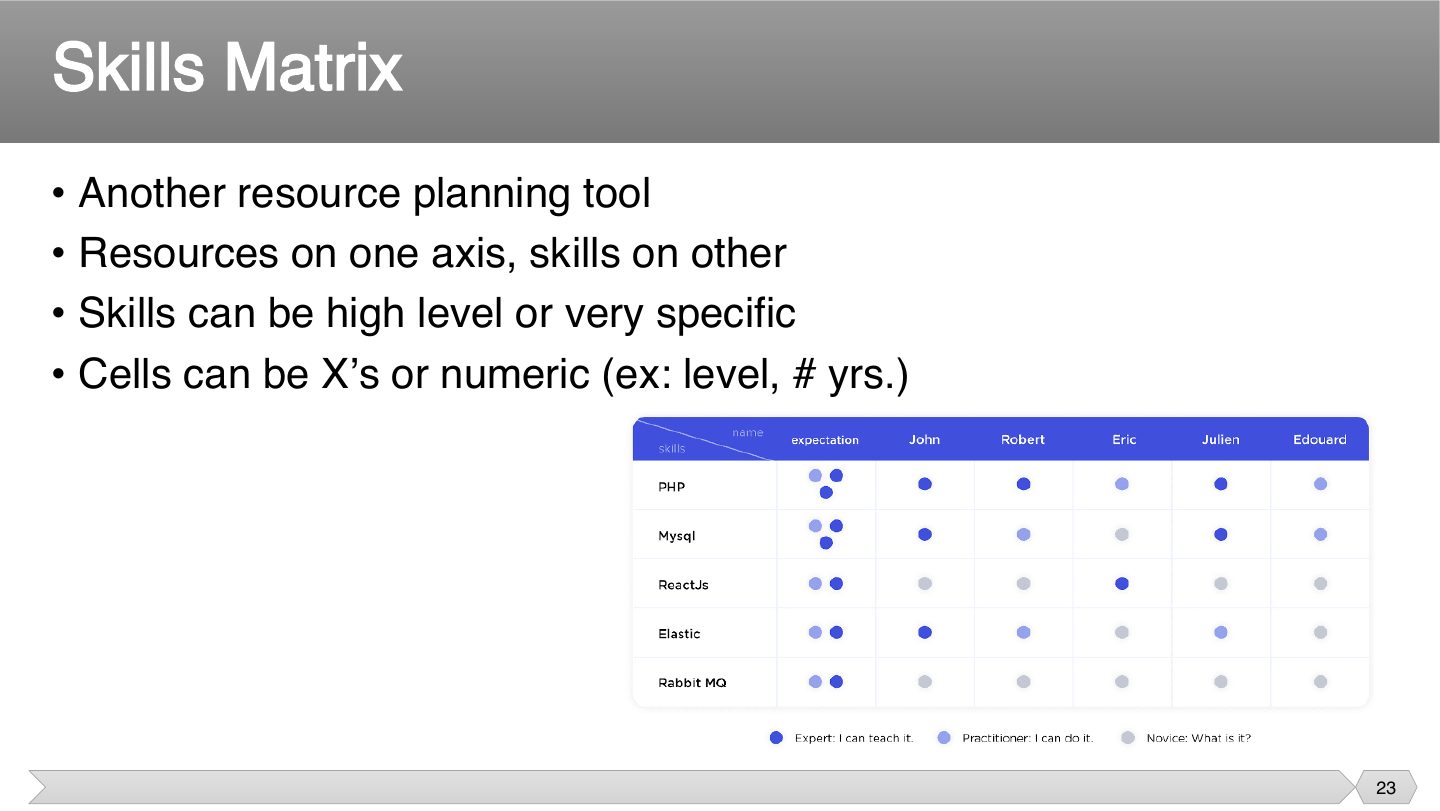
  23. 23 Skills Matrix
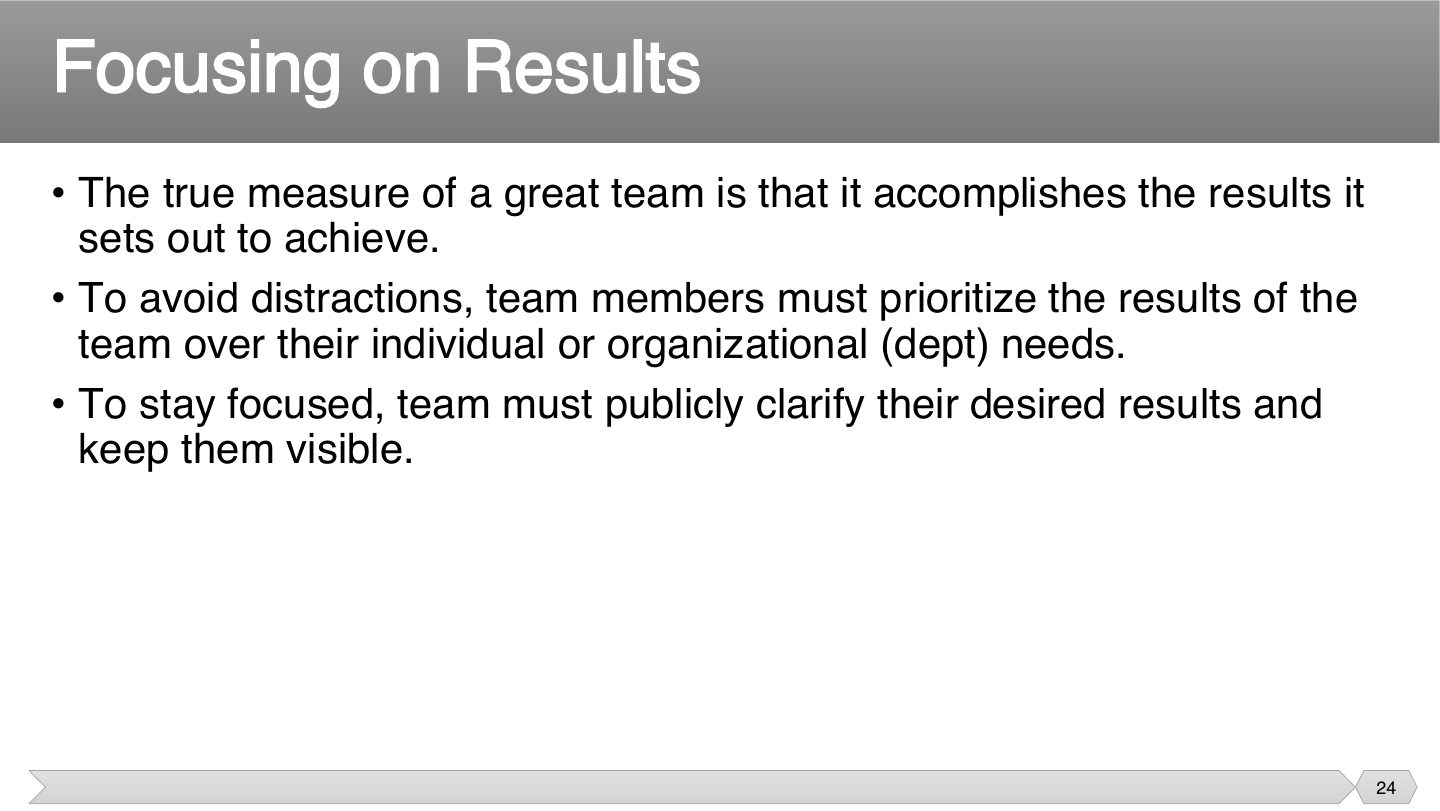
  24. 24 Focusing on Results
  25. 25 Slide 25
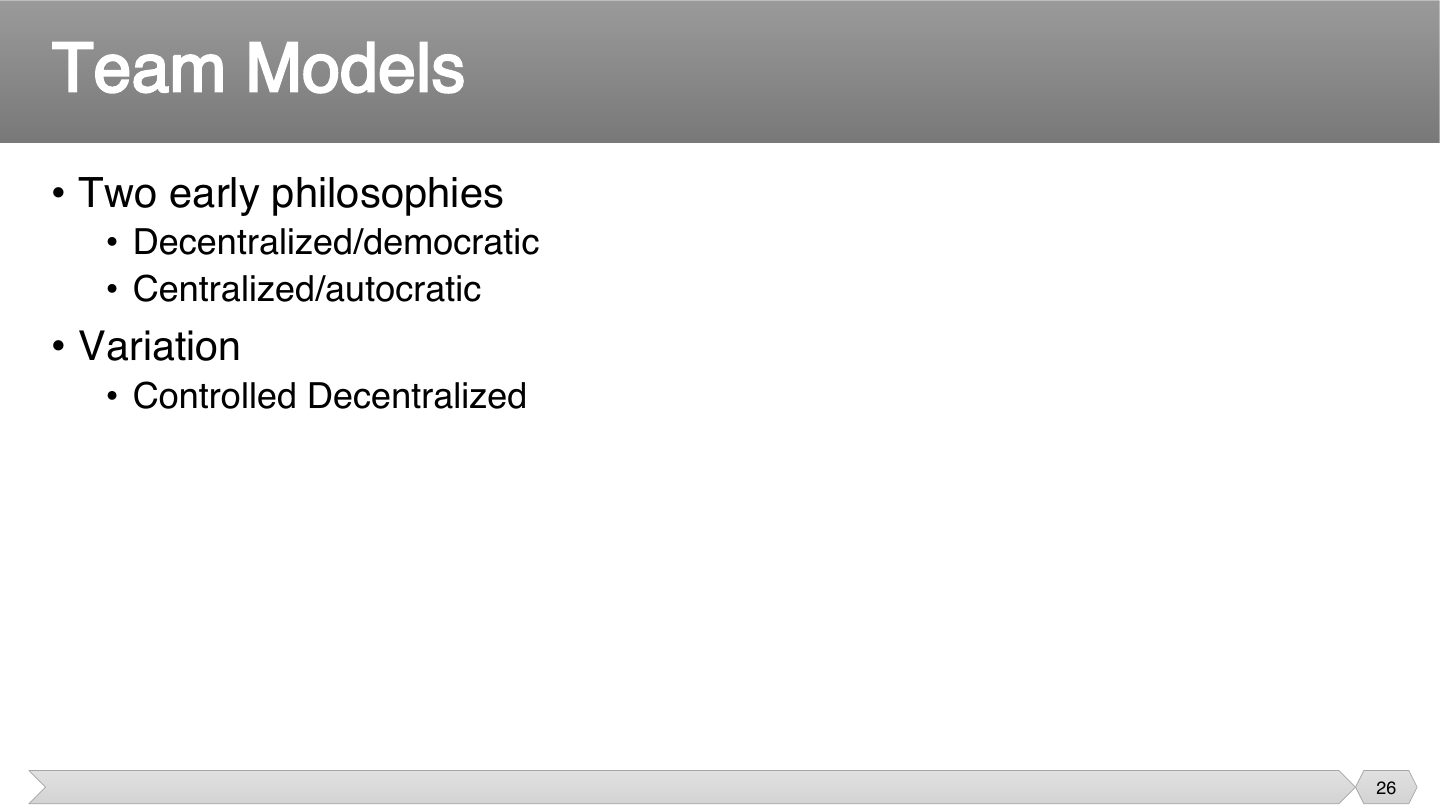
  26. 26 Team Models
  27. 27 Team Models
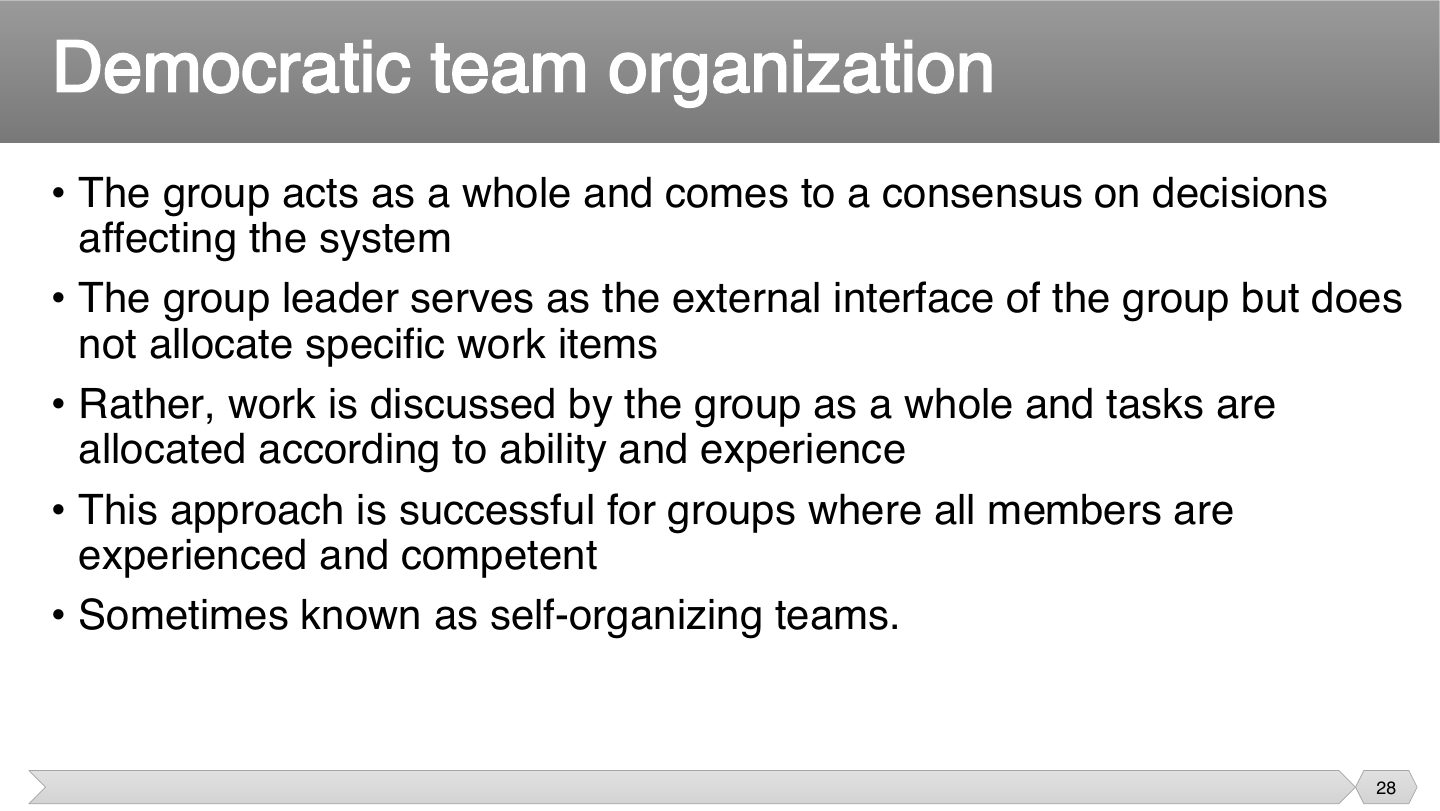
  28. 28 Democratic team organization
  29. 29 Agile programming groups
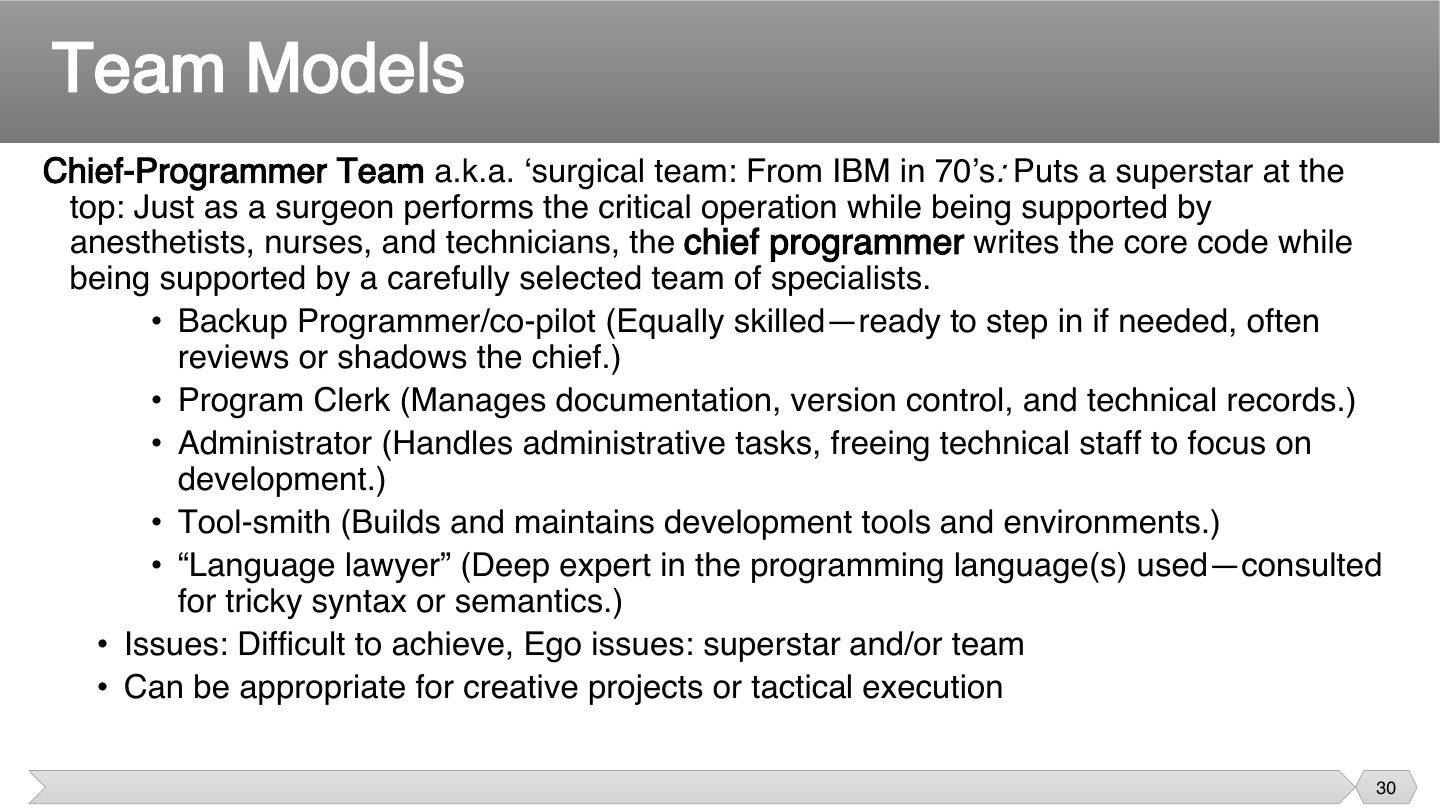
  30. 30 Team Models
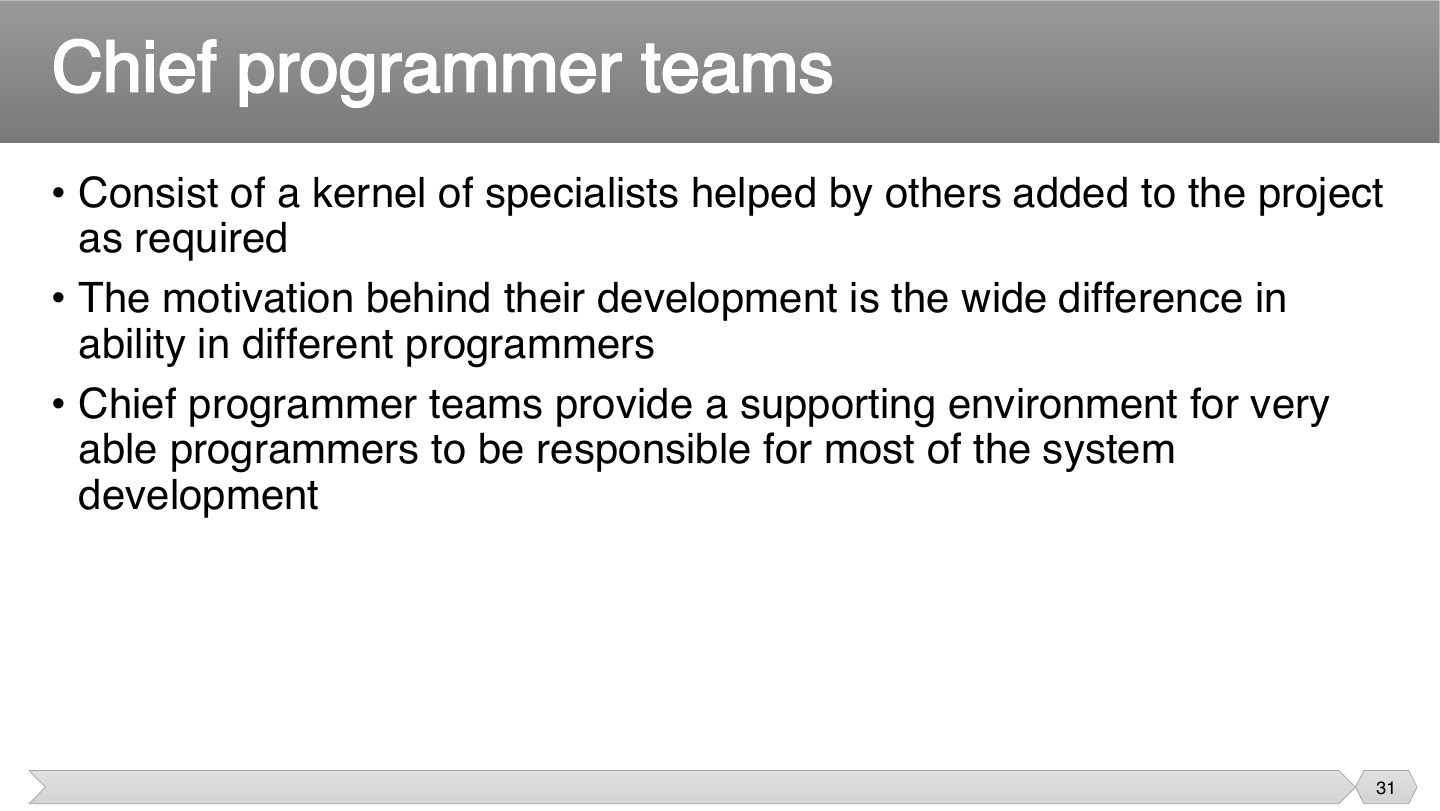
  31. 31 Chief programmer teams
  32. 32 Problems
  33. 33 Team Models
  34. 34 Team Models
  35. 35 Managing People
  36. 36 People in the process
  37. 37 Management activities (related to people)
  38. 38 Motivation
  39. 39 Motivating people
  40. 40 Need satisfaction
  41. 41 Personality types
  42. 42 Motivation balance
  43. 43 Group composition: group working
  44. 44 Time distribution
  45. 45 Group composition
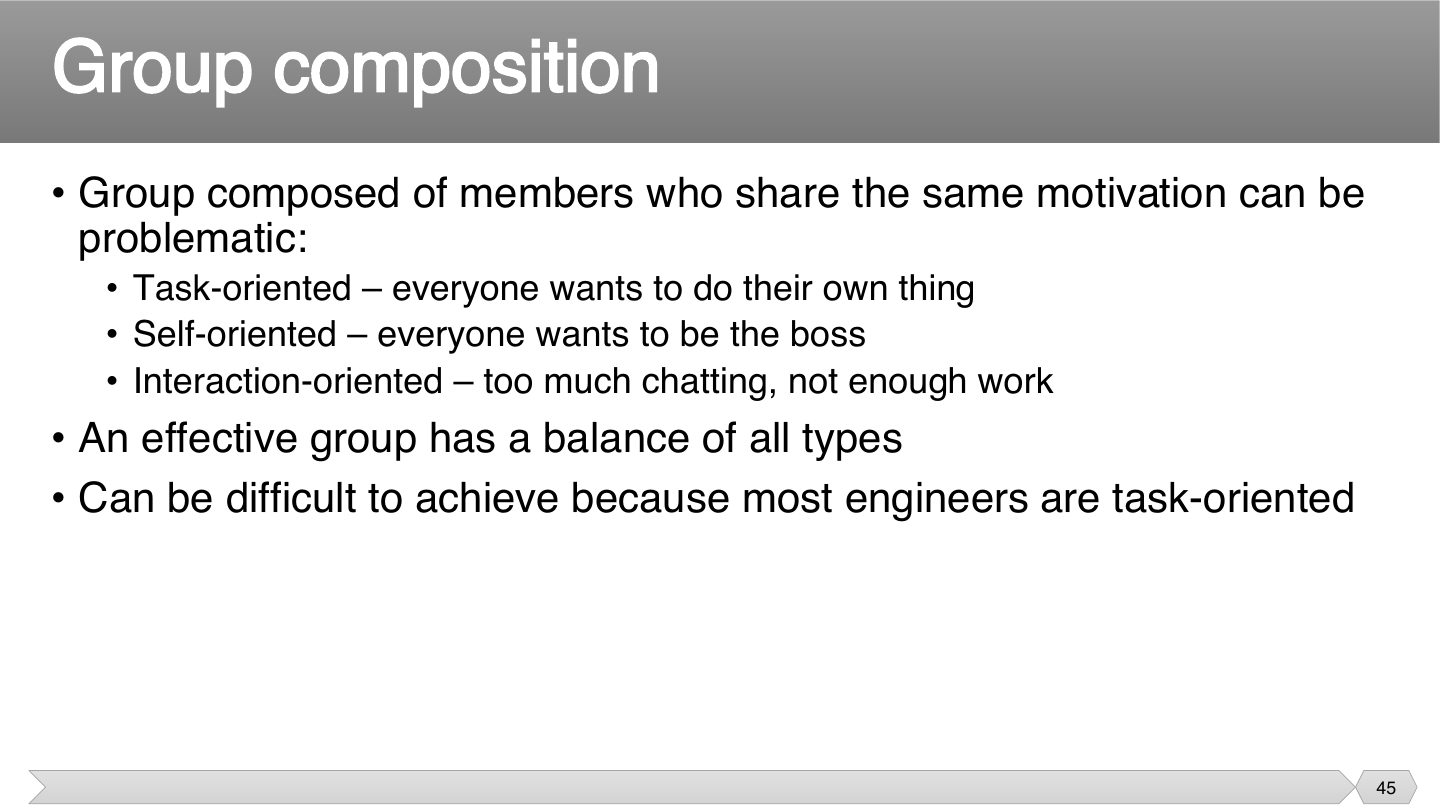
  46. 46 Group composition: group leadership
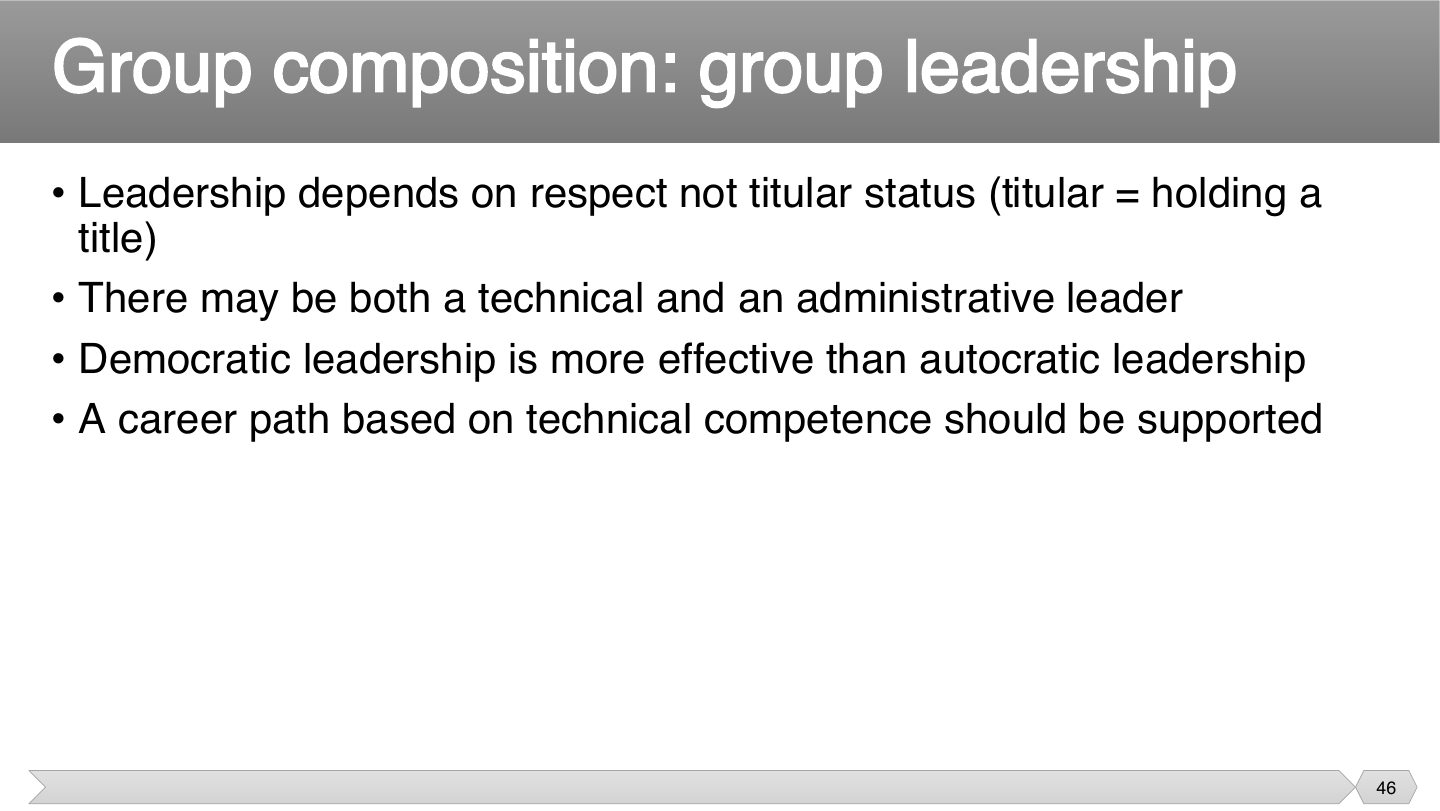
  47. 47 Group cohesiveness
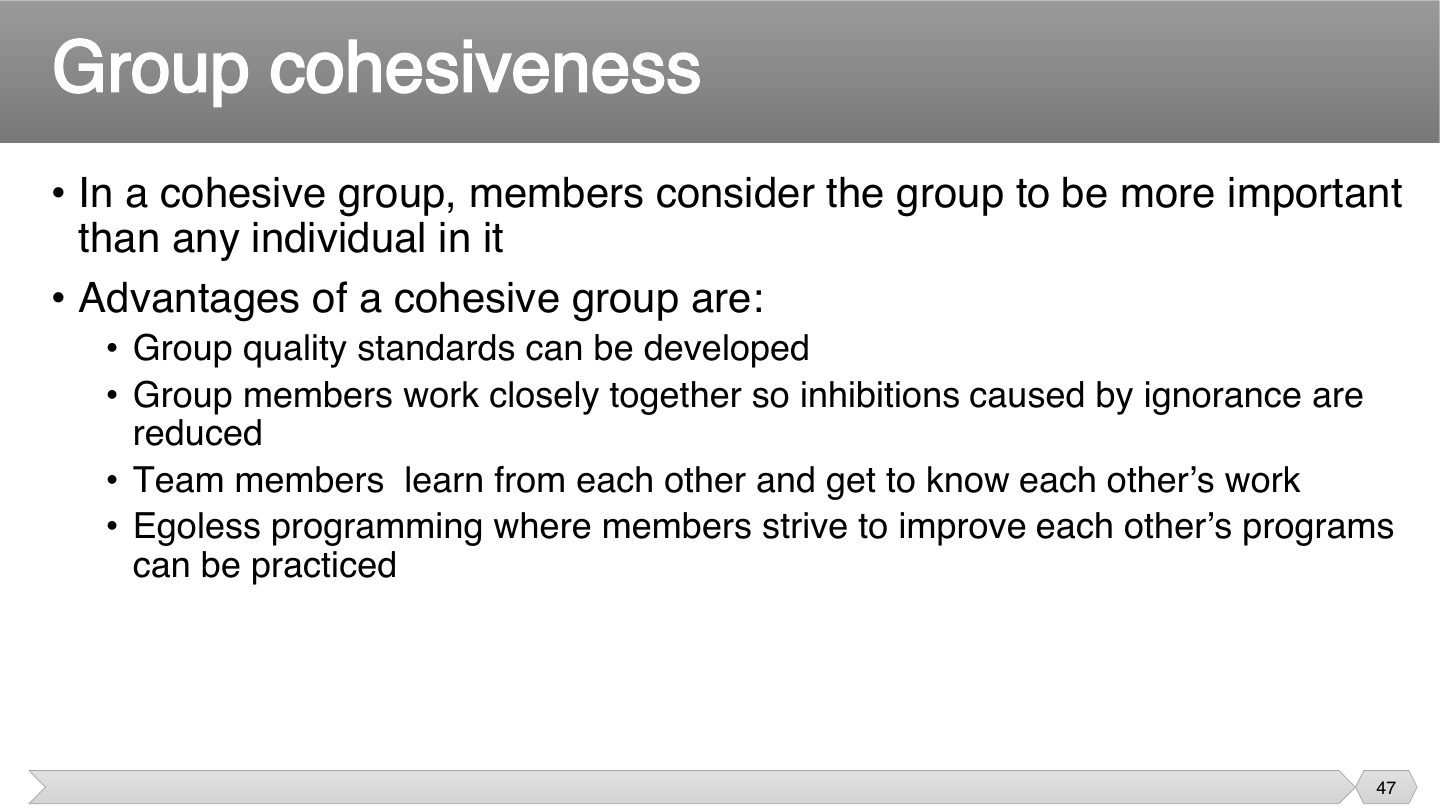
  48. 48 Developing cohesiveness
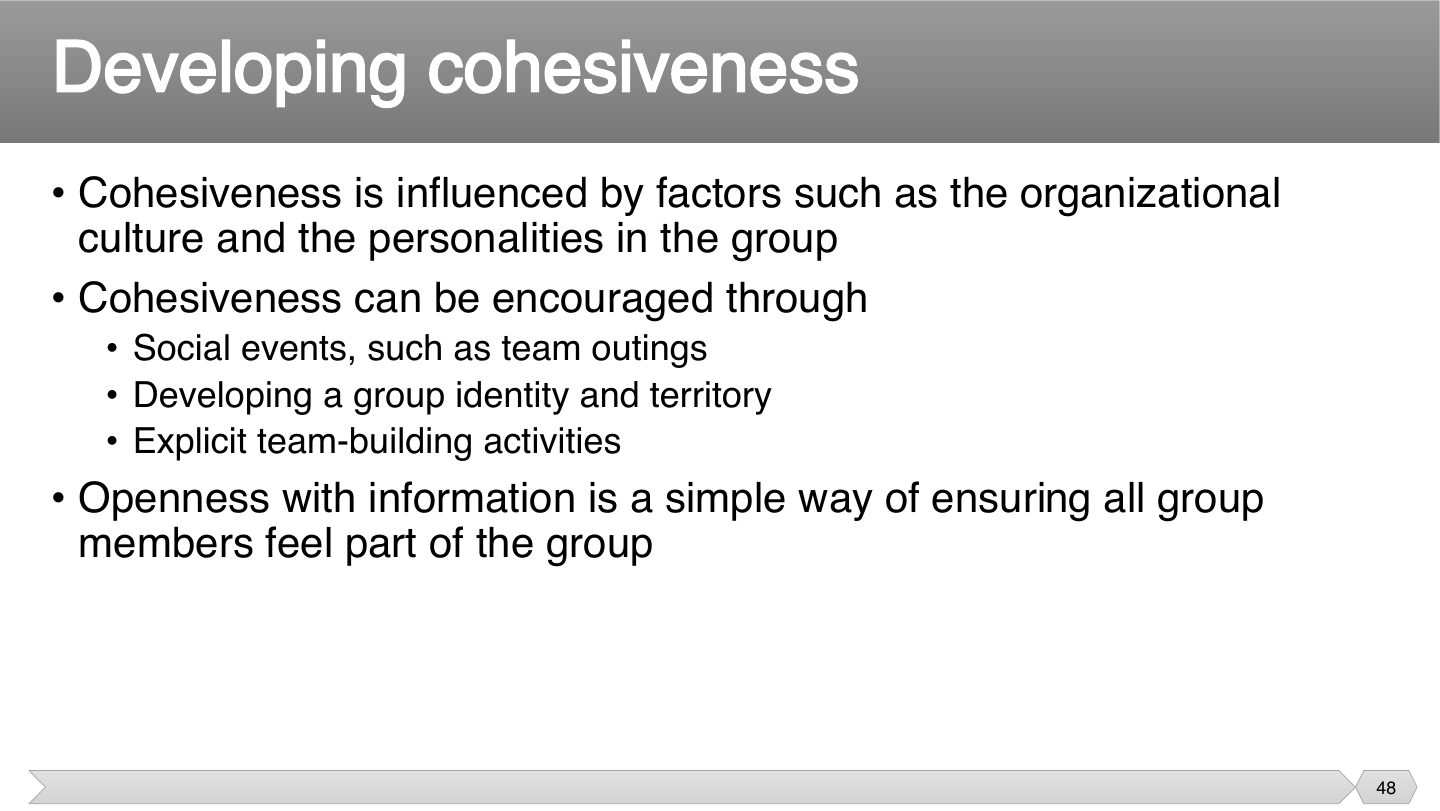
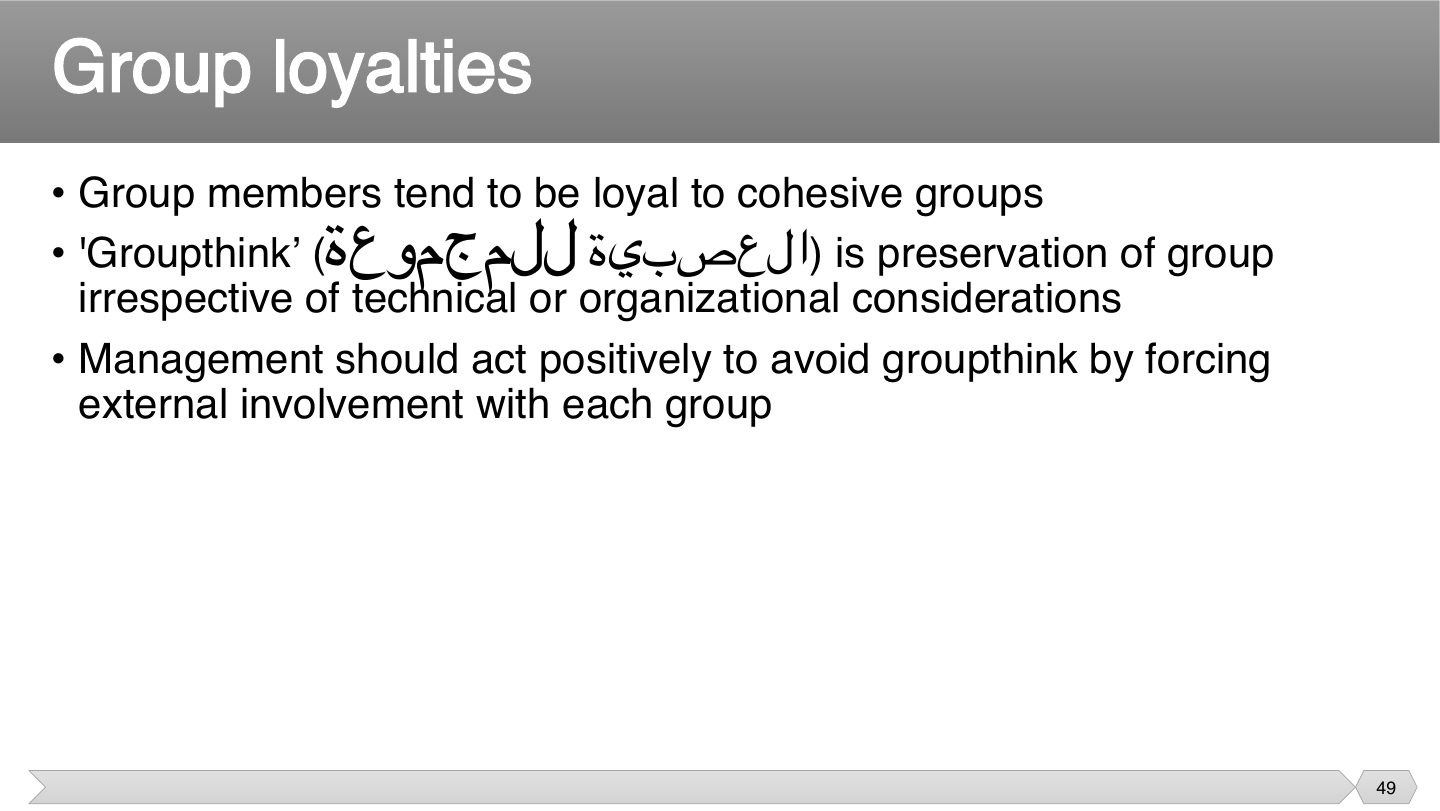
  49. 49 Group loyalties
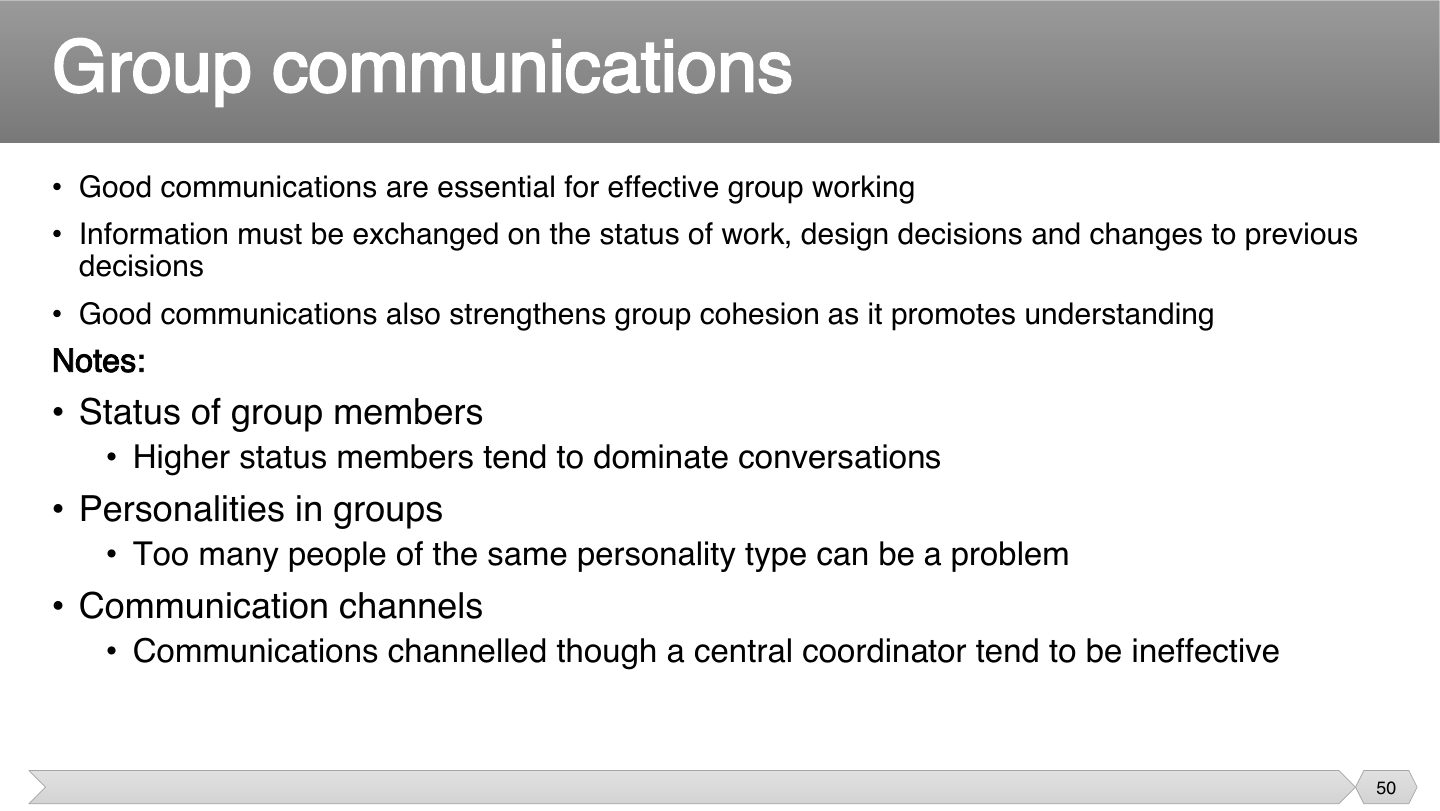
  50. 50 Group communications
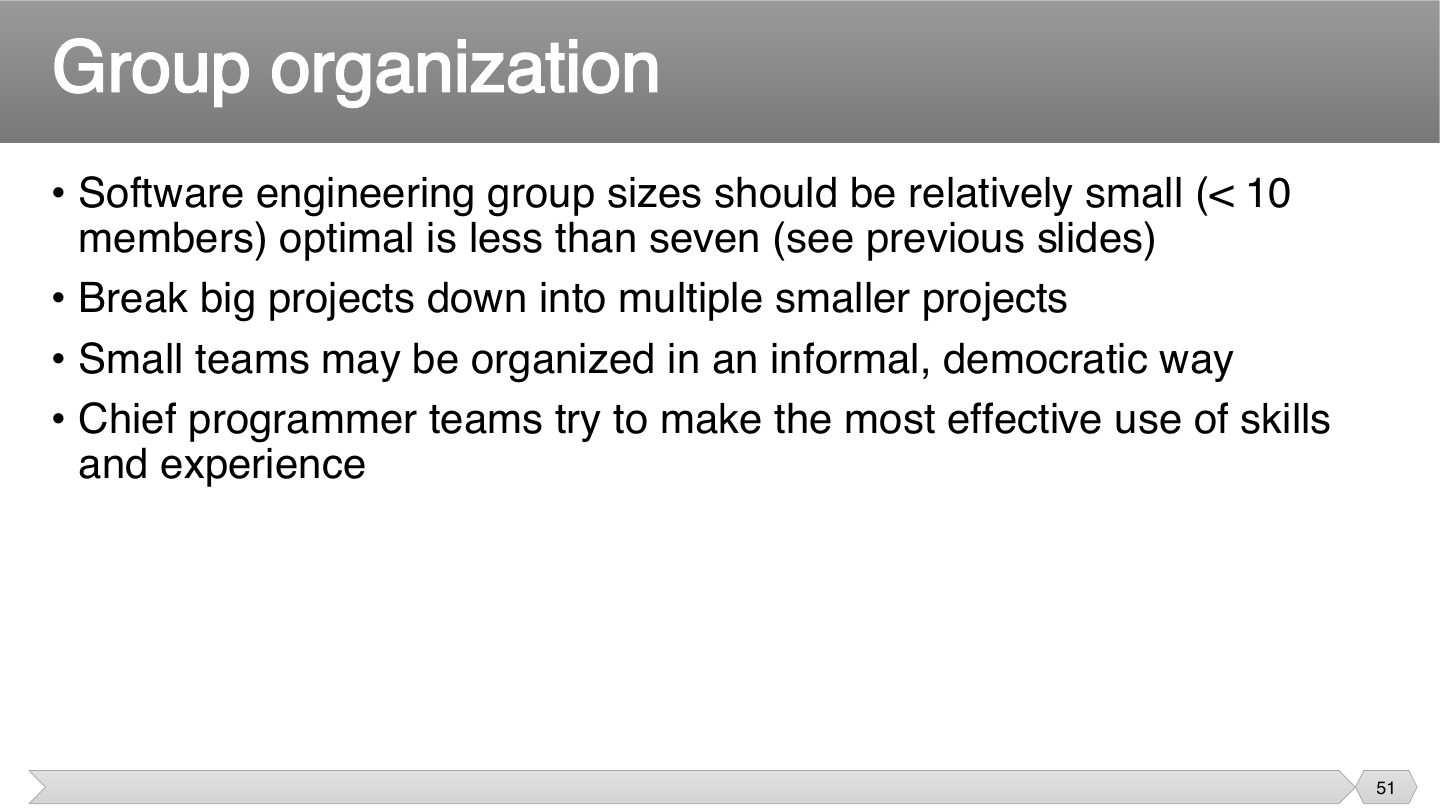
  51. 51 Group organization
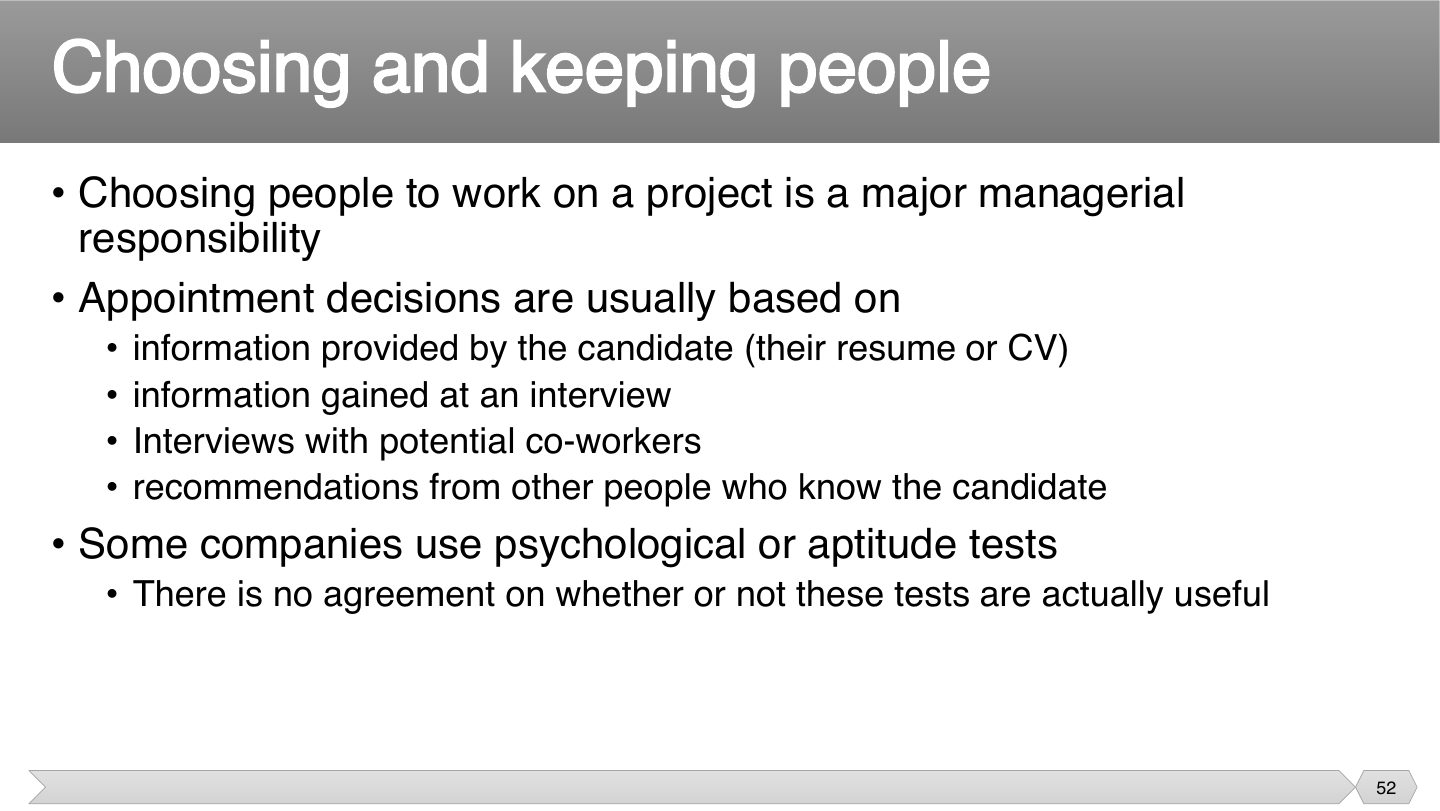
  52. 52 Choosing and keeping people
  53. 53 Staff selection factors
  54. 54 Working environments
  55. 55 Environmental factors
  56. 56 Workspace organization
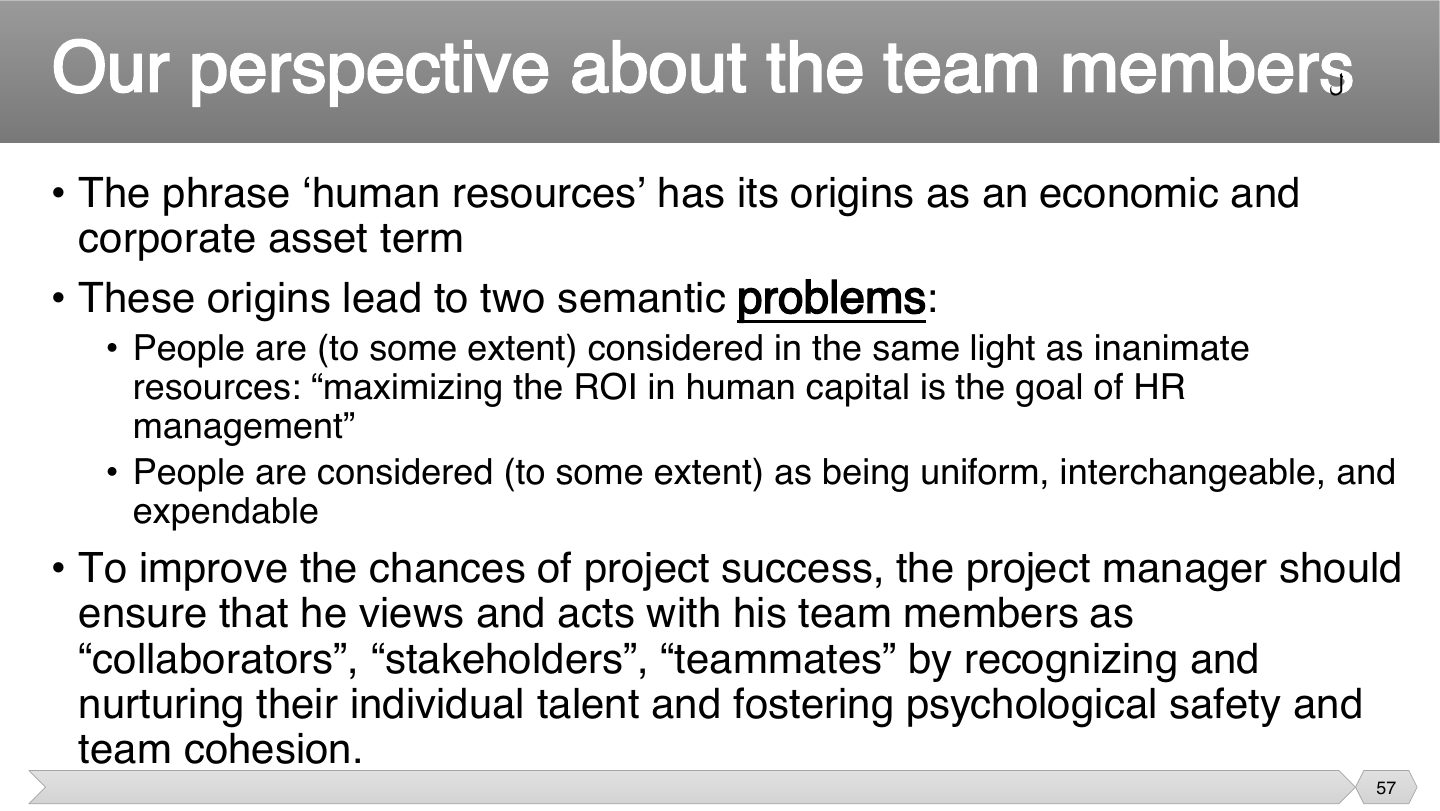
  57. 57 Our perspective about the team members
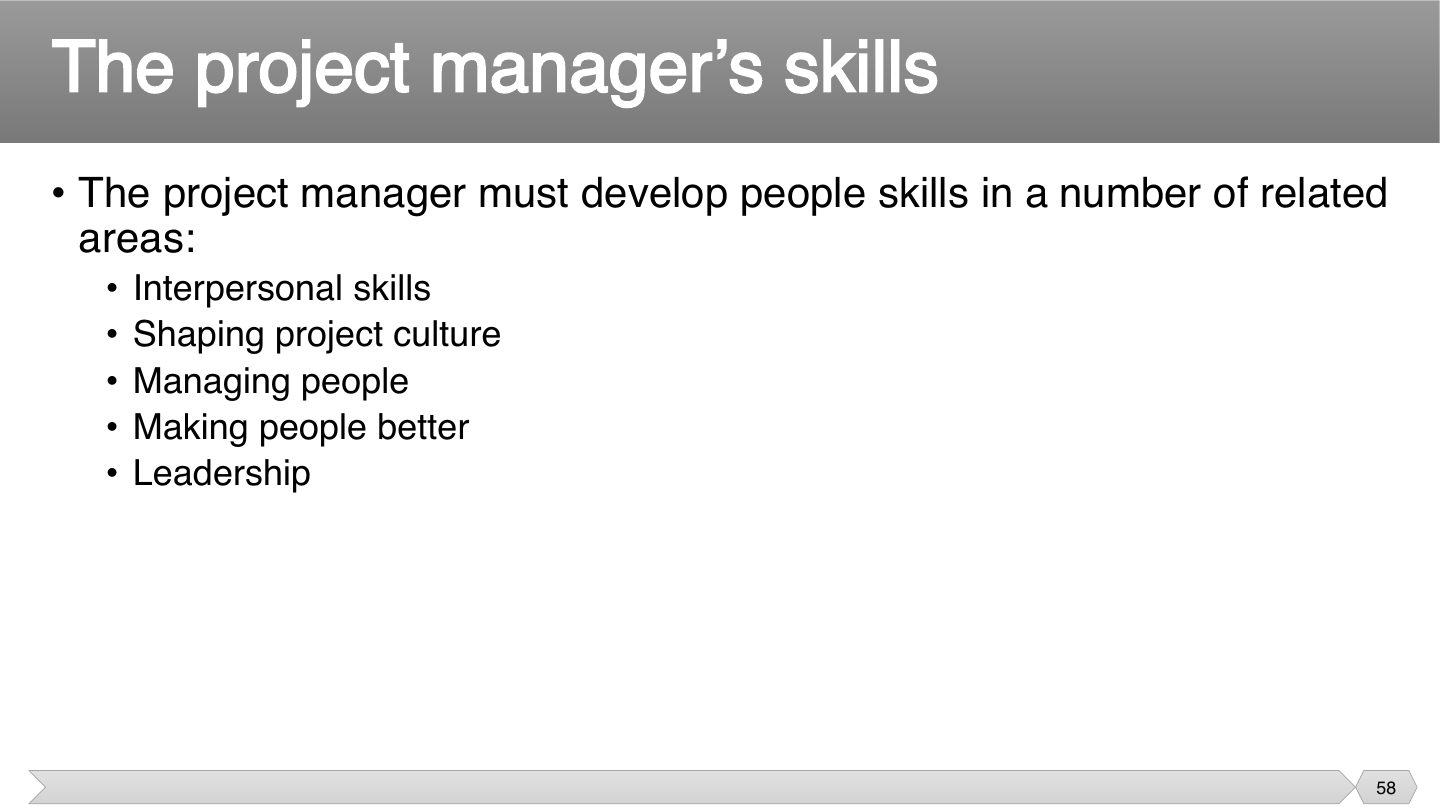
  58. 58 The project manager’s skills
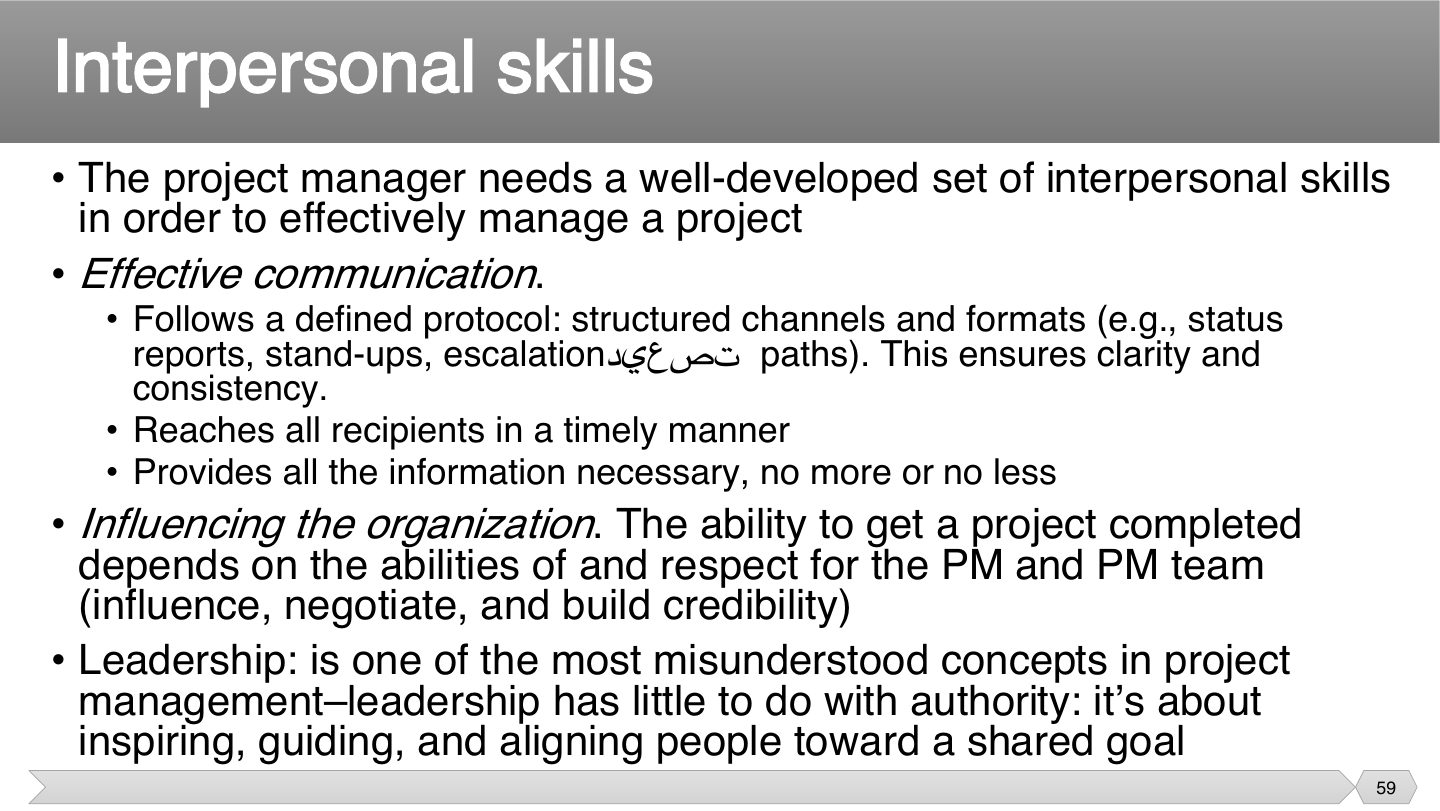
  59. 59 Interpersonal skills
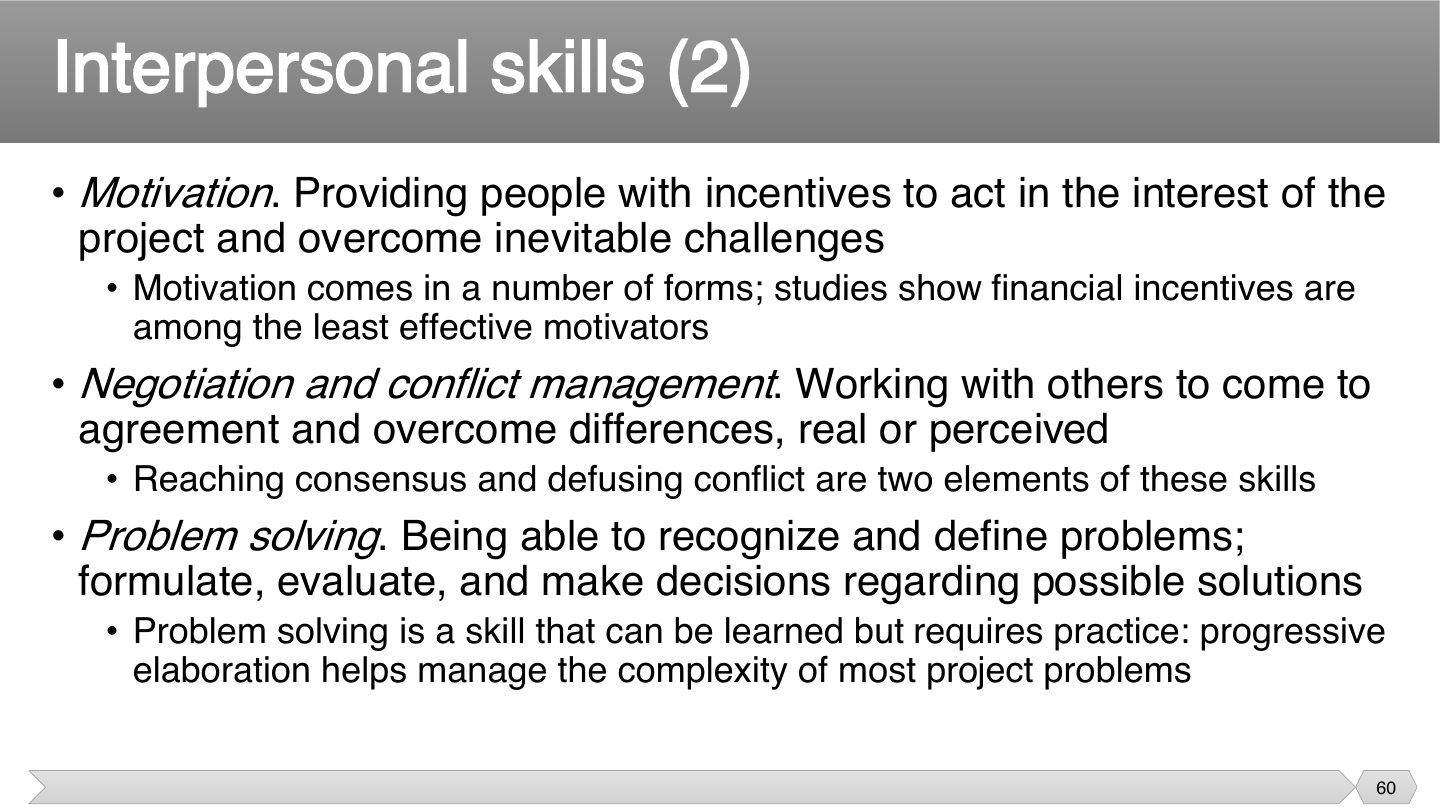
  60. 60 Interpersonal skills (2)
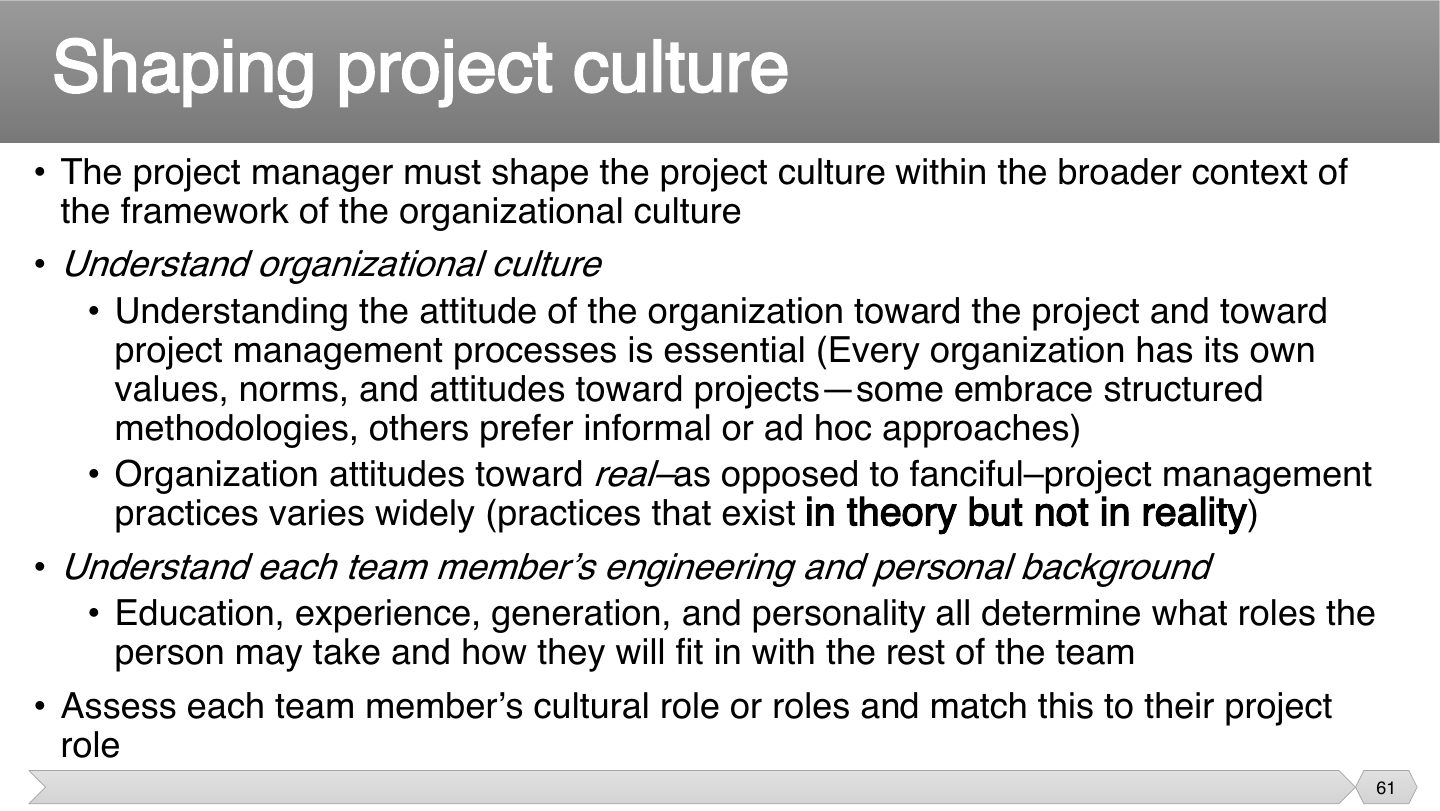
  61. 61 Shaping project culture
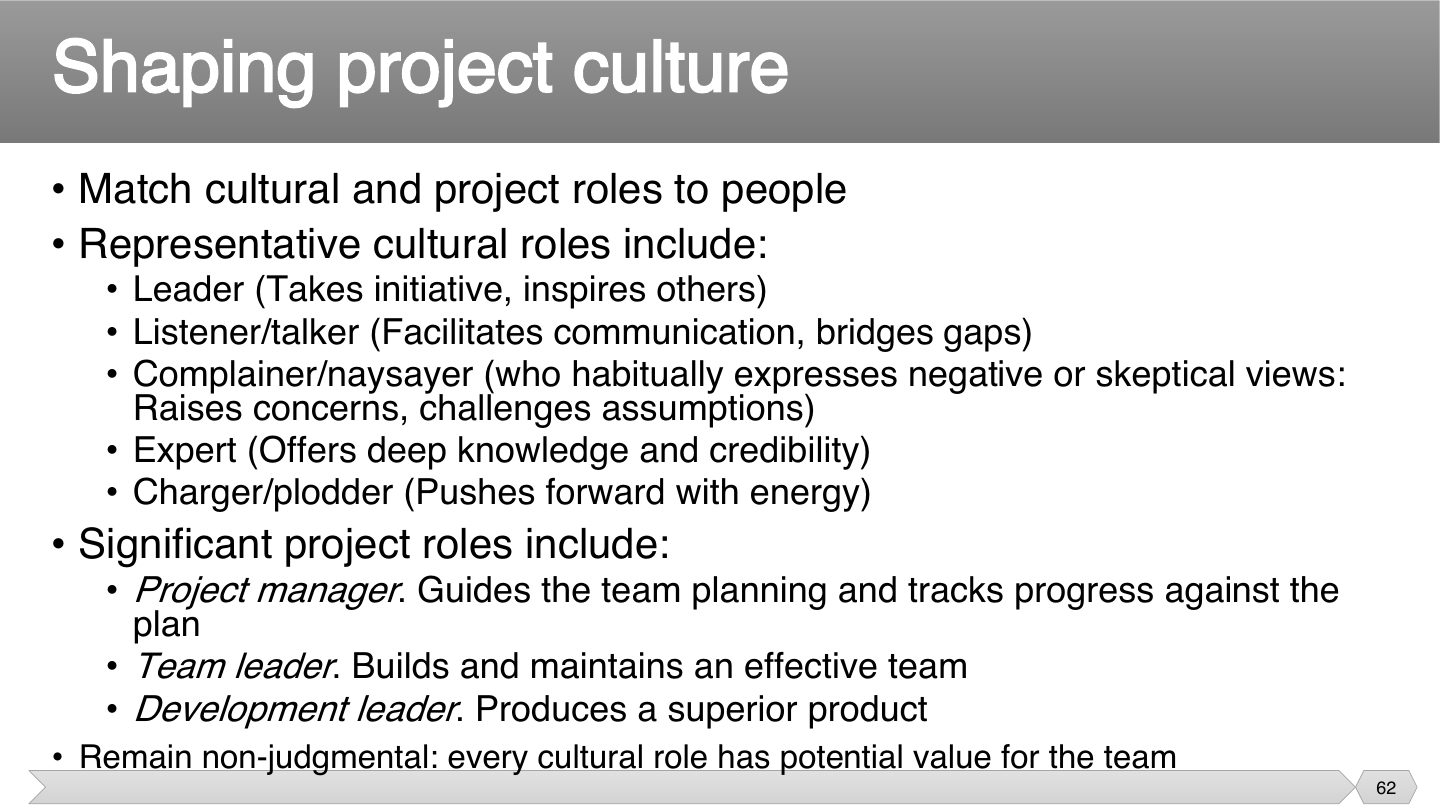
  62. 62 Shaping project culture
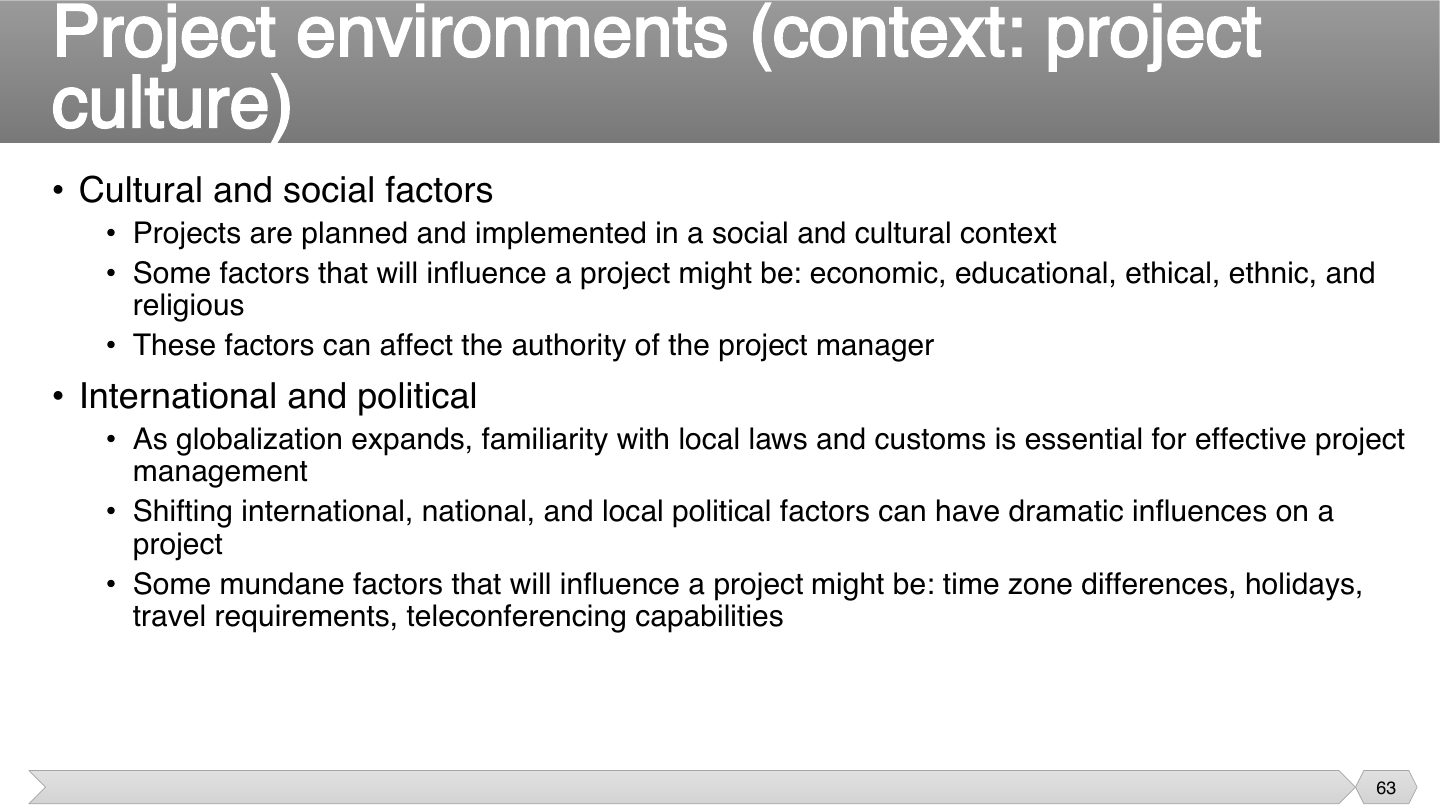
  63. 63 Project environments (context: project culture)
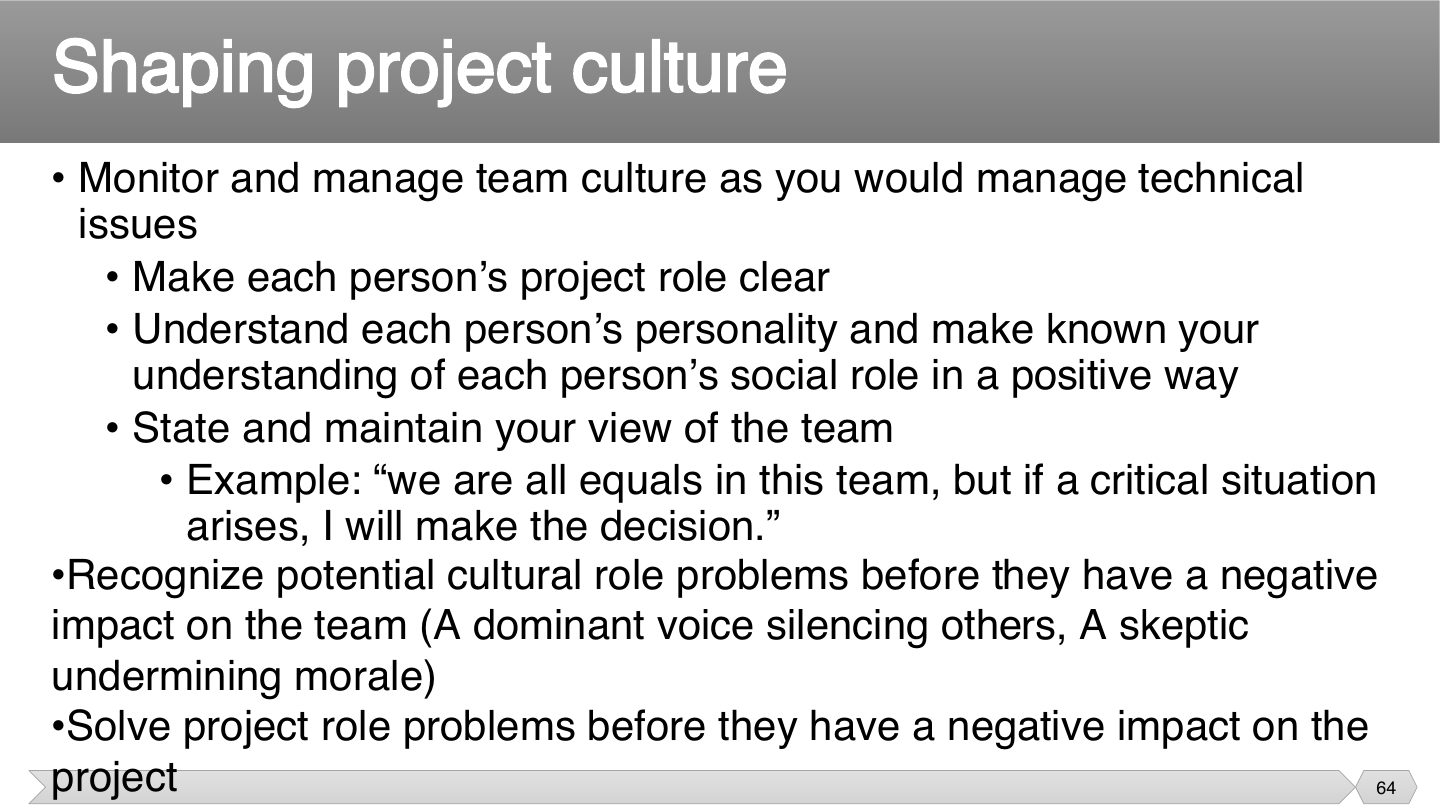
  64. 64 Shaping project culture
  65. 65 Project Culture
  66. 66 Managing People
  67. 67 Managing People
  68. 68 production line efficiency
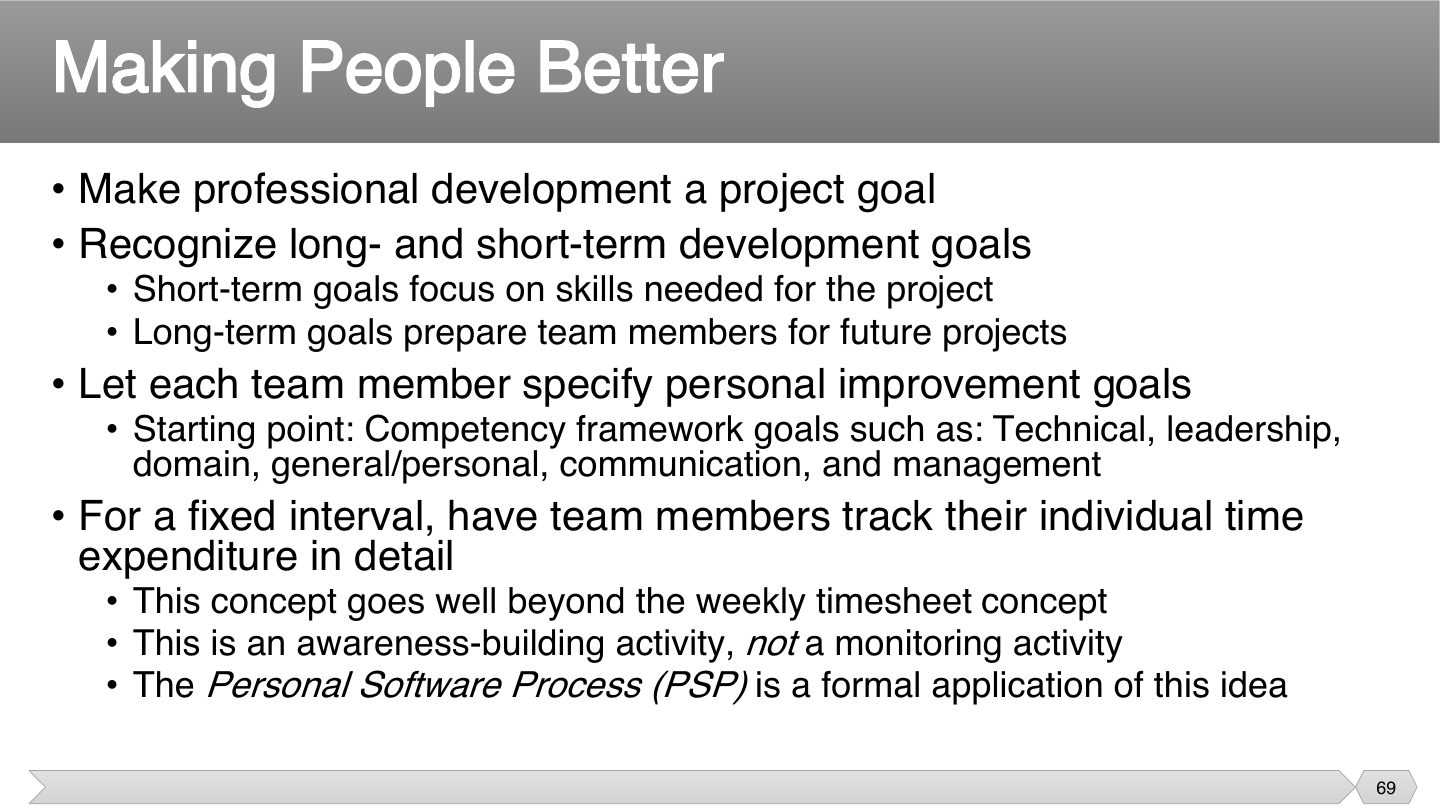
  69. 69 Making People Better
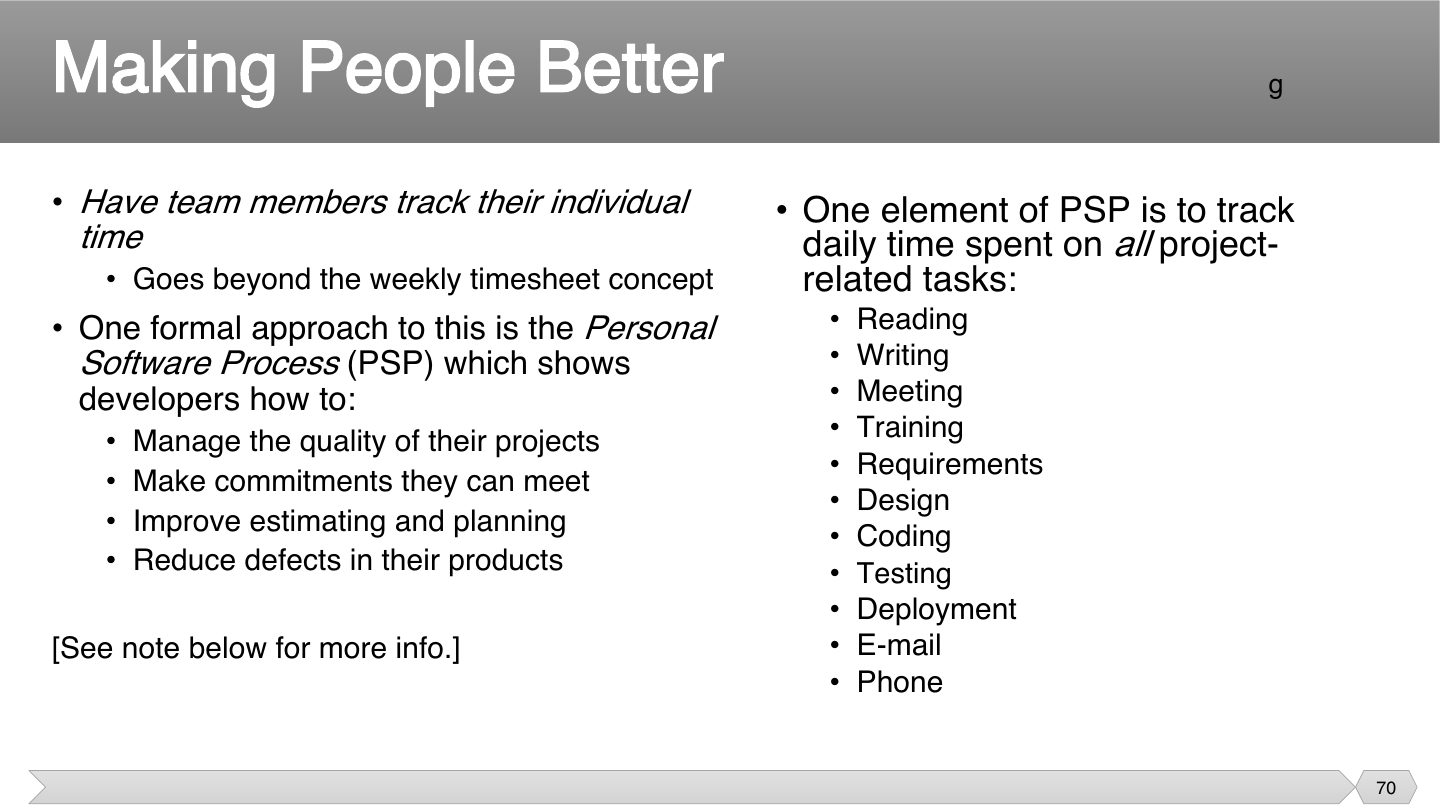
  70. 70 Making People Better
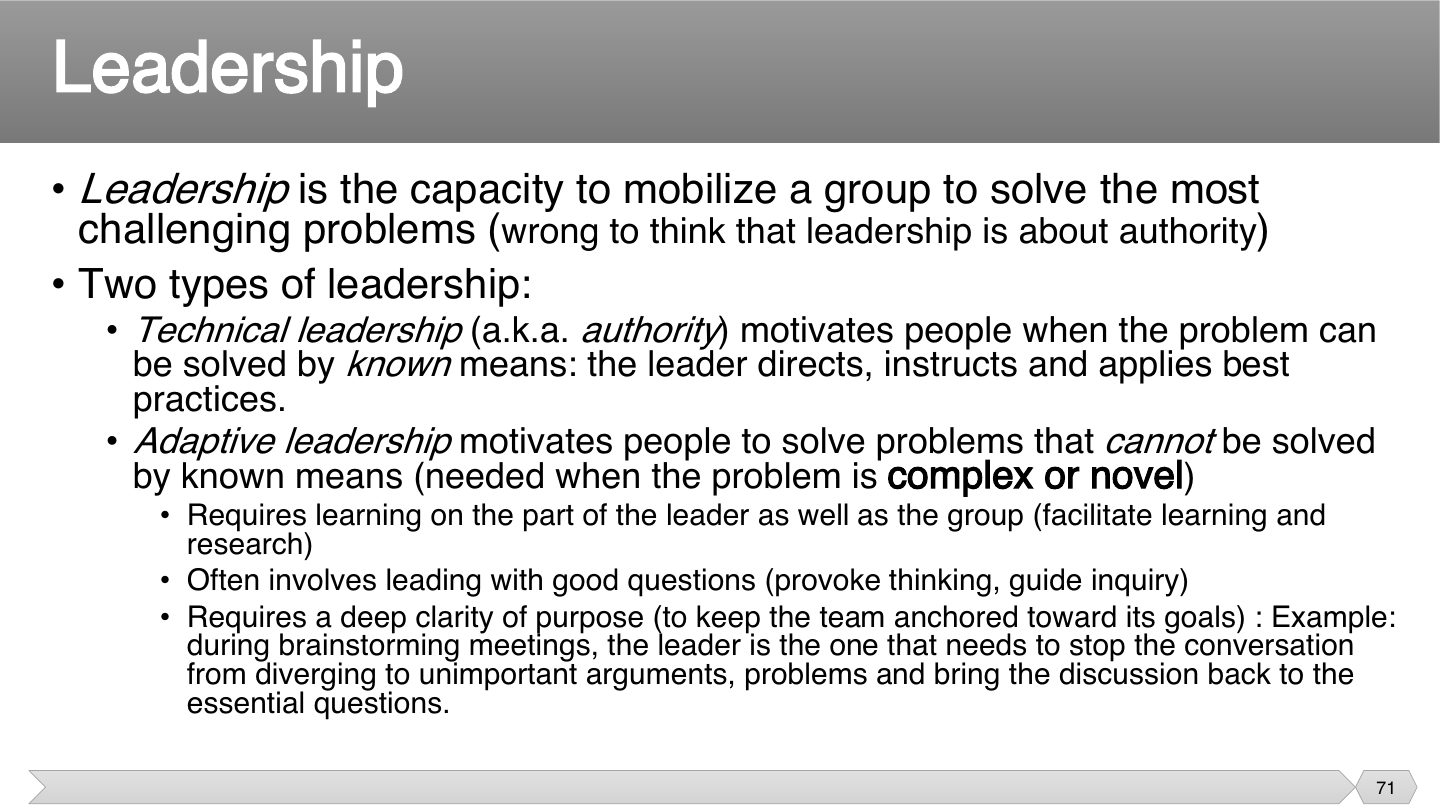
  71. 71 Leadership
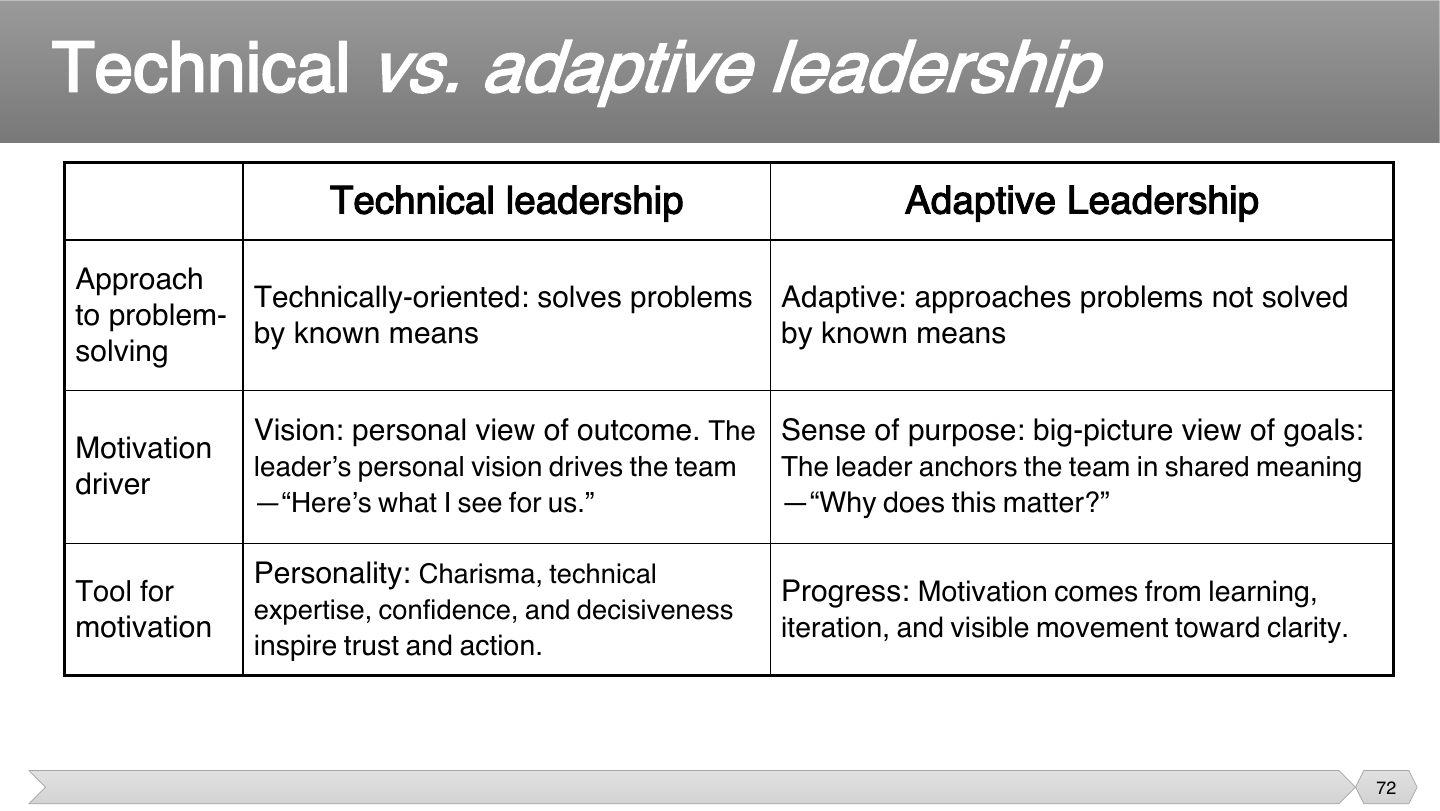
  72. 72 Technical vs. adaptive leadership
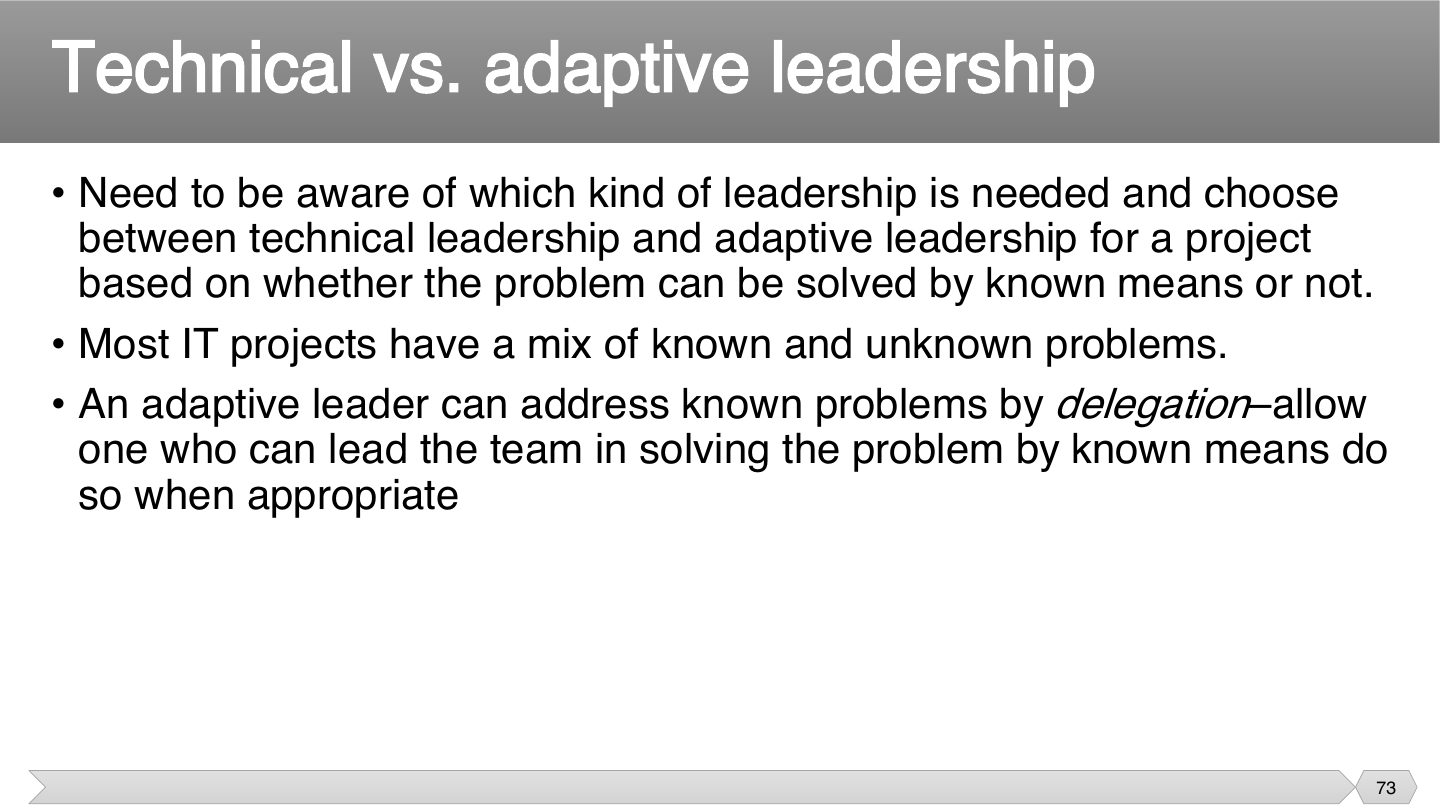
  73. 73 Technical vs. adaptive leadership
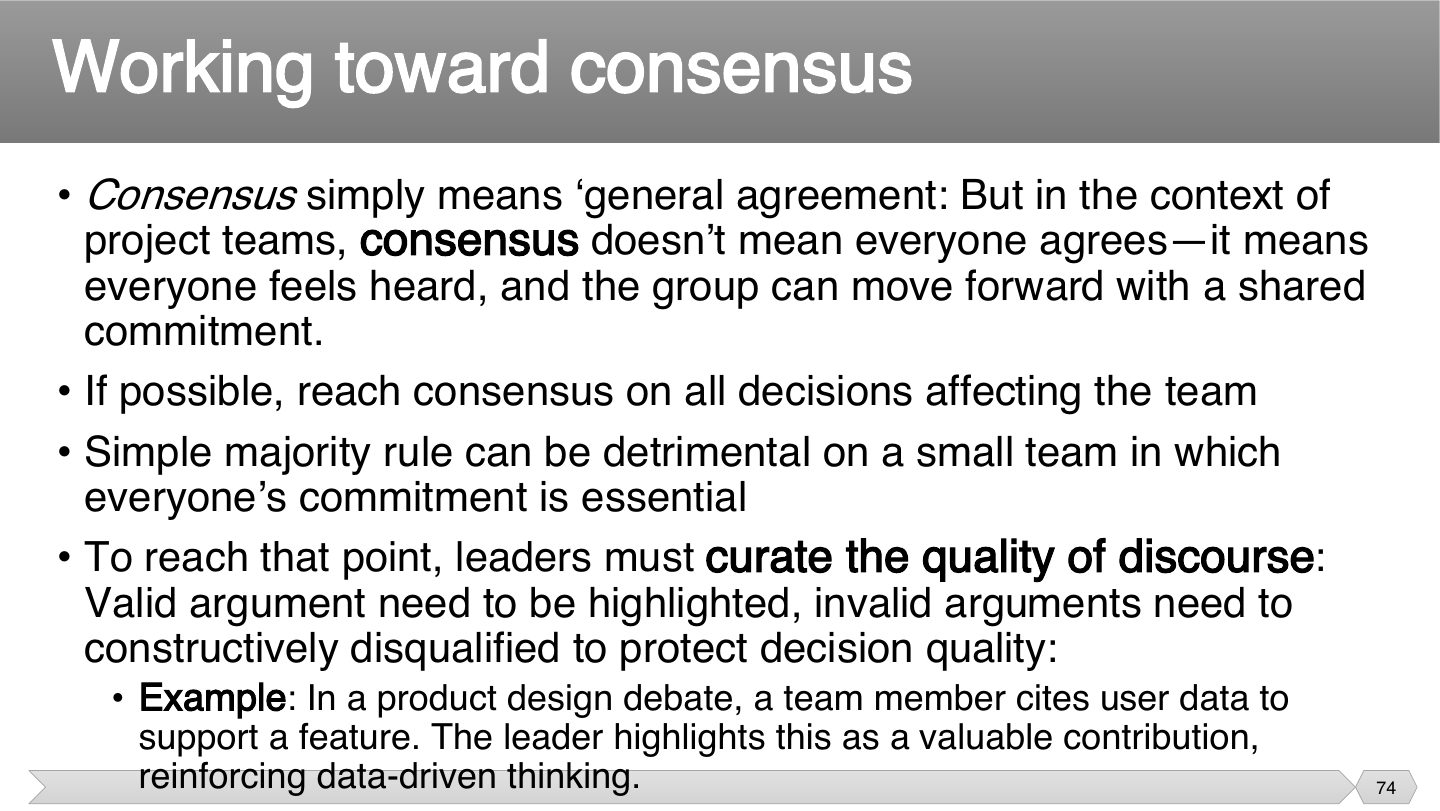
  74. 74 Working toward consensus
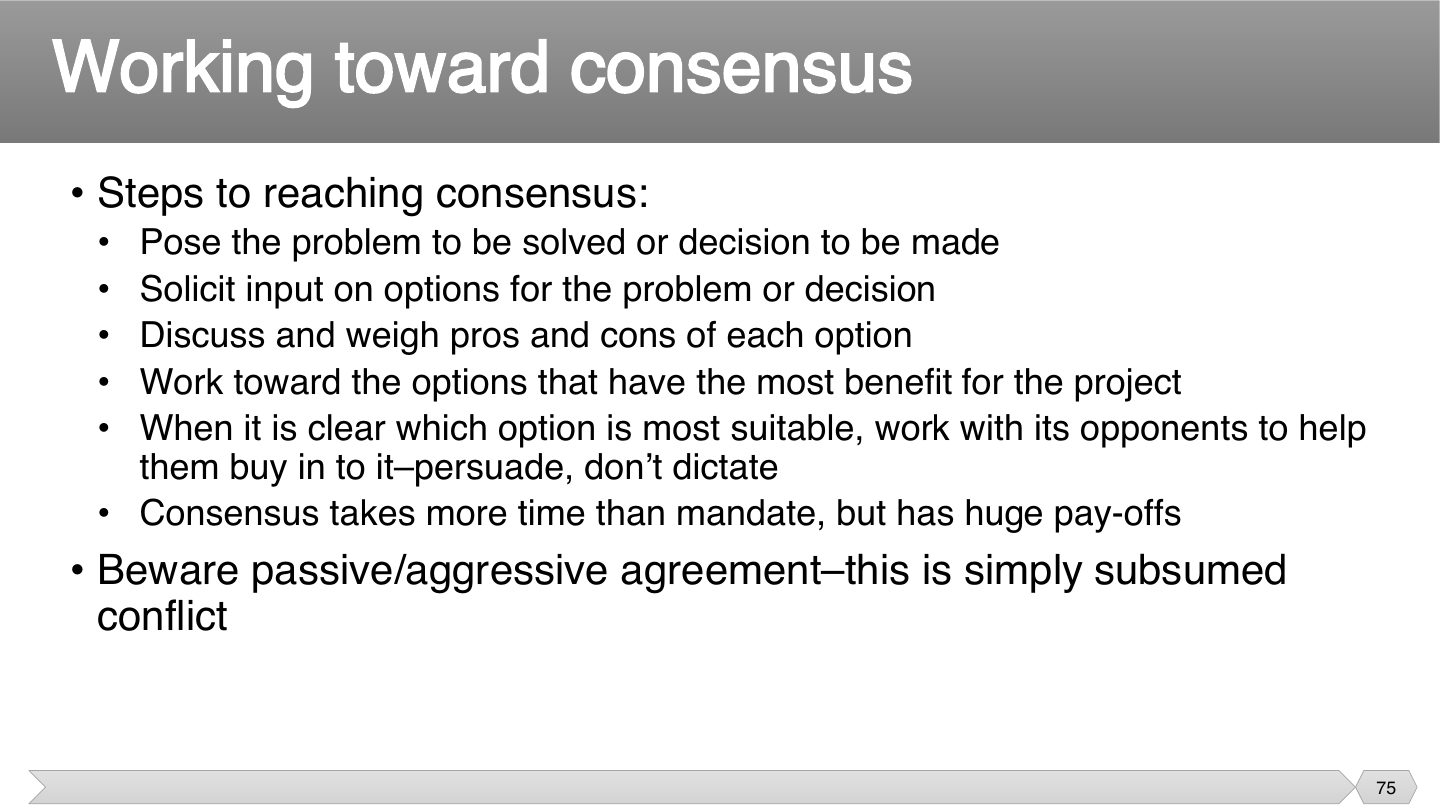
  75. 75 Working toward consensus
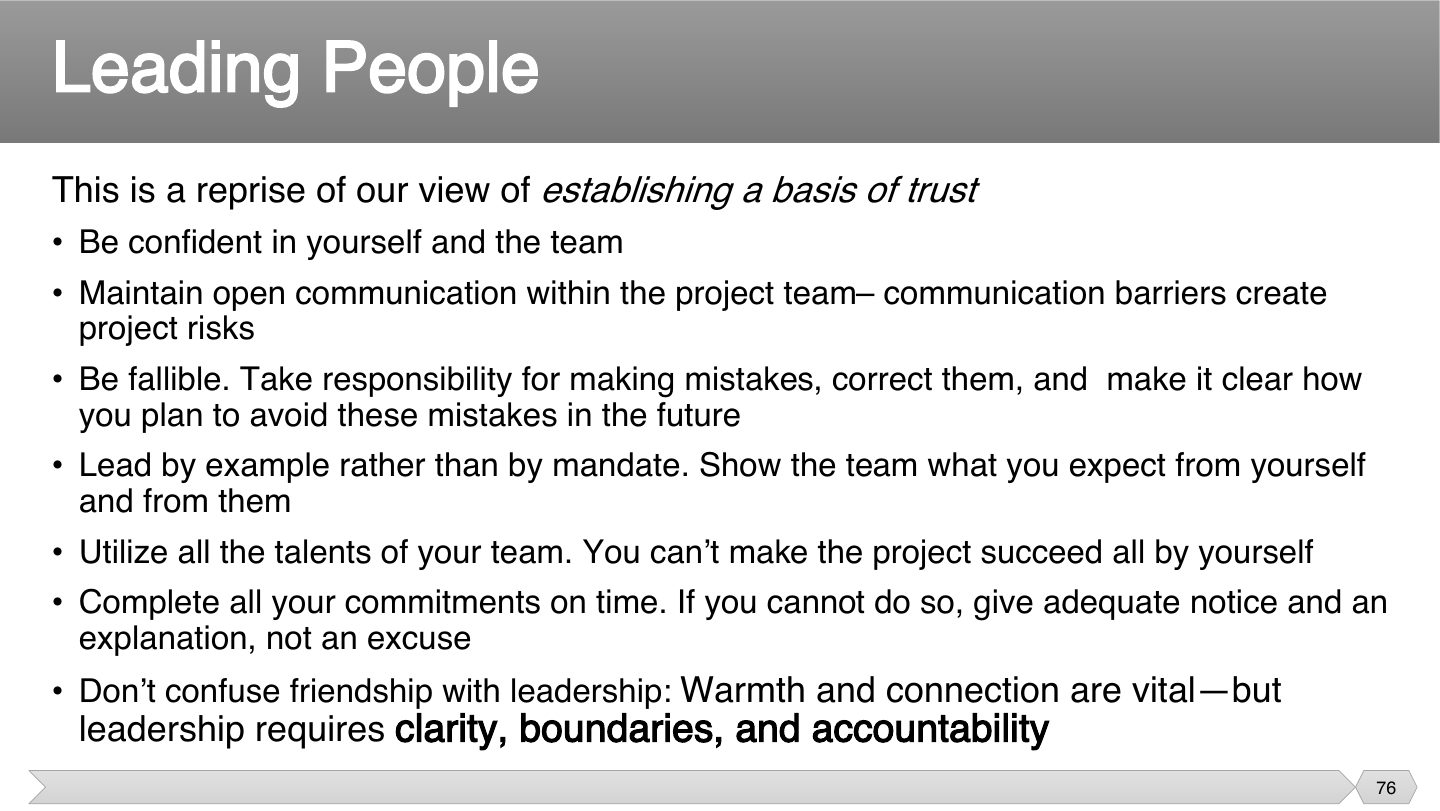
  76. 76 Leading People
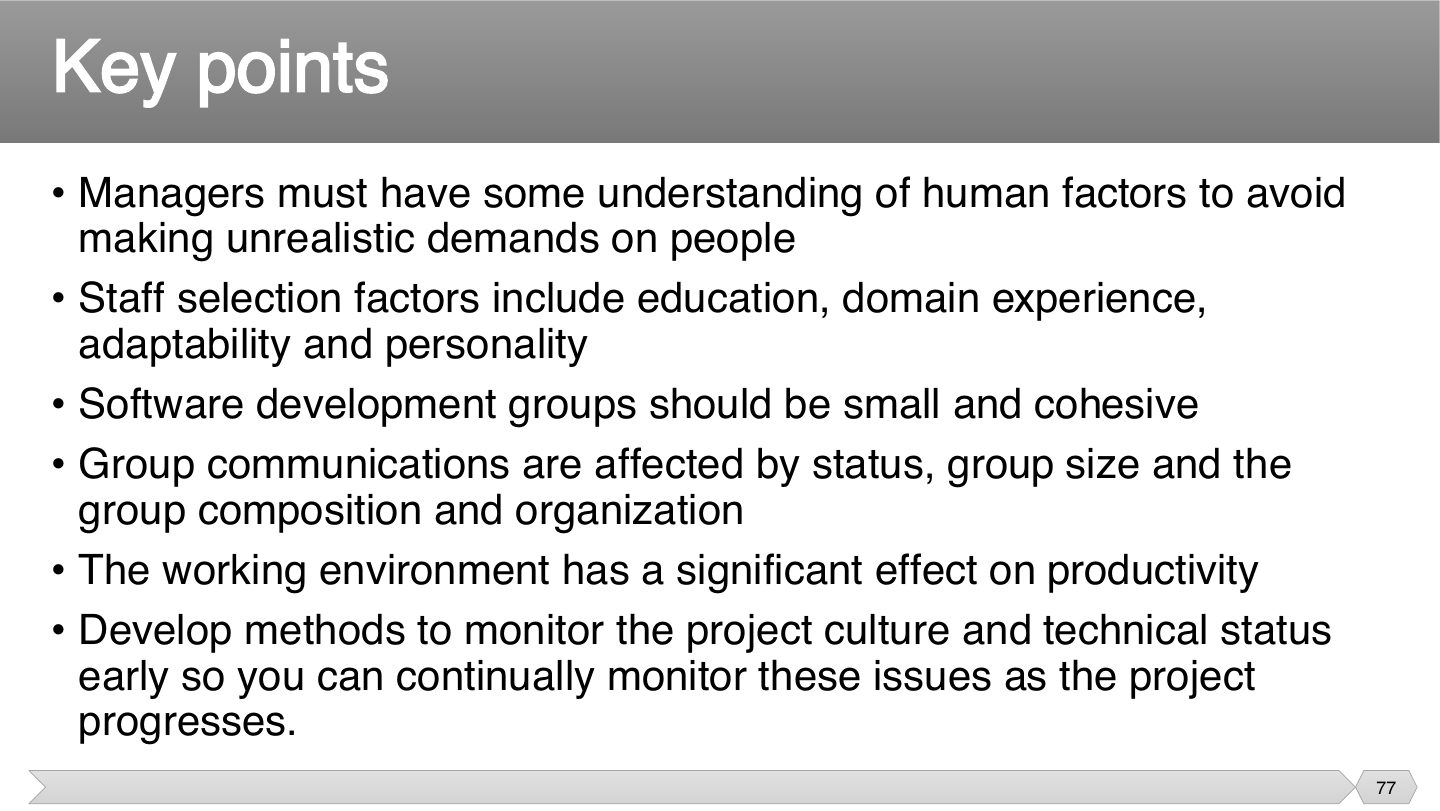
  77. 77 Key points
Slide 1 / 77

Slide 1

Slide 1: Slide 1

Notes

  1. The deck has three parts: team development and the team needs pyramid (slides 3–24), team models (25–34) and managing people (35–77). The pyramid (trust → conflict → commitment → accountability → results) is the spine of the chapter and of most exam questions on it.

Slide 2 / 77

Outline

Slide 2: Outline

Notes

  1. Team development first: how a group becomes a team.

  2. Then three of the pyramid layers in order: building trust, managing conflict, embracing accountability (commitment and results are covered between them).

  3. Then the team models (how teams are organized) and managing people (motivation, selection, culture, leadership).

Slide 3 / 77

Slide 3

Slide 3: Slide 3

Notes

  1. Section divider: Team Development.

Slide 4 / 77

Team Development - Introduction

Slide 4: Team Development - Introduction

Notes

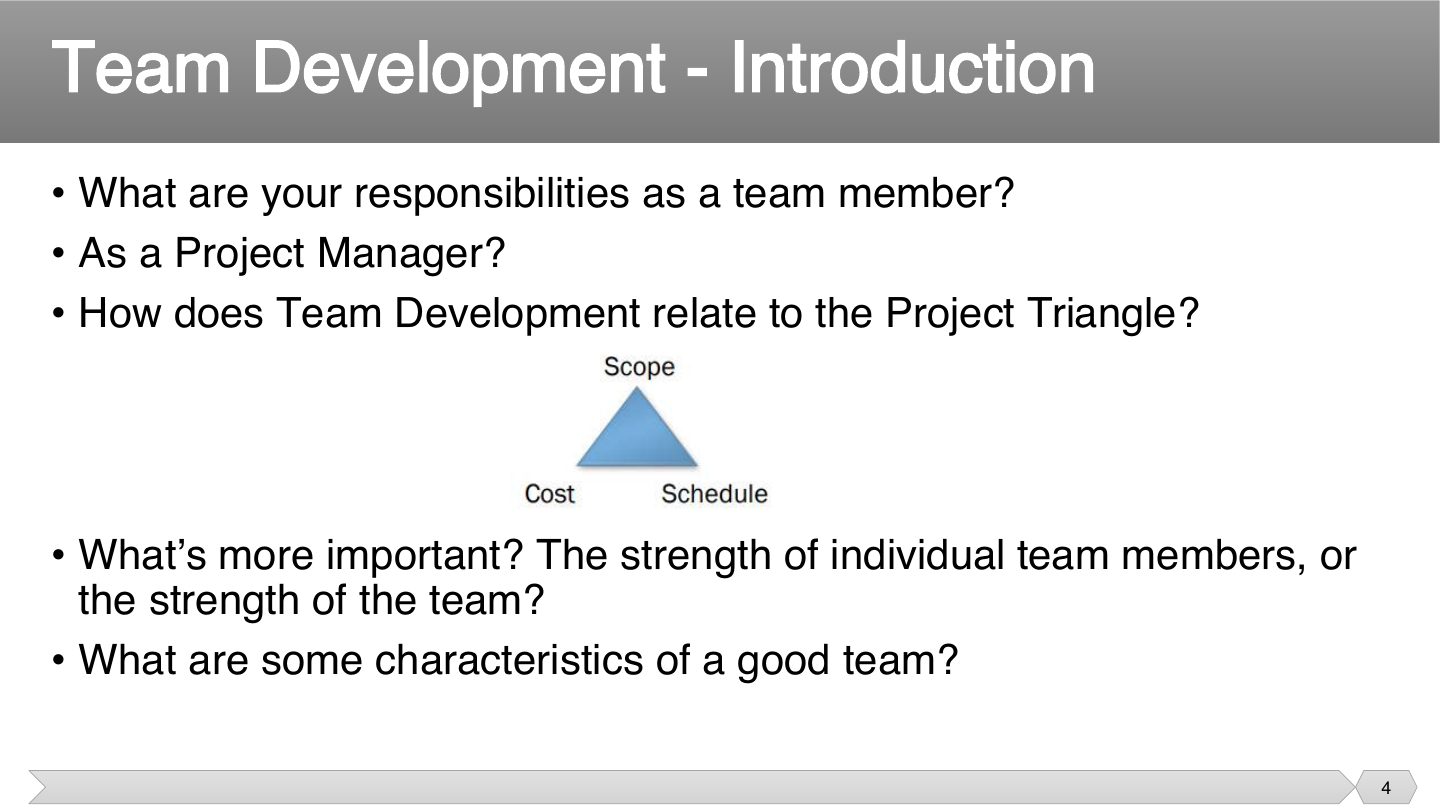
  1. Discussion questions to open the topic. As a team member you own your tasks and support others; as a PM you build the conditions for the team to work: clear goals, roles, trust.

  2. The link to the project triangle: a weak team costs you on scope, schedule or cost. People are the resource that turns the plan into results.

  3. Individuals vs. team: a team of strong individuals who don’t trust each other usually loses to a well-functioning team of average people. Team strength wins.

  4. “Characteristics of a good team” was a real midterm short question. Answer it with the pyramid, from the bottom up.

Exam angle

Past exam · Midterm 251 · V1 · Short Q1Q1

What are key characteristics of a good team?

Compare with the model answer

Members trust each other (the foundation), so they speak openly and admit mistakes; they have healthy conflict about ideas rather than people; they commit to decisions with clarity and buy-in; they hold each other accountable; and they put team results ahead of individual credit. A good team also shares a clear goal with clear roles, communicates openly, is cohesive, balances personality types and is the right size (about 4–6 developers plus a lead).

Slide 5 / 77

Quote

Slide 5: Quote

Notes

  1. McConnell’s two reasons projects fail. Knowledge: the team doesn’t know how to run a software project. Training, hiring and process fix this.

  2. Resolve (determination, commitment, mental toughness): the team knows how but doesn’t push through. This is what team building, motivation and leadership fix, and it is what the rest of the chapter is about.

Exam angle

PredictionQ1

A skilled team keeps giving up when work gets hard. Which of McConnell’s two reasons fits?

Slide 6 / 77

Team Skills, Influence, and Style

Slide 6: Team Skills, Influence, and Style

Notes

  1. The types of influence a PM can use. Formal (legitimate): authority granted by the organizational hierarchy or role. The skills table above lists the PM’s team skills (planning, negotiation, hiring, risk management, judgement) and the bottom table lists leadership styles (directing, facilitating, coaching, supporting, etc.).

  2. It works because people want the reward, and it stops working if you run out of things to offer. Reward also requires that you actually control something they value, such as bonuses or interesting assignments.

  3. Penalty (coercive): influence through the threat or use of punishment. It gets compliance, not commitment.

  4. People follow you because you know the answer, even without a title. That’s why a senior developer can have more real expert influence over a team than their manager does.

  5. Referent: influence based on personal traits, charisma or likability. Formal, reward and penalty come from your position; expert and referent come from you, and they last longer because people choose to follow.

Exam angle

PredictionQ1

A senior developer persuades the team because everyone respects her deep database knowledge. This is:

PredictionQ2

Which types of influence come from the person rather than from the position?

Slide 7 / 77

Needs and the Team

Slide 7: Needs and the Team

Notes

  1. The rule from Maslow: lower-level needs must be satisfied before higher ones can be addressed. On the left is Maslow’s individual pyramid; on the right the team needs pyramid (Lencioni).

  2. The team pyramid from the bottom: trust, then managed conflict, then commitment, then accountability, then results. You can’t have healthy conflict without trust, or commitment without having debated the decision.

  3. Results sit at the top: the team’s collective goals. The ticks on the slide show a team that has secured trust and conflict but is stuck at commitment, so the PM works on that layer next.

Exam angle

Past exam · Midterm 251 · V1 · MCQ 8 (also V2 MCQ 8)Q1

Which of the following is considered the foundation of teamwork?

PredictionQ2

In the team needs pyramid, which layer sits directly above trust?

Slide 8 / 77

Tuckman's Model for Team Development

Slide 8: Tuckman's Model for Team Development

Notes

  1. New people are careful and polite, and they look to the leader for direction. Forming feels calm, but little gets done yet, because people are still working out what’s expected of them.

  2. Once people relax, they start to push back and test who has influence. Storming feels like something’s going wrong, but it’s a normal stage. The PM’s job here is to surface and manage the conflict, not suppress it.

  3. Arguments settle and the group agrees how it will work, such as how decisions get made. Norming is when people start saying “we” rather than “I” and accept each other’s strengths.

  4. People stop spending energy on how to work together and spend it on the work. Performing is what you’re aiming for, and the team needs little supervision at this point.

  5. People may feel loss when a good team breaks up, so a proper ending matters: adjourning is when you wrap up and capture what was learned. Order: form → storm → norm → perform → adjourn.

Tips & tricks

  • The order matters, and they rhyme: Form, Storm, Norm, Perform, then Adjourn.

Exam angle

Past exam · Midterm 251 · V1 · MCQ 7 (also V2 MCQ 7)Q1

According to Tuckman’s model of team development, which stage is characterized by members competing for leadership and struggling with group processes?

PredictionQ2

The stage where the team reaches agreement on how it will operate is:

Slide 9 / 77

Team Structure

Slide 9: Team Structure

Notes

  1. A production outage isn’t the time for meetings and approvals. Problem resolution needs a small group that can decide fast. Once it’s fixed, the team usually disbands, which is why it’s a temporary task force.

  2. You can’t order someone to have a new idea. Creativity needs freedom to try and fail, so a looser hierarchy and mixed backgrounds help, and punishing mistakes would kill it.

  3. Here the plan already exists, so success depends on precise execution. Tactical execution favors clear roles and tight controls, and creative freedom would only get in the way. (The instructor noted she spent time explaining this slide.)

Exam angle

Past exam · Midterm 251 · V1 · Case Q4 (also V2)Q1

As the project manager, you must establish the team structure for this project. What team structure would you create to ensure smooth development, stakeholder engagement, and integration with Edugate, and why?

Compare with the model answer

A cross-functional Agile team: a Project Manager, a Product Owner from Edugate/IT, developers, a UI/UX designer, QA testers, a faculty advisor representative and a student representative (1.0). This puts every stakeholder’s voice inside the team, balances usability against compliance, and supports iterative delivery (0.5).

PredictionQ2

A team must roll out an already-designed module on a fixed timeline. Which objective type and structure fit?

Compare with the model answer

Tactical execution: carrying out a well-defined plan. Use a hierarchical or matrix structure with clear roles, tight controls and performance tracking, because the work is known and the risk is in coordination and deadlines, not in discovering what to build.

Slide 10 / 77

Slide 10

Slide 10: Slide 10

Notes

  1. Section divider: Building Trust, the base of the pyramid.

Slide 11 / 77

Building Trust

Slide 11: Building Trust

Notes

  1. Everything else in the pyramid depends on this. If people don’t feel safe, they hide problems and avoid arguments, so trust comes first as the foundation.

  2. Most people assume that trust means “you’re reliable”. This kind goes further: it means being able to say “I messed up” and know nobody will use it against you. This list was a real midterm question, so learn vulnerability-based trust.

  3. Words can’t build it fast, as people need to see you keep your word several times. So it takes time, and since one broken promise can undo months, it must be maintained.

  4. Knowing how a teammate tends to work removes a lot of misunderstanding: “she’s direct, not rude”. Behavioral profiling is useful as a conversation starter, not as a label, and it lets the PM give people work that suits them.

Exam angle

Past exam · Midterm 251 · V1 · Short Q2 (also V2 Short Q1)Q1

What does vulnerability-based trust involve?

Compare with the model answer

Team members are comfortable being open with each other: admitting mistakes and weaknesses, asking for help, and saying “I don’t know”, without fear that it will be used against them. It takes time to build through consistent behavior, follow-through and shared experiences under pressure, must be maintained, and is the foundation of the team pyramid.

Past exam · Final 242 · Q5.2Q2

How does fostering trust and managing conflict within a software project team contribute to improved collaboration and project success?

Compare with the model answer

Trust lets members admit mistakes, share information and ask for help, so problems surface early and people cooperate instead of protecting themselves. Managed (healthy) conflict means ideas are debated openly and respectfully, which gives better technical decisions and avoids groupthink or disputes that turn personal. Together they lead to real commitment and collaboration, which drives quality and project success.

Slide 12 / 77

Establishing a basis of trust

Slide 12: Establishing a basis of trust

Notes

  1. A title makes people obey, but it doesn’t make them trust you. You have to show them through what you do, so trust is earned, not granted, starting from a natural wariness.

  2. If people can’t tell you things, you find out about problems only when it’s too late. So open communication is risk management, and not just being friendly.

  3. If the PM hides their own mistakes, everyone learns to hide theirs. Be fallible by owning an error openly, because that makes it safe for others to do the same.

  4. People watch what you do far more than what you say. A PM who asks for punctuality and arrives late has told them what’s really expected. That’s why you lead by example.

  5. Nobody expects perfection, but they do expect honesty. Telling people in advance that you’ll miss a commitment keeps trust, while a surprise and an excuse damages it.

  6. Friendship ≠ leadership: warmth helps, but leading needs clarity and boundaries (repeated on slide 76).

Exam angle

PredictionQ1

Which behavior does the slide recommend for establishing trust?

Slide 13 / 77

Slide 13

Slide 13: Slide 13

Notes

  1. Section divider: Managing Conflict, the second layer.

Slide 14 / 77

Managing Conflict

Slide 14: Managing Conflict

Notes

  1. Think of healthy debate as a fight about ideas where nobody’s attacking the person. It only works if you trust that disagreement won’t be used against you, which is why healthy conflict sits above trust.

  2. If everyone is always comfortable, tough topics probably aren’t being raised. So some uncomfortable moments are a good sign, not something to fix.

  3. What’s normal in one team feels rude in another. Agreeing the rules up front, such as “challenge the idea, not the person”, stops arguments about how to argue. That’s what conflict norms are for.

  4. If nobody challenges a weak design because it would feel awkward, the mistake ships. That’s the cost of avoidance, and groupthink is what it looks like: everyone nods, and nobody really agrees.

Exam angle

Past exam · Midterm 251 · V1 · Short Q3 (also V2 Short Q3)Q1

Why is healthy conflict important in teams?

Compare with the model answer

Healthy conflict is open debate about ideas, not people. It brings out different perspectives so the team makes better decisions, avoids groupthink and artificial harmony, and surfaces problems early. Because everyone has been heard, members are more willing to commit to the final decision even if they disagreed. It needs trust underneath and agreed conflict norms.

PredictionQ2

A team values harmony so much that it stops critically evaluating ideas. This is:

Slide 15 / 77

Managing Conflict – How?

Slide 15: Managing Conflict – How?

Notes

  1. This asks “what’s really causing this?” and tackles that. It takes longer, but the problem doesn’t come back, which is why confronting isn’t the same as being aggressive.

  2. Compromising: both sides give something up to reach a middle ground. Quick, but nobody gets what they needed.

  3. These two feel peaceful, but the cause stays there and tends to return bigger. Withdrawal can buy time when emotions are high. Smoothing can suit minor issues, or when the relationship matters more than the point.

  4. Each side’s view contributes something, so you may end up with a better answer than either started with. Collaborating takes time, so save it for decisions that matter.

  5. Sometimes there’s no time to discuss, like during an outage. Forcing gets a quick decision, but people who were overruled won’t feel committed, so use it rarely.

  6. Notice the first step: many teams solve the wrong problem because they jump to answers. The final step is the one often skipped: review whether it actually fixed the issue.

Tips & tricks

  • Sentence, in slide order: Cool Cats Will Still Calm Fights. Confronting, Compromising, Withdrawal, Smoothing, Collaborating, Forcing.

Exam angle

Past exam · Midterm 261 · ShortQ1

Team members disagree about the best solution to a problem. How can the project manager encourage collaboration? (Saying “negotiation” alone is not enough: explain.)

Compare with the model answer

Treat it as healthy conflict and use collaborating/confronting (problem solving) rather than forcing or smoothing. Bring the people together for an open discussion focused on the problem, not on people; define the real problem and agree the criteria for a good solution; ask each person to present their option with its reasoning and data; weigh the pros and cons of each option together; then converge on the option that best serves the project, or combine ideas into a better one. Work with those who preferred other options so they buy in. This gives a better decision and real commitment because everyone was heard.

PredictionQ2

A PM ends a debate by declaring “we use my design, end of discussion.” Which technique is this?

Slide 16 / 77

ict

Slide 16: ict

Notes

  1. Conflict that’s ignored doesn’t go away, as it comes back in other forms, such as people refusing to cooperate. The difference is whether a team resolves it.

  2. People can disagree and still work things out. It’s conflict once they’ve dug in, and each stops listening. Spotting that shift tells you when to step in.

  3. Taking sides only spreads the fight and splits the team, so others stay neutral. The conciliator helps both sides listen again until it’s an ordinary disagreement once more.

  4. Finally, aim for reconciliation between the two parties so the working relationship survives.

Exam angle

PredictionQ1

Disagreement and conflict are the same thing.

Slide 17 / 77

Commitment

Slide 17: Commitment

Notes

  1. Ever left a meeting and found that everyone understood something different? Commitment fails that way, so a decision needs to be both understood and accepted.

  2. A simple habit fixes most of this: end each discussion by stating what’s been decided and who does what next. Without that clarity, people act on their own assumptions.

  3. People can accept a decision they argued against, as long as they feel it was fair and their view was heard. That’s why buy-in comes after debate rather than instead of it.

  4. Waiting for everyone to agree can freeze a team. Great teams argue, decide, and then back the decision (“disagree and commit”). A common trap: “commitment requires everyone to agree” is false, because buy-in does not require consensus.

Tips & tricks

  • CuB: Clarity, Buy-in.

Exam angle

Past exam · Final 242 · Q5.1Q1

In the context of the Team Needs Pyramid, explain how a project manager can foster commitment among team members.

Compare with the model answer

In the pyramid (trust → managed conflict → commitment → accountability → results), commitment sits on trust and healthy conflict: people commit when they trust each other and have had their say. The PM fosters it with clarity (clear decisions, goals, roles and deadlines, confirmed at the end of each meeting, with no assumptions) and buy-in (letting everyone voice their views so they support the decision even if they disagreed; consensus isn’t required). Recording decisions and owners (e.g. in a RACI) then lets commitment be followed by accountability.

PredictionQ2

Team buy-in requires that every member agrees with the decision.

Slide 18 / 77

Slide 18

Slide 18: Slide 18

Notes

  1. Section divider: Embracing Accountability, the fourth layer.

Slide 19 / 77

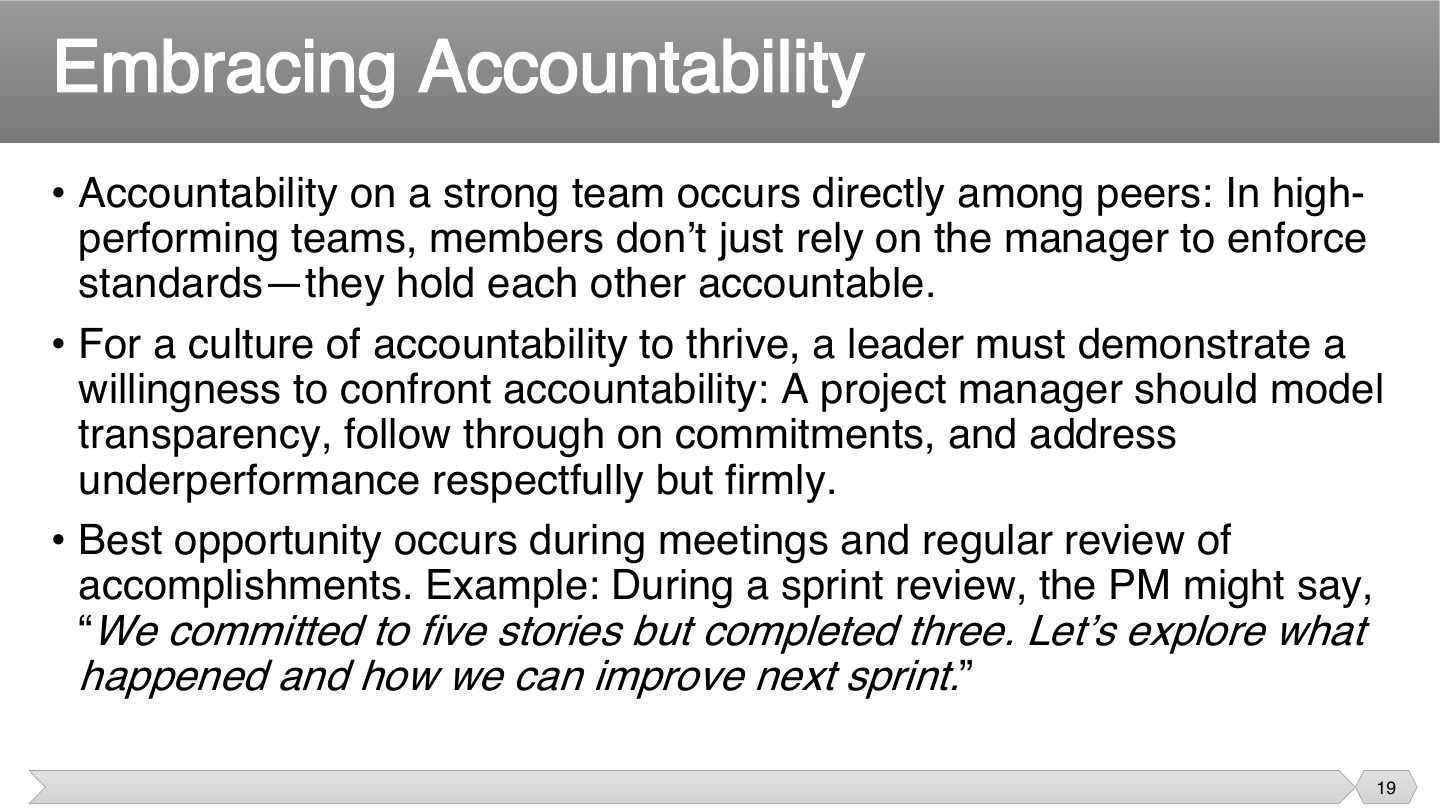
Embracing Accountability

Slide 19: Embracing Accountability

Notes

  1. If only the manager enforces standards, you have one person chasing everyone. When teammates say “this isn’t up to what we agreed” to one another, problems get fixed faster. That’s accountability among peers.

  2. If the PM lets poor work slide, the team learns that standards are optional. So the leader needs a willingness to confront it, and doing that respectfully shows others how.

  3. Reviews work because the facts are in front of everyone. Note the tone in the slide’s example, about the commitment and what happened rather than who failed, in meetings and regular reviews.

Exam angle

Past exam · Midterm 251 · V2 · Short Q2Q1

What’s the best time to reinforce accountability?

Compare with the model answer

During meetings and regular reviews of accomplishments, such as sprint reviews and status meetings, where what was committed is compared with what was done (e.g. “we committed to five stories but completed three; let’s explore why”). Make commitments clear and public at the start and address a missed commitment when it happens rather than waiting for the end of the project, so peers hold each other accountable continuously.

Past exam · Midterm 251 · V1 · Case Q1 (also V2)Q2

During a sprint deployment, a key feature was discovered to be not thoroughly tested and caused issues after release. As the project manager, what steps would you follow to address this issue and ensure accountability within the team?

Compare with the model answer

Use a RACI matrix to establish who was Responsible, Accountable, Consulted and Informed for testing that feature (0.5). Hold a retrospective to find the root cause (0.25). Make the responsible roles clear without blaming individuals (0.25). Take corrective action: release a hotfix, redistribute tasks, and add automated testing so it can’t recur (0.25). Inform the stakeholders of the recovery plan (0.25).

Past exam · Final 242 · Q5.3Q3

Your software project team is experiencing delays due to unclear task ownership and inconsistent updates. As the project manager, how would you apply a team-based approach to improve accountability and transparency within the team? Describe specific steps you would take to enhance collaboration and increase the project’s chances of success.

Compare with the model answer

1) Clarify ownership with a RACI matrix so every task has a Responsible person and exactly one Accountable person. 2) Hold short daily stand-ups (done, next, blocked) so updates are consistent. 3) Put all tasks on a shared board (e.g. Jira or Kanban) with visible goals and deadlines so progress is transparent. 4) Review commitments against results in regular reviews, encourage peer accountability, and run retrospectives to fix what caused the delays.

Slide 20 / 77

Embracing Accountability

Slide 20: Embracing Accountability

Notes

  1. RACI: Responsible does the work; Accountable owns the outcome and signs off (exactly one A per activity); Consulted gives input before or during the work (two-way); Informed is kept updated (one-way). Several R’s on one activity are fine.

  2. It’s worth a mention because some companies use it, so you won’t be confused if you see RASCI. It’s for people who help out on a task without being responsible for it.

  3. In the example, Activity 4 has the project manager as RA: one person can be both Responsible and Accountable for a task they do and own.

Exam angle

Past exam · Midterm 251 · V1 · Short Q6 (V2 asked T2 and T5)Q1

Your team has been assigned to develop a mobile app for a local fitness center. The app will allow users to book classes, track workouts, and receive personalized fitness tips. The project is expected to be completed in 8 weeks. Fill in the RACI assignments for T1 and T6 only.

Compare with the model answer

These cells come from the instructor’s key. The person who does the work is R (the client representative for requirements, the UI/UX designer for the interface, the lead developer for building and launching, the marketing specialist for promotion). Whoever’s expertise is needed is C, and everyone else is I. The key makes the PM Accountable (A) for requirements and launch, the two tasks that commit the project; on the other tasks the PM is kept Informed.

PredictionQ2

In RACI, who owns the outcome and signs off on the task?

Slide 21 / 77

Responsibility Assignment Matrix

Slide 21: Responsibility Assignment Matrix

Notes

  1. If nobody clearly owns a task, it tends to fall through the cracks, and two people may each assume the other has it. A RAM makes that visible, and RACI is just one way of filling one in.

  2. During planning you assign the work, and during tracking you can see where a task has no owner. So it keeps its value after the first week.

  3. On a large project you may not assign to named people yet, so you can start with a team or department. Row totals show if one person or task is overloaded.

Exam angle

PredictionQ1

What does a Responsibility Assignment Matrix show?

PredictionQ2

A RAM can be used only during planning.

Slide 22 / 77

Simple RAM

Slide 22: Simple RAM

Notes

  1. A real RAM: project deliverables grouped by phase (initiate, plan, execute, control, close) down the side, and roles grouped as project leadership, team members, sub-teams and external resources across the top. Each cell holds a RACI letter, so you can read across a row to see who is involved in a deliverable, or down a column to see one role’s workload.

Exam angle

PredictionQ1

How do you see one role’s workload on a RAM?

Slide 23 / 77

Skills Matrix

Slide 23: Skills Matrix

Notes

  1. A RAM says who is doing what, while a skills matrix says who is able to. Use it before assigning work, so you aren’t guessing about abilities.

  2. Skills can be high level or very specific (PHP, MySQL, React); cells can be X’s or numeric levels (the legend: expert, practitioner, novice). Use it to assign tasks to the right people and to spot gaps, e.g. only one person is an expert in a key technology, which is a key-person risk.

Exam angle

Past exam · Final 242 · Q2.3Q1

You are responsible for managing a diverse team with varying availability and skill sets. Describe two strategies you would use to allocate your team’s resources efficiently across tasks. How would you adjust your resource plan if one hardware specialist becomes unavailable for 4 weeks?

Compare with the model answer

1) Build a skills matrix and assign tasks to the people whose skills match, recording owners in a RAM/RACI. 2) Check availability per period and level the workload so nobody is overallocated, using float on non-critical tasks. If the hardware specialist is out for 4 weeks: move their non-critical tasks later within their float, reassign what others can do (using the skills matrix to find the next-best person), bring in a contractor or borrow a specialist for critical work, and update the schedule and inform stakeholders if the critical path moves.

Slide 24 / 77

Focusing on Results

Slide 24: Focusing on Results

Notes

  1. Everything below this exists for one reason. A team can have trust and good meetings and still have failed if it doesn’t deliver, so it’s judged by results.

  2. A developer might want a clever feature for their CV, and a department might want its own goal. Team results come first, or everyone wins individually and the project loses.

  3. If a goal lives in a document nobody opens, it can’t guide daily decisions. A public, visible goal also makes it awkward for anyone to quietly drift from it.

Exam angle

PredictionQ1

A developer pushes a pet feature that helps their CV but delays the team goal. Which pyramid layer is the problem?

PredictionQ2

How can a team stay focused on results?

Slide 25 / 77

Slide 25

Slide 25: Slide 25

Notes

  1. Section divider: Team Models, the ways a software team can be organized.

Slide 26 / 77

Team Models

Slide 26: Team Models

Notes

  1. These are the two extremes. A democratic team gets better buy-in but decides slowly, while an autocratic one decides fast but depends on one person’s judgment.

  2. The variation in between, controlled decentralized, has a leader who coordinates while sub-groups decide within their own areas.

Exam angle

PredictionQ1

In which philosophy does one person decide?

Slide 27 / 77

Team Models

Slide 27: Team Models

Notes

  1. Why is it so common? It’s simple, so everyone knows who to ask and who answers to outsiders. If a question doesn’t mention anything special, the business team is the safe assumption.

  2. One lead keeps responsibility clear, while the rest of the team stay equal. Strong suits a new or inexperienced team, and loose suits a skilled one. It’s this flexibility that makes it general.

  3. Trust has to come first. A new team asked to decide everything together would stall, so moving to a democratic team is something a team grows into.

Tips & tricks

  • Team models, in slide order: Busy Developers Code Super Software. Business, Democratic, Chief-programmer, Skunk works, SWAT.

Exam angle

Past exam · Midterm 251 · V1 · Short Q4 (also V2 Short Q4)Q1

What’s the difference between a Business Team and a Democratic Team?

Compare with the model answer

A business team has a technical lead who is the principal contact and makes or facilitates decisions, with the other members at equal status under the lead (a strong or loose hierarchy); it is the most common model. A democratic team acts as a group: decisions are made by consensus, the leader is only the external interface and does not allocate work, tasks are allocated by ability and experience, and it works best with experienced, competent members. Teams often move from business to democratic as trust and norms develop.

Slide 28 / 77

Democratic team organization

Slide 28: Democratic team organization

Notes

  1. Nobody hands down a decision, so people commit to it, and it takes longer. That’s the trade-off behind reaching consensus: strong buy-in in exchange for speed.

  2. Someone still has to talk to the outside world, but that person isn’t the boss. As an external interface, they pass on information, and the team decides who does what.

  3. People take the work they’re best at, rather than getting tasks by rank. That only works when everyone knows one another’s ability and experience, as you can’t allocate fairly otherwise.

  4. If some members are beginners, they can’t judge decisions well and will either stay quiet or slow things down. So this is the condition to remember: all members experienced and competent.

Exam angle

PredictionQ1

In a democratic team, what does the leader do?

PredictionQ2

A team of beginners tries a democratic model and stalls. Why?

Slide 29 / 77

Agile programming groups

Slide 29: Agile programming groups

Notes

  1. Agile teams estimate and assign their own work, because they’re closest to it. That’s why they count as democratic variants, though someone like a product owner still sets priorities.

  2. In XP, programmers work in pairs and take collective responsibility for the code: anyone can change any part, and nobody “owns” a module.

Exam angle

PredictionQ1

In XP, who is responsible for the code?

Slide 30 / 77

Team Models

Slide 30: Team Models

Notes

  1. Why would you build a team this way? Some people are far more productive, so the idea is to free your best person from everything except the hardest code, like the surgeon in an operating room.

  2. If the chief is ill or quits, everything depends on them. The backup exists to remove that risk, and also gives the chief someone able to catch their mistakes.

  3. Each role removes one kind of distraction from the chief: paperwork, admin, tools, language questions. You don’t need to memorize details beyond the fact that they’re supporting roles, though the list is fair for a listing question.

  4. Real superstars are rare, and those around them may resent the imbalance. So despite the appeal, it’s difficult to achieve. It can suit creative projects or tactical execution.

Tips & tricks

  • BAT CLiP: Backup programmer, Administrator, Tool-smith, Chief programmer, Language lawyer, Program clerk.

Exam angle

PredictionQ1

In a chief-programmer team, who is equally skilled and ready to step in for the chief?

Slide 31 / 77

Chief programmer teams

Slide 31: Chief programmer teams

Notes

  1. Think of a core group that stays, with others joining for particular parts. That kernel keeps the design consistent, as a few minds decide the system’s shape.

  2. The motivation: the wide difference in ability between programmers. If the best are many times more productive, build the team around them.

  3. If someone can do the work of several people, the efficient choice is to remove obstacles from them. That’s the logic of a supporting environment: everyone else exists to help them produce.

Exam angle

PredictionQ1

Why were chief-programmer teams developed?

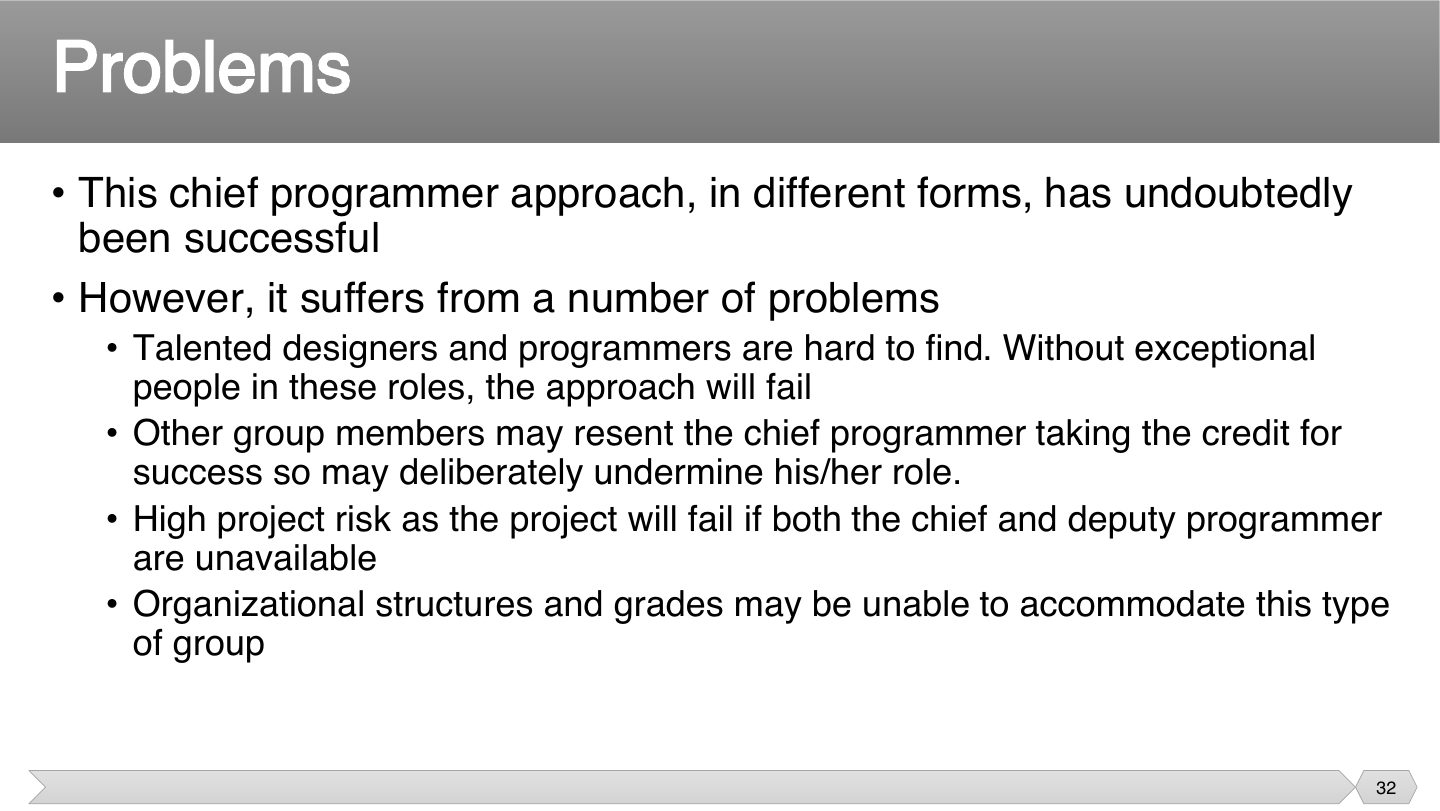
Slide 32 / 77

Problems

Slide 32: Problems

Notes

  1. The whole model assumes you have a superstar. An average lead in this role becomes a bottleneck, so if exceptional people are hard to find, it fails.

  2. If one person gets the praise for everyone’s work, the rest may stop caring or even work against them. That’s why resent is on this list: the human side can sink the team.

  3. So much depends on two people that losing both, even temporarily, stops the project. This is key-person risk: the same thing a skills matrix would warn you about.

  4. The organization’s structures and pay grades may not accommodate a team where one person is far above the rest.

Exam angle

PredictionQ1

A chief-programmer team carries high project risk because the project fails if both the chief and the deputy are unavailable.

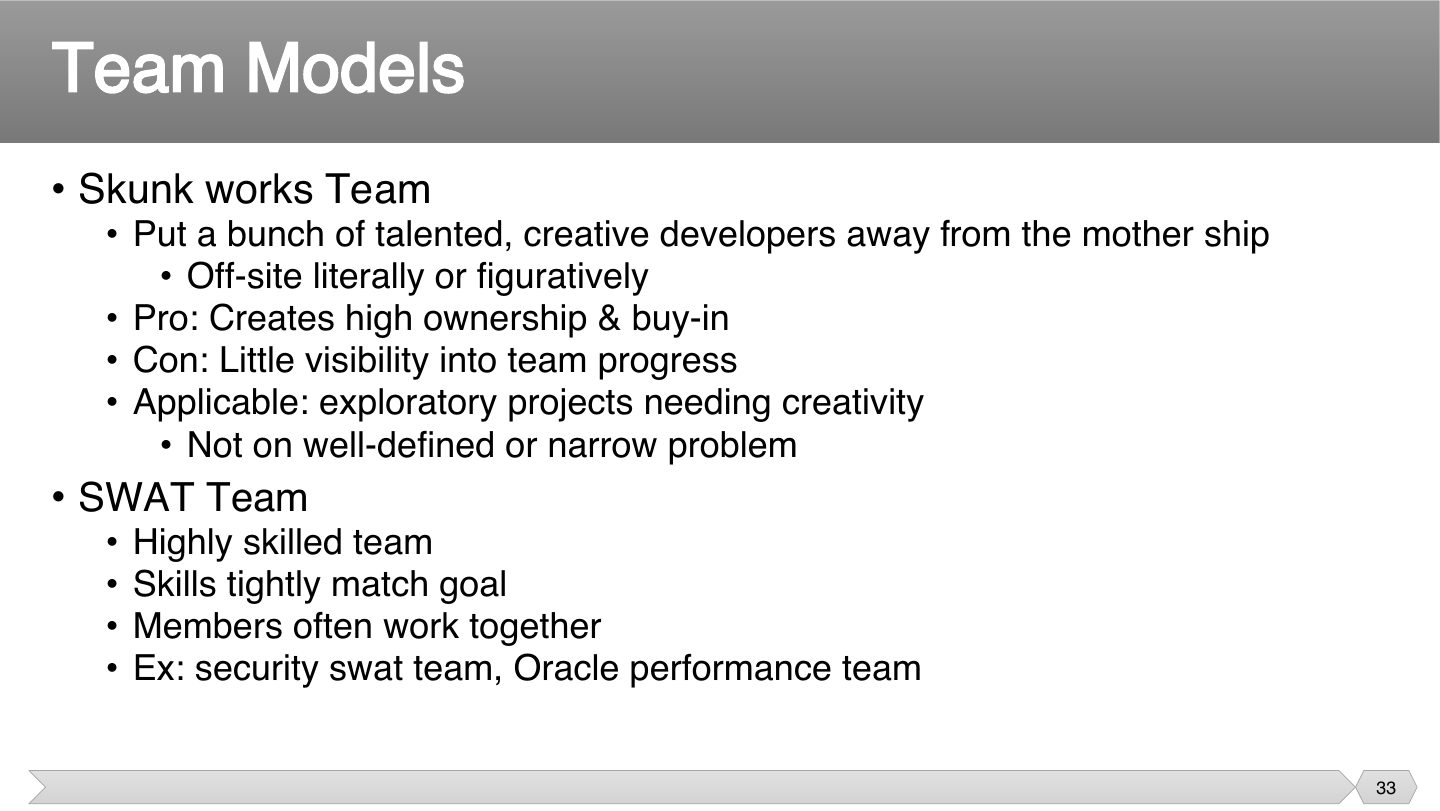
Slide 33 / 77

Team Models

Slide 33: Team Models

Notes

  1. Distance from the main organization removes interruptions and rules, and the team feels the result is really theirs. That’s the appeal of skunk works, and the reason for high ownership.

  2. If they’re off on their own, nobody can easily tell how it’s going. Fine for exploring a new idea, but a narrow, well-defined job doesn’t need this freedom, and little visibility would just be a risk.

  3. Compare the two: skunk works is about freedom to explore, while SWAT is about precise skills for a known goal. They already work well together, so they can be dropped into a problem and start immediately.

Exam angle

PredictionQ1

A team of database experts is brought in to fix Oracle performance problems. This is a:

PredictionQ2

A company sends a few creative developers off-site to explore a new product idea with little reporting. This is a:

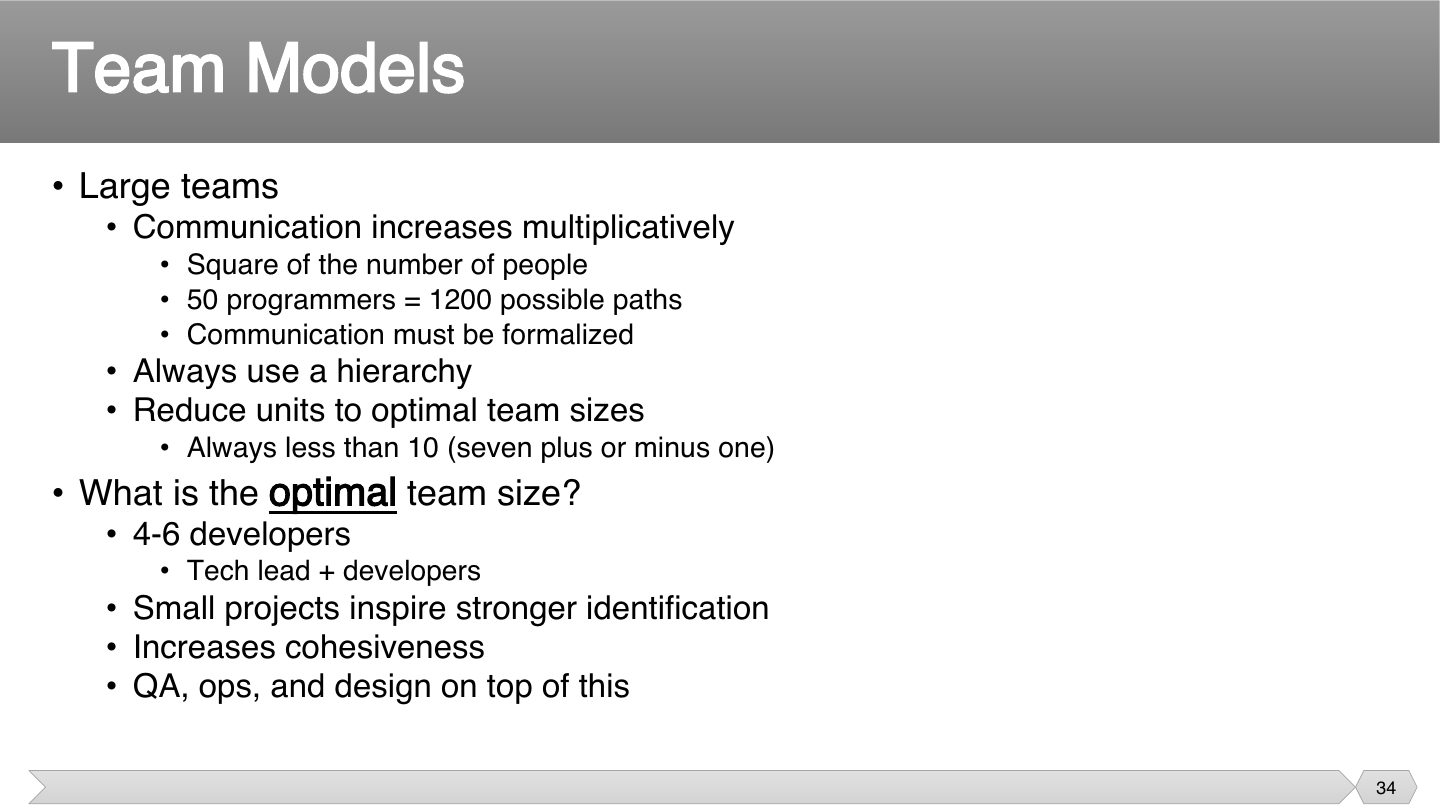
Slide 34 / 77

Team Models

Slide 34: Team Models

Notes

  1. In large teams communication paths grow with roughly the square of the team size. The exact formula is n(n − 1) / 2: 50 people → 1,225 paths (the slide rounds to 1,200); 7 people → 21.

  2. With that many paths, informal chat can’t keep everybody informed. A hierarchy reduces the paths, since people talk within small groups and leads talk to each other.

  3. Why so small? In a small team, everyone knows what’s going on and feels their work matters, and that’s what builds cohesiveness. The other roles sit around this core so it stays small.

Exam angle

Past exam · Final 242 · Q3.2Q1

Calculate the number of communication channels for a project team of 7 members.

Compare with the model answer

n(n − 1) / 2 = 7 × 6 / 2 = 21 channels.

PredictionQ2

Your team grows from 5 to 10 people. By how much do the communication channels increase?

Compare with the model answer

From 5 × 4 / 2 = 10 to 10 × 9 / 2 = 45 channels: the team doubled but channels grew 4.5 times. That is why large teams need hierarchy and should be split into sub-teams under 10.

Slide 35 / 77

Managing People

Slide 35: Managing People

Notes

  1. Section divider: Managing People.

Slide 36 / 77

People in the process

Slide 36: People in the process

Notes

  1. Equipment can be replaced, but people carry the knowledge and make the decisions. Calling them the most important assets means a PM should plan for people as carefully as for tasks.

  2. A manager’s tasks are essentially people-oriented; without understanding people, management fails however good the technical plan is.

Exam angle

PredictionQ1

Why does a manager need to understand people?

Slide 37 / 77

Management activities (related to people)

Slide 37: Management activities (related to people)

Notes

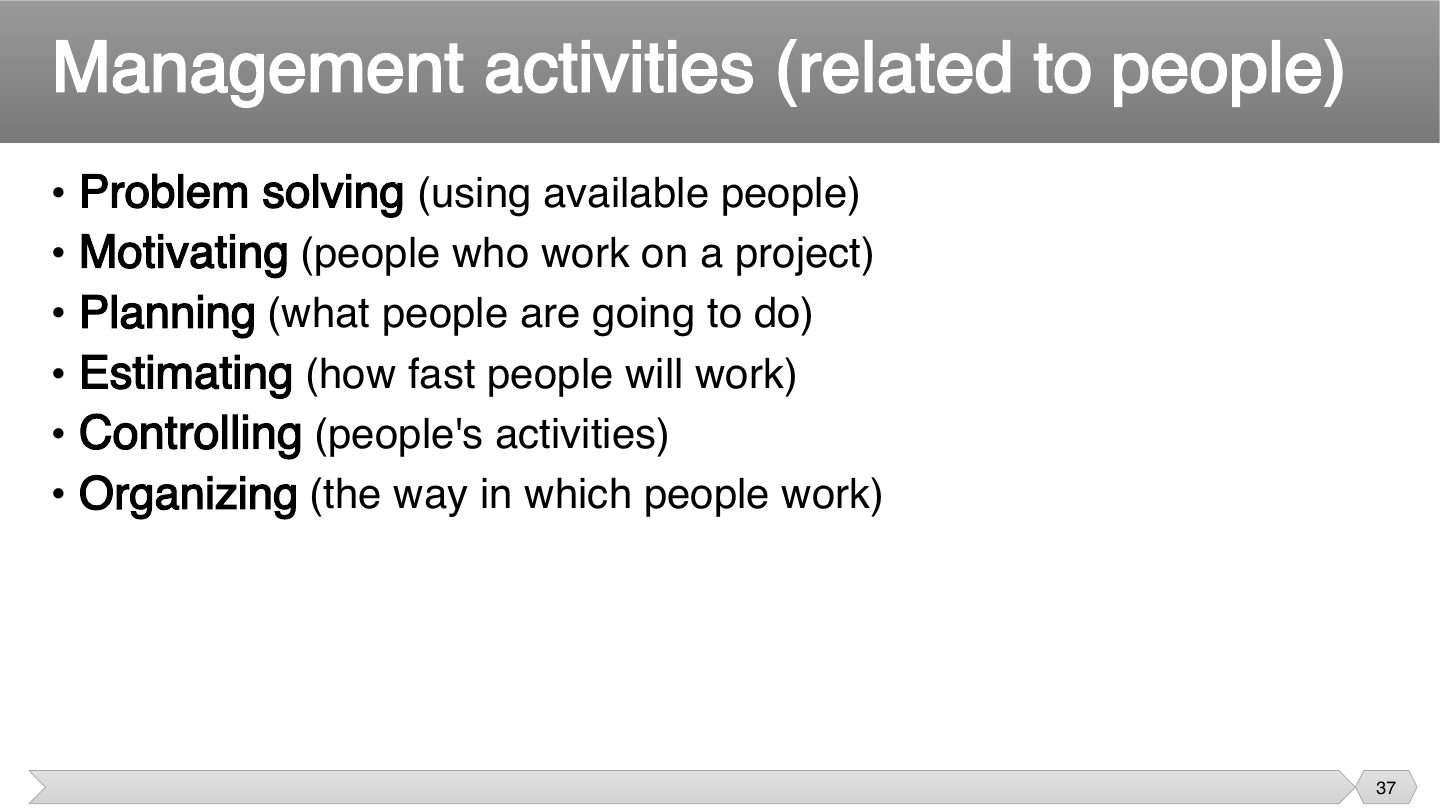
  1. Notice that “using available people” is a real limit: you rarely get to choose your ideal team. And motivating comes up here because a plan only happens if people want to do it.

  2. Plans and estimates can look purely technical, but “how fast” depends on who’s doing it. The same task can take one developer a day and another a week, so estimating is about people too.

  3. Controlling doesn’t mean micromanaging; it means knowing whether the work is on track. Organizing is about who works with whom and how, which shapes how well they do.

Tips & tricks

  • Sentence, in slide order: Project Managers Plan, Estimate, Control, Organize. Problem solving, Motivating, Planning, Estimating, Controlling, Organizing.

Exam angle

PredictionQ1

“How fast will people work?” belongs to which management activity?

Slide 38 / 77

Motivation

Slide 38: Motivation

Notes

  1. Needs-based means that to motivate someone, you first ask what they’re lacking. The same reward can motivate one person and do nothing for another whose need is different.

  2. Think of the groups as moving outward: staying alive, feeling valued, then belonging. A manager has most influence on personal and social needs, since those arise at work.

  3. Maslow’s hierarchy: physiological → safety → social → esteem → self-realization (self-actualization).

Tips & tricks

  • Maslow from the bottom up, where the order matters: Please Students, Study Every Session. Physiological, Safety, Social, Esteem, Self-realization.

Exam angle

PredictionQ1

A teammate wants to be accepted as part of a group. Which type of need is this?

PredictionQ2

Motivation is based on needs.

Slide 39 / 77

Motivating people

Slide 39: Motivating people

Notes

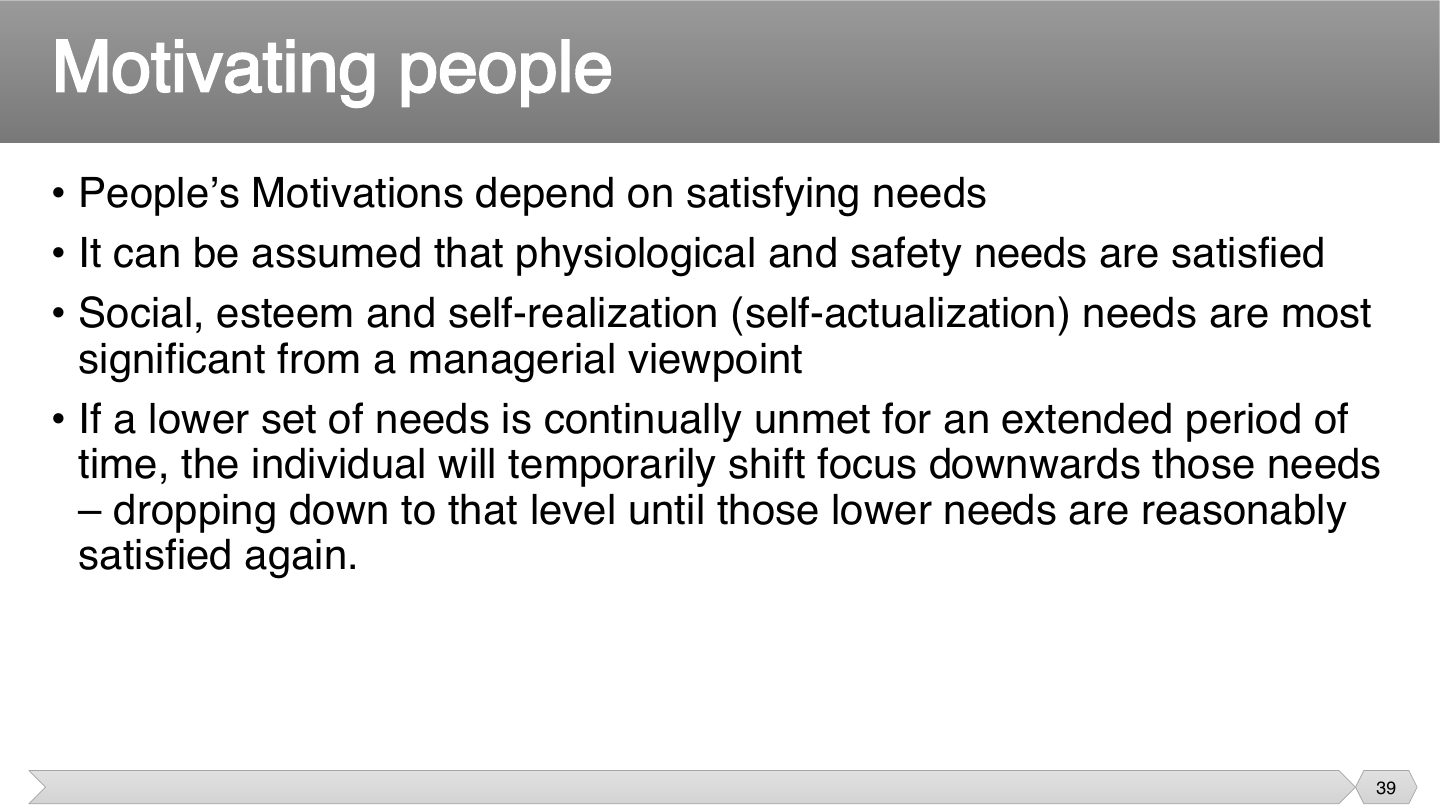
  1. A paying job with a safe office usually covers the basics. So a manager can start higher up, which is why physiological and safety needs aren’t the usual focus.

  2. Once the basics are covered, what makes people try harder is belonging, feeling respected and growing. These are the needs a manager can really act on, so social, esteem and self-realization matter most.

  3. But if a lower need stays unmet for a long time (e.g. job security during layoffs), people shift focus downwards to it until it is satisfied again, and higher motivators stop working.

Exam angle

PredictionQ1

During layoffs, recognition stops motivating someone who fears for their job. Why?

Slide 40 / 77

Need satisfaction

Slide 40: Need satisfaction

Notes

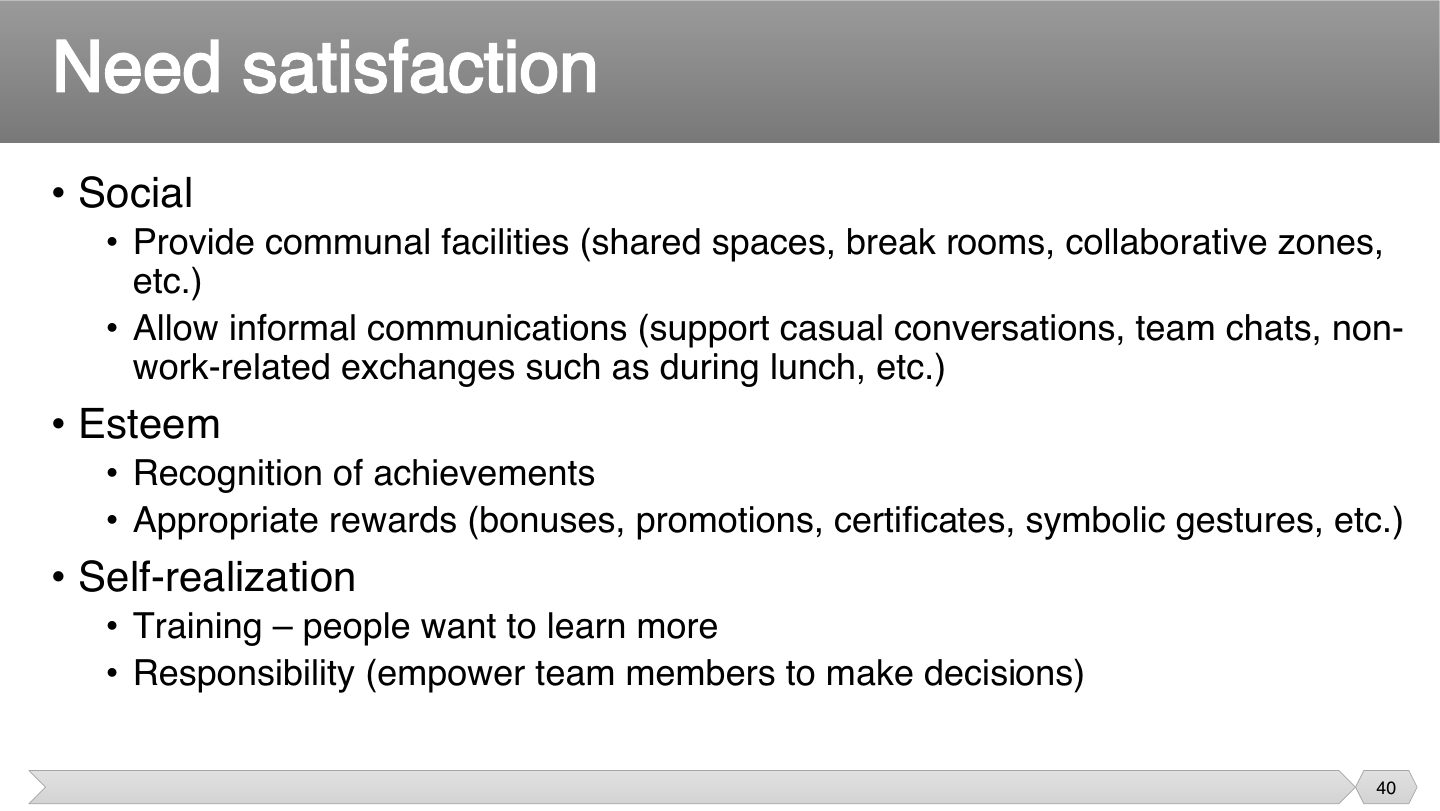
  1. People work better with colleagues they know. Break rooms and casual chats look like wasted time, but they’re how social needs get met and how information spreads.

  2. People want to feel their effort was noticed. A specific “thank you” in front of the team can matter as much as a bonus, so recognition doesn’t have to be expensive.

  3. Here people want to grow and be trusted. So training and real responsibility motivate strong staff, while doing the same simple task for years drives them away.

Exam angle

Past exam · Final 251 · Q5.3Q1

Your team has just completed a major milestone in the project development process. How would you celebrate this achievement collaboratively with your team members? How would you recognize individual contributions to the team’s success? What actions would you take to ensure that team morale remains high as you move forward in the project?

Compare with the model answer

Celebrate as a team (social need), e.g. a team lunch and an announcement of the milestone to the stakeholders. Recognize individuals specifically and publicly (esteem): name what each person contributed in the meeting, send thank-you notes to their managers, and give certificates or small rewards. Keep morale high (self-realization): hold a retrospective that captures what went well, set clear and achievable next goals, balance the workload, and offer training and more responsibility to those who want to grow.

PredictionQ2

Sending a developer on a cloud-architecture course mainly satisfies which need?

Slide 41 / 77

Personality types

Slide 41: Personality types

Notes

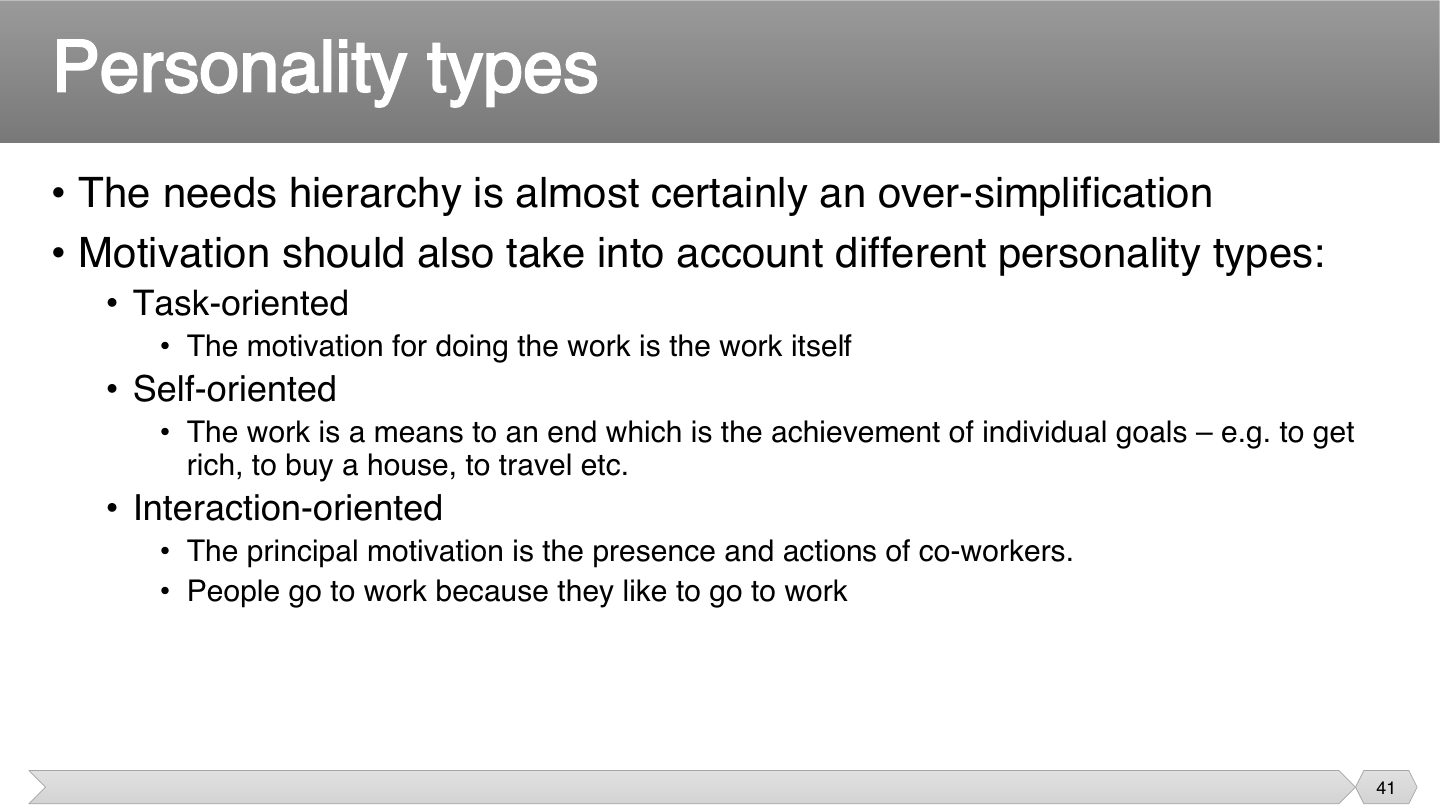
  1. Maslow suggests everybody wants the same things in the same order, and real people aren’t like that. Two teammates at the same level can want very different things, hence personality type.

  2. Task-oriented: the motivation is the work itself (they love solving the problem).

  3. The same project might be a means to a promotion or to buying a house. Self-oriented isn’t a criticism, but it tells you these people respond to personal benefit.

  4. For them, an isolated task with no contact is demotivating, even if it’s interesting. Interaction-oriented people keep a team talking, and that has real value.

Tips & tricks

  • SIT: Self-oriented, Interaction-oriented, Task-oriented.

Exam angle

PredictionQ1

A developer works mainly to save for a house. This personality type is:

Slide 42 / 77

Motivation balance

Slide 42: Motivation balance

Notes

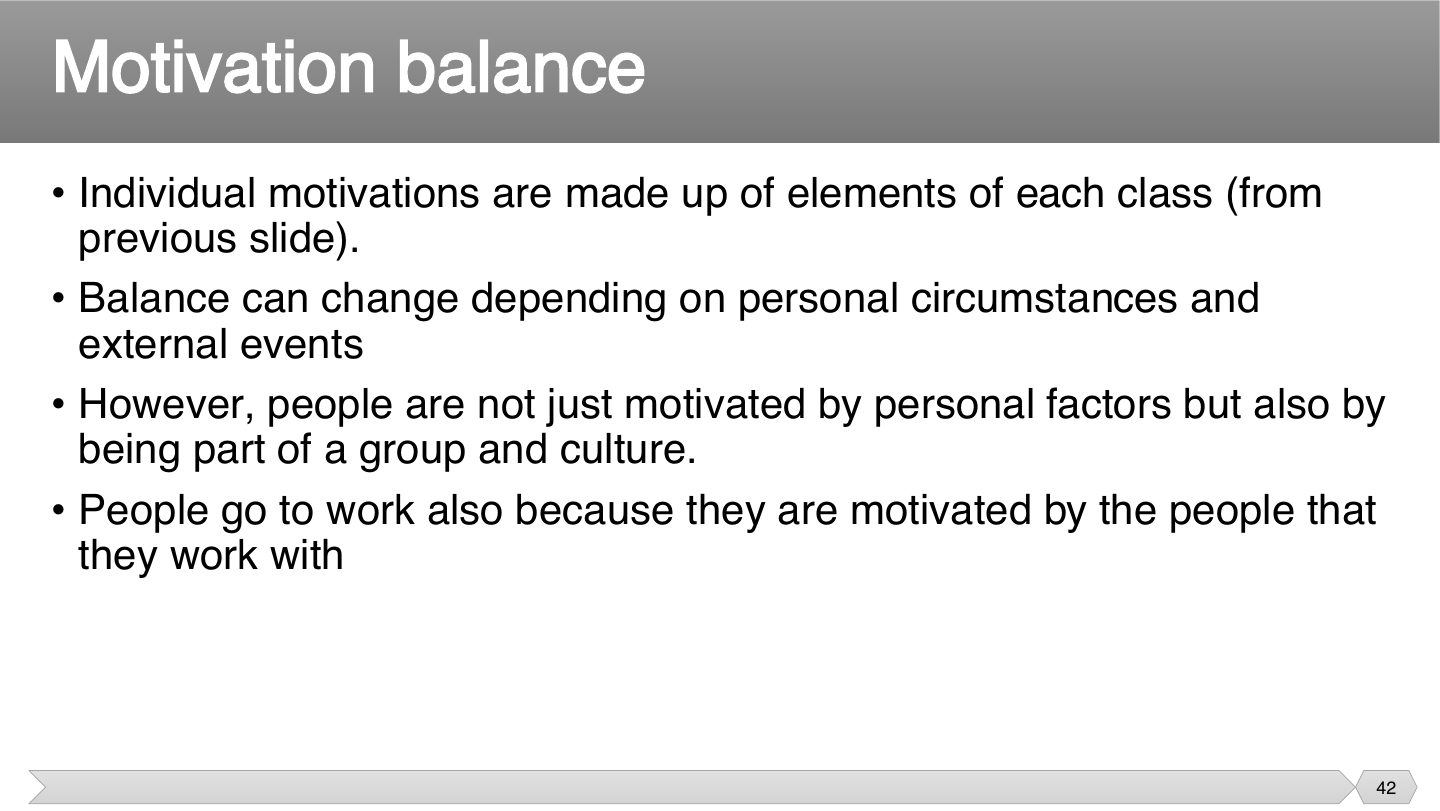
  1. Real people have elements of each class, and the balance changes with personal circumstances (a new baby makes someone more self-oriented for a while).

  2. Even someone working mainly for money may stay because they like the team. So building a good group and culture is a motivation tool that doesn’t cost much.

Exam angle

PredictionQ1

A new parent becomes more focused on income for a while. What does this show?

Slide 43 / 77

Group composition: group working

Slide 43: Group composition: group working

Notes

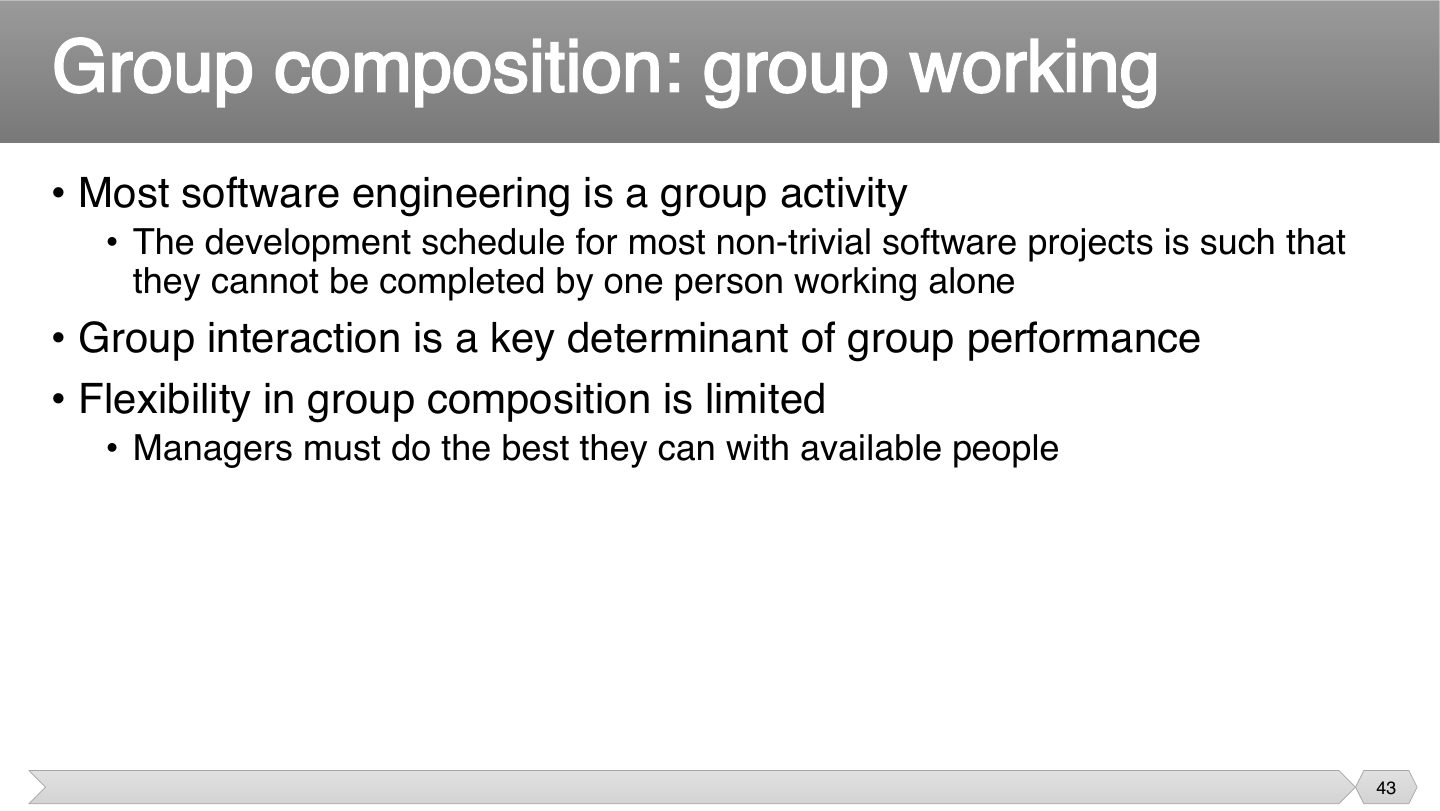
  1. Real software is too big for one person, however talented. Working out how people fit together is therefore central, because this is a group activity by necessity.

  2. Group interaction is a key determinant of performance, so how the group works together matters as much as individual skill.

  3. You rarely get to hand-pick a dream team, so plan around who you actually have. That’s why group composition is listed as limited: adapt the work to people’s strengths.

Exam angle

PredictionQ1

Why can’t a manager just choose the ideal group?

Slide 44 / 77

Time distribution

Slide 44: Time distribution

Notes

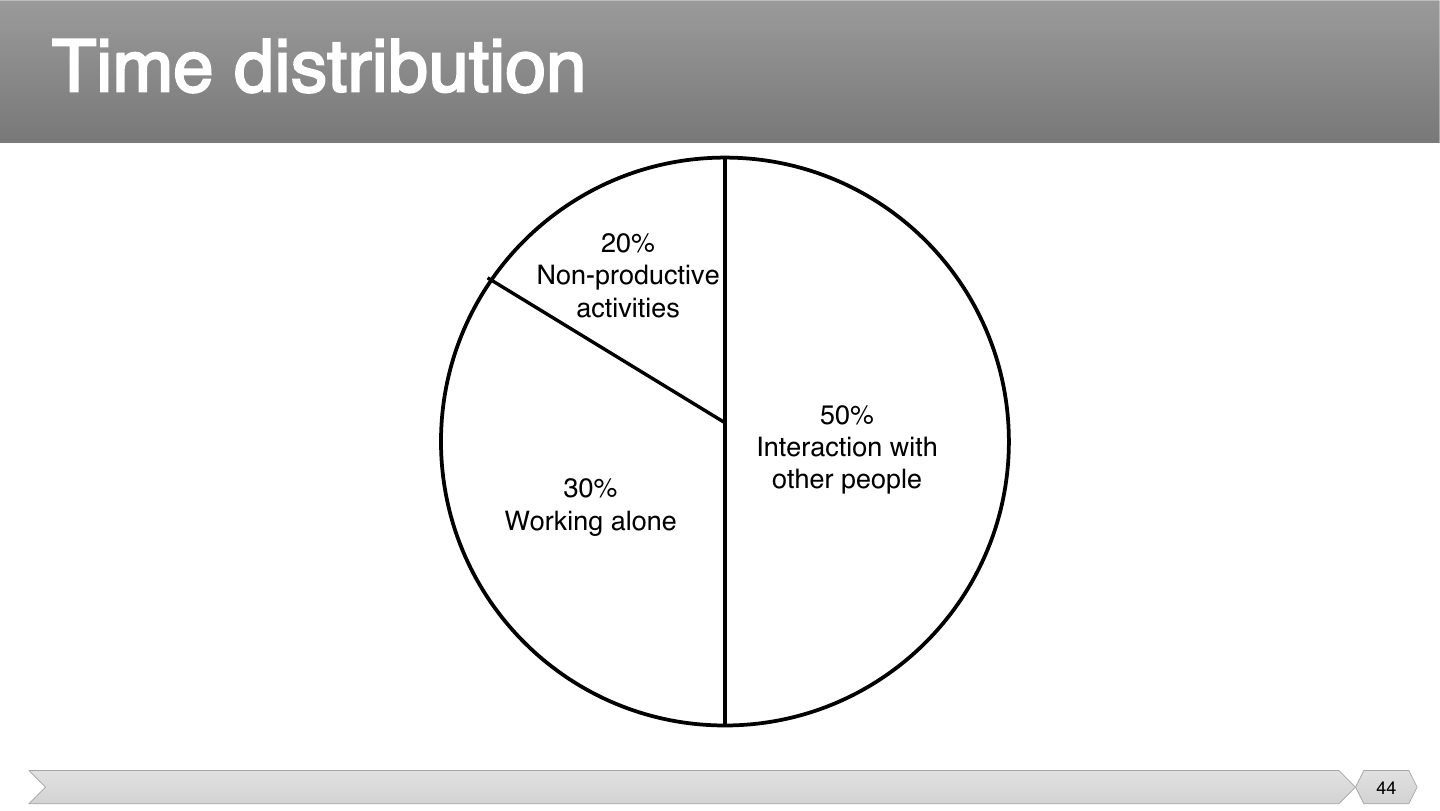
  1. About 50% of an engineer’s time is spent interacting with other people (meetings, reviews, discussions), so communication skills matter far more than people expect.

  2. Don’t plan a person’s time as if they code all day. With only 30% alone, an estimate that assumes eight hours of solo work will be far too optimistic.

Tips & tricks

  • WIN: Working alone, Interaction with others, Non-productive.

Exam angle

PredictionQ1

According to the time-distribution chart, roughly how much of an engineer’s time is spent interacting with other people?

Slide 45 / 77

Group composition

Slide 45: Group composition

Notes

  1. Mixing types is deliberate. People with identical motivations tend to clash or leave gaps, just like a team of only goalkeepers, which is why having the same motivation is a problem.

  2. Each extreme has a weakness on its own: nobody coordinates, everybody competes, or nobody finishes. That’s why you look at the mix, not only at individuals: task, self, interaction.

  3. Since most engineers enjoy the work itself, you’ll often lack people who keep communication going. So value the interaction-oriented member, even if they write less code.

Exam angle

PredictionQ1

A team where “everyone wants to be the boss” is dominated by which personality type?

Slide 46 / 77

Group composition: group leadership

Slide 46: Group composition: group leadership

Notes

  1. A manager with a title can be ignored in practice if nobody respects them, while a respected senior developer gets followed. So respect is what actually makes a leader.

  2. Good engineers aren’t always good at budgets and reports, and vice versa. Splitting the role into technical and administrative leaders lets each person do what they’re good at.

  3. Skilled people often know more than their manager about the problem. Letting them contribute to decisions gets better answers and more commitment. That’s why democratic leadership works in software.

  4. Support a technical career path so good engineers don’t have to become managers to progress.

Exam angle

PredictionQ1

Why might a group have both a technical and an administrative leader?

PredictionQ2

What does leadership depend on, according to the slide?

Slide 47 / 77

Group cohesiveness

Slide 47: Group cohesiveness

Notes

  1. When people care about the group, they help each other and protect its standards, rather than only their own task. That’s what cohesive means in practice.

  2. Standards the group sets for itself get followed, while rules imposed from outside are often dodged. Working closely also means people quickly learn what they don’t know, rather than hiding it, which is how ignorance shrinks.

  3. If only one person understands a module, you have a risk. When people learn from each other, the team can cope with someone being away.

  4. Egoless programming: members try to improve each other’s programs and don’t treat code as personal property.

Exam angle

Past exam · Midterm 251 · V1 · MCQ 10 (also V2 MCQ 9)Q1

In a cohesive team, which of the following is an advantage?

Slide 48 / 77

Developing cohesiveness

Slide 48: Developing cohesiveness

Notes

  1. You can’t simply order people to bond. A blaming organizational culture works against it, and some personalities need more time, so treat it as something to encourage.

  2. A shared name or space sounds trivial, but it gives people something to belong to. Group identity is what turns individuals into “us”.

  3. Openness with information is the simplest tool: when everyone knows what is going on, everyone feels part of the group.

Exam angle

PredictionQ1

Which is the simplest way to help everyone feel part of the group?

PredictionQ2

A team picks a name and has its own space. What’s being developed?

Slide 49 / 77

Group loyalties

Slide 49: Group loyalties

Notes

  1. A close team defends its members, which helps morale. But loyalty can also stop people from speaking up when the group is wrong.

  2. Groupthink: preserving the group regardless of technical or organizational considerations (defending a bad design because the group made it).

  3. A team can’t easily see its own blind spots, so bring in someone who isn’t invested. That’s what external involvement does: outsiders can ask the awkward questions.

Exam angle

PredictionQ1

How should management counter groupthink?

Slide 50 / 77

Group communications

Slide 50: Group communications

Notes

  1. If one developer changes a design and nobody hears about it, others build on something that no longer exists. So status and design decisions must be shared, and sharing them also makes people feel included.

  2. Juniors may have the answer but stay quiet. A good PM deliberately asks them first, so the status of a senior person doesn’t shut the discussion down.

  3. If everyone is quiet, nothing gets raised, and if everyone is dominant, nobody listens. A mix of personalities helps conversations work, the same point as slide 45.

  4. If everything must pass through one person, they become a traffic jam, and messages get distorted along the way. Direct channels are usually better.

Exam angle

PredictionQ1

Juniors stay quiet while a senior person dominates a discussion. Which factor is this?

PredictionQ2

All questions must go through one coordinator, and answers are slow. What’s the problem?

Slide 51 / 77

Group organization

Slide 51: Group organization

Notes

  1. More people mean many more communication paths, so past a certain size you spend more time coordinating than working. That’s why you break big projects down instead.

  2. With so few people, formal roles and procedures would only slow things down. An informal, democratic setup works because people can simply talk to each other…

  3. …while a chief-programmer team takes the opposite view: if skills are scarce, arrange the team so your strongest people do the critical work.

Exam angle

PredictionQ1

What should you do with a big project, according to the slide?

Slide 52 / 77

Choosing and keeping people

Slide 52: Choosing and keeping people

Notes

  1. Hiring mistakes are expensive and hard to undo, as a poor fit slows down everybody. Good selection is a major responsibility that prevents problems no process can fix later.

  2. Each source has a weakness: a CV is written to impress, and an interview is a short performance. That’s why you use several, and why meeting co-workers matters: they’re the ones who’ll work with this person.

  3. Don’t assume a test score predicts good work, since experts disagree. If an option says these tests are proven to work, it’s wrong: the slide says there’s no agreement.

Exam angle

PredictionQ1

Psychological tests are proven to predict how well someone will do.

PredictionQ2

Why is meeting potential co-workers valuable?

Slide 53 / 77

Staff selection factors

Slide 53: Staff selection factors

Notes

  1. A developer who doesn’t understand banking can write clean code that does the wrong thing. That’s why application domain knowledge often matters more than knowing a specific language.

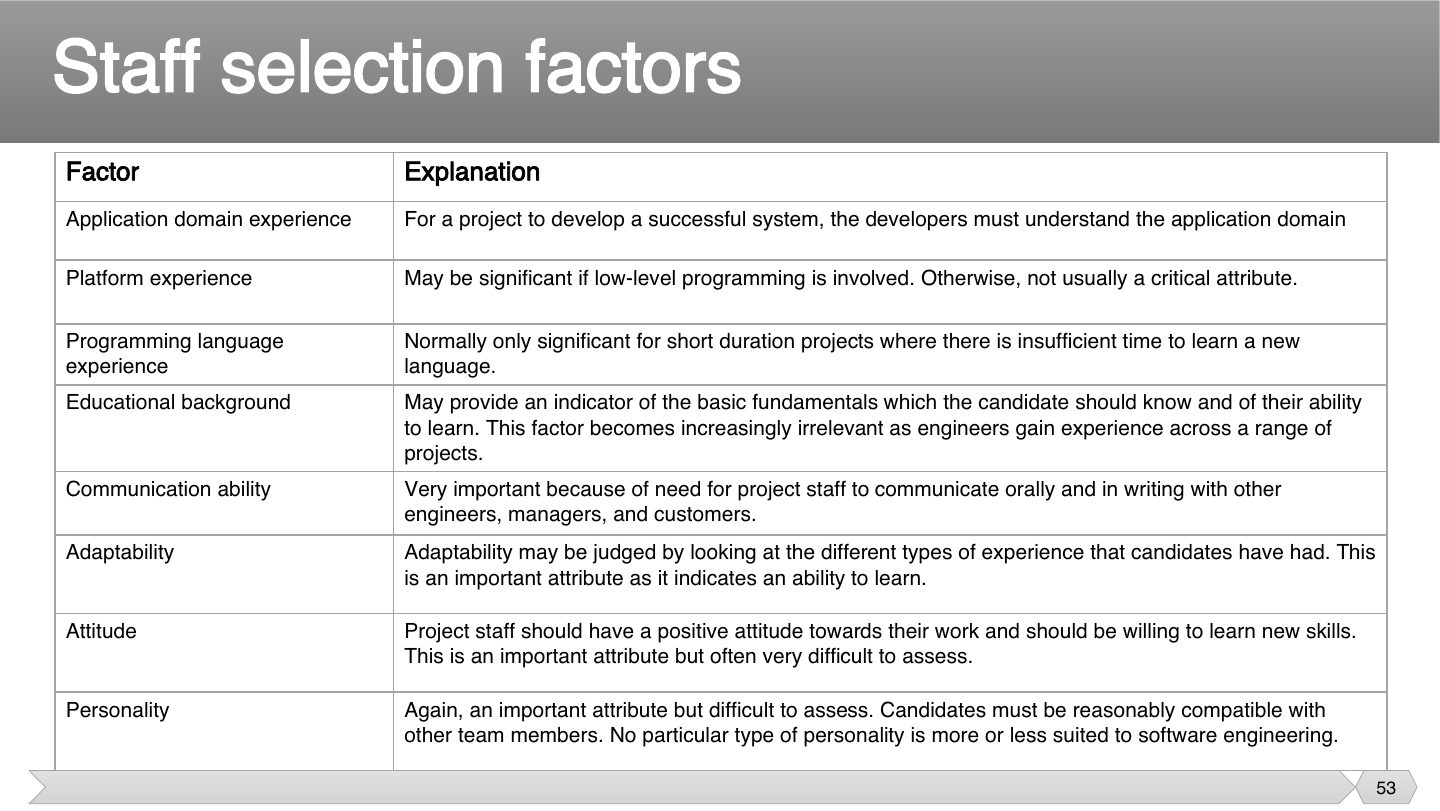
  2. Good programmers pick up a new language fairly quickly, so it’s only critical when there’s no time to learn. Platform knowledge counts when you’re working close to the hardware. A common trap: it is not the most critical factor.

  3. A degree tells you what someone has probably been taught, and how well they can learn. As real work builds up, it says less, which is why education counts for less over time.

  4. Software is a people job, and half of it is interaction (slide 44). Technology also changes constantly, so communication and adaptability can outlast any one technical skill.

  5. You can’t measure these from a CV, so they’re hard to judge, but a bad fit can harm a whole team. There’s no ideal “programmer personality”; what matters is whether they fit this team.

Tips & tricks

  • Sentence, in slide order: All Programmers Prefer Easy Code And Awesome Pizza. Application domain, Platform, Programming language, Educational background, Communication ability, Adaptability, Attitude, Personality.

Exam angle

PredictionQ1

According to the table, programming language experience is significant mainly when:

Slide 54 / 77

Working environments

Slide 54: Working environments

Notes

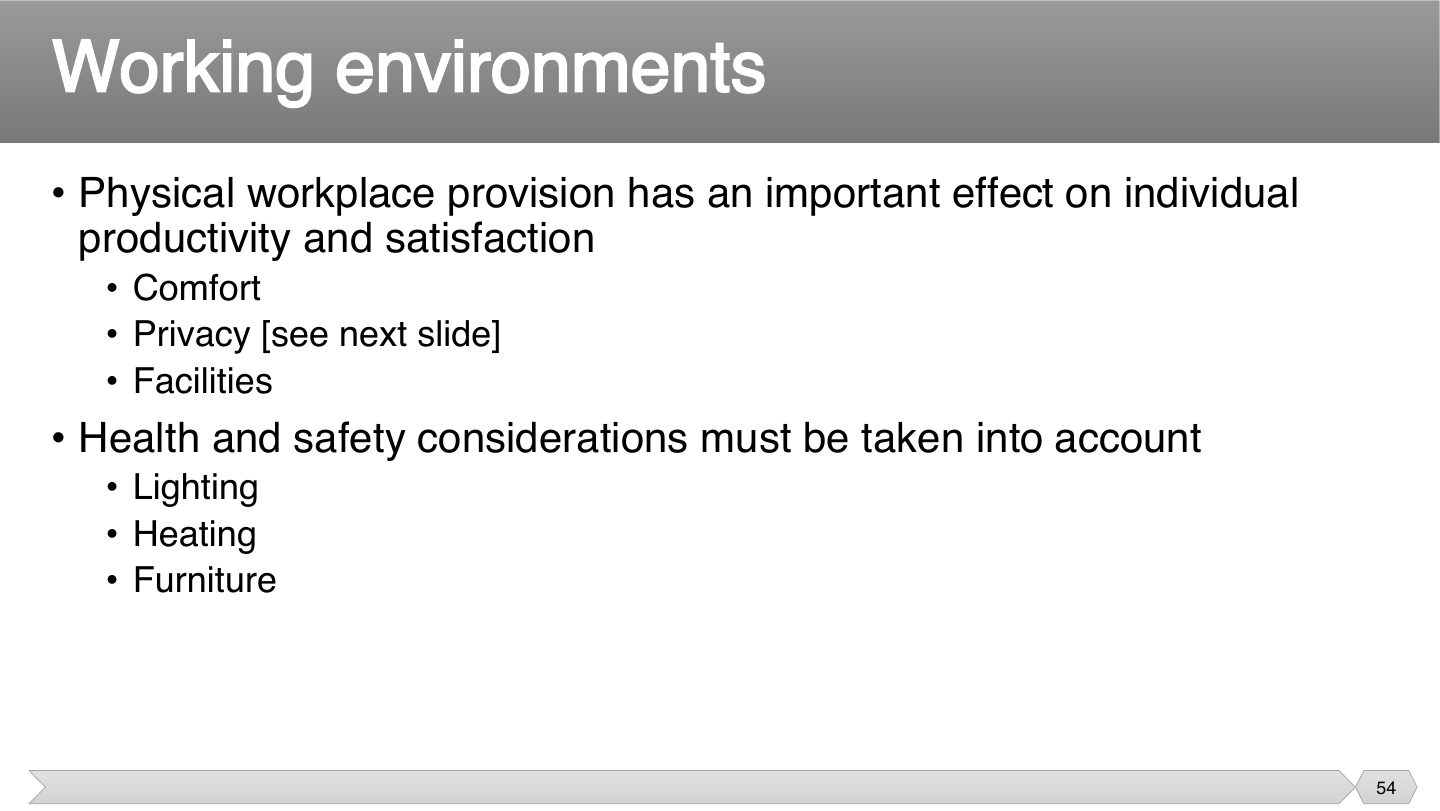
  1. People who are too hot, or who can’t see properly, work worse and get tired faster. So the workplace is a real productivity lever, and cheap compared with salaries.

  2. These aren’t luxuries, since people concentrate better when they’re comfortable and undisturbed. Privacy is singled out because of how much focused work depends on it.

  3. This one isn’t optional, because it’s about people’s wellbeing and is often a legal duty. Health and safety covers the basic conditions a workplace must meet.

Tips & tricks

  • PaCiFy: Privacy, Comfort, Facilities.

Exam angle

PredictionQ1

Which are health and safety considerations in the workplace?

Slide 55 / 77

Environmental factors

Slide 55: Environmental factors

Notes

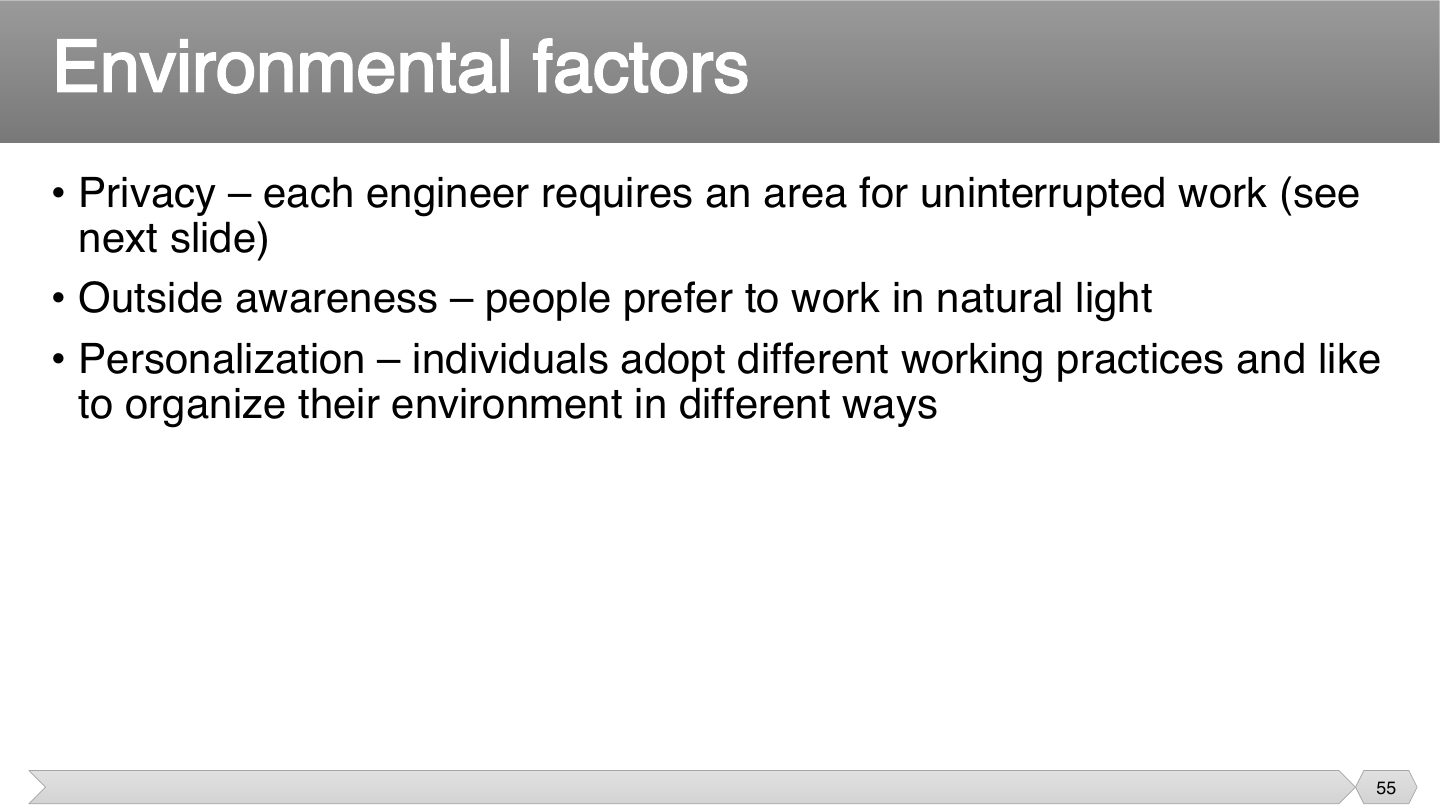
  1. Privacy: each engineer needs an area for uninterrupted work, because deep work is destroyed by interruptions.

  2. Windowless rooms affect mood over time. It seems a small thing, yet natural light comes up often in research on satisfaction at work, and it costs little to consider.

  3. Allowing people to arrange their own space and way of working tells them they’re trusted. Personalization helps them feel at home and work the way that suits them.

Tips & tricks

  • POP: Privacy, Outside awareness, Personalization.

Exam angle

PredictionQ1

Which factor is about letting people arrange their environment their own way?

Slide 56 / 77

Workspace organization

Slide 56: Workspace organization

Notes

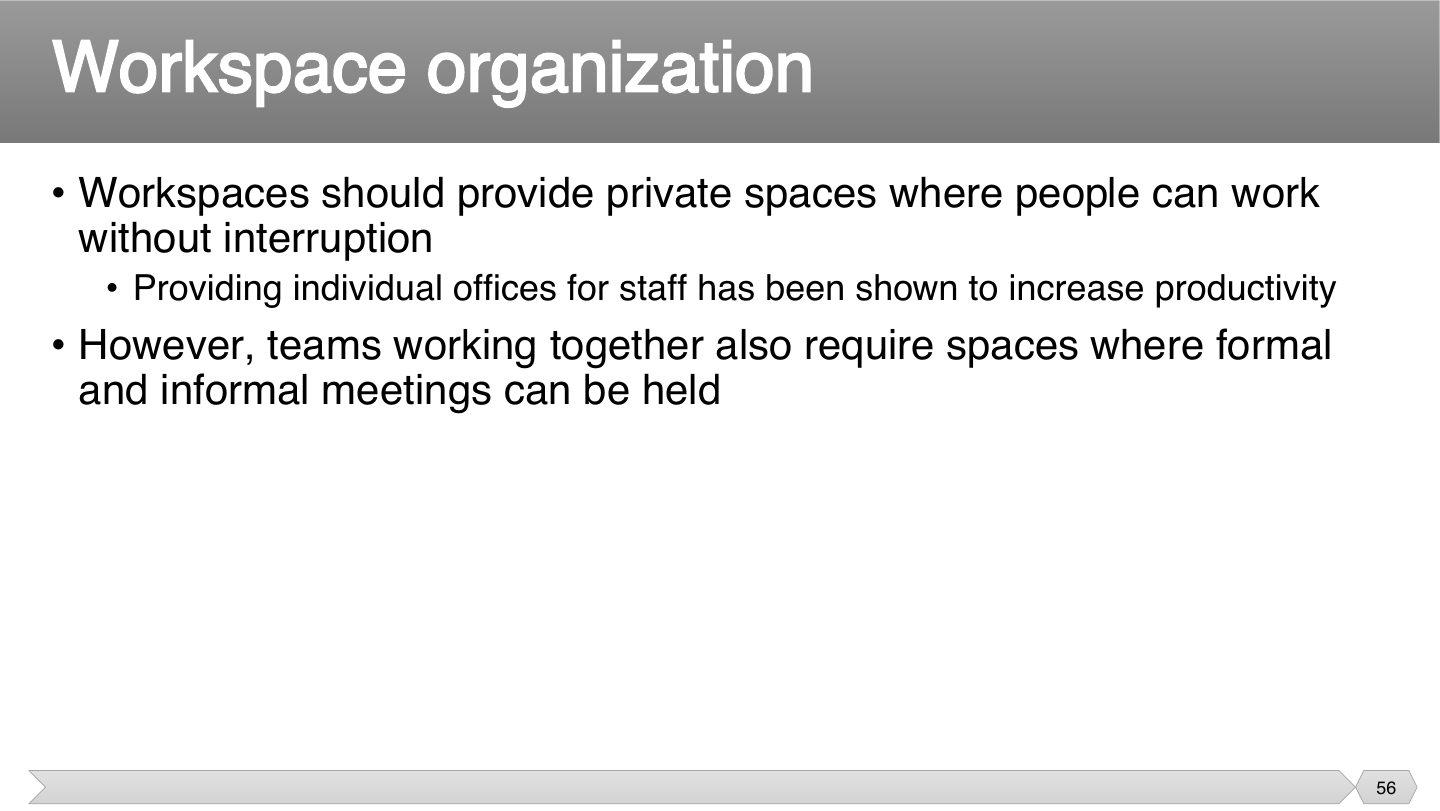
  1. Each interruption costs more than the interruption itself, since it takes time to get back into a hard problem. That’s why individual offices raise productivity, even with their cost.

  2. But teams also need shared spaces for formal and informal meetings. Balance focus and collaboration.

Exam angle

PredictionQ1

Which is true of workspaces?

Slide 57 / 77

Our perspective about the team members

Slide 57: Our perspective about the team members

Notes

  1. Words shape how we think. Calling people “resources” puts them in the same category as desks and servers, which comes from the economic origin of the term.

  2. If you see people as parts, you assume one programmer can simply replace another, and that’s rarely true. Treating them as interchangeable also makes them feel disposable, so the good ones leave.

  3. Treating people as partners changes how you act: you ask instead of telling, and develop people instead of using them up. Psychological safety then lets them speak up, which protects the project.

Exam angle

PredictionQ1

What problem comes from the phrase “human resources”?

PredictionQ2

How should a PM view team members instead?

Slide 58 / 77

The project manager’s skills

Slide 58: The project manager’s skills

Notes

  1. Think of these as different jobs: interpersonal skills are how you deal with one person, and shaping culture is how you influence how the whole team behaves…

  2. …managing is about getting today’s work done, while making people better is about what they’ll be able to do next year…

  3. …and leadership ties these together, by giving the team a direction they want to follow.

Tips & tricks

  • SLiMMIng: Shaping project culture, Leadership, Managing people, Making people better, Interpersonal skills.

Exam angle

PredictionQ1

Which is NOT one of the PM’s five people-skill areas?

Slide 59 / 77

Interpersonal skills

Slide 59: Interpersonal skills

Notes

  1. Too little and people work on outdated information; too much and they stop reading. Effective communication means a known way of sharing, so everyone gets what they need, on time.

  2. A PM often needs help from people who don’t report to them. They can’t order it, so influencing the organization depends on credibility built earlier.

  3. Exam trap: someone with no title can lead and a manager can fail to. Leadership is about whether people choose to follow you toward a goal, which has little to do with authority.

Exam angle

Past exam · Final 251 · Q3.1Q1

In what ways do proficient communication abilities contribute to the management of project risks and the attainment of project success? Illustrate with an instance of how a breakdown in communication could affect a project, and propose methods for prevention or resolution.

Compare with the model answer

Good communication surfaces risks and issues early, while they are cheap to handle; keeps requirements and expectations shared across the team and stakeholders; and supports fast, informed decisions. Example: the backend team changes an API without telling the frontend team, integration fails at the end of the sprint, causing rework and a missed release. Prevention: a communication plan with defined channels (stand-ups, change notifications, API contracts), timely updates to everyone affected, and an escalation path; resolution: a joint meeting to agree the interface and re-plan.

Slide 60 / 77

Interpersonal skills (2)

Slide 60: Interpersonal skills (2)

Notes

  1. Money works up to a point, but it fades quickly and can’t make a job interesting. The surprising point is that financial incentives are among the weakest motivators, so try recognition, growth and meaningful work first.

  2. Differences may only be perceived, so listening can dissolve them. A PM rarely has the power to simply impose an outcome, so negotiation is an everyday tool, not a rare event.

  3. Most project problems are poorly defined at first. So the first skill is working out what’s really wrong, and then progressive elaboration means solving complex problems in steps rather than all at once.

Tips & tricks

  • Slides 59 and 60 together, IMPLEmeNt: Influencing, Motivation, Problem solving, Leadership, Effective communication, Negotiation.

Exam angle

PredictionQ1

Studies show financial incentives are among the most effective motivators for project teams.

Slide 61 / 77

Shaping project culture

Slide 61: Shaping project culture

Notes

  1. You can’t build a culture that fights the wider company for long. So learn how your organizational culture treats projects first, and shape your team’s habits within those limits.

  2. Some companies have impressive process documents that nobody follows. Knowing whether real practice matches the “fanciful” version tells you which rules you actually need to work with.

  3. Someone’s education and past experience shape how they work and what they’ll accept. A person’s background can tell you what kind of role they’d do well in, so you need to know your people.

  4. People tend to play a natural part in a team, whatever their job title. Knowing each person’s cultural role lets you give them work that suits it, which the next slide explains.

Exam angle

PredictionQ1

Why must a PM first understand the organization’s culture?

PredictionQ2

What does “fanciful” project management refer to?

Slide 62 / 77

Shaping project culture

Slide 62: Shaping project culture

Notes

  1. These describe how people behave in a team, not their job title. A tester may be the team’s expert or its charger, and a healthy team needs a mix…

  2. …and the complainer/naysayer, who habitually voices negative or skeptical views but raises concerns and challenges assumptions, often the first to spot a risk.

  3. Don’t confuse these with the cultural roles: these are assigned jobs. The team leader looks after people, and the development leader looks after the product, and on a small team one person may do both.

  4. It’s easy to label a critic as a problem, but they may be the only one seeing a risk. Being non-judgmental means asking what each role can contribute, rather than trying to change who they are.

Tips & tricks

  • Cultural roles, in slide order: Lazy Lions Catch Every Cow. Leader, Listener or talker, Complainer, Expert, Charger or plodder.

Exam angle

PredictionQ1

Someone often points out what might go wrong. How should the PM treat this person?

PredictionQ2

Which of these is a project role rather than a cultural role?

Slide 63 / 77

Project environments (context: project culture)

Slide 63: Project environments (context: project culture)

Notes

  1. A young PM may struggle where age earns respect, regardless of the org chart. So authority doesn’t only come from a title, and your authority in one culture may not carry over to another.

  2. What’s normal in one country may be illegal in another, and a change of government can change the rules. So on international projects, local laws and customs are real planning inputs.

  3. If half the team sleeps while the other half works, every question can take a full day to answer. These mundane details can quietly cause much of the delay on a global project.

Exam angle

PredictionQ1

A young PM is struggling where age earns authority. Which factor does this show?

PredictionQ2

Half a team is asleep when the other half works. Which kind of factor is this?

Slide 64 / 77

Shaping project culture

Slide 64: Shaping project culture

Notes

  1. Culture problems can kill a project just as a technical flaw can, and yet nobody tracks them. Treat team culture as you would technical issues: look for it, discuss it and fix it.

  2. People who are unsure of their role either overlap or leave gaps. Clear roles stop that, and telling someone you value their style helps them accept the role.

  3. People work better when they know the rules for hard moments. The slide’s example shows it: equal in normal times, and one decider in a crisis. Stating your view of the team up front avoids a fight later.

  4. It’s far easier to deal with one person dominating early than after others have stopped talking. So recognize the warning signs, and act before they harm the team.

Exam angle

PredictionQ1

A PM says: “We’re all equals, but in a crisis I decide.” What’s this an example of?

Slide 65 / 77

Project Culture

Slide 65: Project Culture

Notes

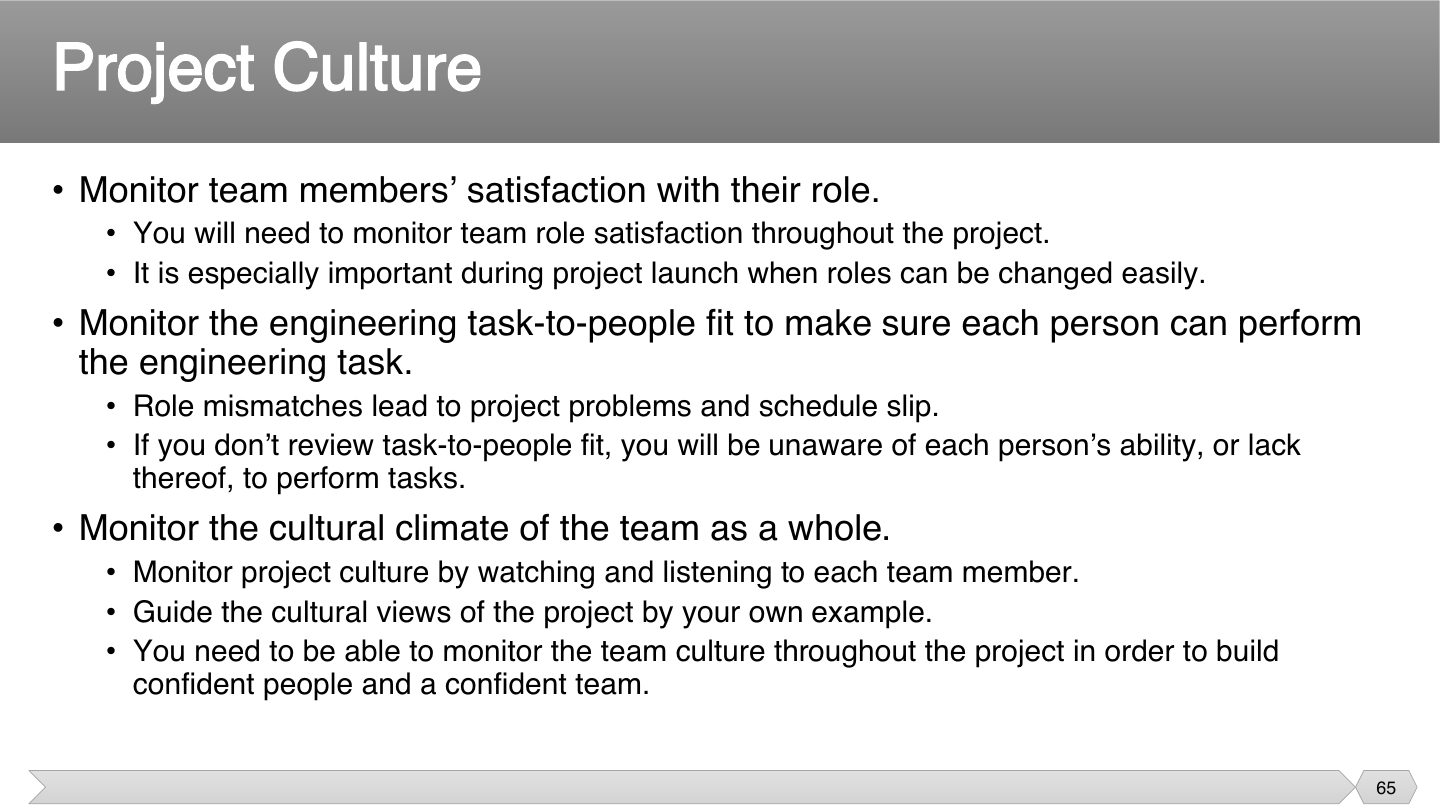
  1. A role that seems fine on day one may turn out badly, and people rarely volunteer that they’re unhappy. Keep asking about satisfaction, especially during launch, when a change costs almost nothing.

  2. Don’t assume a job title means someone can do the task. A role mismatch shows up late as missed dates, and checking early is much cheaper than finding out after the schedule has slipped.

  3. You won’t find team mood in a report. Watch how people talk in meetings. Your behavior sets the tone too, so the cultural climate responds to your own example.

Exam angle

PredictionQ1

When is it easiest to change someone’s role?

PredictionQ2

What can a role mismatch lead to?

Slide 66 / 77

Managing People

Slide 66: Managing People

Notes

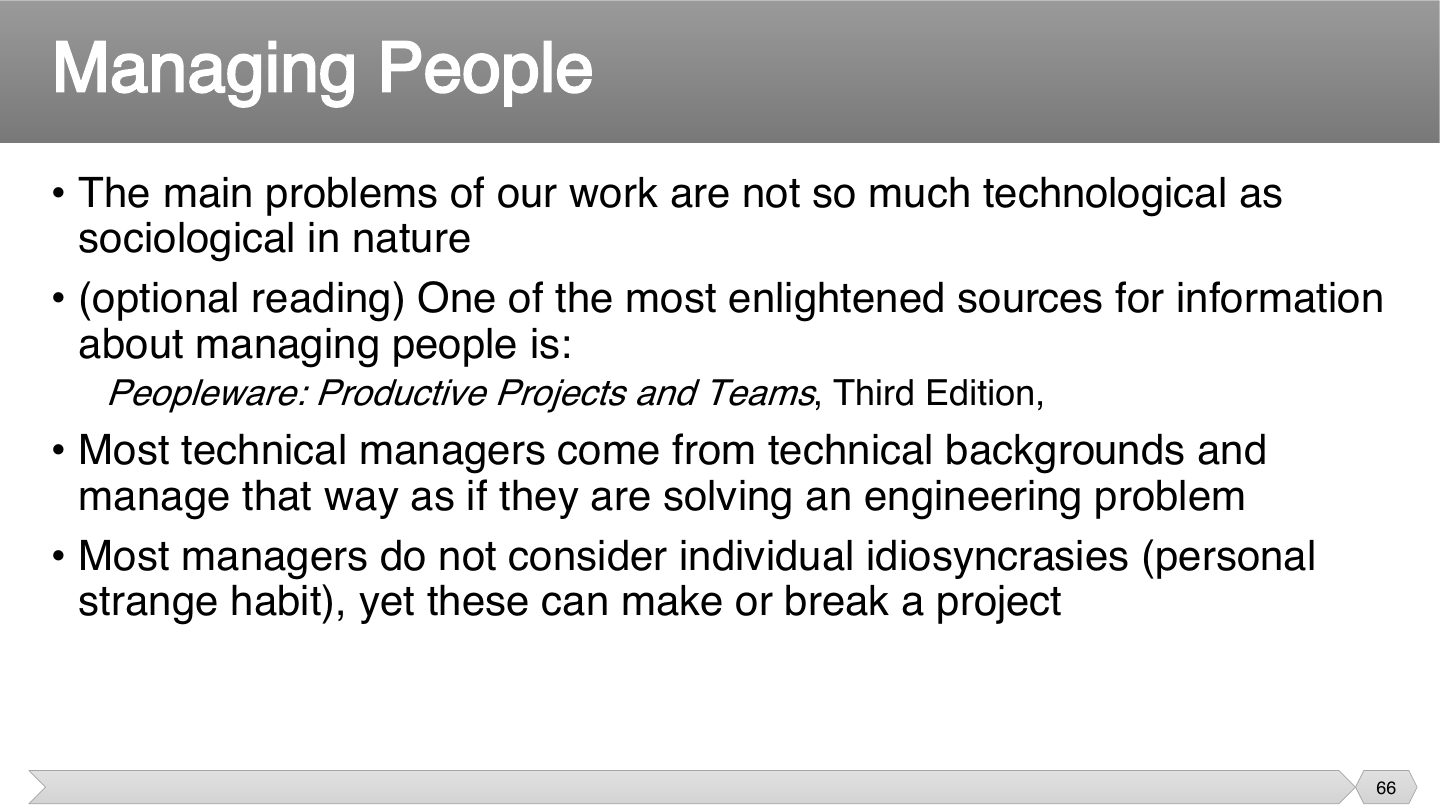
  1. A project rarely fails because the technology was impossible. It’s more often poor communication or a team that doesn’t work together, and that’s what sociological means here.

  2. Peopleware (DeMarco and Lister) is the recommended optional reading on managing people.

  3. Promoted engineers tend to treat people as a puzzle with a correct answer. But people aren’t logical systems, so one person’s idiosyncrasies, like needing quiet, can decide whether they do great work.

Exam angle

PredictionQ1

According to the slide, what are the main problems in our work?

Slide 67 / 77

Managing People

Slide 67: Managing People

Notes

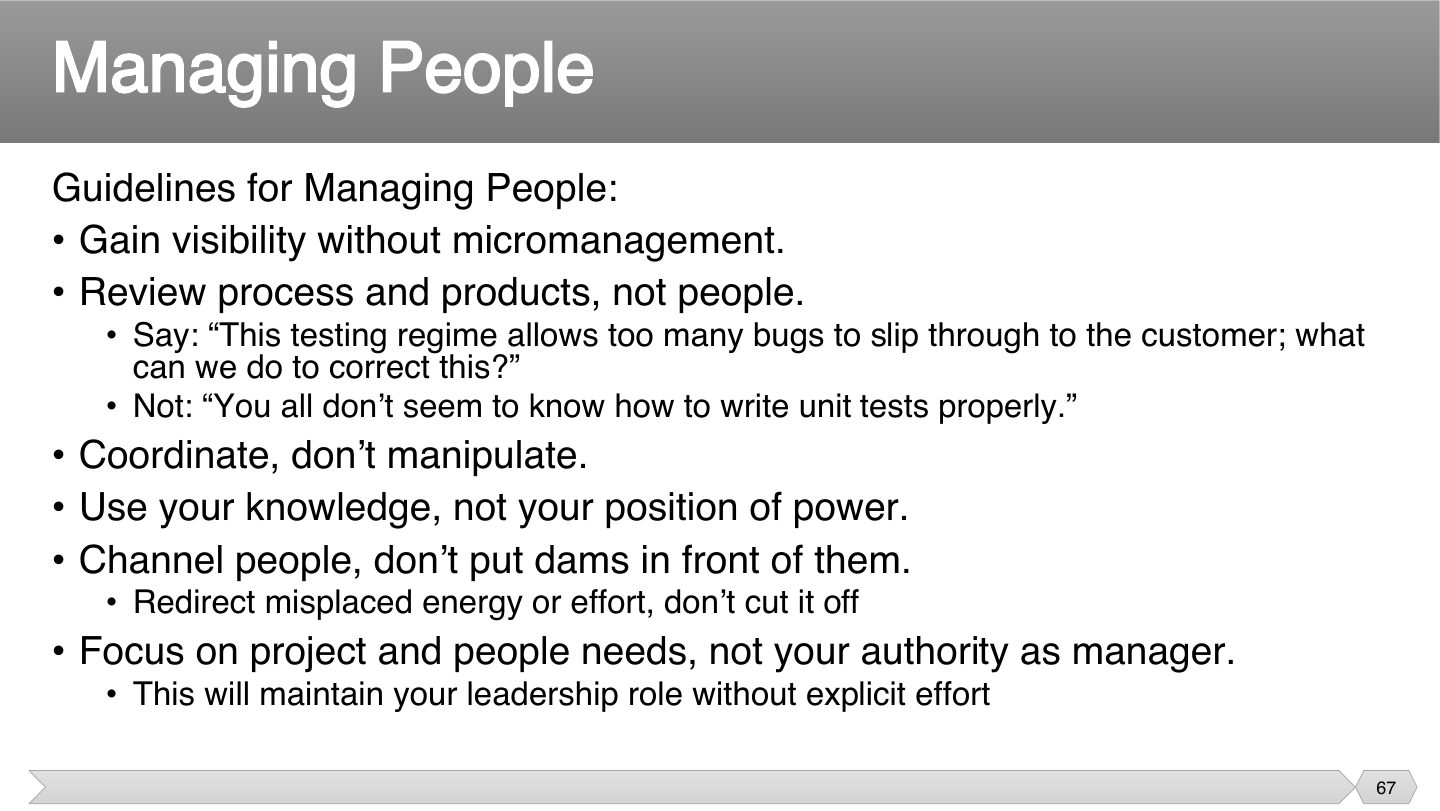
  1. Gain visibility without micromanagement: know the status through boards and reviews, not by watching over shoulders.

  2. Criticizing someone’s ability makes them defensive, and they stop listening. Discussing the process puts everyone on the same side against the problem, as the slide’s two sentences show.

  3. Tricking or pressuring people may work once, but it destroys trust. Coordinate by explaining why, and if someone’s effort is going to the wrong place, redirect it rather than discouraging them altogether.

  4. People notice when you’re protecting your position rather than helping. When your attention is on what the project and team need, they respect you without being told to. That’s why you focus on needs.

Exam angle

PredictionQ1

Which statement follows the guideline “review process and products, not people”?

Slide 68 / 77

production line efficiency

Slide 68: production line efficiency

Notes

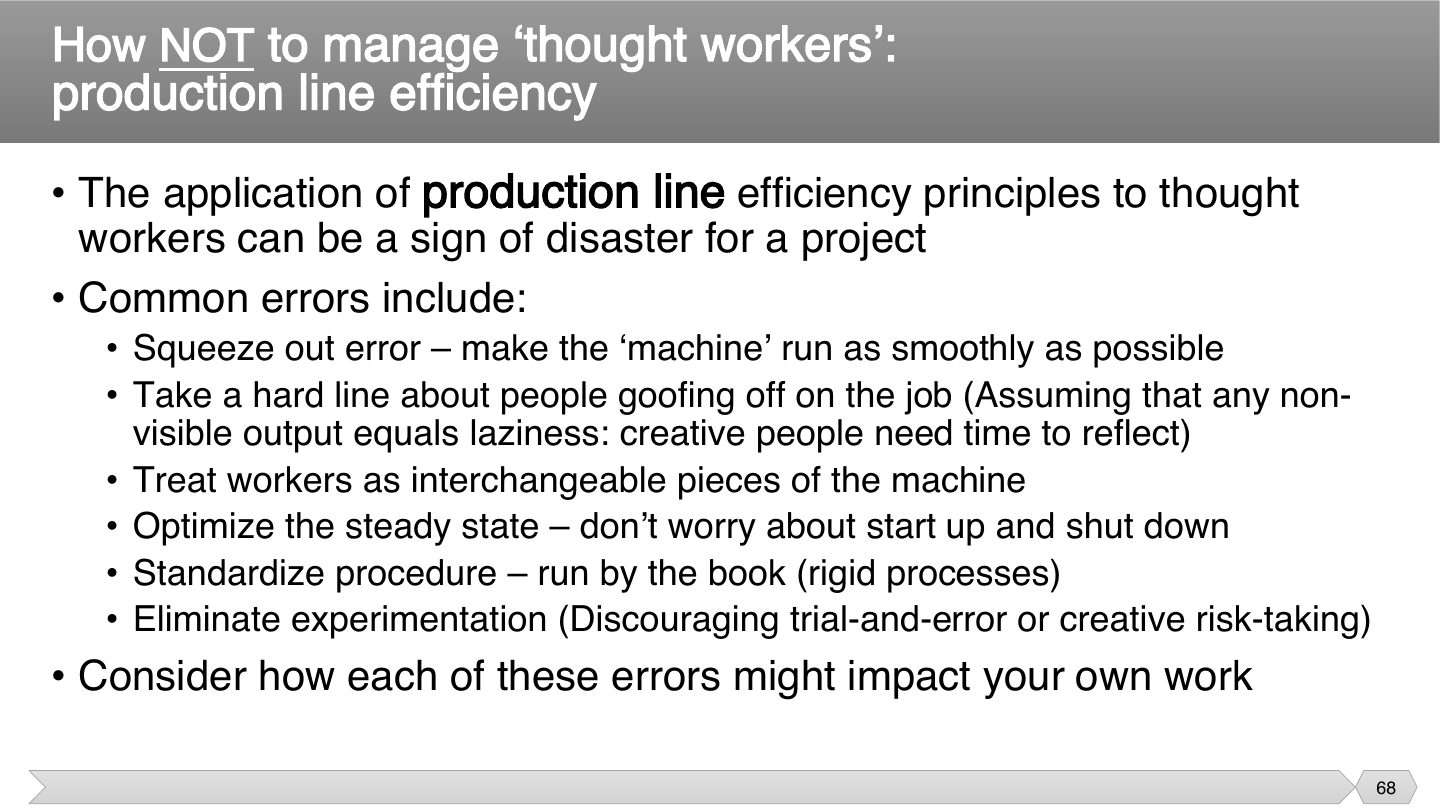
  1. Factory methods assume that identical work gets repeated. Software is different each time, so applying production-line thinking to it causes the errors listed below.

  2. On a line, an error is a defect, while in design it’s often how you learn. Someone staring out a window may be solving your hardest problem, so treating that as goofing off drives out your best thinking.

  3. A new person takes months to reach full speed, so people aren’t interchangeable like machine parts. Plans that assume a smooth steady state ignore the expensive start and end of work.

  4. Strict rules suit repeated tasks, but software keeps meeting new problems. If trying something new isn’t allowed, you won’t find better ways, so eliminating experimentation is harmful.

Exam angle

PredictionQ1

A manager treats a developer thinking at their desk as “goofing off”. What’s the error?

PredictionQ2

Why is treating workers as interchangeable an error?

Slide 69 / 77

Making People Better

Slide 69: Making People Better

Notes

  1. It’s usually the first thing dropped under pressure, unless it’s a stated goal. Treating professional development like any other goal means time and money get set aside for it.

  2. You need both. Short-term learning helps this project now, while long-term learning keeps people growing, and it’s a large part of why good staff stay.

  3. People work harder at goals they chose. A competency framework just gives them a useful list to pick from, so that “improve” turns into something specific.

  4. Most people don’t know where their time really goes, and the results often surprise them. It only helps if it’s safe, so stress that this is for their own awareness, not for monitoring.

Exam angle

PredictionQ1

A team tracks its time in detail for a few weeks. What is the purpose?

PredictionQ2

A short-term development goal focuses on:

Slide 70 / 77

Making People Better

Slide 70: Making People Better

Notes

  1. A weekly timesheet is too rough to teach you anything. Tracking daily gives a developer real evidence, such as how long testing actually takes compared with what they guessed.

  2. With your own numbers, your next estimate gets better, and you stop promising what you can’t deliver. That’s how the PSP helps developers make commitments they can meet.

Exam angle

PredictionQ1

What is one thing the PSP shows developers how to do?

Slide 71 / 77

Leadership

Slide 71: Leadership

Notes

  1. Having a title doesn’t get a group to solve hard problems. Mobilize is the key word: people have to want to take it on, so it’s wrong to equate leadership with authority.

  2. If the problem has a known fix, the team just needs someone who knows it. Technical leadership is direct and efficient, and asking “what do you all think?” would just waste time.

  3. If nobody knows the answer, a leader giving orders is only guessing. Adaptive leadership helps the group learn its way there, and good questions do more than instructions.

  4. When people are exploring, it’s easy to drift. A clarity of purpose gives everyone a reason to keep going without a clear path, and lets the leader pull a discussion back.

Exam angle

PredictionQ1

A novel problem has no known solution. Which leadership is needed?

PredictionQ2

Leadership is mainly a matter of having authority.

Slide 72 / 77

Technical vs. adaptive leadership

Slide 72: Technical vs. adaptive leadership

Notes

  1. Ask first: does anyone know how to solve this? The answer decides which approach fits, and using the wrong one either wastes time or gives false confidence.

  2. Technical says “here’s what I see for us”, and it works because they know the way. Adaptive doesn’t have that map, so it uses a sense of purpose: why it’s worth working through.

  3. Tool for motivation: technical relies on personality: charisma, expertise, confidence, decisiveness. Adaptive relies on progress: learning, iteration and visible movement toward clarity. In short: technical = “follow me, I know”; adaptive = “let’s figure it out together.”

Exam angle

Past exam · Midterm 251 · V1 · Short Q5 (also V2 Short Q5)Q1

How can a project manager balance technical leadership with adaptive leadership in a software team?

Compare with the model answer

First diagnose the problem: can it be solved by known means? When it can (a coding standard, a deployment the team has done before), use technical leadership: give direction from expertise and vision, or delegate it to someone who can lead it. When it can’t (new technology, unclear requirements), use adaptive leadership: frame the purpose, lead with questions, let the team experiment and learn, and motivate through visible progress. Most IT projects mix both, so the PM switches between the two as the situation changes, delegating the known parts and focusing on the unknown ones.

Slide 73 / 77

Technical vs. adaptive leadership

Slide 73: Technical vs. adaptive leadership

Notes

  1. Neither style is always better, so diagnose first. Fixing a known bug doesn’t need a discussion, and a brand-new product can’t be directed by a checklist. Known means is the deciding question.

  2. One project contains both: routine deployment work and a new algorithm nobody’s tried. So a PM has to switch between them, which is why a mix matters.

  3. A leader doesn’t need to handle everything personally. Delegation lets the person who knows the answer lead that part, which frees the leader to work on the problems nobody has solved.

Exam angle

PredictionQ1

An adaptive leader should personally solve all known technical problems.

Slide 74 / 77

Working toward consensus

Slide 74: Working toward consensus

Notes

  1. Exam trap: consensus doesn’t require full agreement. People can accept a decision they’d have made differently if they feel they had a fair hearing. That’s why it’s about being heard.

  2. On a five-person team, a 3–2 vote leaves two people who may quietly stop trying, and you need all five. That’s why majority rule can do harm, even though it seems fair.

  3. Everyone being heard doesn’t mean every argument is good. The leader should strengthen the good points and gently remove the bad ones, because they must curate what the decision rests on.

Exam angle

Past exam · Final 251 · Q5.1Q1

Share an experience from a software project you were involved in where collaboration among team members significantly contributed to its success. Describe the specific strategies or techniques you employed to foster collaboration.

Compare with the model answer

Any honest experience earns marks if it names concrete techniques. For example: in a course project building a booking app, we split the work by feature with clear owners, met twice a week for short stand-ups, tracked tasks on a shared board, used pull requests so every change was reviewed by a teammate, and paired up on the hardest integration work. Decisions were discussed until everyone had been heard, so we committed to them even when we disagreed.

Slide 75 / 77

Working toward consensus

Slide 75: Working toward consensus

Notes

  1. Don’t start with solutions: agree on the problem first, and collect options before anybody defends one. The order is what keeps the discussion from turning into a contest.

  2. People who were simply overruled will resist later. Spending time to persuade now costs less than dealing with resistance during delivery, which is why the extra time pays off.

  3. Beware passive-aggressive agreement: people who say yes but don’t act on it. It is just hidden (subsumed) conflict.

Tips & tricks

  • The order matters here: Please Sit Down, We Confirm. Pose the problem, Solicit input, Discuss pros and cons, Work toward the best options, Confirm the choice.

Exam angle

Past exam · Final 251 · Q5.2Q1

You are leading a cross-functional team tasked with selecting a continuous integration/continuous deployment (CI/CD) platform for an upcoming project. The team includes software developers, DevOps engineers, and QA testers, each with distinct expectations regarding automation workflows and pipeline management. Describe your approach to collaboratively choosing the most suitable CI/CD platform.

Compare with the model answer

Run the consensus steps. Pose the decision in a kickoff workshop where developers, DevOps engineers and QA testers each list their needs (build speed, deployment control, test automation). Agree the criteria and their weights together: integration with the repository and tools, automation and test support, pipeline flexibility, scalability, security, cost, ease of use and vendor support. Shortlist options, weigh each against the criteria (a weighted scoring table, or a short proof of concept), converge on the one with the most benefit for the project, then work with those who preferred others so they buy in. Don’t just vote or dictate, and watch for passive-aggressive agreement.

Slide 76 / 77

Leading People

Slide 76: Leading People

Notes

  1. The same habits that build trust are how you lead day to day. If a question mixes these slides, the answer is the same, as this is a reprise.

  2. A nervous leader makes a team nervous. Be confident, without pretending you can do it alone, and you’ll get more from people who feel their talents are being used.

  3. A good relationship helps, but a friend may avoid saying hard things. You must sometimes give tough feedback, and that needs boundaries, even with people you like.

Exam angle

PredictionQ1

Why does a PM need to use all the team’s talents?

Slide 77 / 77

Key points
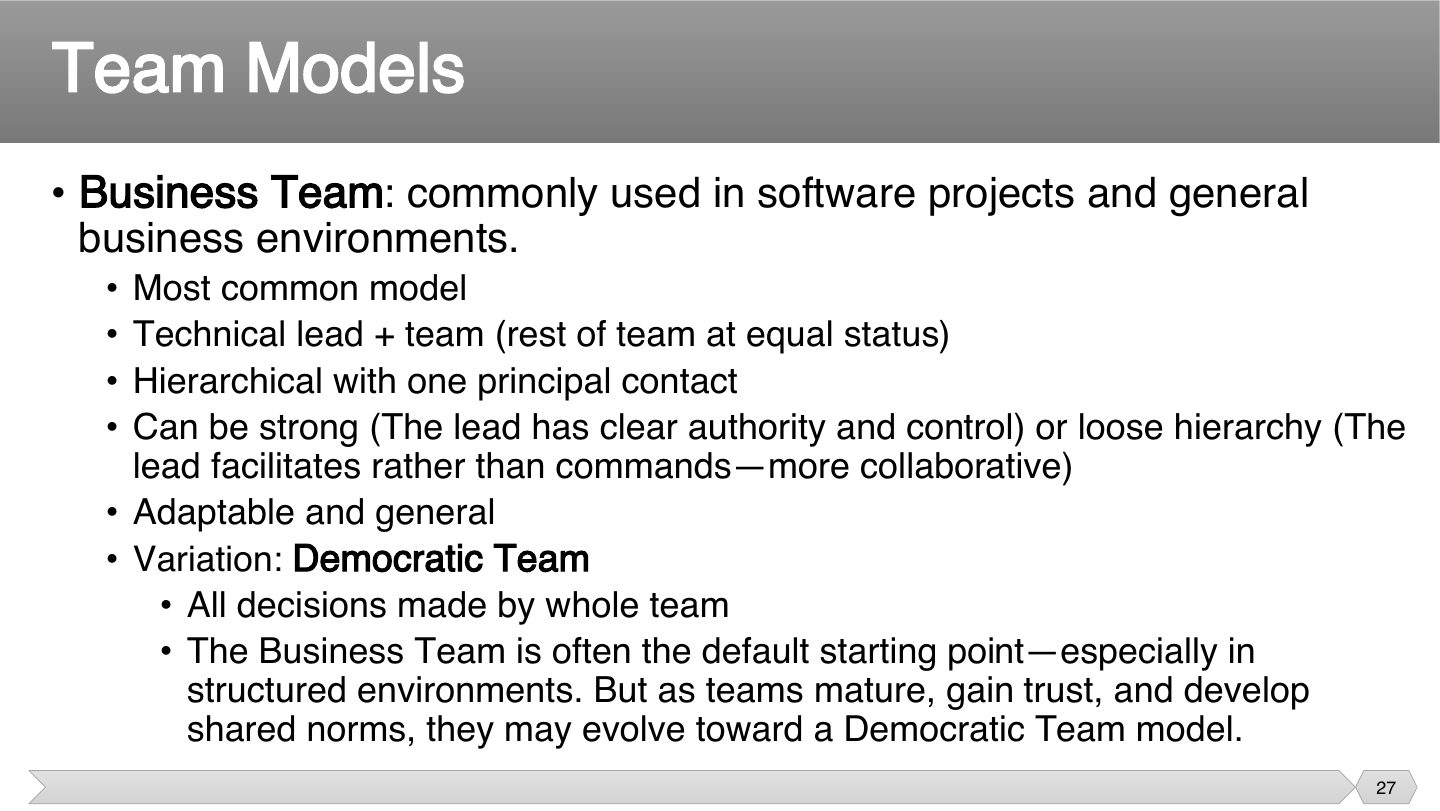
Slide 77: Key points
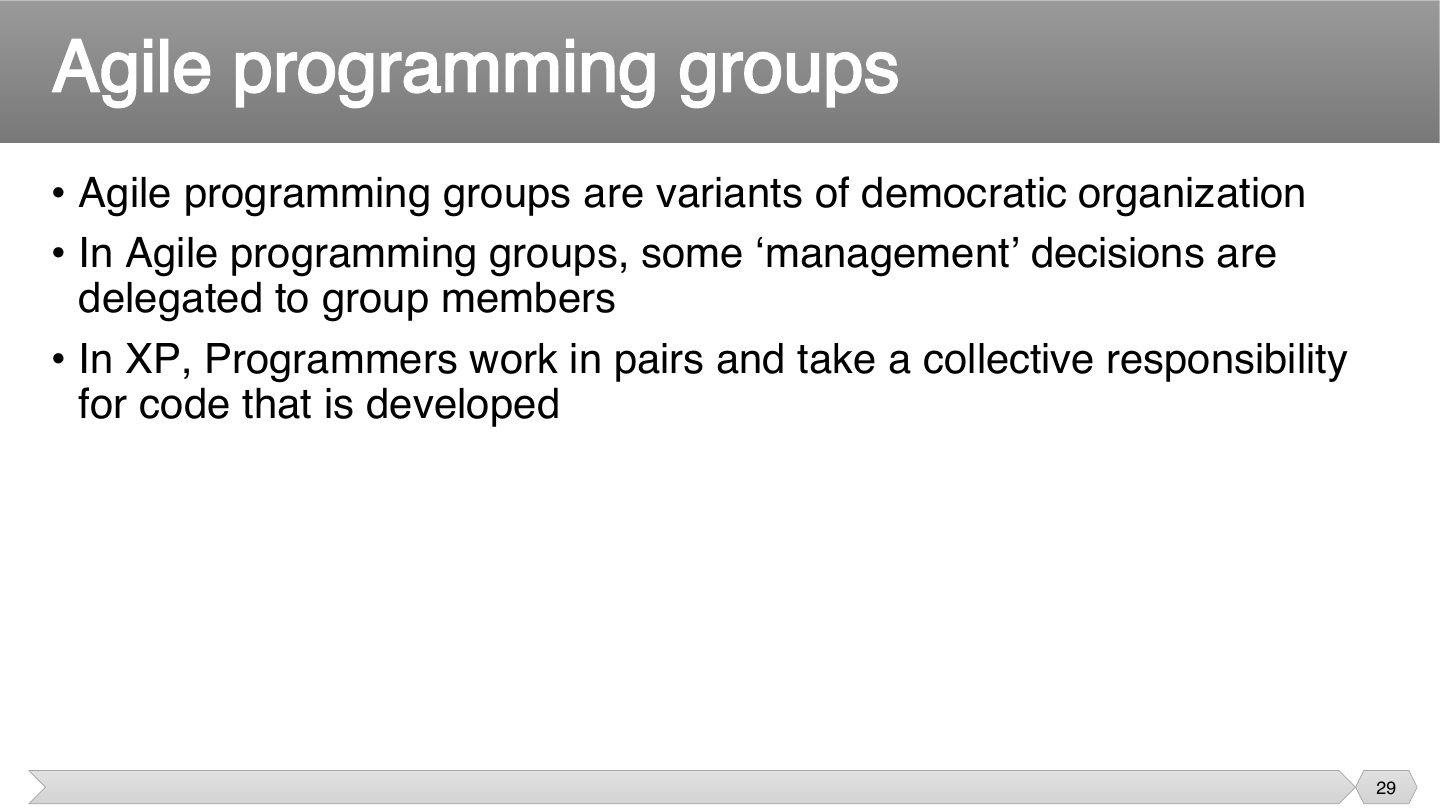
Notes

  1. Asking for what people can’t realistically do leads to burnout and resignations. Knowing the human factors tells you what’s reasonable to demand.

  2. A good exam summary of slide 53. Domain experience and adaptability often count for more than knowing a specific language.

  3. The reason is communication paths: small groups share information easily. Status matters because juniors may stay quiet, even when they’re right.

  4. Don’t wait for a culture problem to show up as a missed deadline. If you monitor early, you can act while it’s still cheap to fix. Your environment also affects output every day.
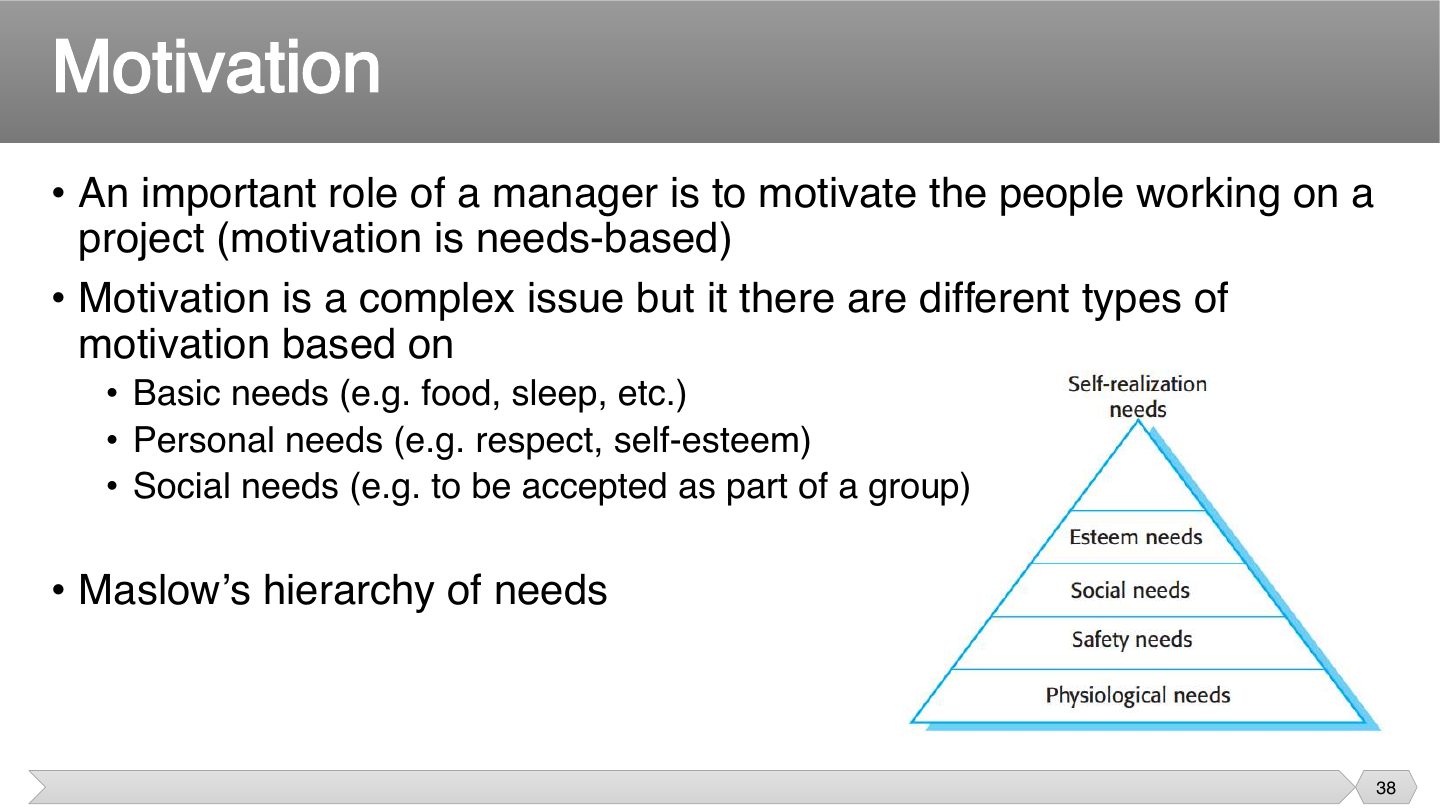
Exam angle

PredictionQ1

Why do managers need to understand human factors?