SE423 · Chapter 1 · Annotated SlidesIntroduction to Software Project Management
PDF
Overview

Introduction to Software Project Management

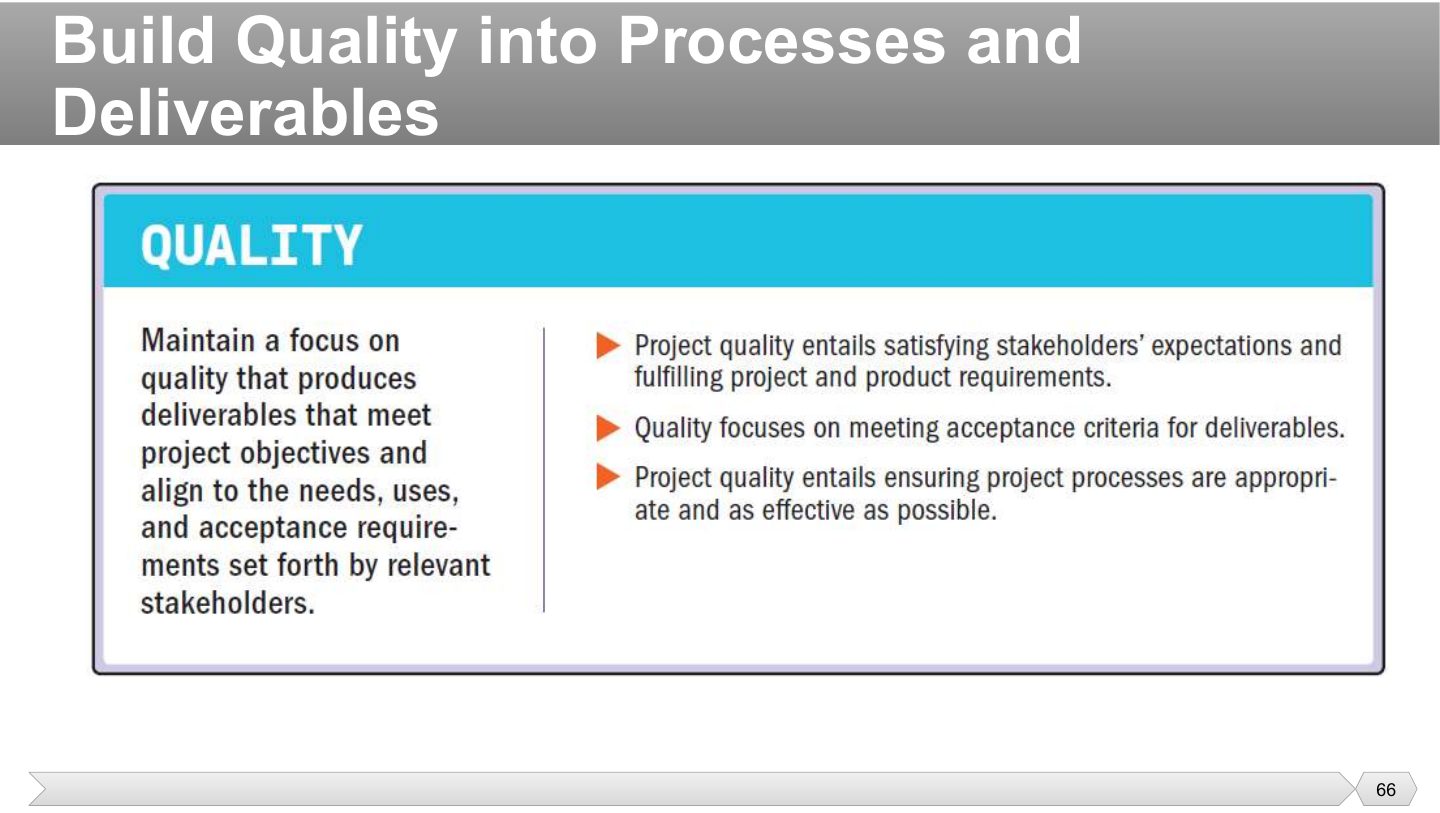
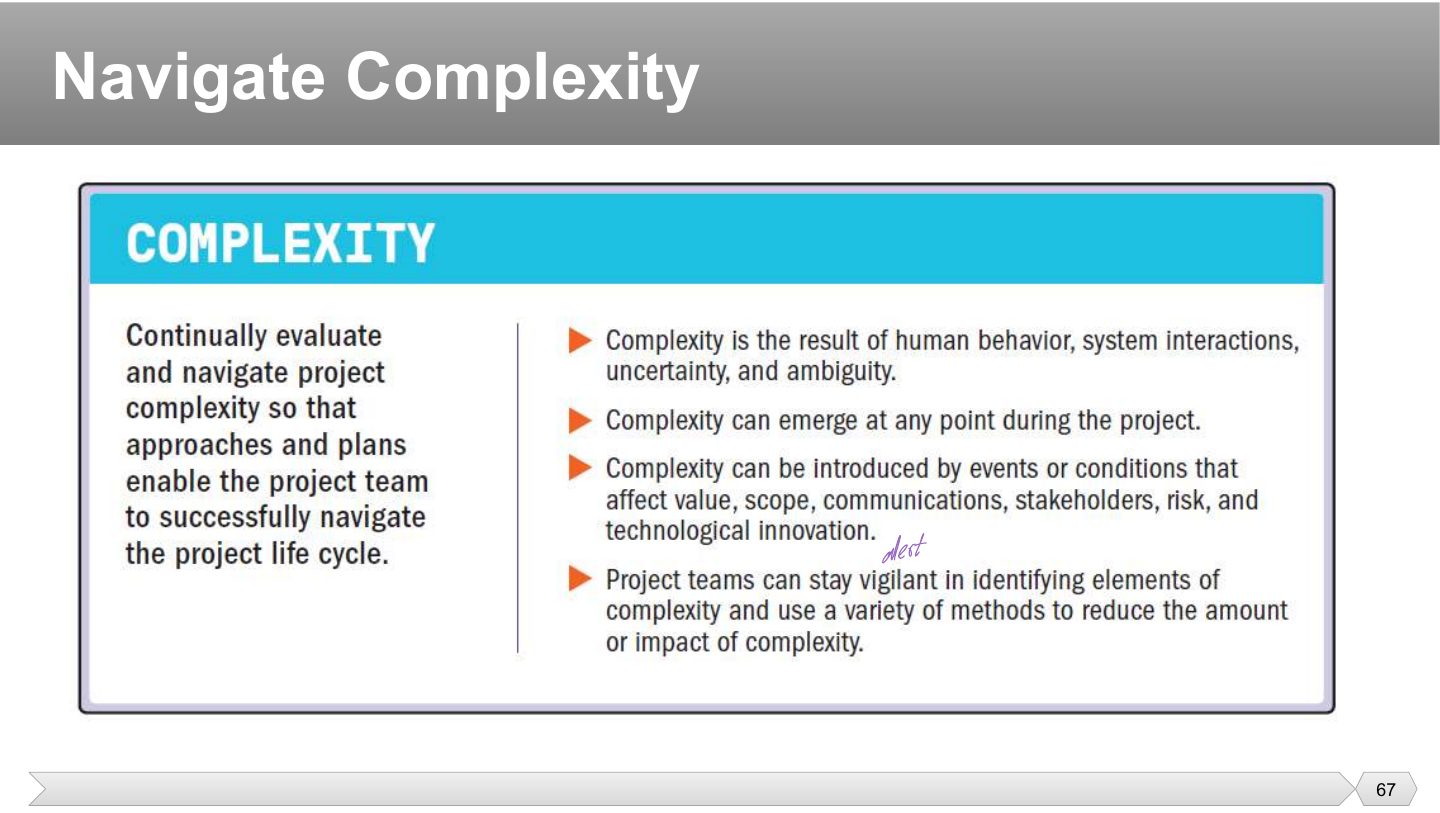
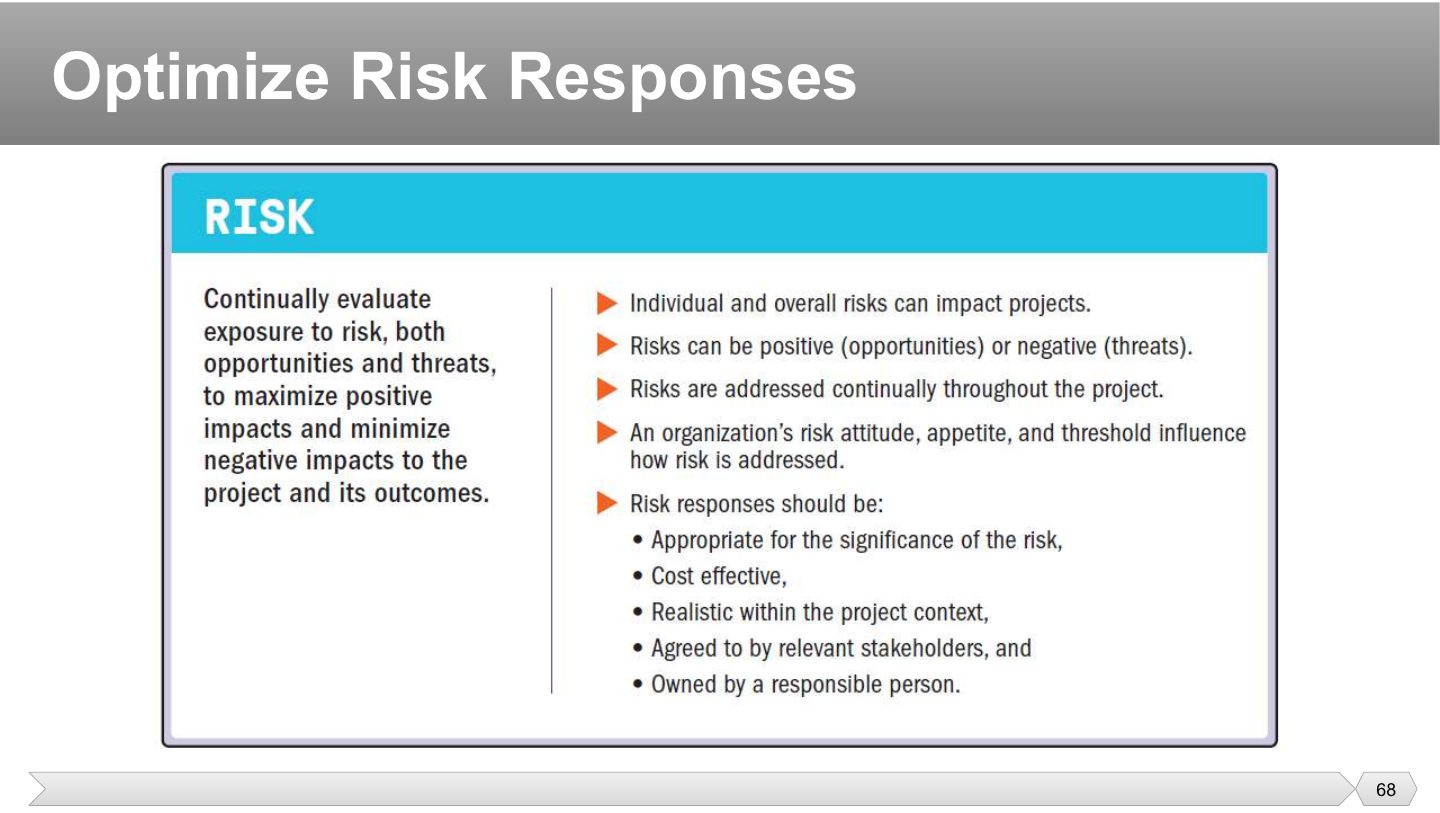
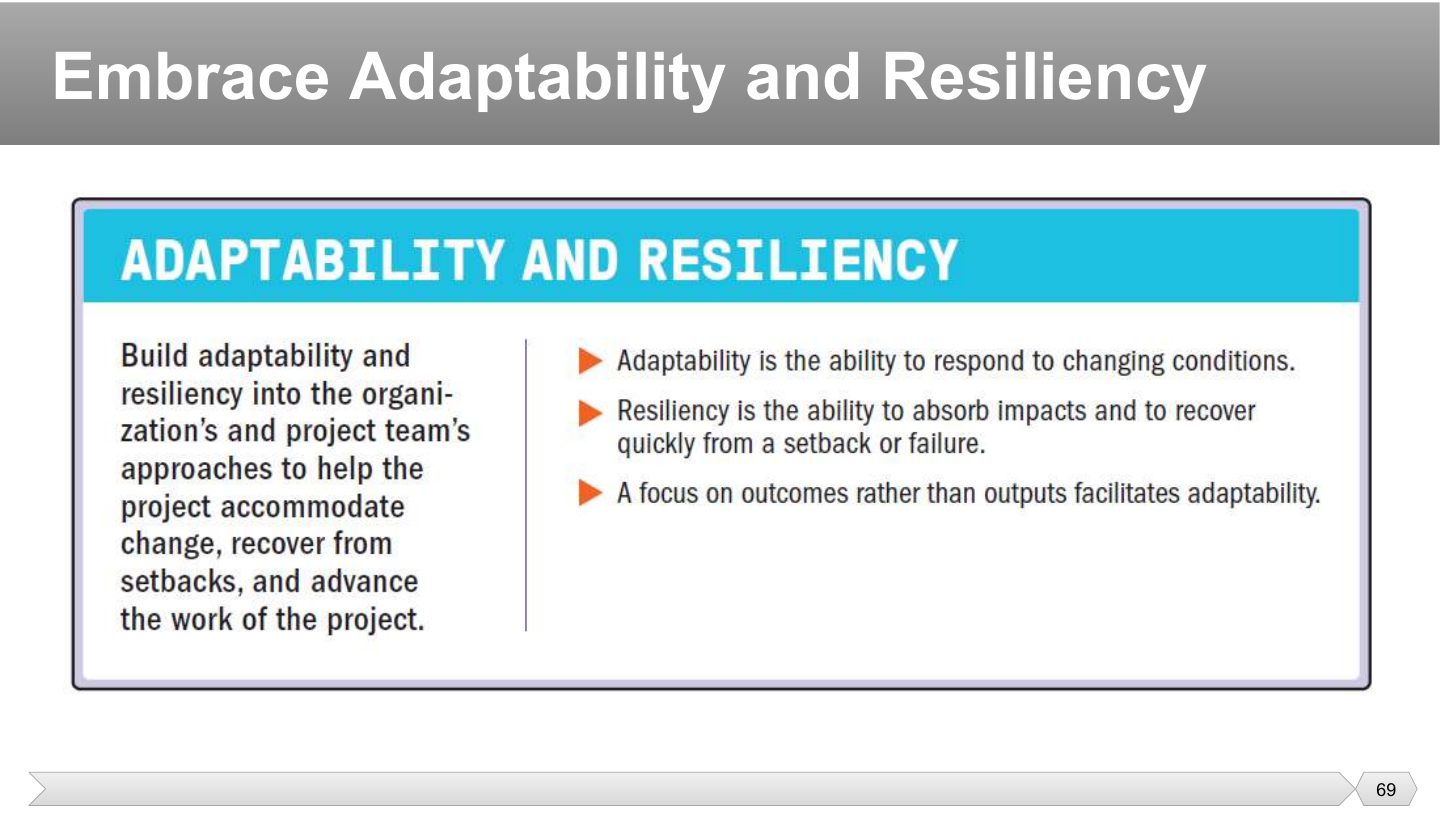
Chapter 1 gives the vocabulary for the whole course. It defines project management, places it in history, describes what a project manager does and needs to be good at, and then works through the PMBOK 7 standard: the 12 principles (how to behave) and 8 performance domains (what to manage), the key terms (portfolio, program, project, product, outcome, value), the system for value delivery with its governance, functions and environment, and how product management relates to projects. The last part gives each principle its own card.

Principles vs. domains

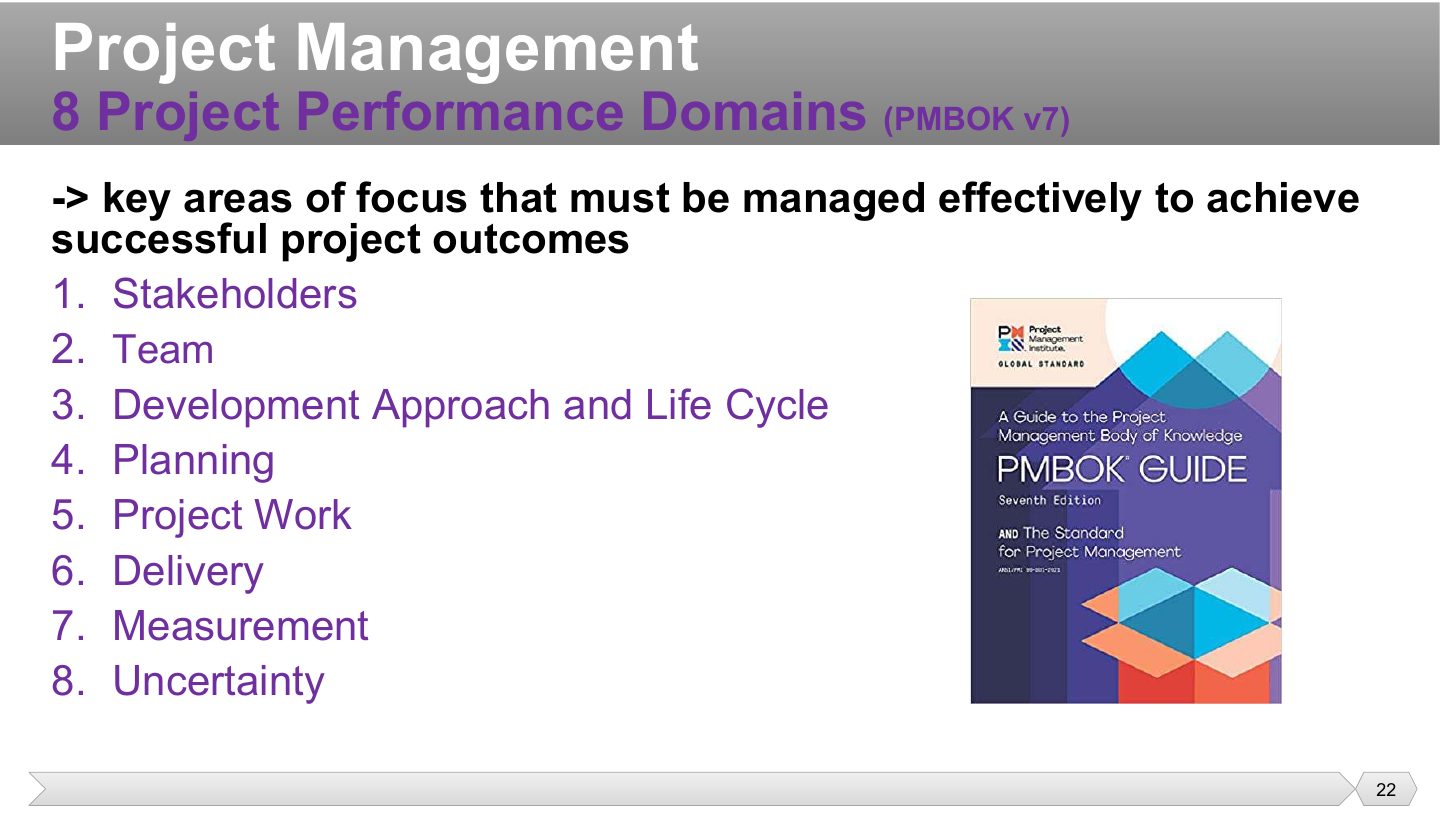
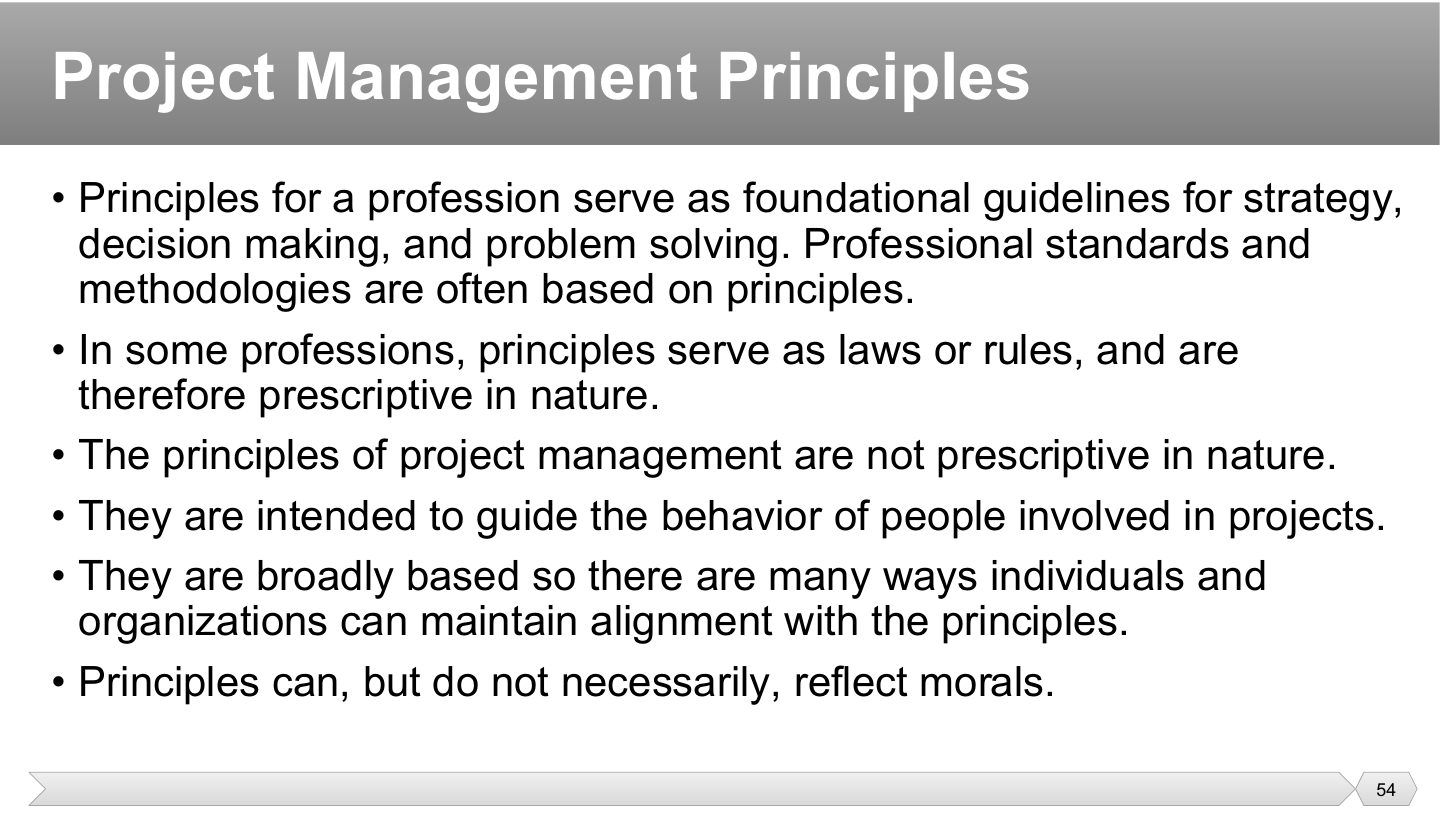
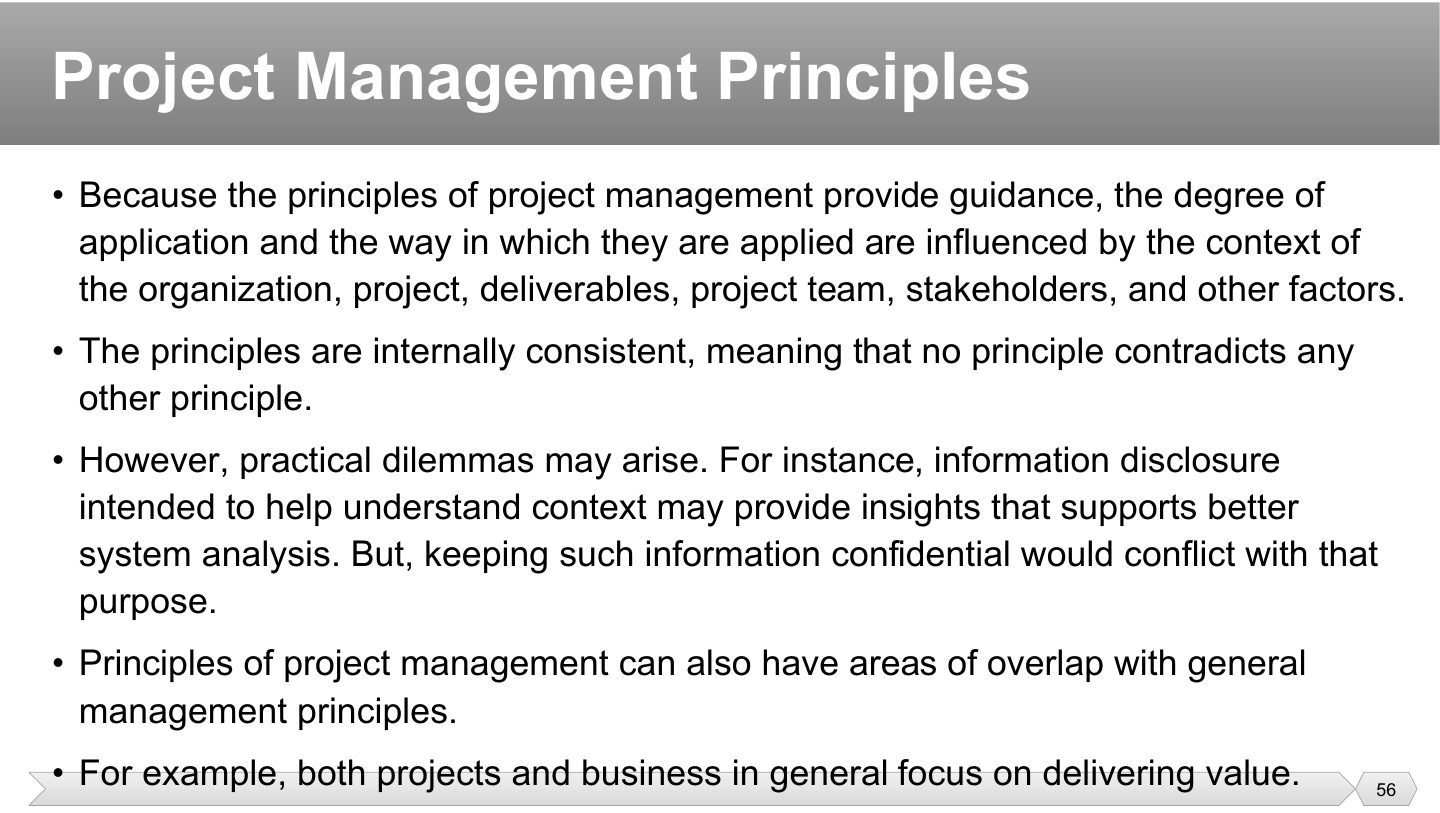
12 principles guide behaviour (stewardship, team, value, systems thinking…); 8 performance domains are areas of focus that run at the same time. Neither is a set of steps.

Portfolio, program, project

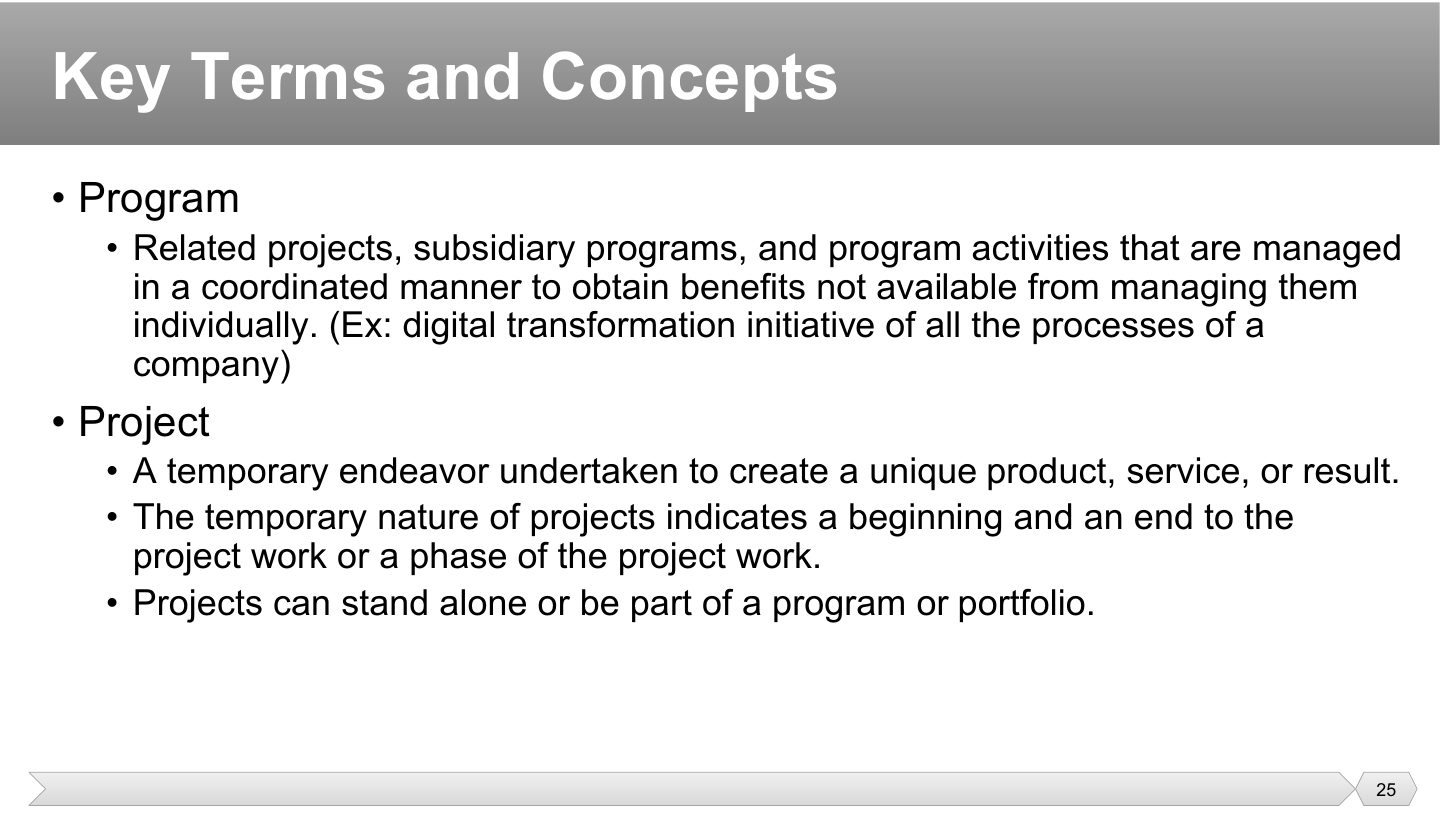
Portfolio = grouped for strategy (may be unrelated, includes operations). Program = related projects for extra benefits. Project = temporary + unique.

Value chain

Components → deliverables → outcomes → benefits → value. Value is the ultimate measure of success.

Coordination

Decentralized: authority spread across a self-organizing team. Centralized: a designated PM leads. Both can be mixed.

How the lecture is organized

  • Slides 1–6What project management is and why it matters
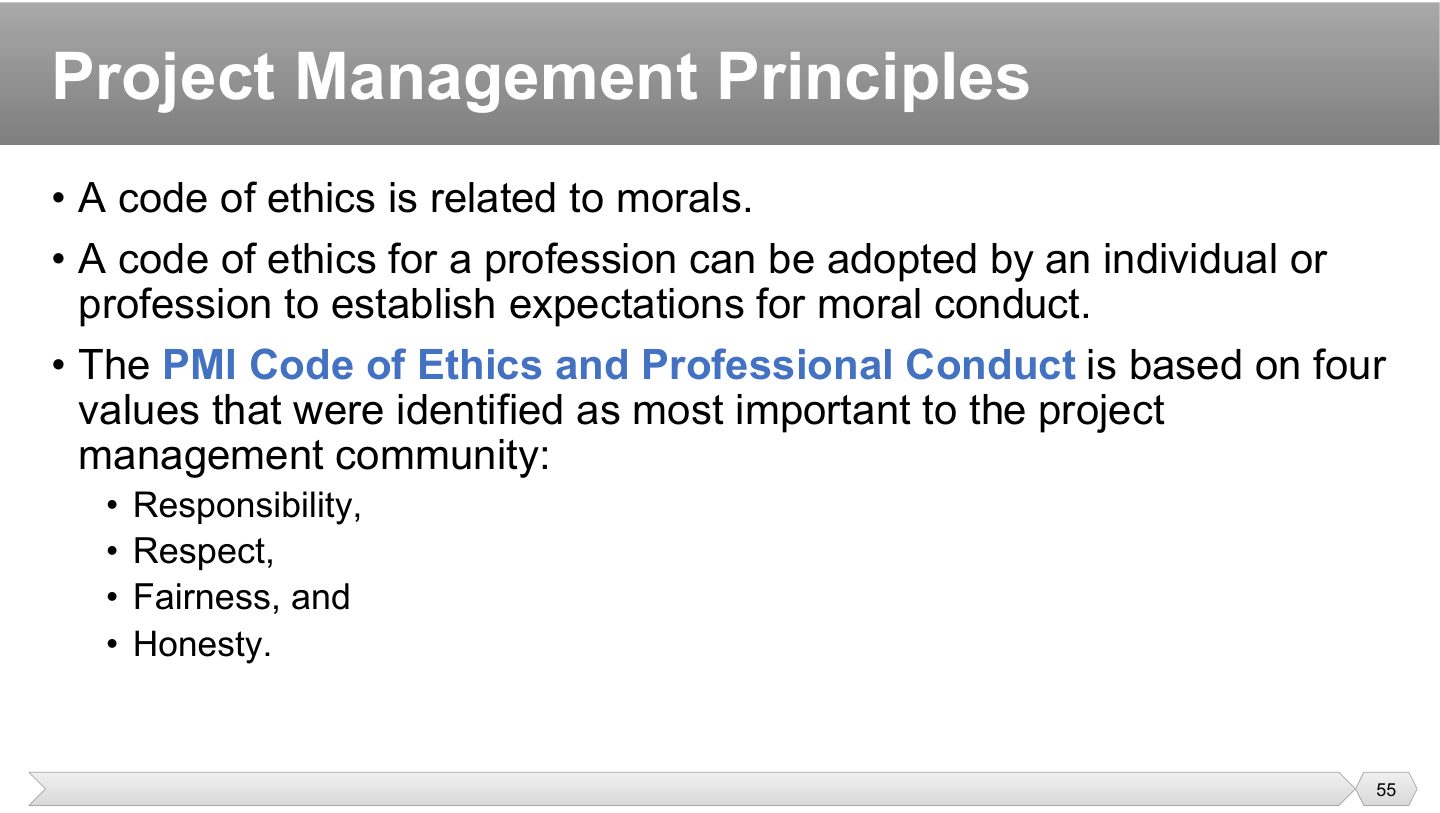
  • Slides 7–13History, PMOs, global issues, certification, ethics
  • Slides 14–18Project managers: responsibilities, skills, competencies, advantages of formal PM
  • Slides 19–28PMBOK: the standard, 12 principles, 8 domains, key terms
  • Slides 29–45The system for value delivery: value, information flow, governance, functions, environment
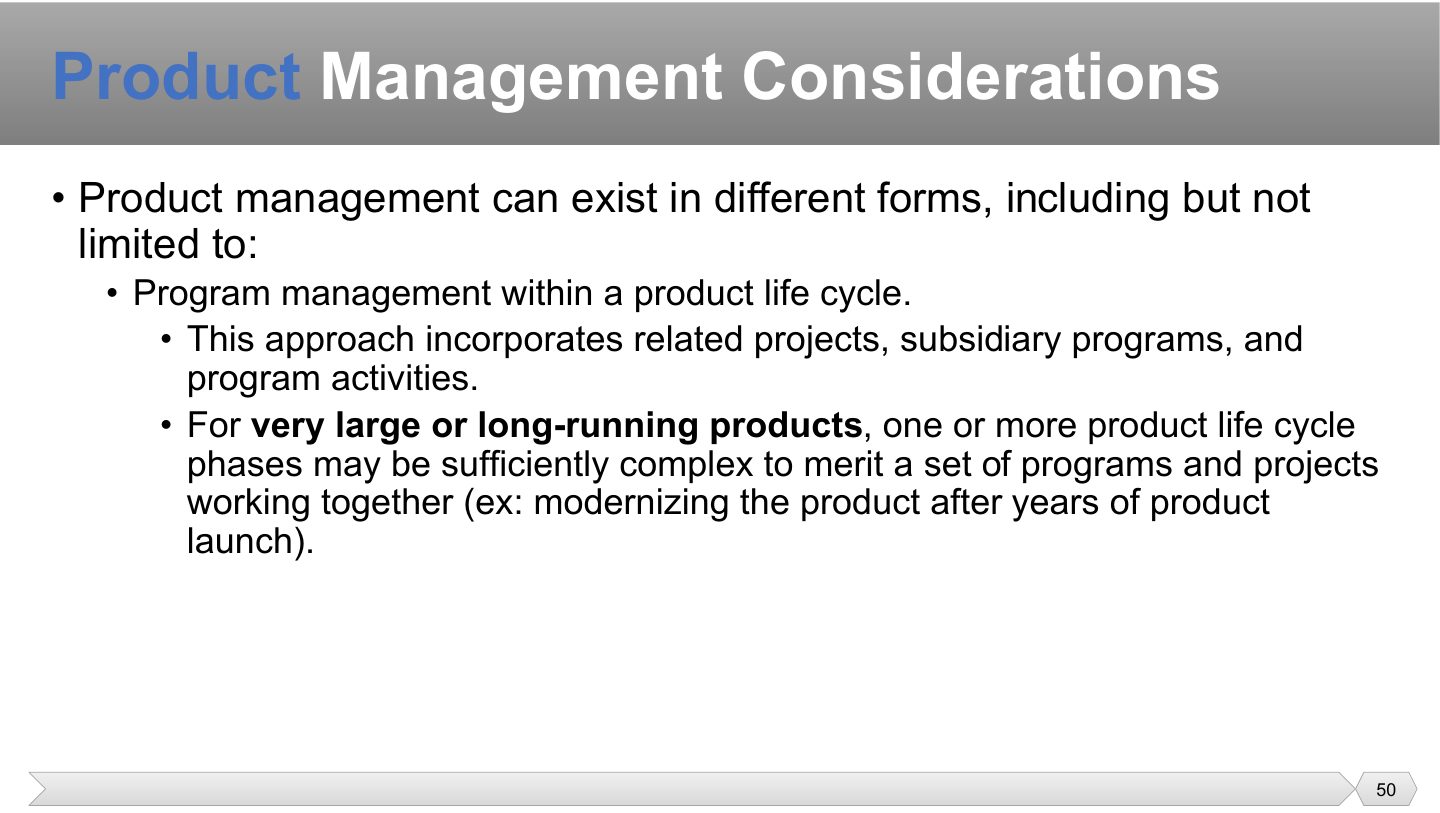
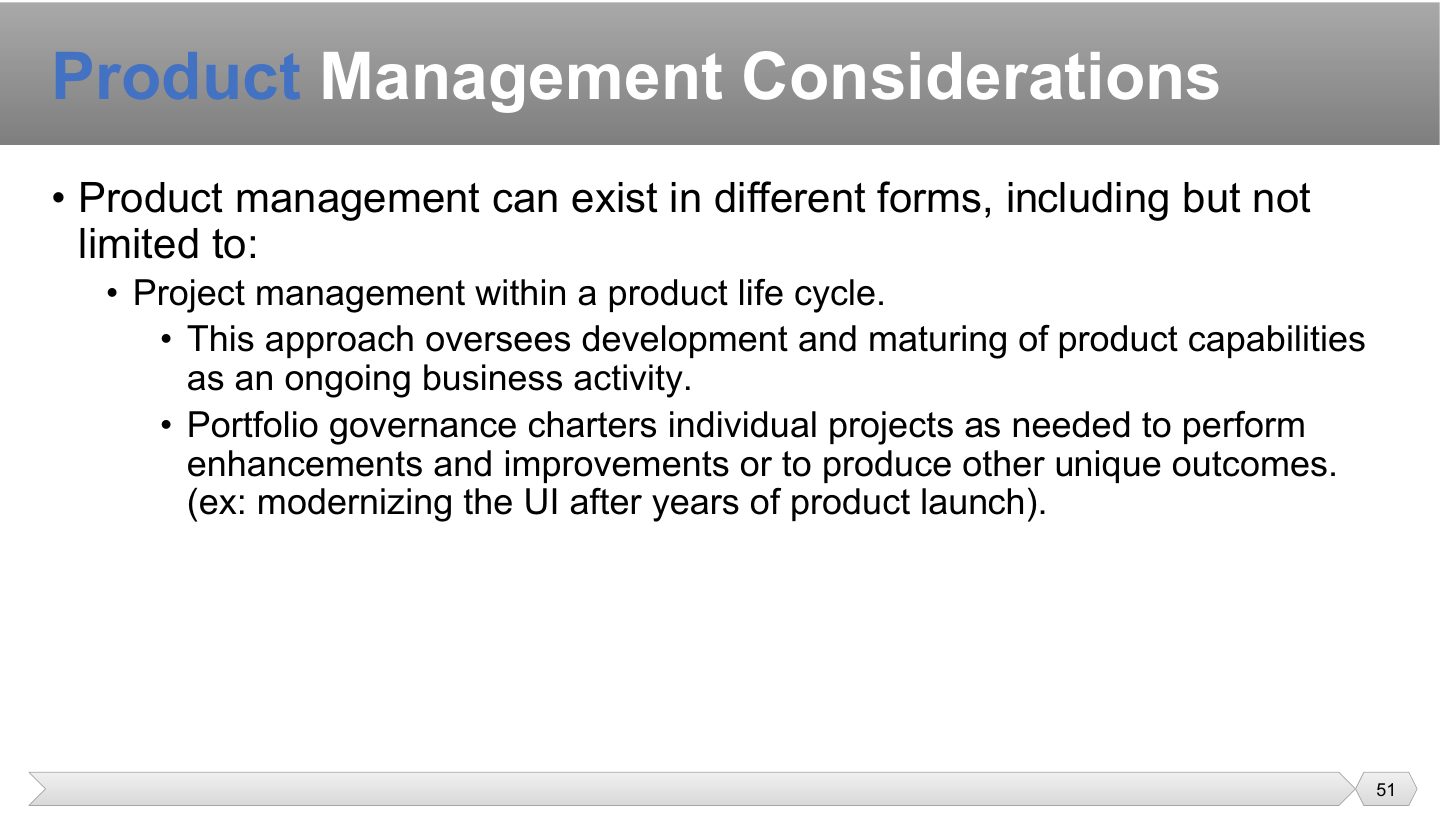
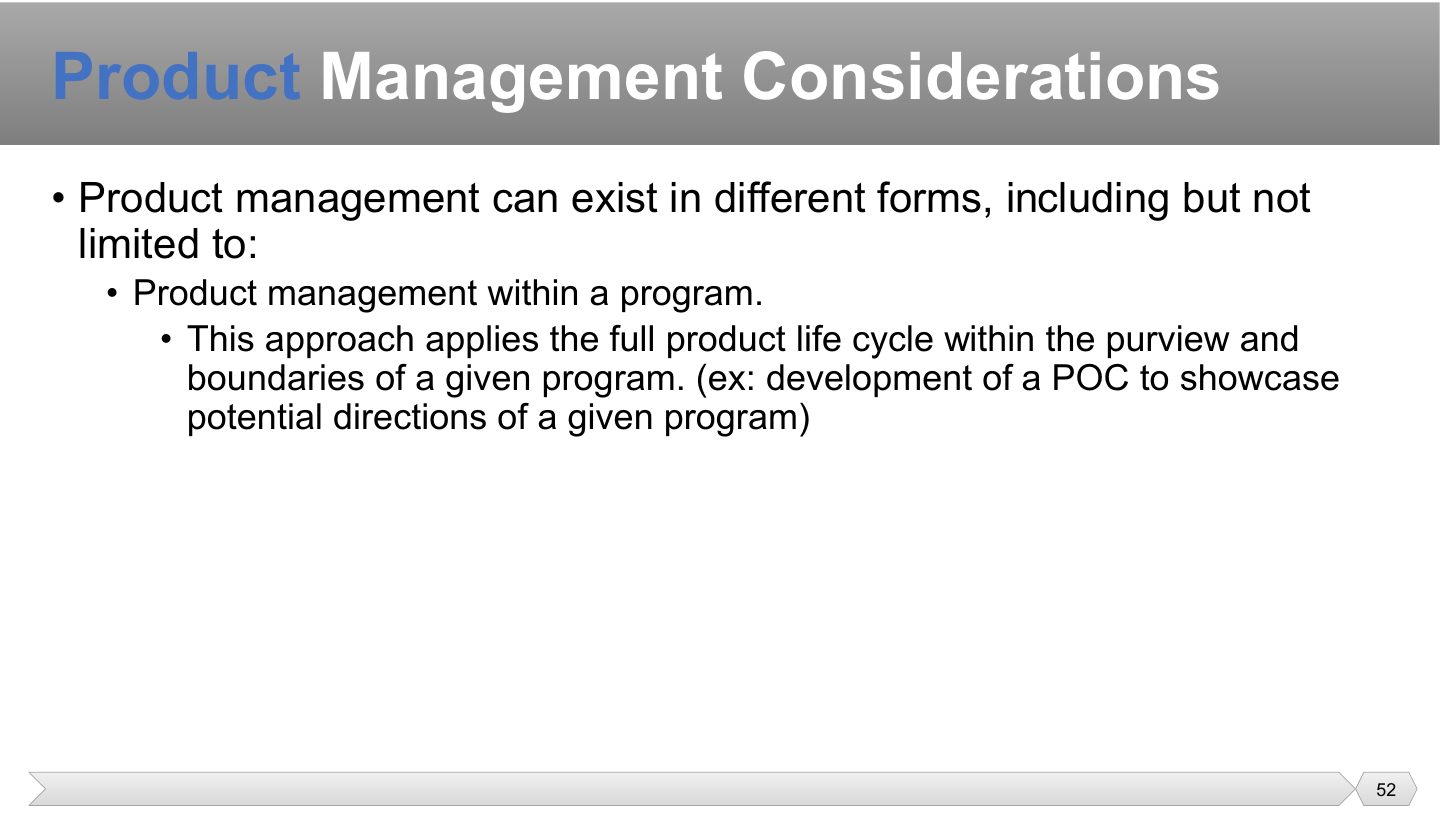
  • Slides 46–52Product management considerations
  • Slides 53–70The 12 principles in detail

Exam focus

Midterm 251 (both versions) took six MCQs from this deck: decentralized decision-making, program, performance domains, stewardship, system for value delivery, and (from 1.2) cadence. The instructor’s 2026 midterm asked project vs. product management and two principle scenarios (Focus on Value; system interactions). Finals asked about constraints, the PMO, and PM vs. general management. She tests application, so expect scenarios that name a situation and ask which principle, term or coordination style applies.
How to read this page

Every original slide is shown unchanged. Yellow marks on a slide point to a numbered note: hover or tap a mark to jump to its note, and hover a note to see its marks. Questions tagged Past exam appeared on a real paper; Prediction questions are likely angles, not confirmed. Pick an answer to each question: a wrong pick tells you why it is wrong, so you can try again.

All 70 slides
  1. 1 Slide 1
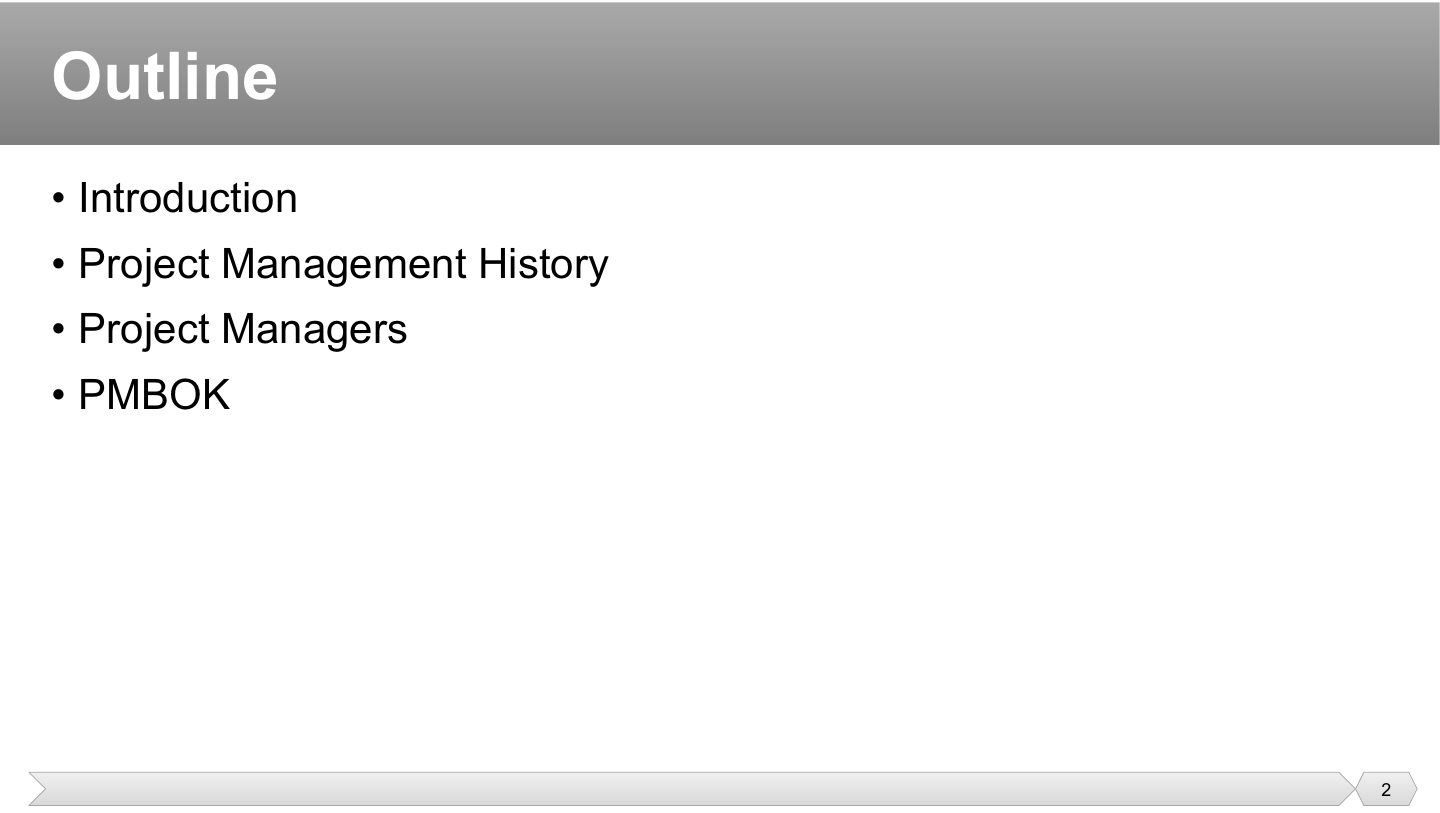
  2. 2 Outline
  3. 3 Introduction (section)
  4. 4 What is Project Management?
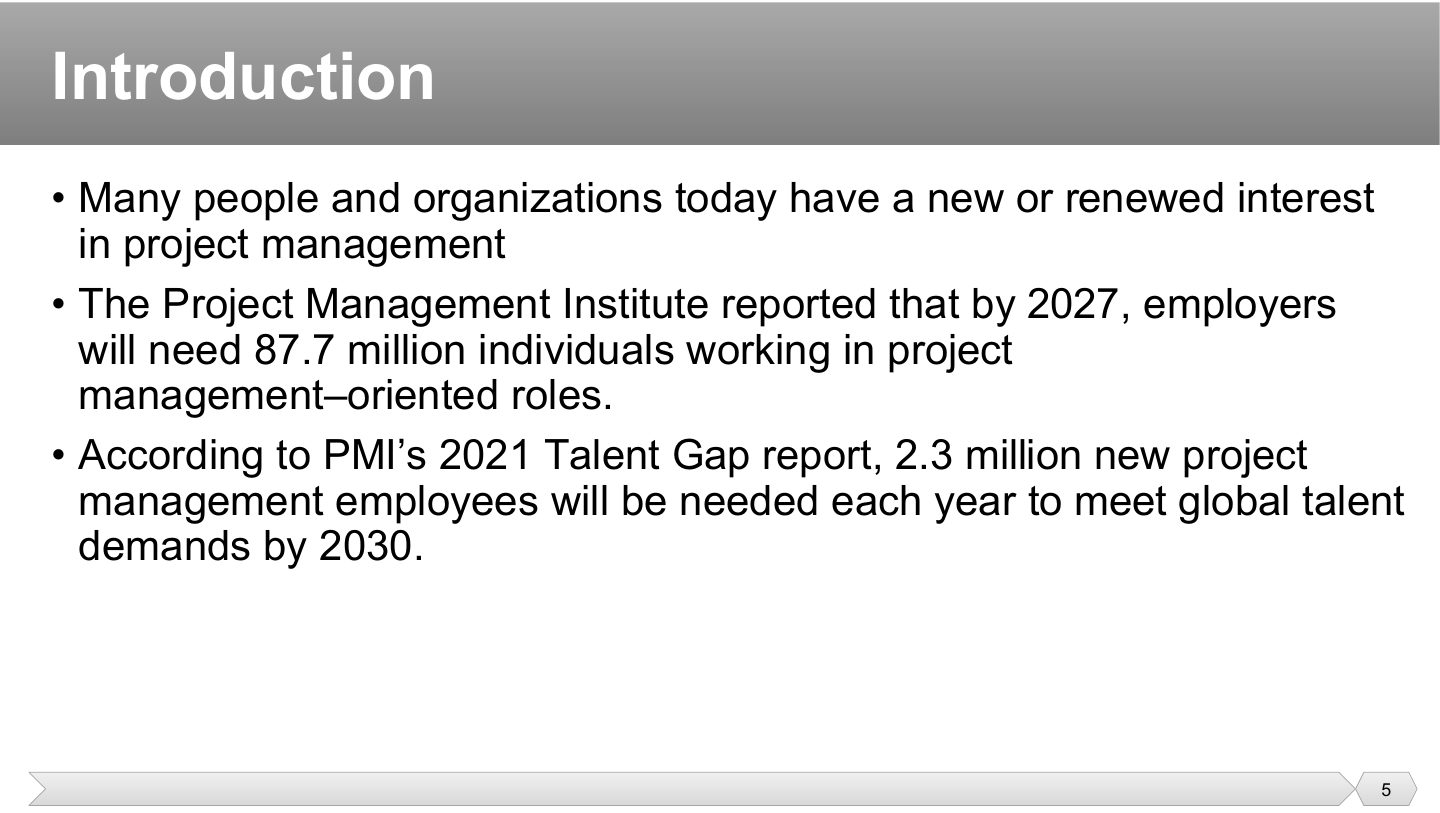
  5. 5 Introduction
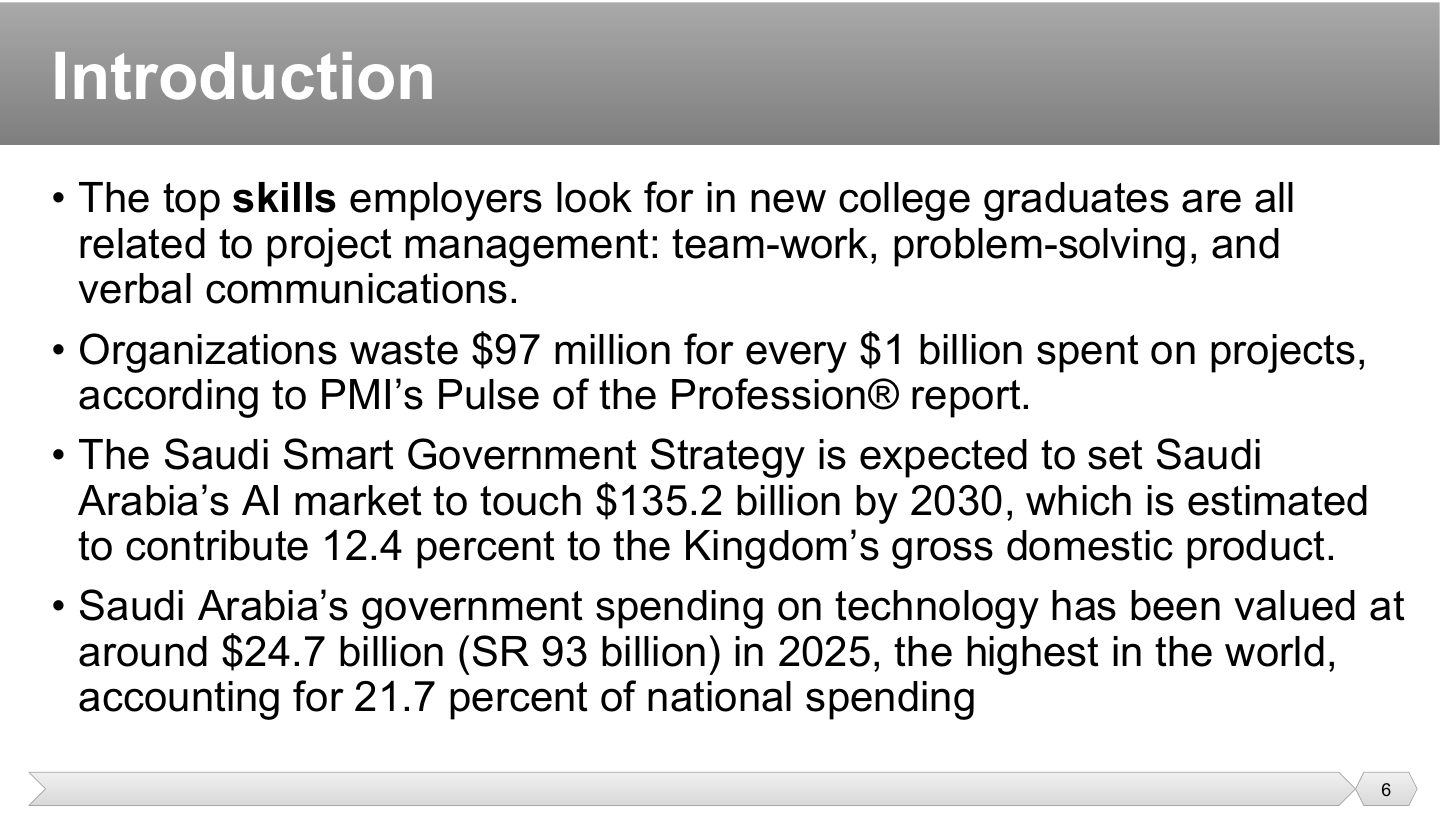
  6. 6 Introduction
  7. 7 Project Management History (section)
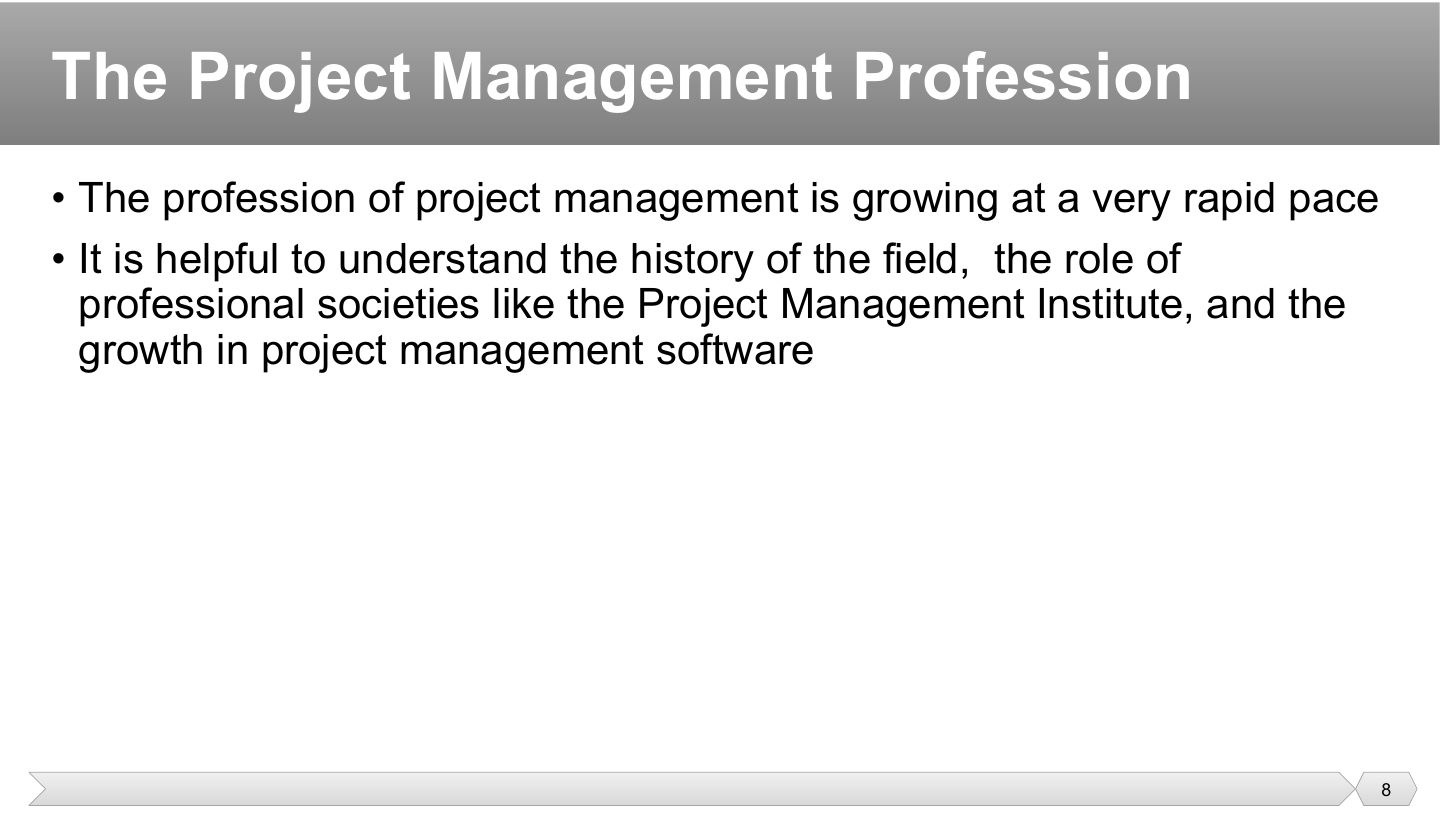
  8. 8 The Project Management Profession
  9. 9 History of Project Management
  10. 10 History of Project Management
  11. 11 Global Issues
  12. 12 Project Management Certification
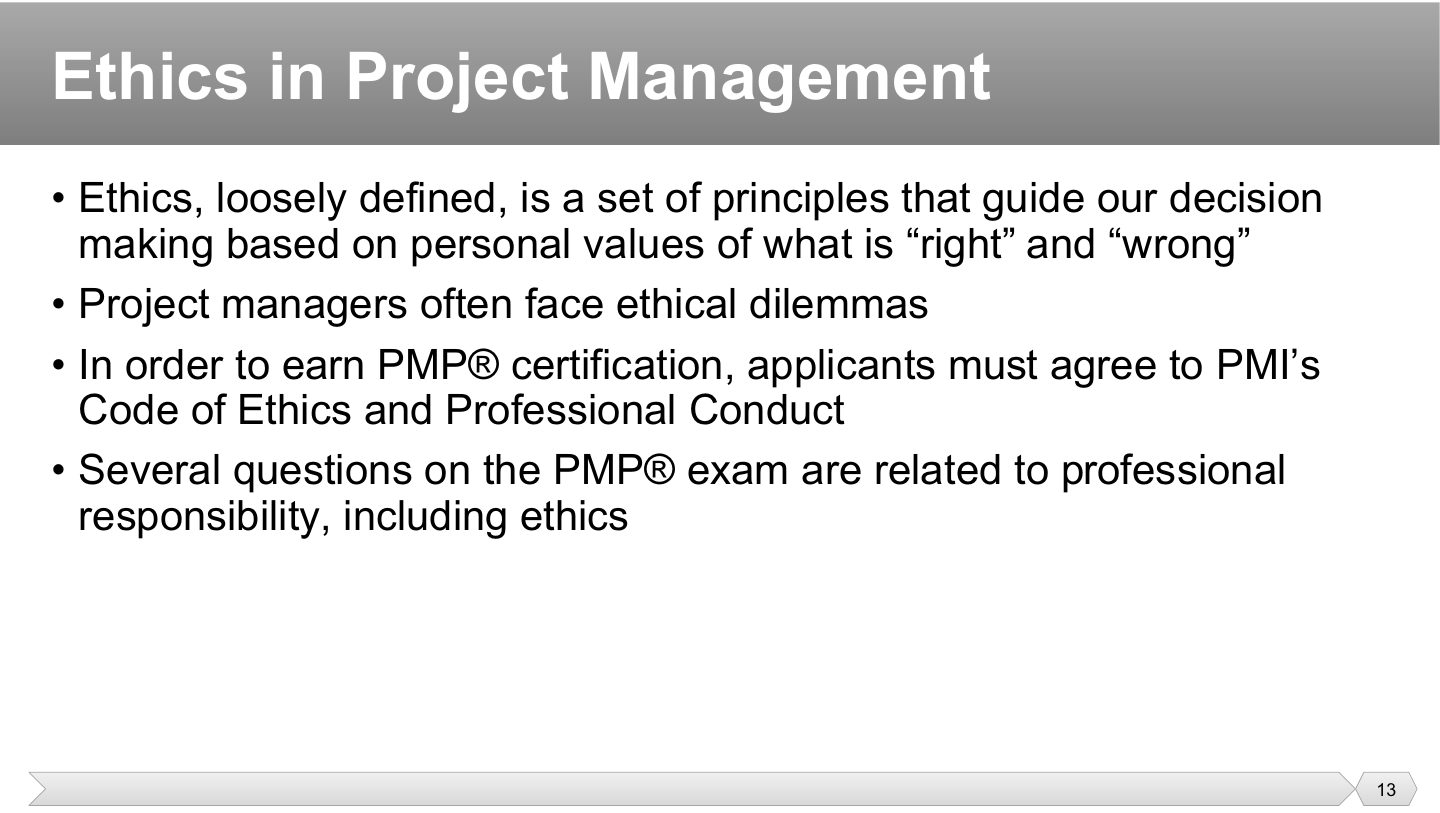
  13. 13 Ethics in Project Management
  14. 14 Project Managers (section)
  15. 15 Project Managers
  16. 16 The Project Manager
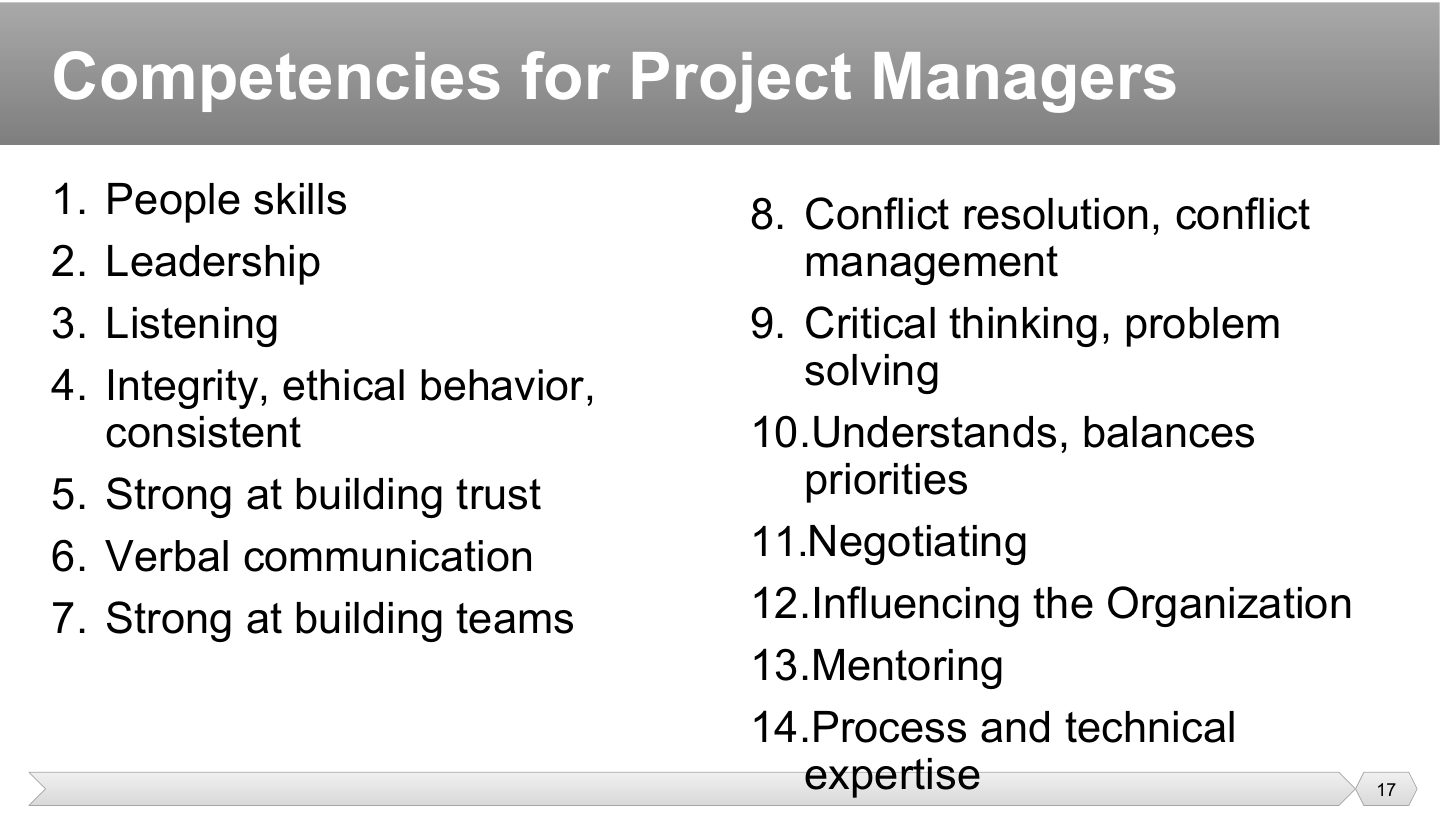
  17. 17 Competencies for Project Managers
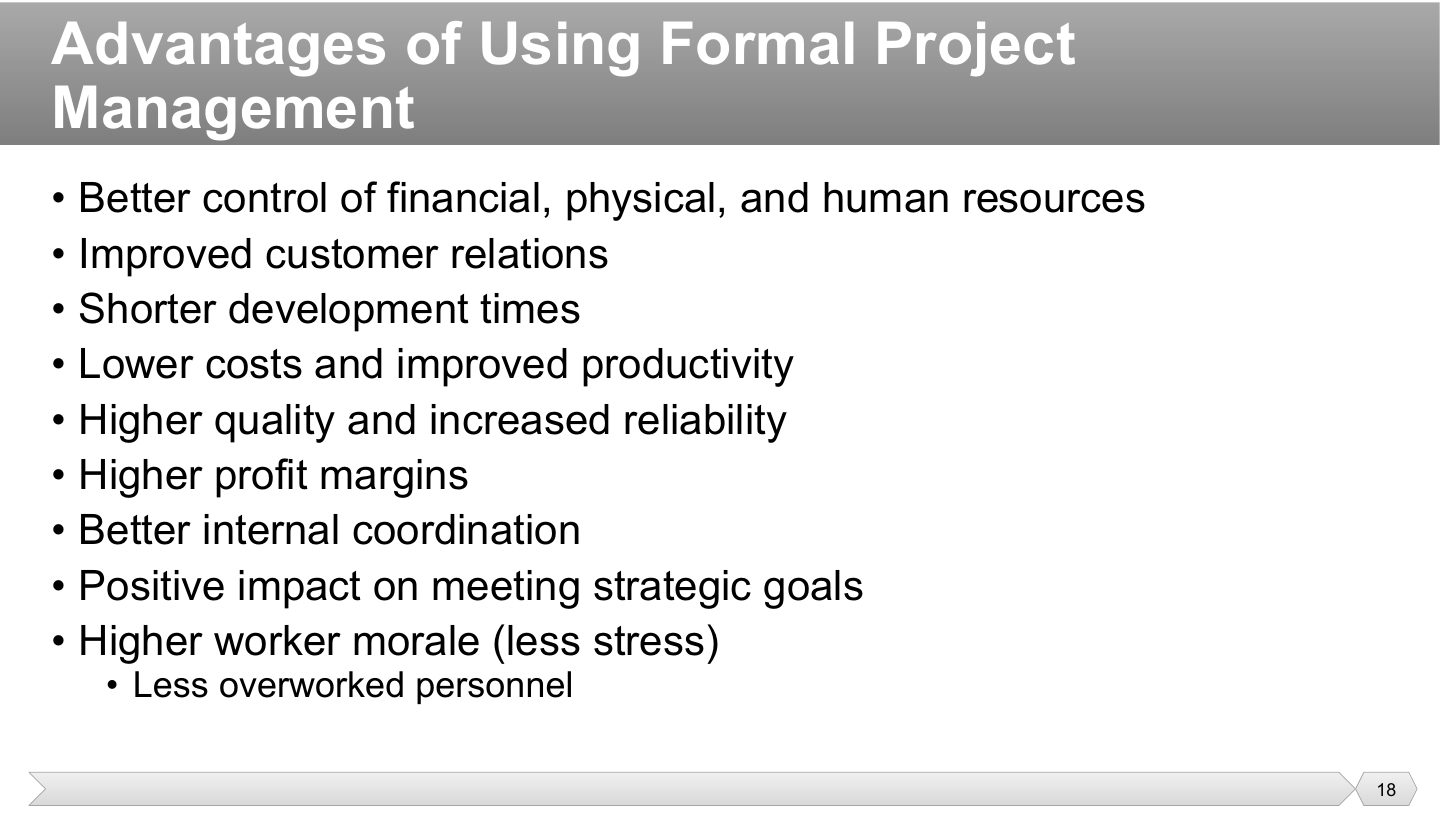
  18. 18 Advantages of Using Formal Project
  19. 19 Project Management Body of Knowledge (section)
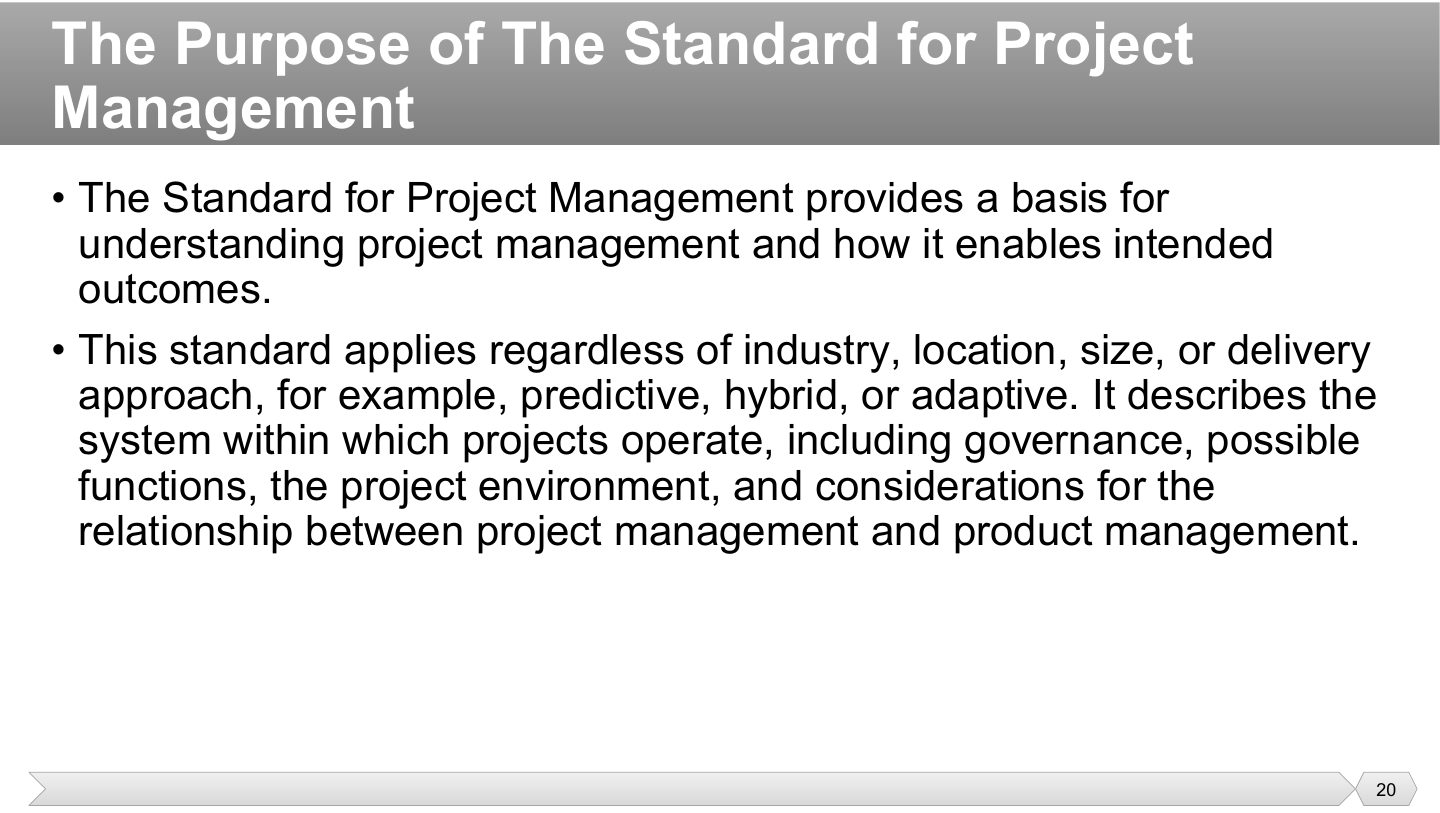
  20. 20 The Purpose of The Standard for Project
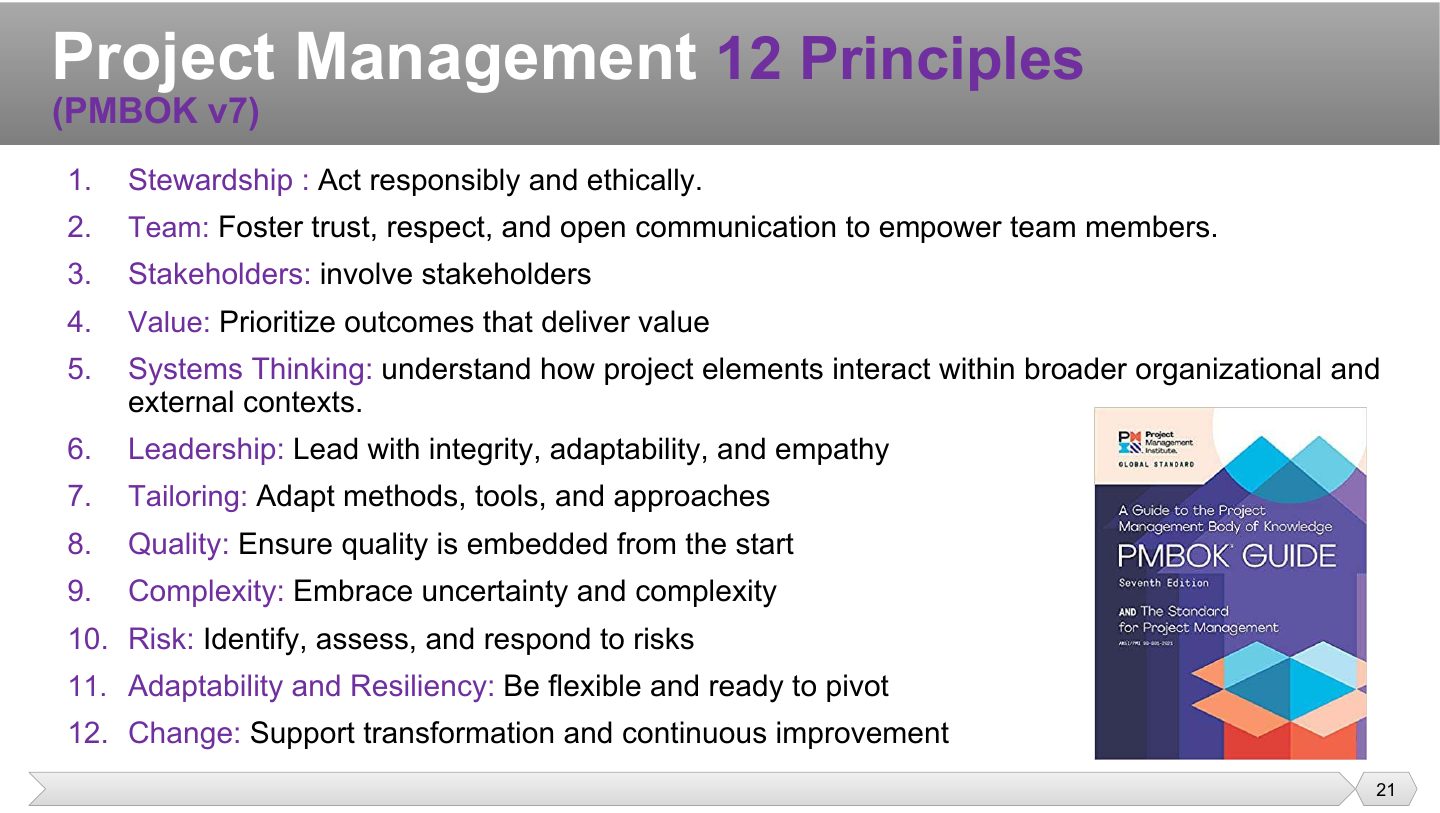
  21. 21 Project Management
  22. 22 Project Management
  23. 23 Key Terms and Concepts (section)
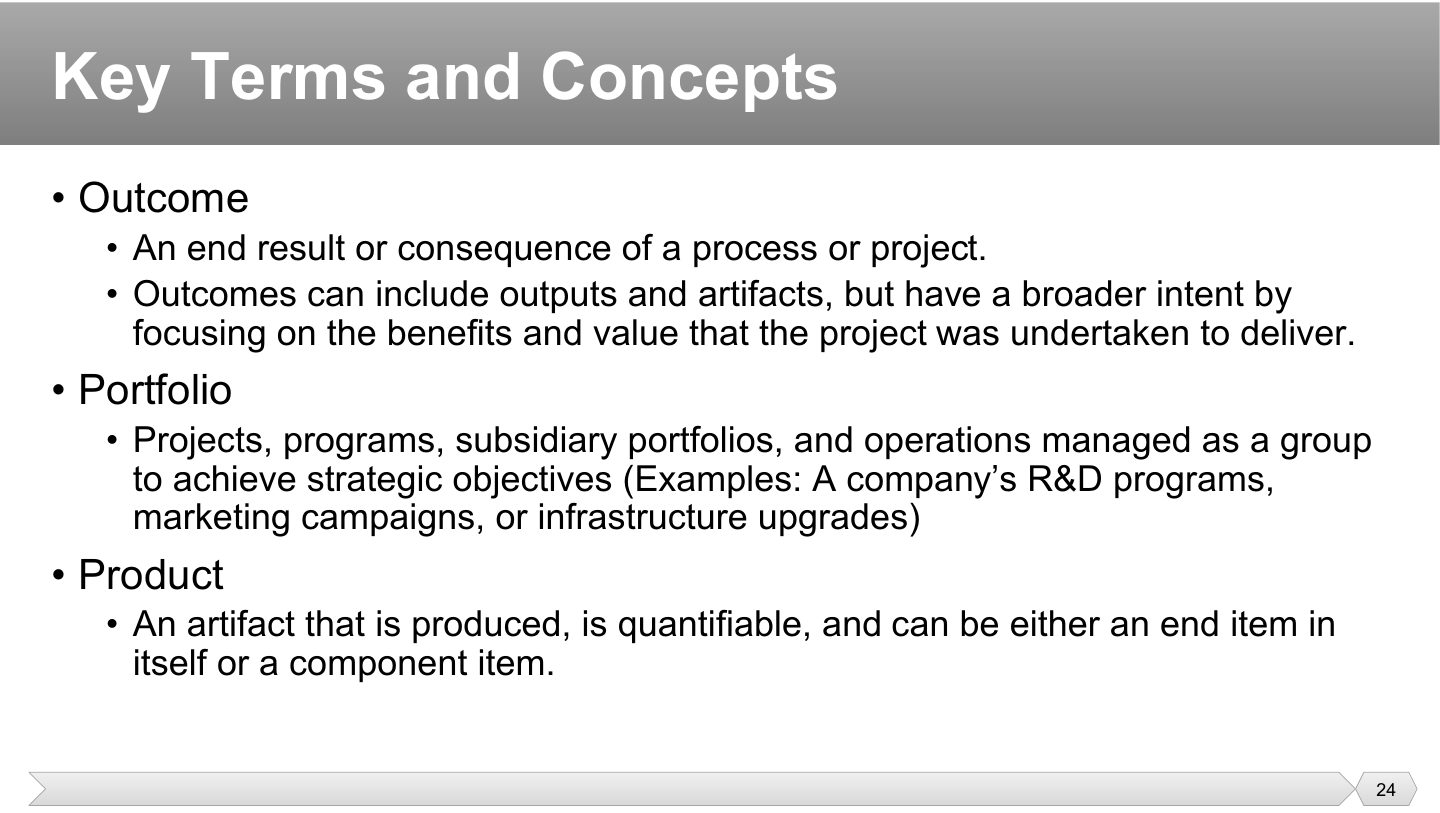
  24. 24 Key Terms and Concepts
  25. 25 Key Terms and Concepts
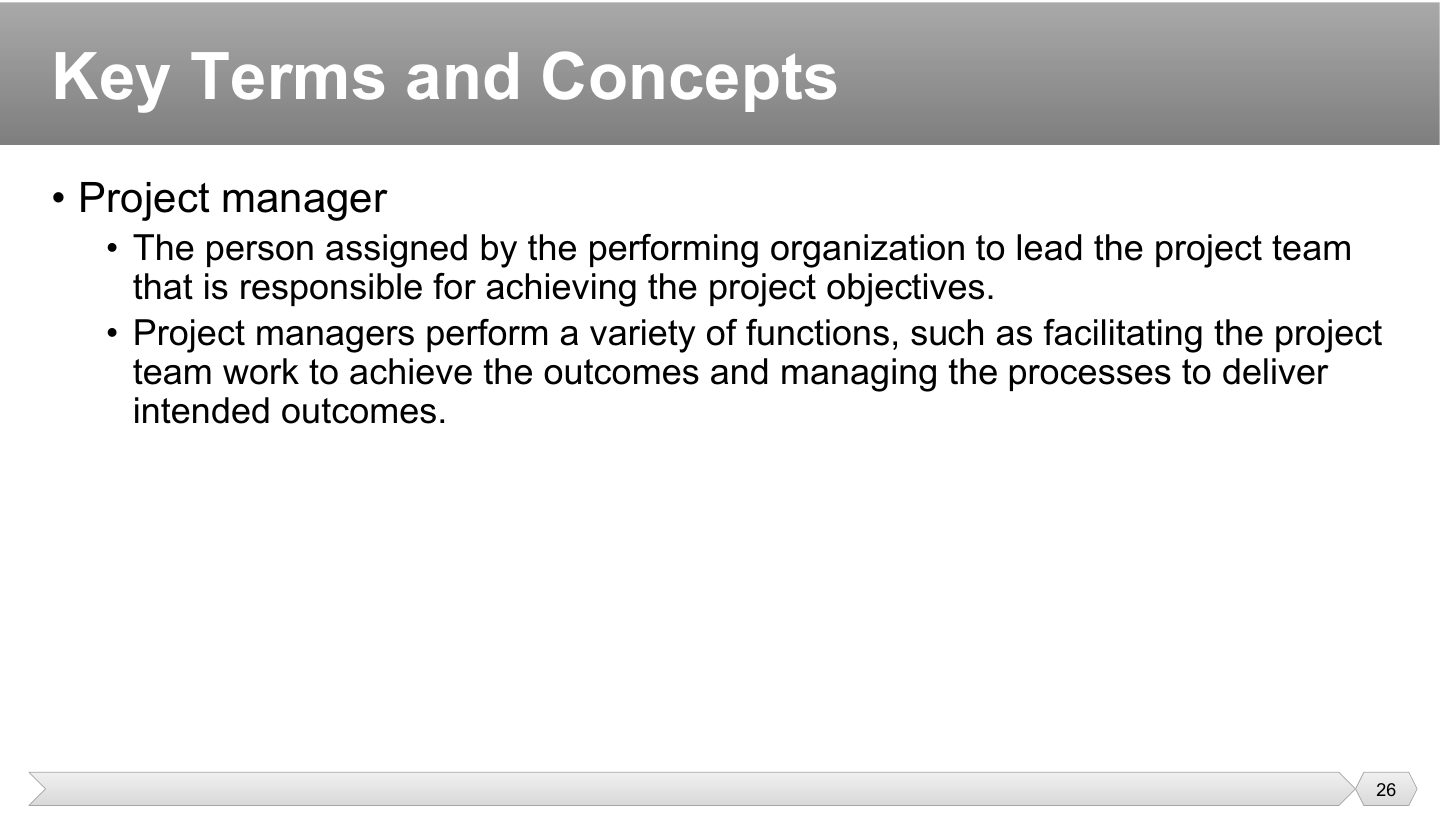
  26. 26 Key Terms and Concepts
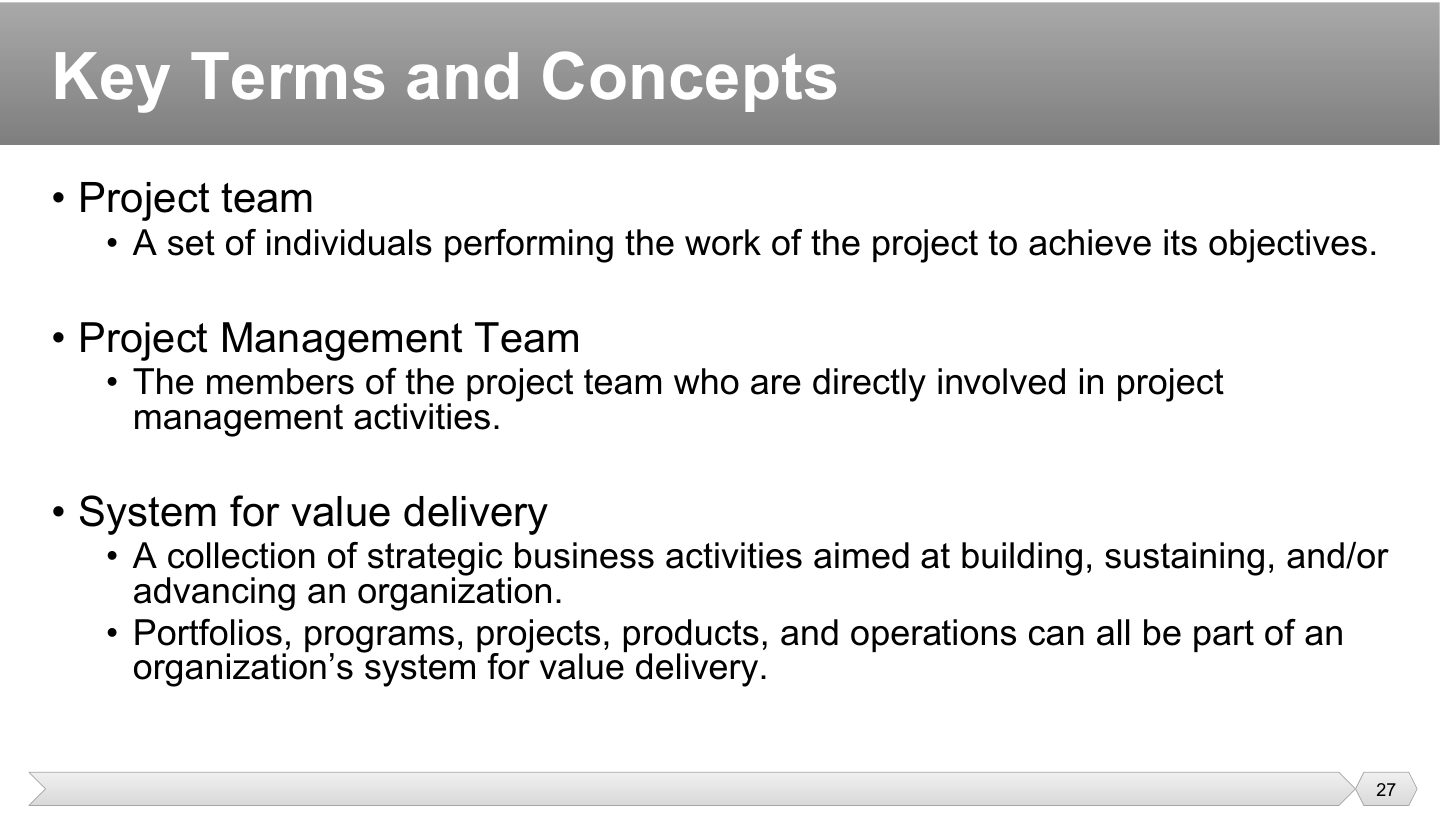
  27. 27 Key Terms and Concepts
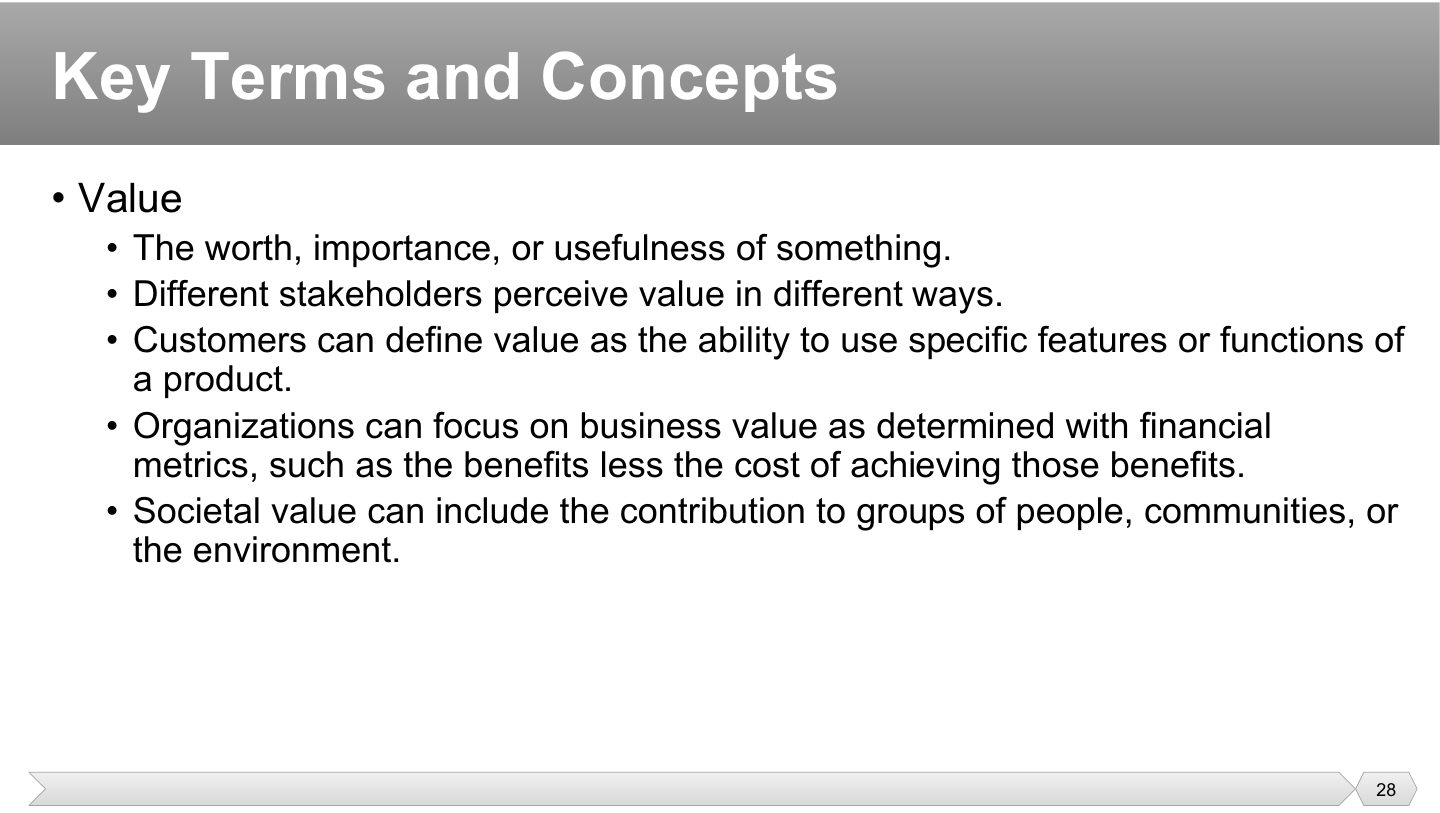
  28. 28 Key Terms and Concepts
  29. 29 A System for Value Delivery (section)
  30. 30 A System for Value Delivery
  31. 31 Creating Value
  32. 32 Value Delivery Components
  33. 33 Value Delivery Components
  34. 34 Value Delivery Components
  35. 35 Information Flow
  36. 36 Information Flow
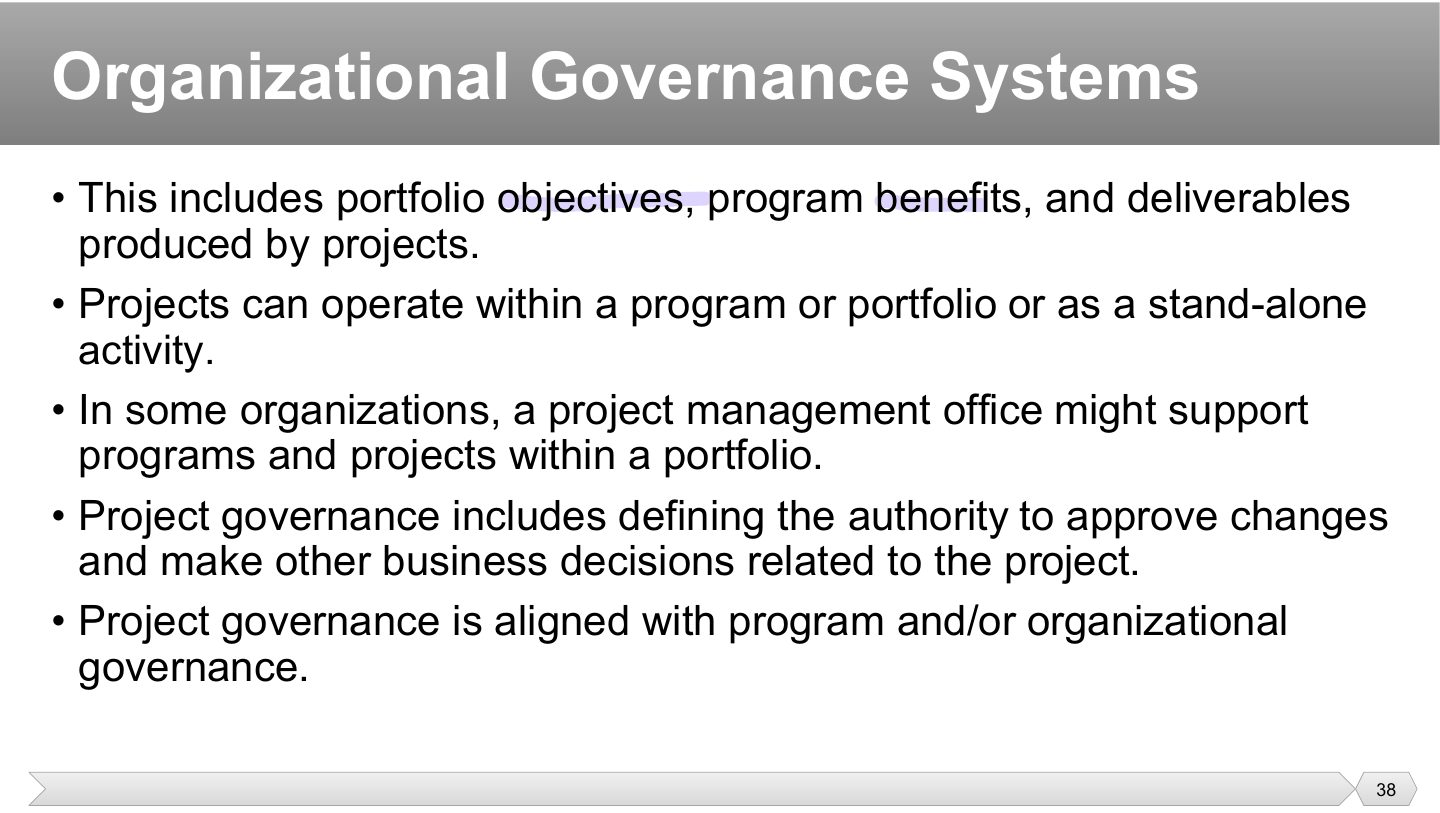
  37. 37 Organizational Governance Systems
  38. 38 Organizational Governance Systems
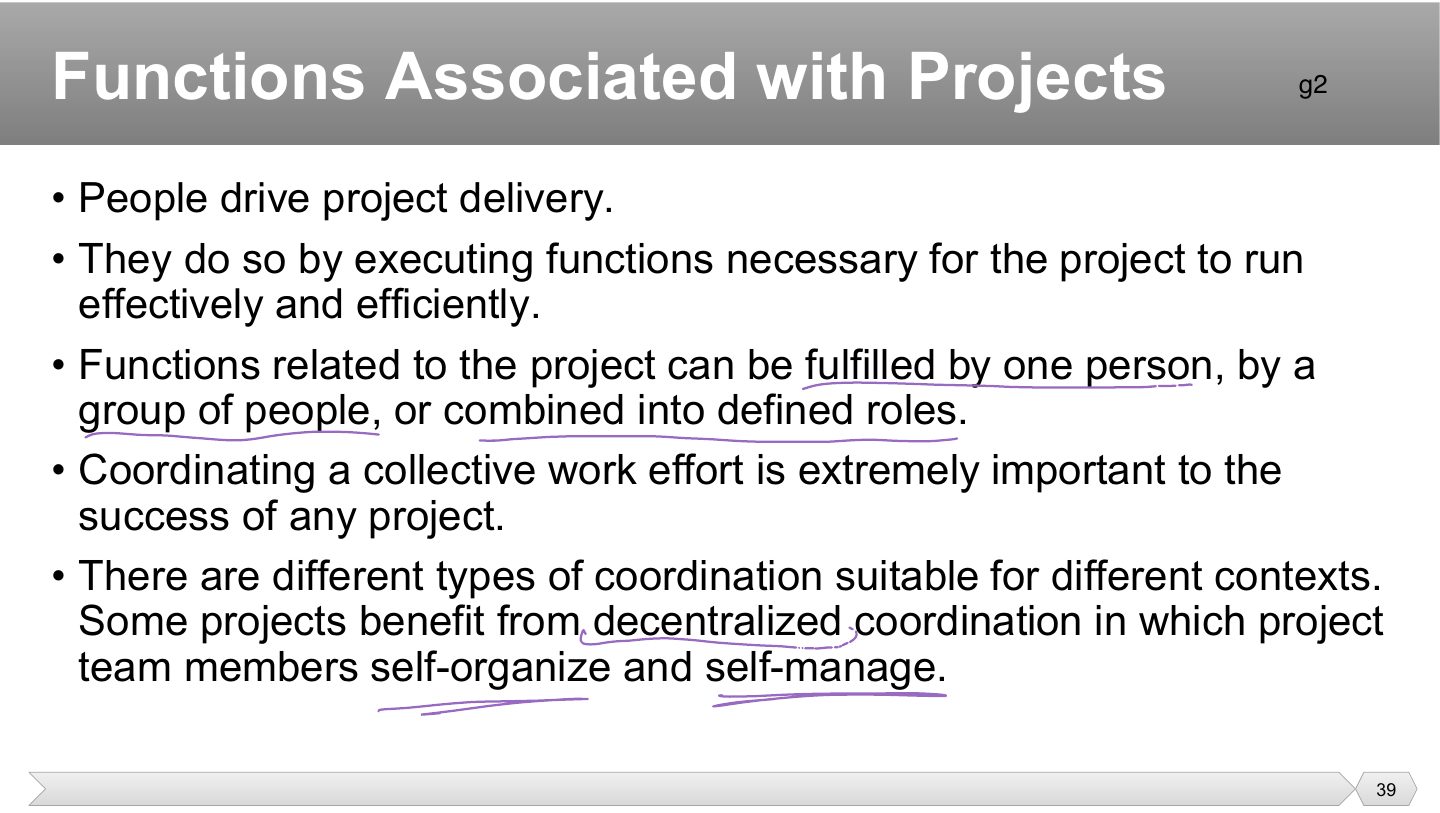
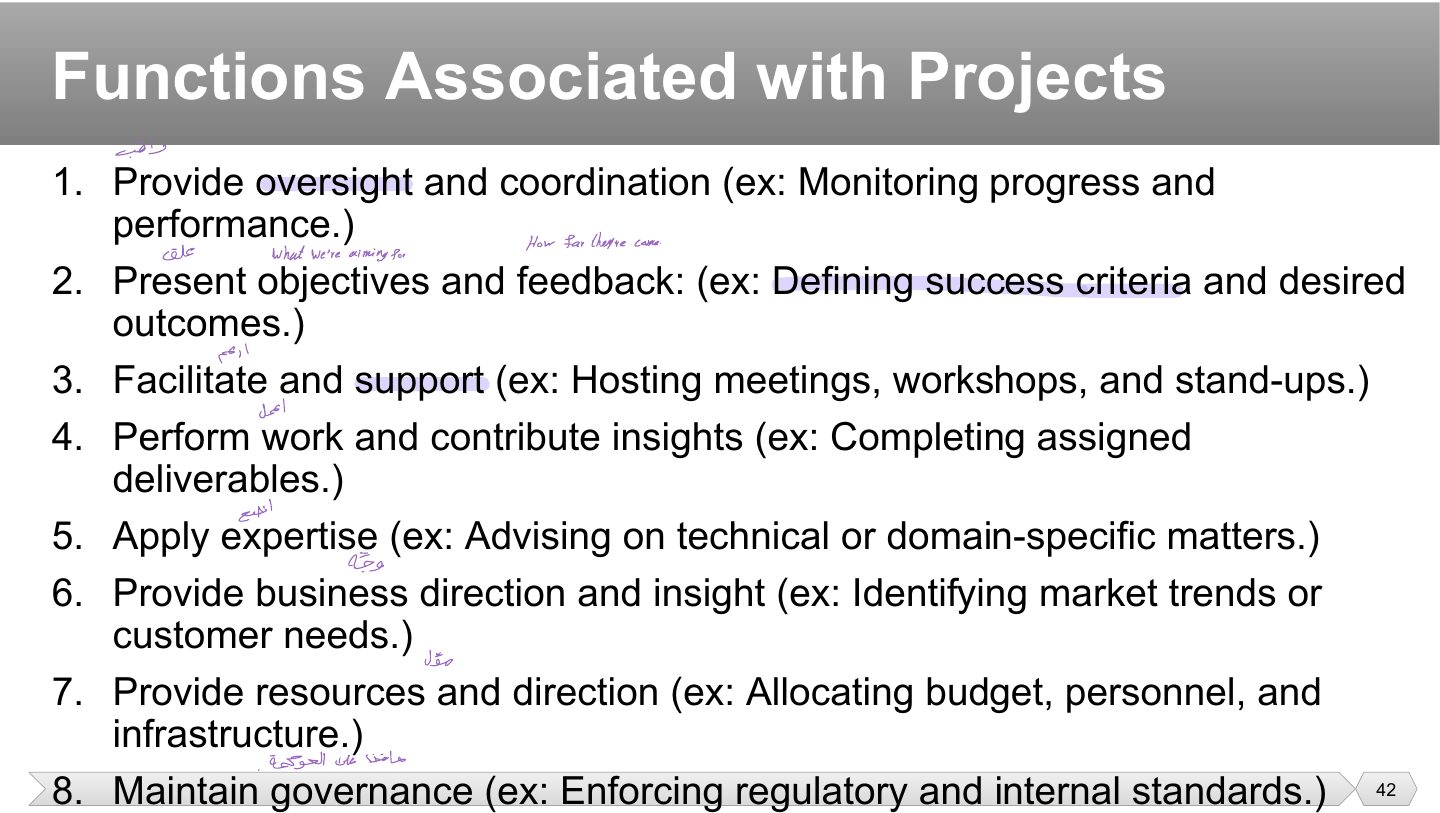
  39. 39 Functions Associated with Projects
  40. 40 Functions Associated with Projects
  41. 41 Functions Associated with Projects
  42. 42 IHow
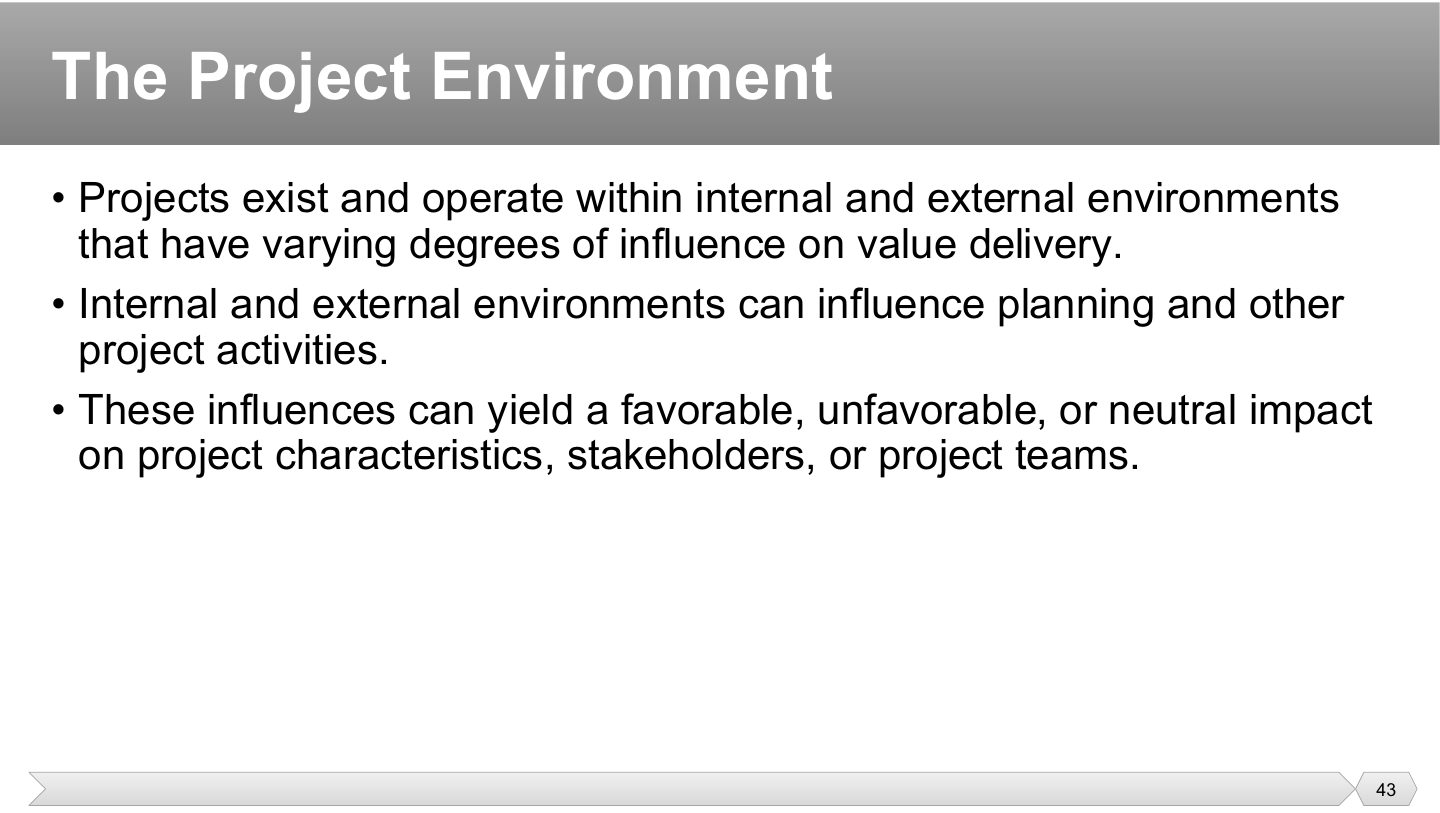
  43. 43 The Project Environment
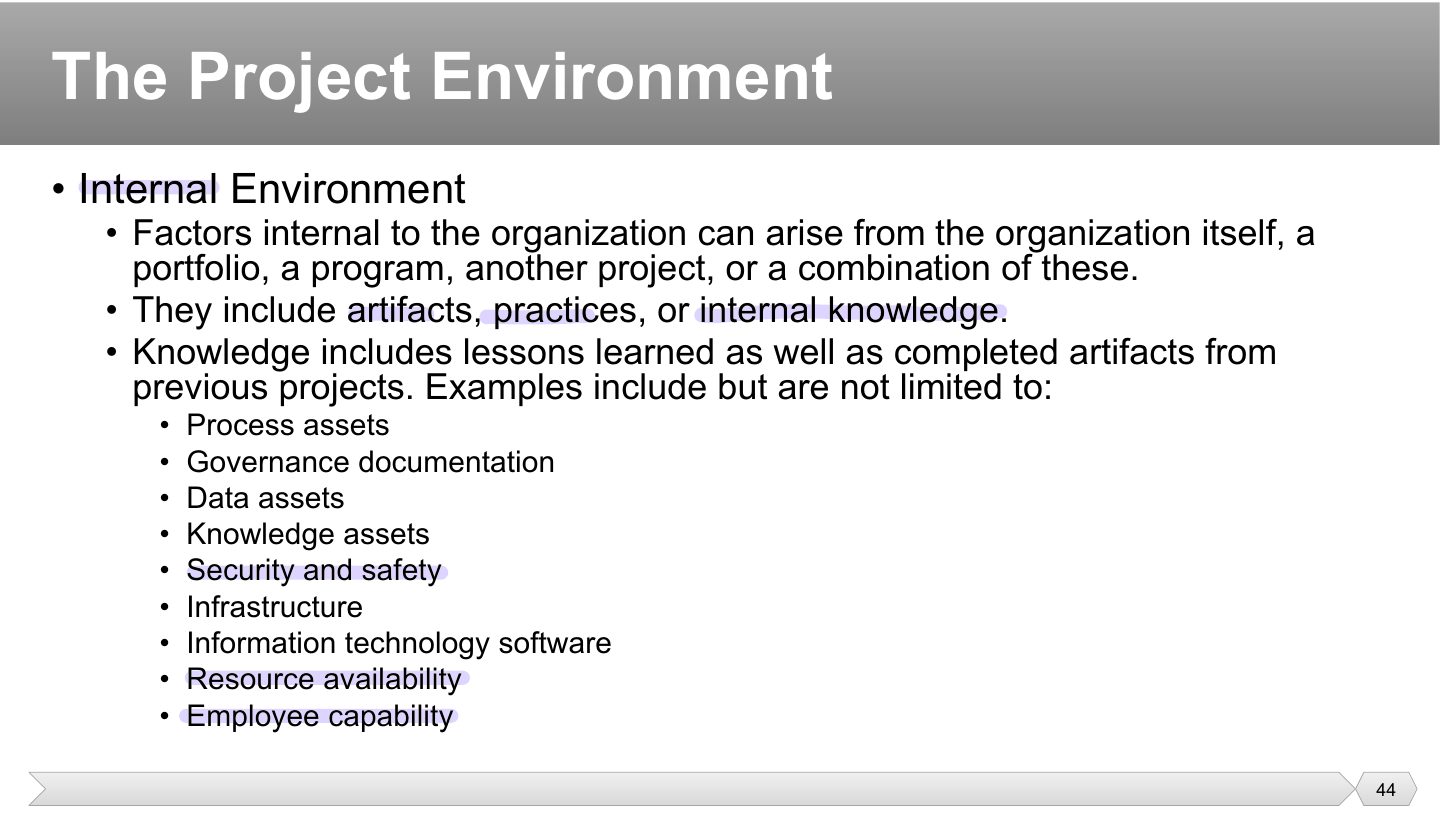
  44. 44 The Project Environment
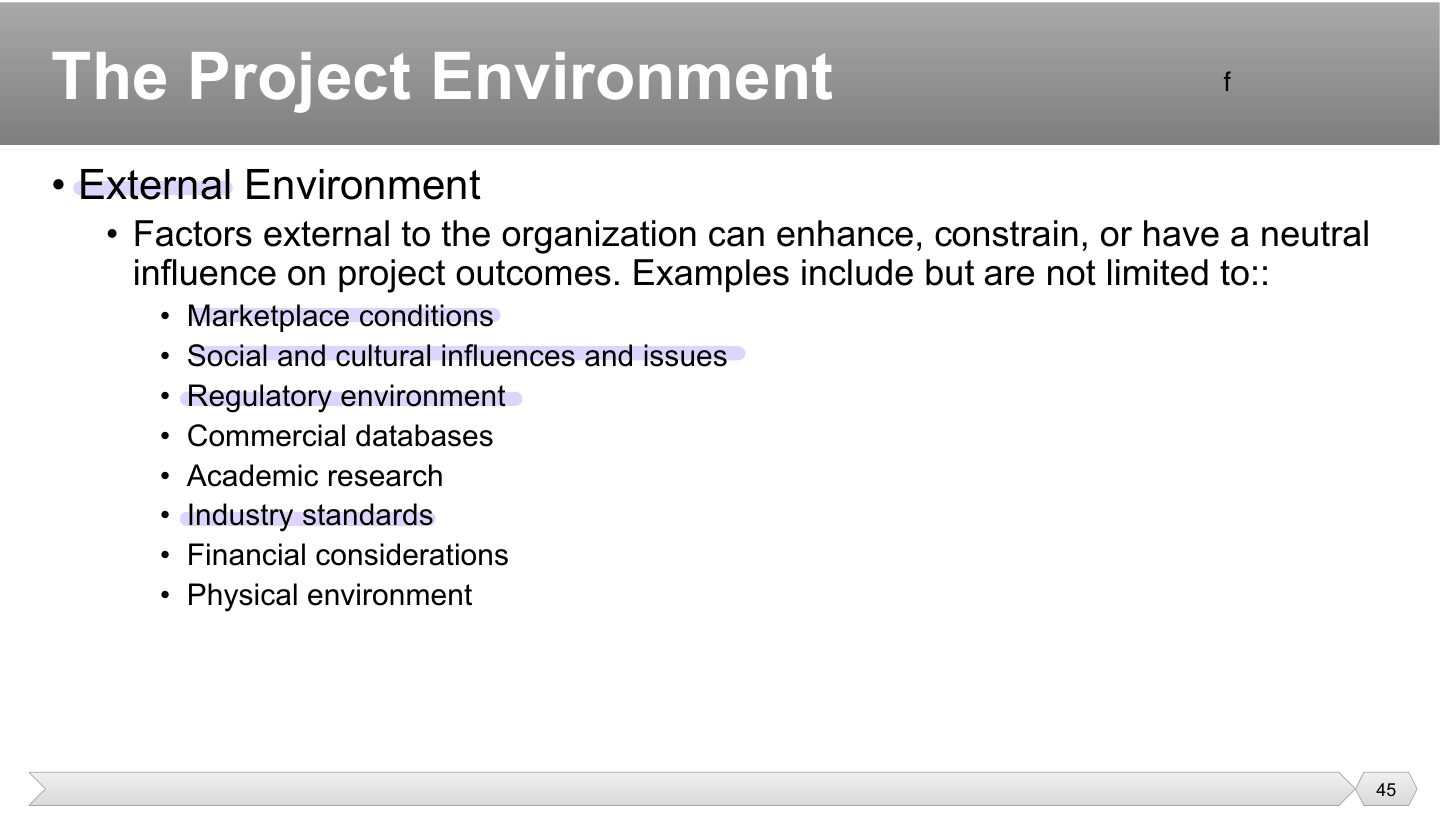
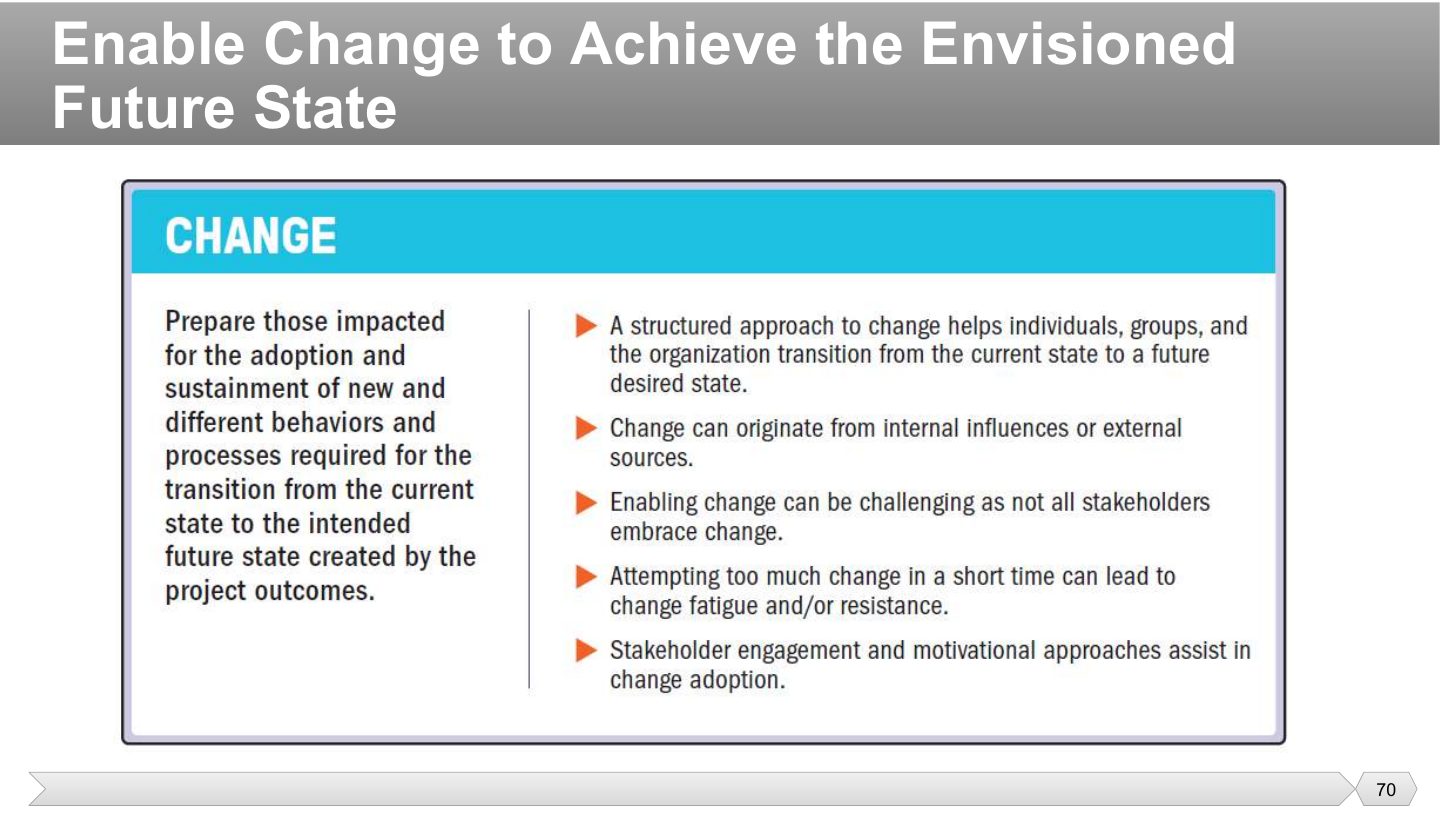
  45. 45 The Project Environment
  46. 46 Product Management Considerations
  47. 47 Product Management Considerations
  48. 48 Product Management Considerations
  49. 49 Product Management Considerations
  50. 50 Product Management Considerations
  51. 51 Product Management Considerations
  52. 52 Product Management Considerations
  53. 53 Project Management Principles (section)
  54. 54 Project Management Principles
  55. 55 Project Management Principles
  56. 56 Project Management Principles
  57. 57 Management Principles
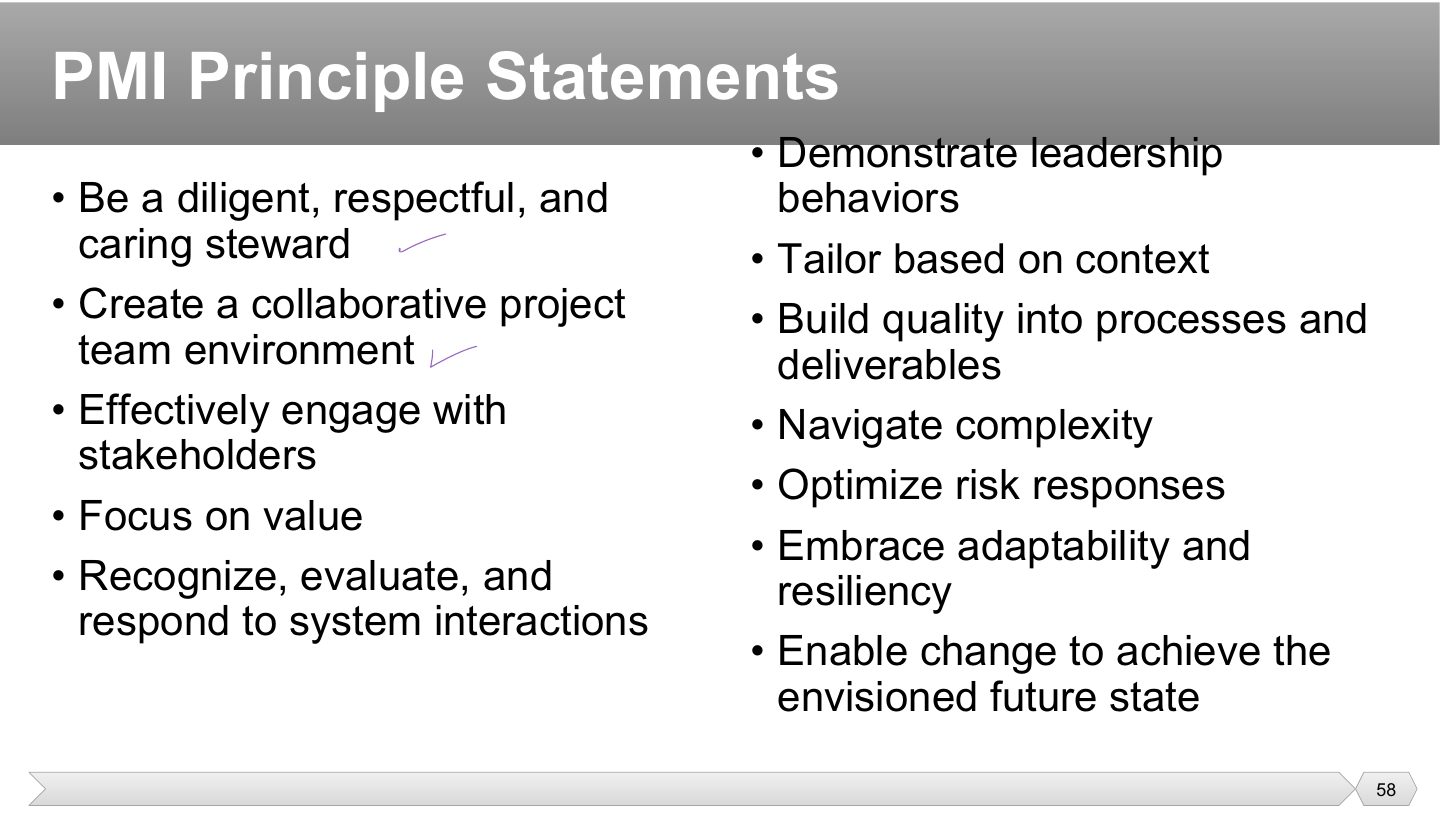
  58. 58 PMI Principle Statements
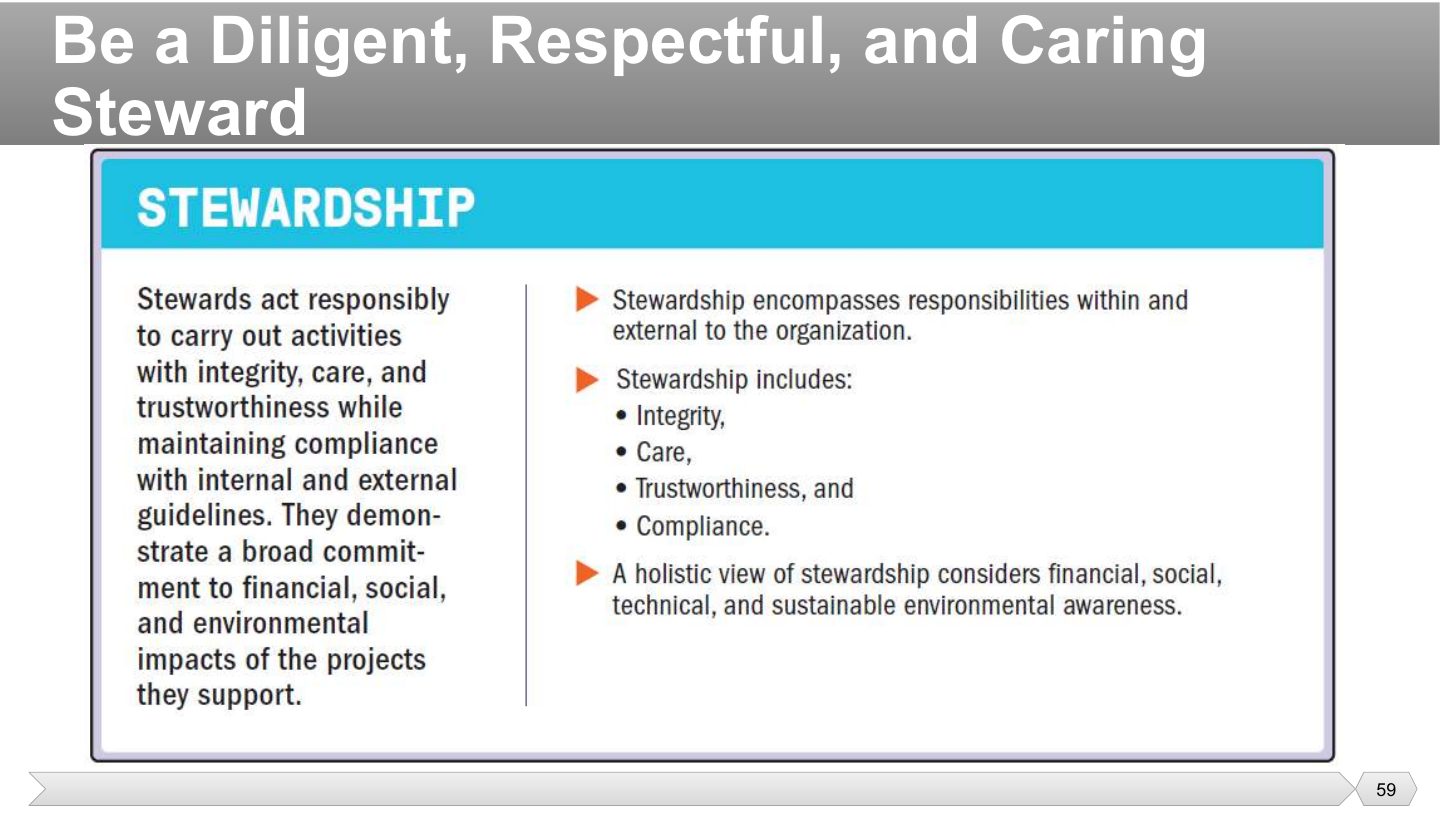
  59. 59 Be a Diligent, Respectful, and Caring
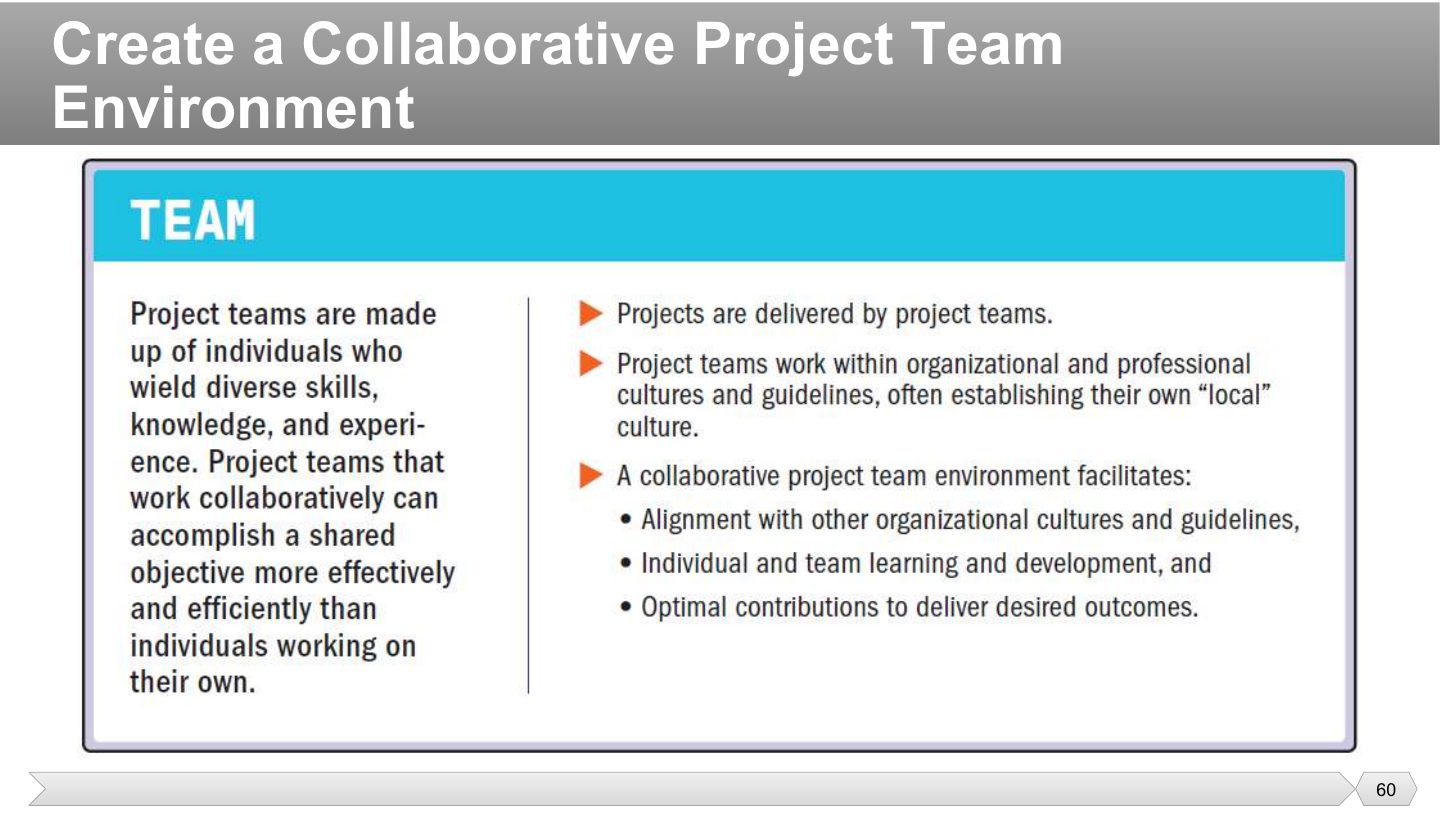
  60. 60 Environment
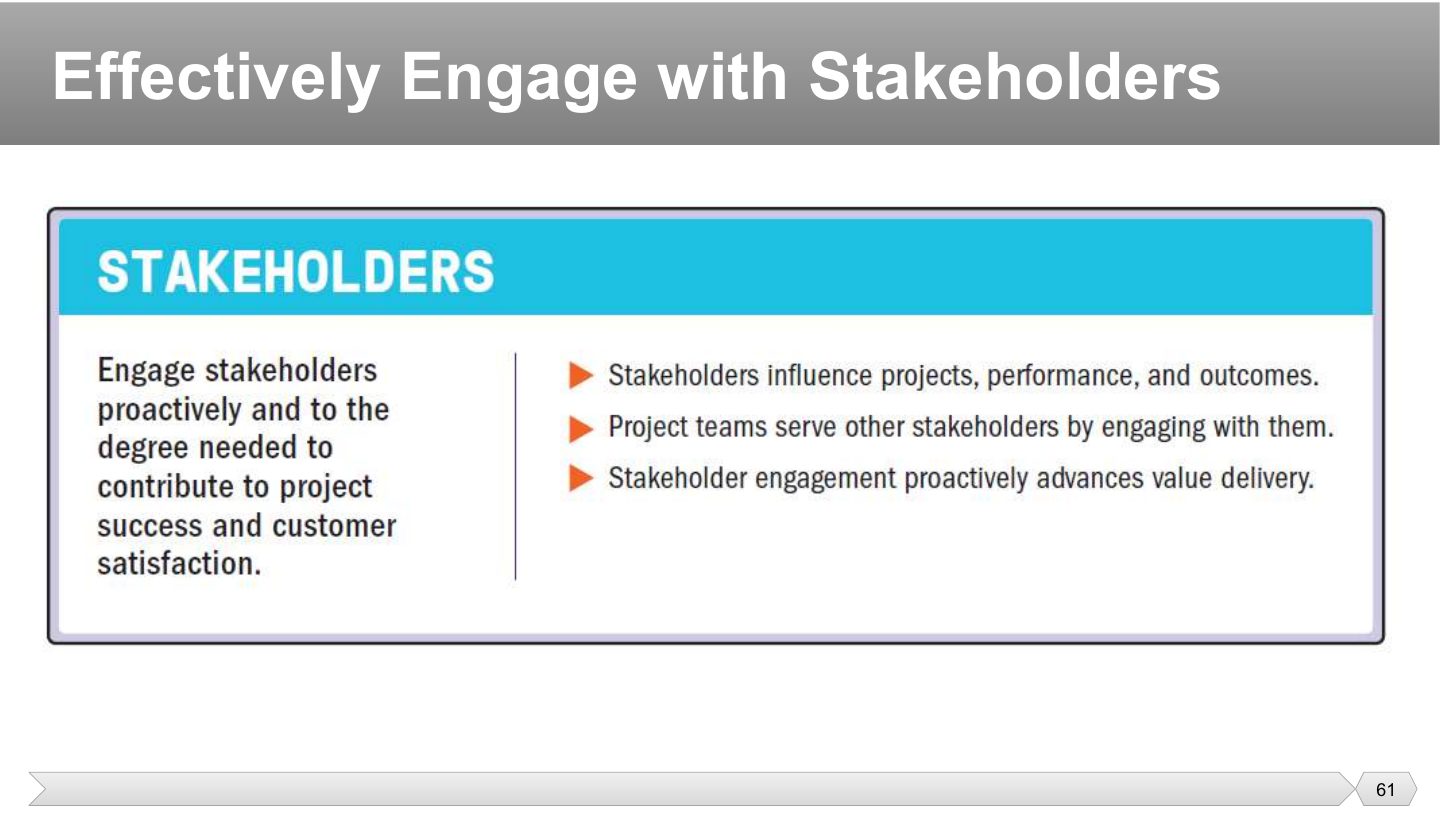
  61. 61 Effectively Engage with Stakeholders
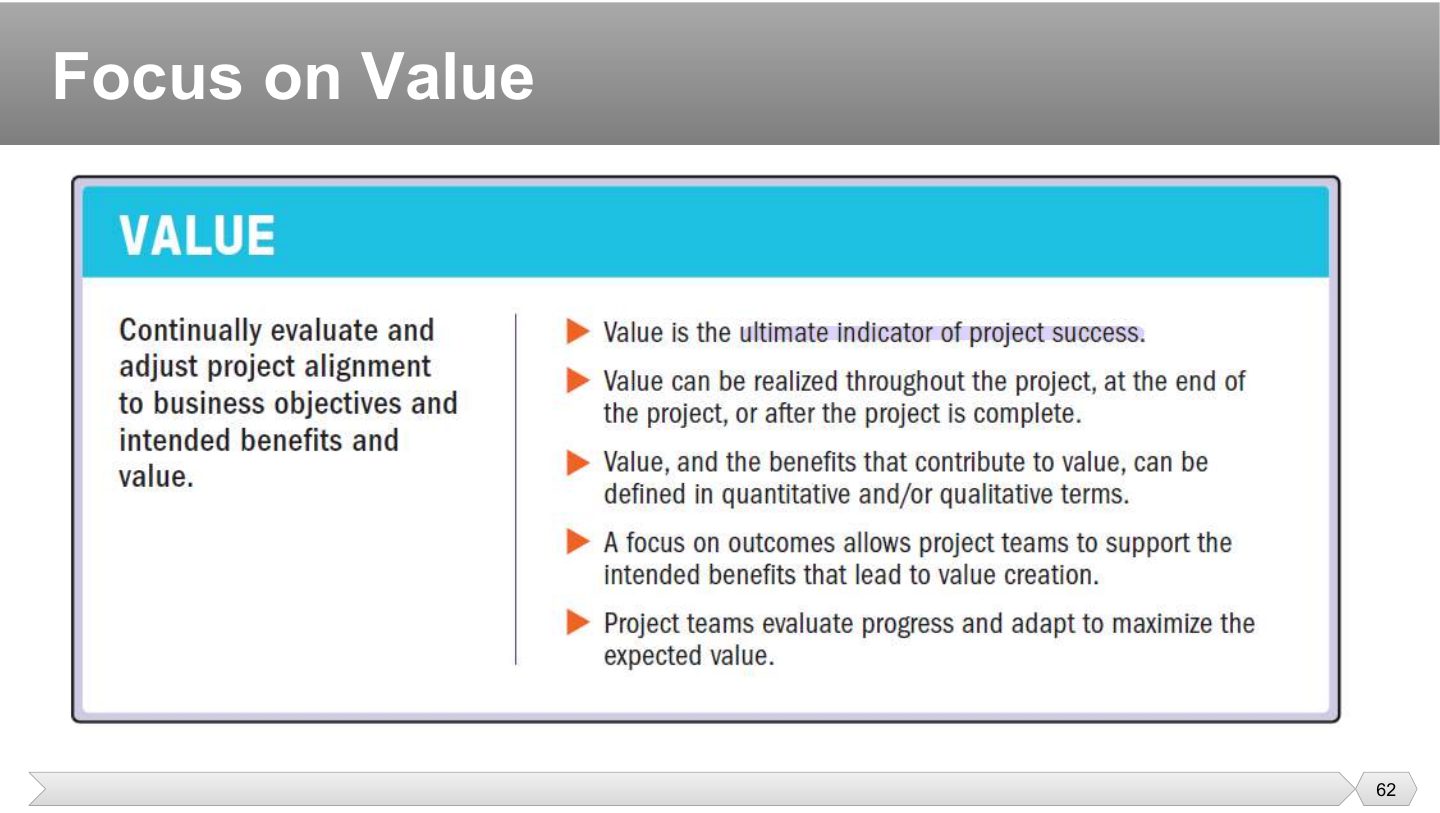
  62. 62 Focus on Value
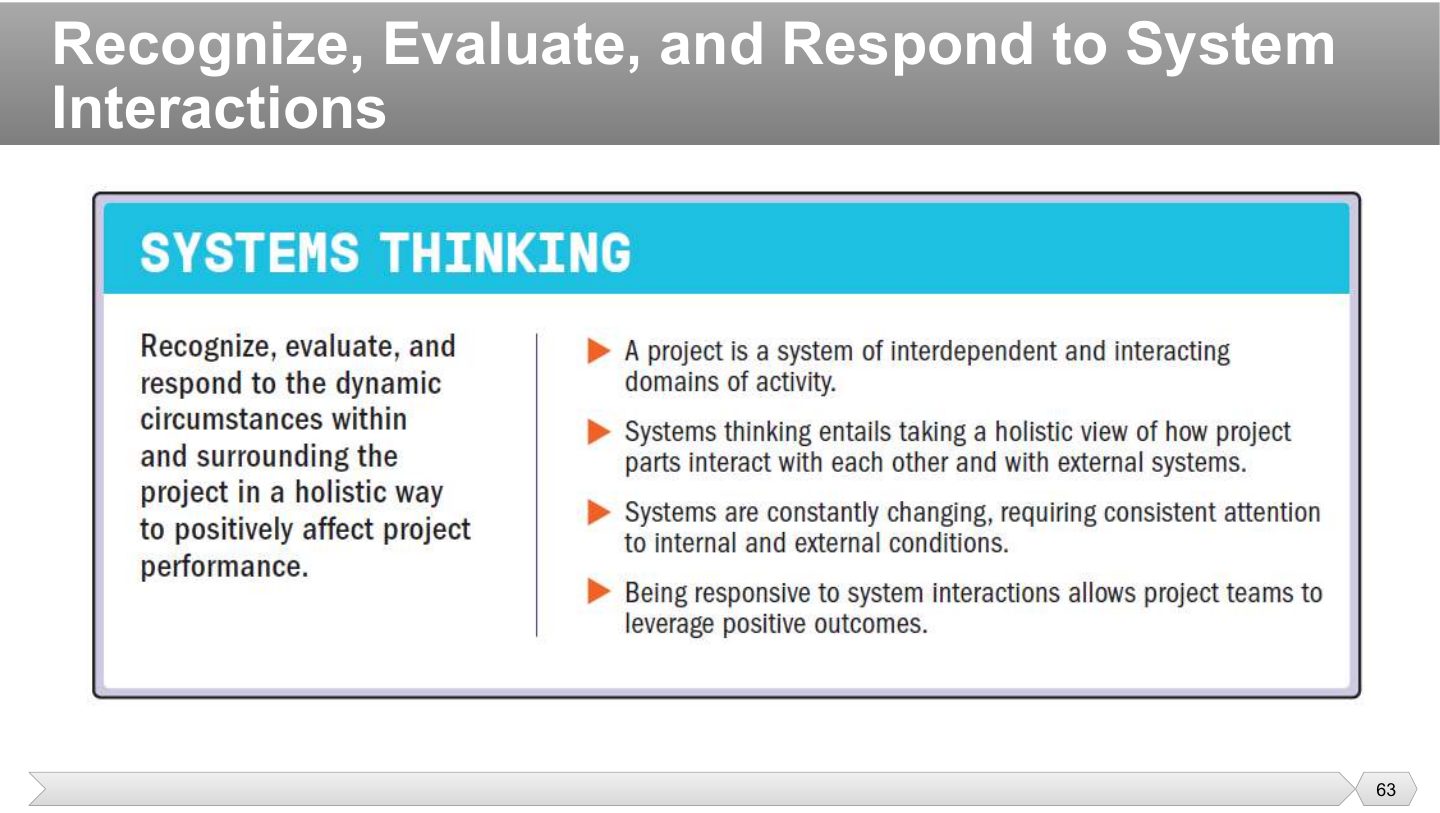
  63. 63 Recognize, Evaluate, and Respond to System
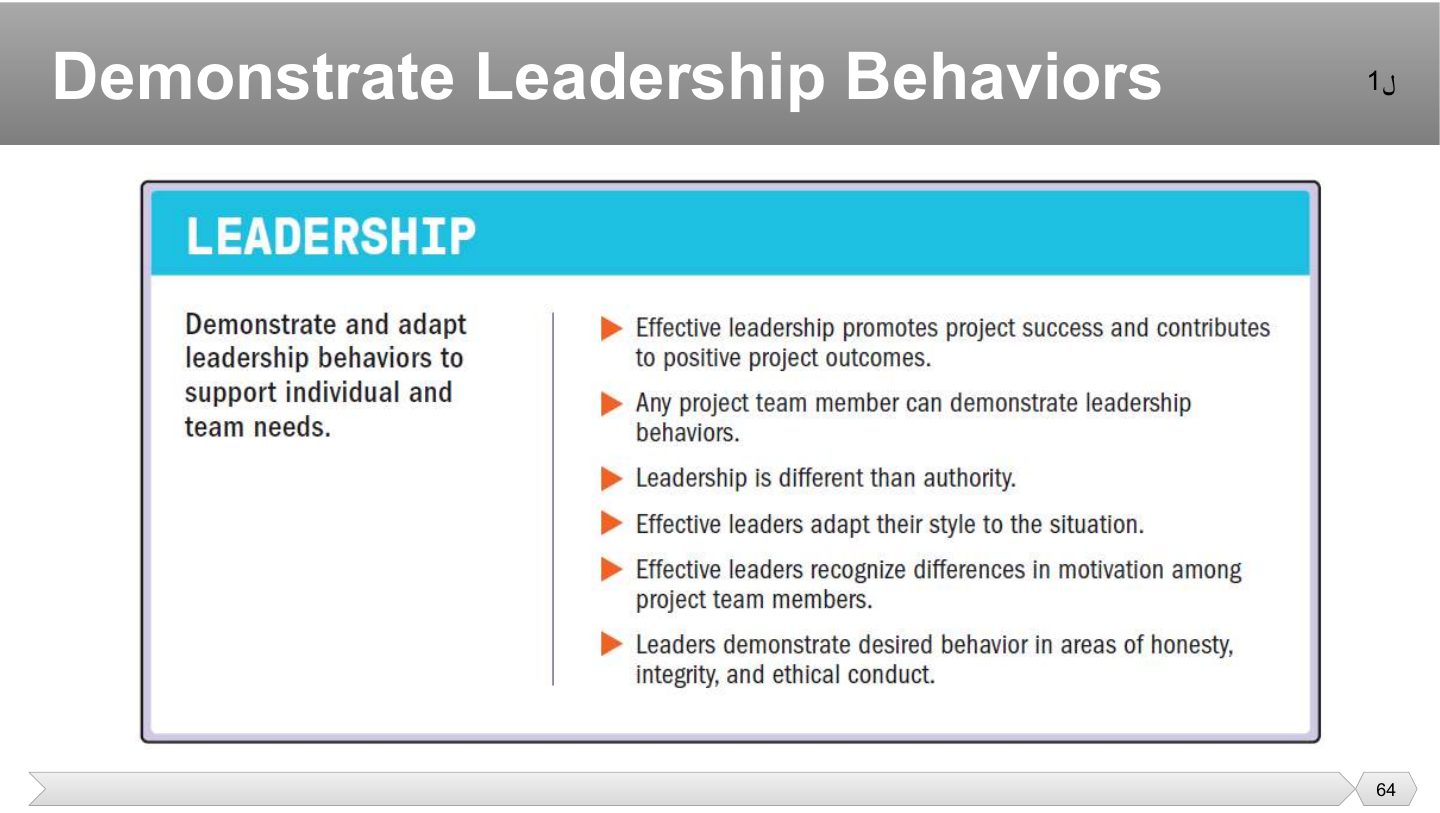
  64. 64 Demonstrate Leadership Behaviors
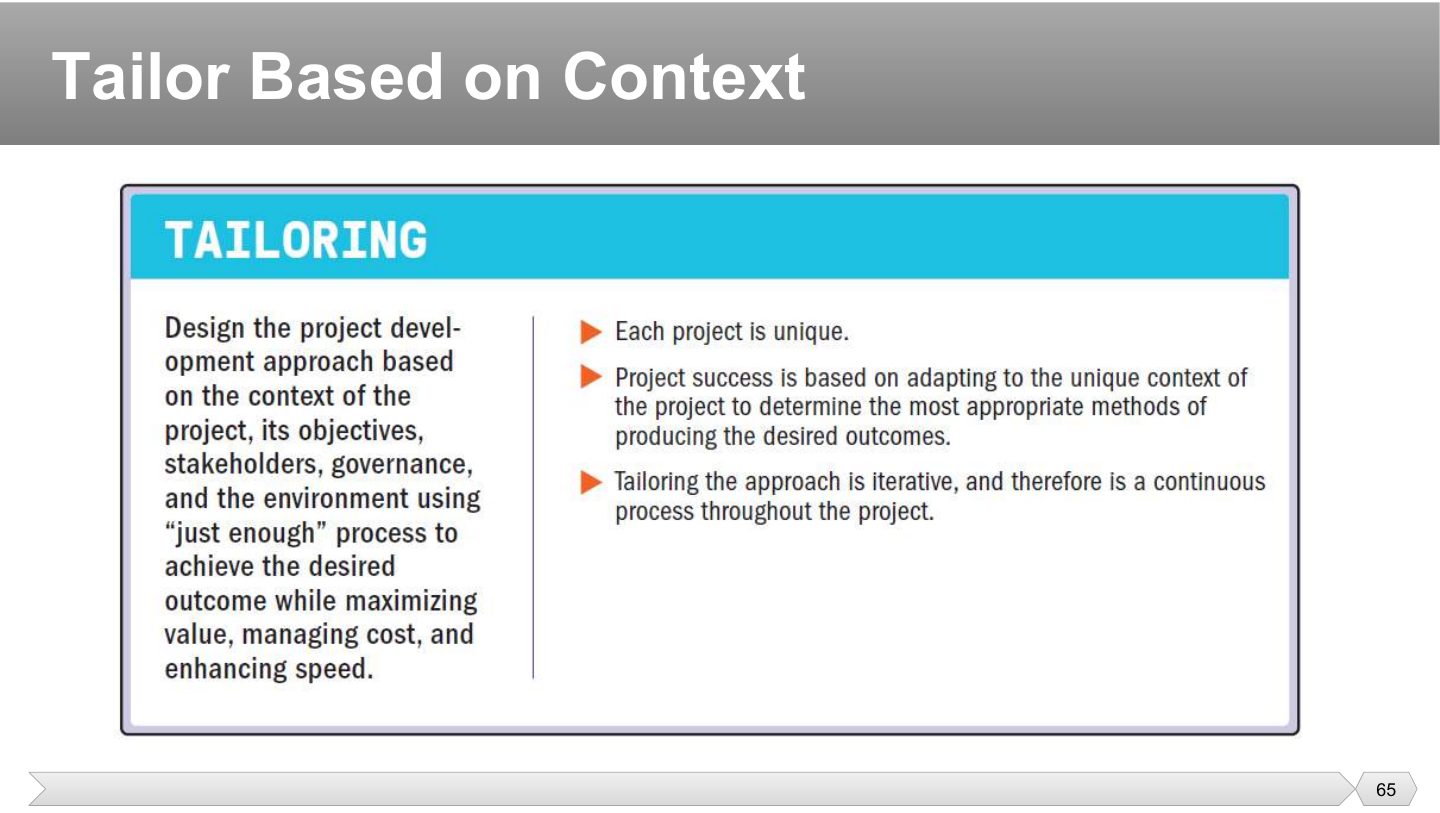
  65. 65 Tailor Based on Context
  66. 66 Build Quality into Processes and
  67. 67 Navigate Complexity
  68. 68 Optimize Risk Responses
  69. 69 Embrace Adaptability and Resiliency
  70. 70 Enable Change to Achieve the Envisioned
Slide 1 / 70

Slide 1

Slide 1: Slide 1

Notes

  1. This deck teaches the vocabulary the rest of the course depends on. When Chapter 5 says “optimize risk responses” or Chapter 8 says “engage stakeholders”, it assumes you already know what those phrases mean here, so time spent on this deck pays off in every later chapter.

  2. A software project manager rarely writes the code. The job is making sure many people’s work adds up to something the organization actually wanted, on time and within budget. That is why this is a management course inside a software engineering degree.

Tips & tricks

  • Study this deck in two passes: first get the big picture (what is a project, who does what), then return to memorize the lists (12 principles, 8 domains).
Slide 2 / 70

Outline

Slide 2: Outline

Notes

  1. The opening explains why anyone should care: organizations lose real money when projects are run badly.

  2. History shows the field did not appear from nowhere. Each development, such as separating technical and managerial leadership or creating PMOs, solved a problem people actually had.

  3. This part moves from the discipline to the person: what a PM is accountable for and which abilities separate good ones from bad ones.

  4. PMBOK is the reference standard the course follows, and it is where most exam questions from this deck come from. Expect to spend most of your revision time here.

Tips & tricks

  • Outline as a story: why it matters → how it developed → who does it → what rules they follow.
Slide 3 / 70

Introduction (section)

Slide 3: Introduction (section)

Notes

  1. Section divider. The next three slides answer one question: what is project management, and why are organizations paying attention to it?

Slide 4 / 70

What is Project Management?

Slide 4: What is Project Management?

Notes

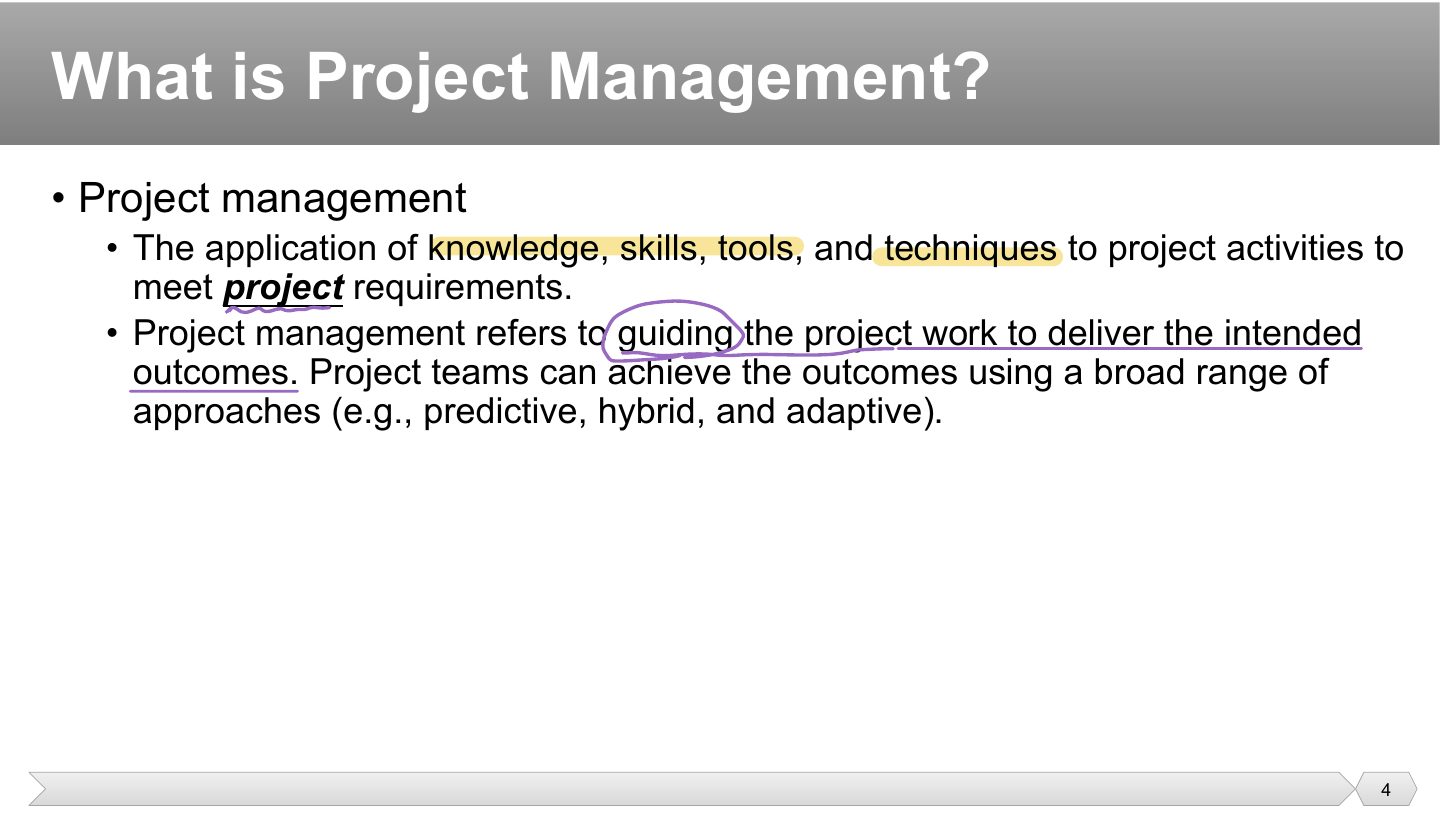
  1. Each of the four nouns does a different job. Knowledge is what you understand (how estimation works). Skills are what you can do well (running a tense meeting). Tools are the things you use (a Gantt chart, Jira). Techniques are the methods you follow (critical path analysis). The definition lists all four because owning a tool without the skill to use it isn’t project management.

  2. A PM guides the work rather than performs it. Think of a film director: the director doesn’t act or operate the camera, but without one, the actors and crew would not produce a coherent film. On a software project the developers write the code, while the PM keeps that work pointed at the outcome the organization wanted.

  3. The approach is a choice, not a rule. Predictive means plan it all up front, which suits fixed requirements such as a regulated banking system. Adaptive means build in short cycles and adjust, which suits a new app whose users’ needs are unclear. Hybrid mixes them. The slide’s point is that good project management does not depend on one method.

Tips & tricks

  • KiTTenS: Knowledge, Tools, Techniques, Skills.
  • Project management guides the work. If an option says the PM “does” or “writes” the work, be suspicious.

Exam angle

PredictionQ1

Project management is the application of ______ to project activities to meet project requirements.

PredictionQ2

A PM spends the week removing blockers, aligning the team on priorities and checking that the work still leads to what the client needs. She writes no code. Which statement describes this?

PredictionQ3

A team must follow fixed regulations and has stable requirements, so it plans the entire project up front. Which approach is this?

Slide 5 / 70

Introduction

Slide 5: Introduction

Notes

  1. The interest is growing because more of what organizations do now takes the form of projects: new systems, new products, digital transformation. Work that used to be routine operations increasingly has a start, an end and a specific result.

  2. Read these numbers as “demand is much larger than supply”. 87.7 million is the total number of people needed in PM-oriented roles by 2027, while 2.3 million is how many new people must enter each year. Many of those people won’t hold the title “project manager”, since team leads and engineers also run project work. For you, this means PM skills are useful even if you stay technical.

Tips & tricks

  • Don’t memorize the exact figures first. Remember the message, a global talent gap, then attach the numbers: 87.7M total by 2027 and 2.3M new per year to 2030.

Exam angle

PredictionQ1

According to PMI, how many people will employers need in project management–oriented roles by 2027?

PredictionQ2

PMI’s Talent Gap report says 2.3 million new project management employees will be needed each year to meet global demand by 2030.

Slide 6 / 70

Introduction

Slide 6: Introduction

Notes

  1. Employers’ top three skills for graduates are not technical: teamwork, problem-solving and verbal communication. Project work builds all three because it forces you to agree on a plan, handle things going wrong and explain decisions to others.

  2. The waste figure is the business case for this course. Out of every $1 billion spent on projects, $97 million (about 10%) produces nothing useful, usually because of unclear requirements, poor planning or weak control. A company spending $50 million would lose about $5 million, which easily justifies paying for good project management.

  3. The Saudi numbers make this local. A national strategy expected to grow the AI market to $135.2 billion by 2030, plus the world’s highest government technology spending ($24.7 billion in 2025, 21.7% of national spending), means many large projects will need people to run them, here in Saudi Arabia.

Tips & tricks

  • $97M per $1B ≈ 10% wasted. Remember the percentage, and you can always rebuild the number.

Exam angle

PredictionQ1

Which set lists the top skills employers look for in new graduates, according to the slide?

PredictionQ2

A company spends $2 billion on projects. Based on PMI’s Pulse of the Profession figure, about how much would it waste?

PredictionQ3

What does the slide say about Saudi Arabia’s government technology spending in 2025?

Slide 7 / 70

Project Management History (section)

Slide 7: Project Management History (section)

Notes

  1. Section divider. These slides show where the profession came from and what it now expects of its members.

Slide 8 / 70

The Project Management Profession

Slide 8: The Project Management Profession

Notes

  1. The profession is growing because the world’s work increasingly comes in the form of projects, and organizations have seen what poorly managed ones cost them.

  2. The slide names three threads to follow. History explains why the job looks as it does. Professional societies like PMI set shared standards and certifications, which is what makes it a profession rather than just a job title. Software made serious planning practical: a schedule with hundreds of tasks is unmanageable on paper but easy to update in a scheduling tool.

Tips & tricks

  • SHiP: Software, History, Professional societies. These are the three things the slide says you should understand.
Exam angle

PredictionQ1

Which three things does the slide say help you understand the project management profession?

PredictionQ2

According to the slide, the project management profession is growing slowly as companies move away from formal management.

Slide 9 / 70

History of Project Management

Slide 9: History of Project Management

Notes

  1. The pyramids count as projects in the modern sense because they were unique, had a clear goal and eventually ended. “Some people argue” matters here: without written methods, nobody can show that they used project management as we know it.

  2. The Manhattan Project, the US effort to build the atomic bomb during the Second World War, is the usual starting point for modern project management. It involved huge scale, a hard deadline and work spread across many sites, so informal coordination could not work.

  3. Its key lesson is the split between a project manager and a technical manager. Knowing the physics and running a three-year, $2 billion program are different jobs. Software teams still do this: an engineering lead makes the technical decisions, while the PM handles schedule, people and budget.

Tips & tricks

  • Picture two chairs at the head of the table: one for managing the project, one for leading the technology. That image is the Manhattan Project’s lesson.

Exam angle

PredictionQ1

Which project is usually considered the first to use “modern” project management?

PredictionQ2

What was distinctive about how the Manhattan Project was organized?

PredictionQ3

A $2 billion (1946 dollars), three-year effort: what do these numbers tell you about why modern project management emerged?

Slide 10 / 70

History of Project Management

Slide 10: History of Project Management

Notes

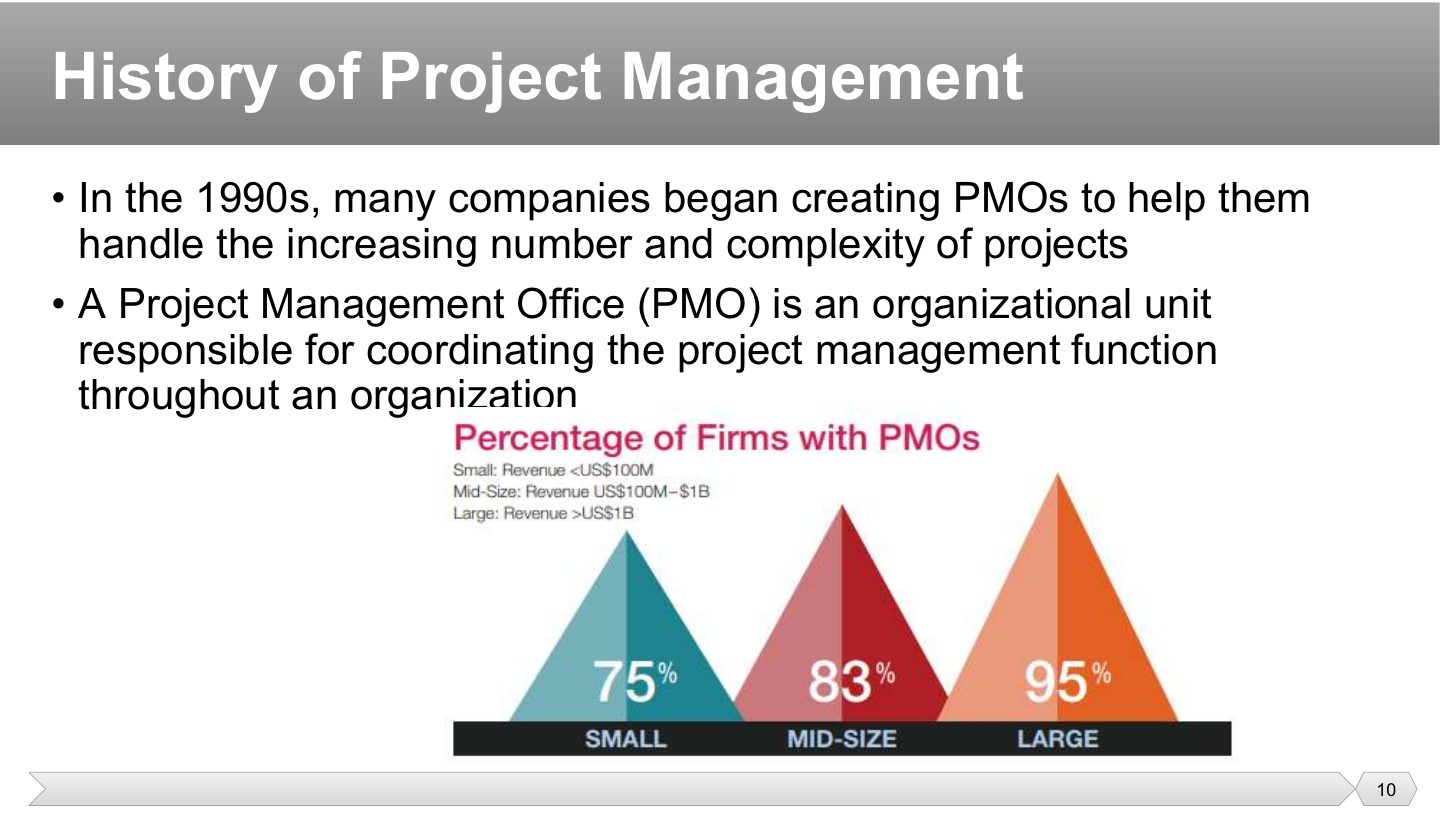
  1. Companies in the 1990s suddenly had dozens of projects running at once, sharing the same people and budgets. Each PM could run their own project well and the organization could still end up with chaos, such as three projects needing the same database expert in the same week. PMOs were created to solve that.

  2. Focus on the word coordinating. A PMO doesn’t usually run each project. It gives projects a common way of working (templates, standards, training), sees across all of them, and tells senior management how they are doing. Think of a university registrar: it doesn’t teach courses, but it makes all of them work together.

Tips & tricks

  • PMO = air traffic control. Pilots still fly the planes (PMs run projects), while the tower keeps everyone from colliding.

Exam angle

Past exam · Final 242 · Q1.3Q1

What is a Project Management Office (PMO) and its role in organizations?

Compare with the model answer

A PMO is a centralized organizational unit that oversees and standardizes how projects are managed. It sets PM standards, methods and templates, trains and supports project managers, monitors and reports on project performance, and coordinates resources across projects. Its control ranges from supportive (consultative) to controlling (requires compliance) to directive (manages the projects directly).

PredictionQ2

Why did many companies begin creating PMOs in the 1990s?

PredictionQ3

A PMO is best described as:

Slide 11 / 70

Global Issues

Slide 11: Global Issues

Notes

  1. Organizations struggle to find capable project and program managers, which matches the talent gap on slide 5. So they treat growing them as a strategic concern, through training, mentoring and career paths.

  2. “Core competency” means this is now a basic expectation. A software engineer may be asked to lead a small feature with its own plan and deadline, without ever being called a PM.

  3. Markets change quickly and requirements shift, and a plan made a year ago may no longer fit. So organizations want approaches that deliver in small pieces and adjust based on feedback. Chapter 4 covers this.

  4. Finishing on time and on budget used to be enough to call a project successful. Now organizations ask whether the promised benefit arrived. A mobile app delivered perfectly but used by nobody has no realized benefit.

Tips & tricks

  • CoBAlT: Core competencies, Benefits, Agile, Talent. These are the four global dynamics on the slide.
  • Delivered ≠ done. Benefits realization asks: “Did it actually help?”

Exam angle

PredictionQ1

A project finished on time and on budget, yet six months later almost nobody uses the system. Which global issue from the slide does this highlight?

PredictionQ2

A company adds “can plan and track a small project” to every engineer’s job requirements. Which dynamic is this?

PredictionQ3

Struggling to find enough experienced program managers, a company launches a mentoring path for them. Which dynamic does this respond to?

PredictionQ4

The slide says organizations want to use less agile approaches to project management.

Slide 12 / 70

Project Management Certification

Slide 12: Project Management Certification

Notes

  1. A profession needs a body that defines good practice. PMI plays that role for project management, and it publishes the PMBOK standard this course is built on. So when these slides say “the standard says”, they mean PMI.

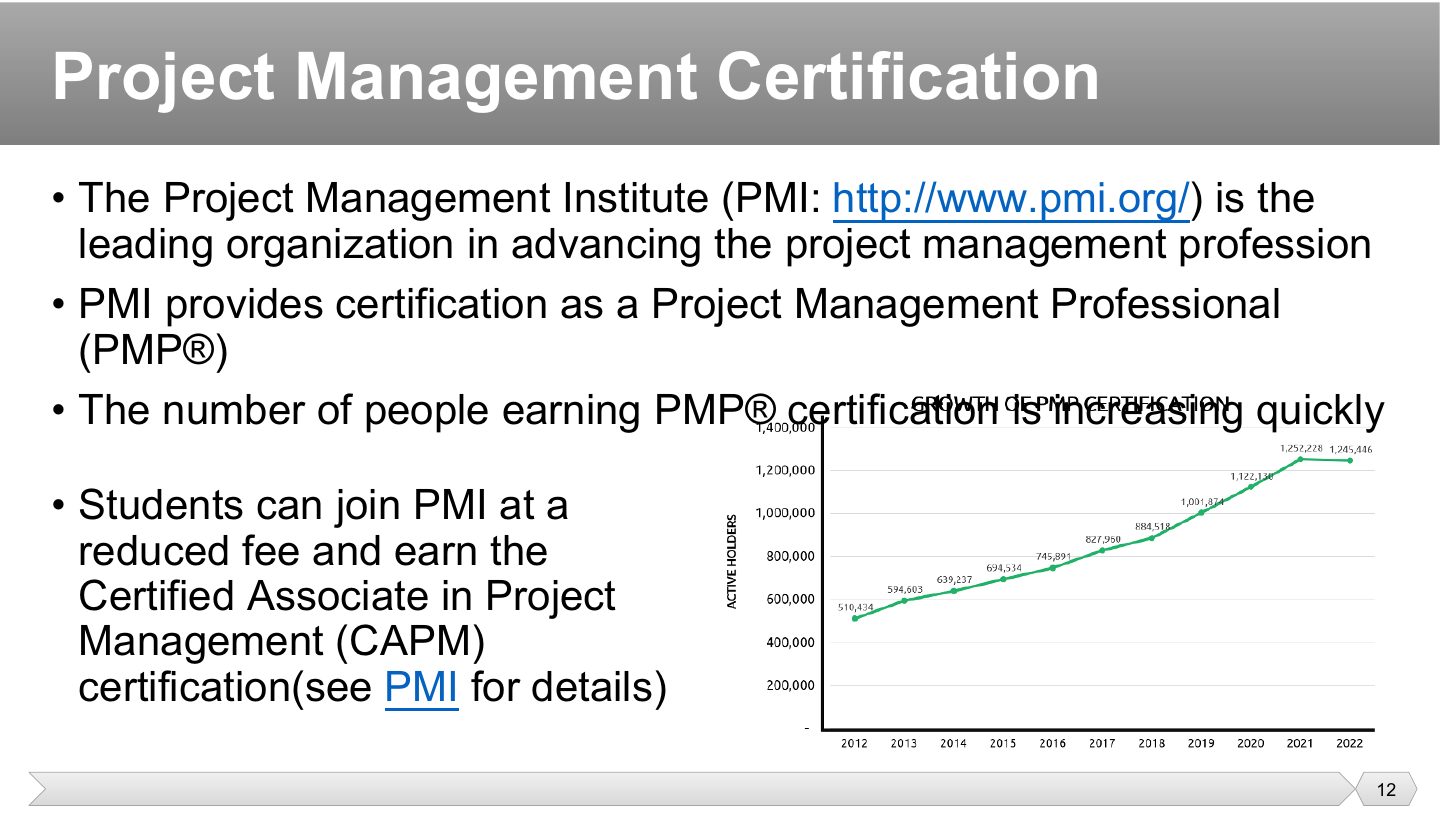
  2. A PMP is the professional-level certification. It signals to employers that someone has real experience and has passed a demanding exam, like a professional engineering license does in other fields. That is why demand for it keeps rising.

  3. The CAPM is the entry-level option, intended for students and people early in their careers who don’t yet have the project experience the PMP requires. This is the one relevant to you now.
Tips & tricks

  • CAPM starts with C, think “Come in”: the entry door. PMP = the “Professional” who has already got experience.

Exam angle

PredictionQ1

Which organization is described as the leader in advancing the project management profession?

PredictionQ2

A third-year student with no project experience wants a PMI certification. Which one does the slide point to?

PredictionQ3

The number of people earning PMP certification is decreasing quickly.

Slide 13 / 70

Ethics in Project Management

Slide 13: Ethics in Project Management

Notes

  1. The key word is personal values: ethics deals with what you believe is right and wrong, not only with what is legal. An action can be legal and still be unethical, like quietly reporting “on track” to a client when you know the project is not.

  2. A dilemma is a situation where the choices are all uncomfortable. A sponsor pressures you to hide a delay until after the funding decision. A friend’s company bids for your project’s contract. PMs face these often because they sit between clients, staff and executives who want different things.
  3. Agreeing to the code is a requirement for earning the PMP, and the exam tests professional responsibility. So ethics isn’t a side topic: the profession treats it as part of being qualified. The four values come on slide 55.
Tips & tricks

  • Ethics quick test: “Would I be comfortable if the client and my manager both saw exactly what I just did?”

Exam angle

PredictionQ1

Ethics is loosely defined as:

PredictionQ2

The sponsor asks the PM to report the project as “green” until the funding decision, although it is two months late. What is this?

PredictionQ3

What must applicants agree to in order to earn the PMP certification?

PredictionQ4

The PMP exam includes questions related to professional responsibility, including ethics.

Slide 14 / 70

Project Managers (section)

Slide 14: Project Managers (section)

Notes

  1. Section divider. The next slides move from the field to the person: what a project manager answers for and what makes one good.

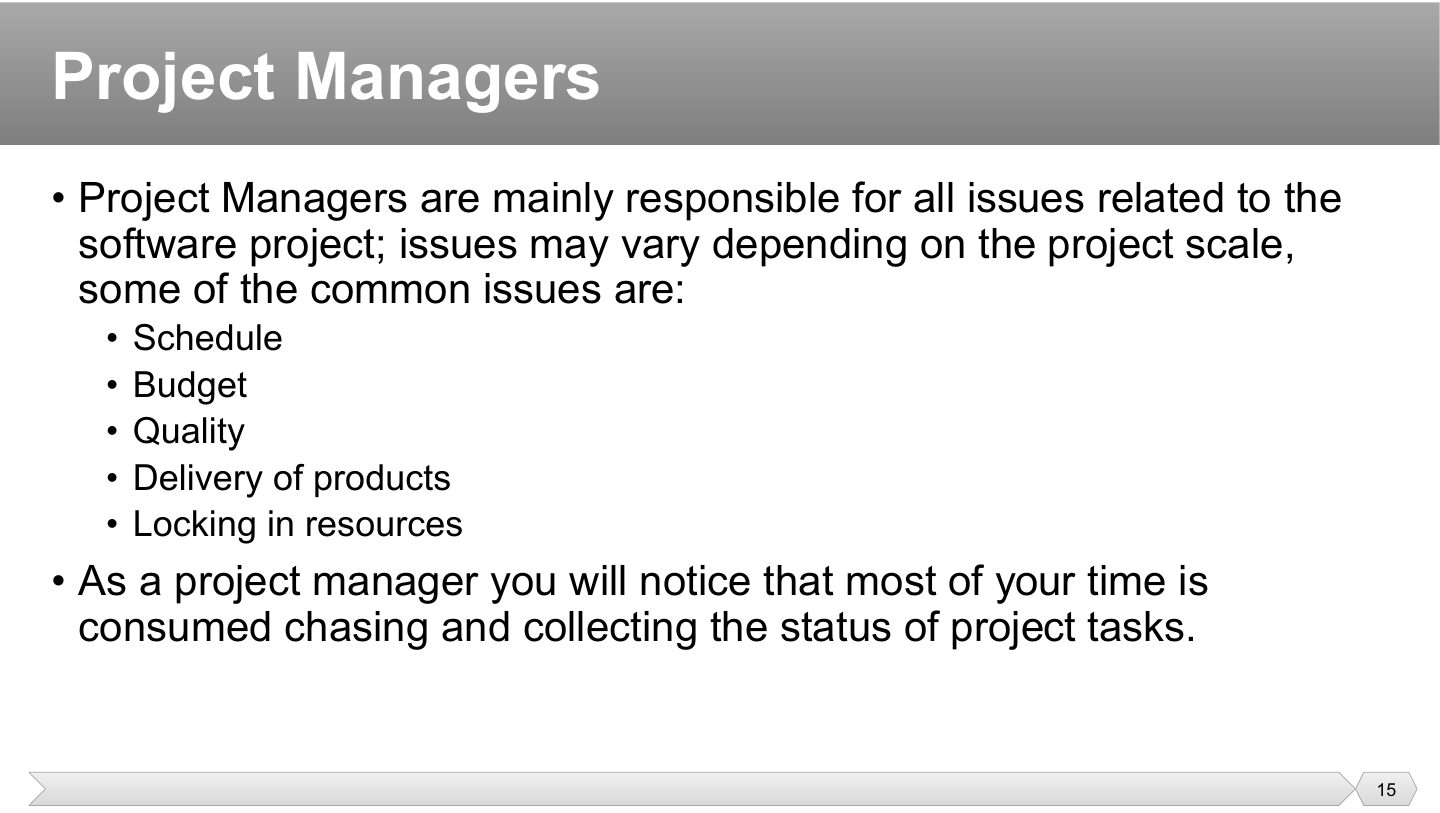
Slide 15 / 70

Project Managers

Slide 15: Project Managers

Notes

  1. The PM answers for anything that threatens the project, even when someone else caused it. Schedule, budget and quality pull against each other: finishing sooner usually costs more money or lowers quality, and much of the job is deciding which one to protect when you can’t keep all three. “Depending on the project scale” means a small project may blur these, while a large one may assign specialists to each.

  2. Delivery means the finished product reaches the customer in a usable state: deployed, documented and accepted, not merely “code complete”. Locking in resources means securing people and equipment early. Your best database engineer can be pulled onto another project unless you’ve secured them, and that can damage your schedule more than a technical bug would.

  3. New PMs expect to spend their days on strategy, and instead they ask “is that done yet?” all day. Each task’s status lives in someone’s head, and the PM can’t make decisions without it. That is why status meetings, dashboards and tracking tools exist.

Tips & tricks

  • SQuaBbLeD: Schedule, Quality, Budget, Locking in resources, Delivery.
  • Triangle trick: picture time, cost and quality at three corners. Pull one corner, and the others move.

Exam angle

Past exam · Final 242 · Q1.1Q1

Define the term ‘project constraints’ and explain how they influence project planning and execution. Provide at least three examples of common constraints and discuss their interrelationship.

Compare with the model answer

Project constraints are the limits a project must be delivered within. The classic three are scope, time and cost, often with quality, resources and risk. They drive planning because every schedule, budget and scope decision has to fit inside them, and during execution the PM keeps trading them off. They are interrelated (the triple constraint): cutting the schedule usually needs more cost or less scope, and adding scope needs more time or money; quality sits in the middle and suffers if they are squeezed.

PredictionQ2

A client wants delivery a month earlier with the same features. What should the PM expect?

PredictionQ3

Another project is about to take the only security engineer next month. Which PM responsibility from the slide applies?

PredictionQ4

What does the slide say consumes most of a project manager’s time?

PredictionQ5

The issues a project manager handles stay the same regardless of the project’s scale.

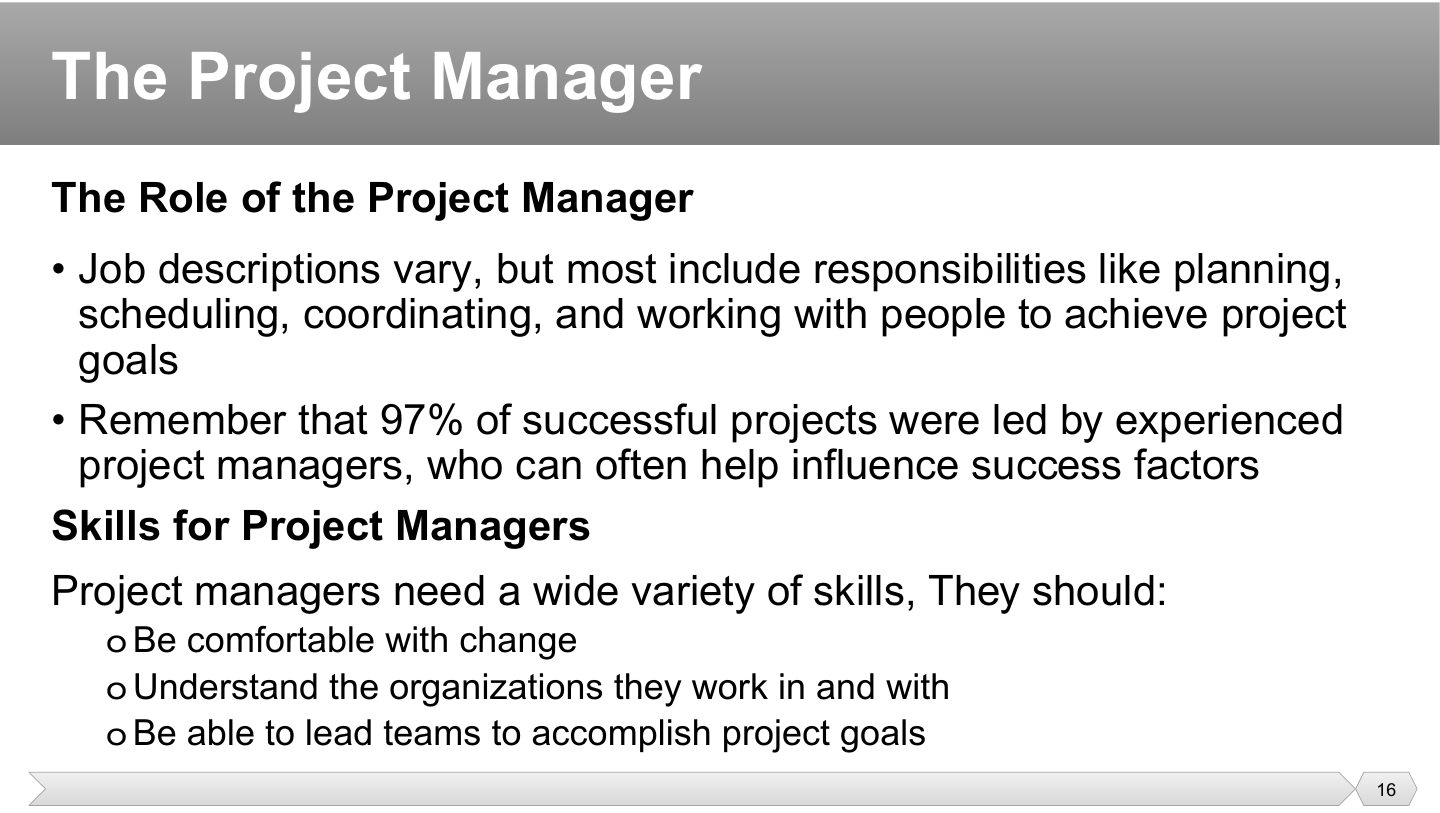
Slide 16 / 70

The Project Manager

Slide 16: The Project Manager

Notes

  1. Notice that all four responsibilities (planning, scheduling, coordinating, working with people) involve other people or their work. Job titles and descriptions vary across companies, but this core stays the same, whatever the industry.

  2. The 97% statistic is about experience. A PM who has seen projects fail recognizes warning signs early, knows who to talk to, and can influence the conditions for success. You can’t get that from a textbook alone, which is why junior PMs benefit from working under senior ones.

  3. These three skills address different things. Change: requirements and people will shift, and a PM who is upset by that won’t last. Understanding the organization: knowing who holds power and how decisions get made often matters more than the plan itself. Leading teams: you usually have no authority over the people on your project, so you get results by earning their cooperation.

Tips & tricks

  • SPaCeWalk: Scheduling, Planning, Coordinating, Working with people.
  • COoL: Change, Organization, Lead. These are the three skills, and a PM needs to stay cool under pressure.

Exam angle

PredictionQ1

Which list matches the responsibilities most PM job descriptions include, according to the slide?

PredictionQ2

What does the 97% statistic on the slide tell you?

PredictionQ3

A PM is talented technically, but keeps getting surprised that a department head can quietly block decisions. Which skill from the slide is missing?

PredictionQ4

Halfway through, the client changes direction, and the PM calmly replans instead of resisting. Which skill is this?

Slide 17 / 70

Competencies for Project Managers

Slide 17: Competencies for Project Managers

Notes

  1. People skills, leadership, listening and verbal communication are at the top because a PM’s only real tool is other people’s work. Listening earns its own line since a PM who talks more than they listen misses the early warnings from the team.

  2. Most PMs have no formal authority over their team, so people cooperate only if they believe the PM. Trust is what makes them do what you ask, and integrity and consistency are how you earn it. A PM who treats people differently from one week to the next quickly loses their trust.

  3. These are for situations with competing interests. Conflict resolution handles disagreements inside the team. Negotiating gets resources from other managers. Influencing the organization gets decisions made above your level. Balancing priorities and critical thinking are how you decide what matters when everything feels urgent.

  4. Only one of the 14 is technical, and it is last on the list. A PM needs enough technical understanding to spot nonsense and earn the team’s respect, not to be the best engineer. This surprises many engineers who become PMs.

Tips & tricks

  • Sort the 14 into three buckets rather than memorizing a list: People (skills, listening, verbal, teams, mentoring), Character (integrity, trust, leadership), Decisions and politics (conflict, critical thinking, priorities, negotiating, influencing). Then add Process and technical as the odd one out.
  • Scenario trick: look at what is going wrong. People arguing → conflict resolution. Need budget from another manager → negotiating. Decision stuck above you → influencing.

Exam angle

PredictionQ1

Two senior developers keep arguing about the architecture in every meeting, and the rest of the team has stopped contributing. Which project manager competencies does this call for, and what should the PM do?

Compare with the model answer

Conflict resolution/management, listening and building trust (plus team building). The PM should bring the disagreement into the open, keep it about the ideas rather than the people, make sure everyone is heard, and drive the group to a decision that the whole team commits to.

PredictionQ2

A PM needs a database expert who reports to another manager, and must agree on how many days she can have him. Which competency does this use?

PredictionQ3

A PM keeps the same standards for everyone and always does what she says she will. Over time, the team tells her about problems early. Which competencies explain this?

PredictionQ4

A senior engineer spends an hour a week helping a new graduate learn how to estimate tasks. Which competency is this?

PredictionQ5

A key decision has been stuck with senior management for weeks. The PM builds support among other department heads to move it forward. Which competency is this?

PredictionQ6

Three urgent requests arrive at the same time, and the PM decides which one matters most for the project goals. Which competency is this?

PredictionQ7

Most of the 14 competencies for project managers are technical.

Slide 18 / 70

Advantages of Using Formal Project

Slide 18: Advantages of Using Formal Project

Notes

  1. Without formal PM, money, equipment and people get spent wherever someone shouts loudest. With it, there is a plan and a budget to compare against, so overspending shows up early instead of at the end. Productivity and profit improve because people spend less time on the wrong work and on redoing it.

  2. Most delays and defects come from unclear requirements and late changes. Formal PM reduces both by agreeing on the work early and checking it regularly, which is why time and quality can improve together. Customers notice too, since they are told what is coming rather than being surprised.

  3. When teams plan together, they stop stepping on each other’s work, which is “better internal coordination”. Strategic goals benefit because projects are how a strategy gets carried out: if projects deliver, the strategy happens.

  4. People notice this benefit last, but it’s very real. Poor planning leads to last-minute crunches, so staff work late and quit. Planned work spreads the effort, giving higher morale and less stress, which then feeds back into quality.

Tips & tricks

  • Group the ten into four: Money (control of resources, lower costs, profit), Delivery (time, quality, customers), Coordination/Strategy (internal coordination, strategic goals), People (morale, not overworked). Remember “CaMPeD”: Coordination, Money, People, Delivery.

Exam angle

Past exam · Final 251 · Q1.1Q1

How does project management contribute to organizations in achieving their strategic objectives? Please elaborate.

Compare with the model answer

Strategy is carried out through projects. Project management selects and prioritizes projects (through portfolios and programs) so they align with strategic objectives, then delivers them so the outputs create the intended outcomes, benefits and value. It uses limited resources efficiently, controls scope, time and cost, and manages risk and change. That lets the organization reach its goals and respond to its market faster than competitors.

PredictionQ2

Which is NOT listed on the slide as an advantage of using formal project management?

PredictionQ3

After adopting formal PM, a team stops doing weekend crunches before each release. Which listed advantage does this show?

PredictionQ4

The finance team can now see what each project spends and which staff it uses. Which listed advantage is this?

PredictionQ5

Two departments stop duplicating work because their project plans are shared. Which listed advantage is this?

Slide 19 / 70

Project Management Body of Knowledge (section)

Slide 19: Project Management Body of Knowledge (section)

Notes

  1. Section divider. PMBOK (the Project Management Body of Knowledge) is PMI’s reference for the profession. These slides use its 7th edition, which is organized around principles and performance domains rather than step-by-step processes.

Slide 20 / 70

The Purpose of The Standard for Project

Slide 20: The Purpose of The Standard for Project

Notes

  1. “Basis for understanding” means the standard gives everyone a shared language. When a contractor from another country says “stakeholder” or “deliverable”, you can both mean the same thing. It explains what project management is for rather than telling you exact steps to follow.

  2. The standard applies to a bank, a hospital, a five-person startup or a national program, and to agile or waterfall teams. If it depended on one industry or method, it couldn’t work as a shared language. Exam options that limit it to large, IT or waterfall projects are false.

  3. The slide says the standard looks beyond the project itself: governance (who makes decisions), functions (who does what), the environment (what surrounds the project) and how it relates to product management (what happens to the product after the project ends). A project’s success depends on all of these, not only on its internal plan.

Tips & tricks

  • SLID: Size, Location, Industry, Delivery approach. The standard applies regardless of these, so if an answer limits it by any of them, it’s wrong.
  • The four things it describes: FiG PiE — Functions, Governance, Product, Environment.

Exam angle

PredictionQ1

The Standard for Project Management applies only to large projects that use a predictive delivery approach.

PredictionQ2

What does the Standard for Project Management provide?

PredictionQ3

Besides the project itself, what does the standard describe?

Slide 21 / 70

Project Management

Slide 21: Project Management

Notes

  1. Principles describe how to behave, not what steps to take. Stewardship means treating the money, people and trust you’ve been given as if they were not yours to waste: reporting honestly, spending carefully, thinking about consequences beyond this project.

  2. Team and Stakeholders are both about people, but in different directions: inward and outward. A team with trust raises problems early. Stakeholders involved from the start tell you what they need before you’ve built the wrong thing.

  3. These three set direction. Value asks, “Is this worth doing?” rather than “Did we finish the list?” Systems thinking reminds you that a change here can break something elsewhere. Leadership means setting the example with integrity, and the slide’s “adaptability and empathy” means adjusting to what people need.

  4. These three shape how the work gets done. Tailoring: no method fits every project, so adapt it. Quality: building it in from the start is cheaper than fixing it at the end. Complexity: some things can’t be fully predicted, so expect that and stay alert.

  5. These three deal with an unpredictable future. Risk: find what might go wrong (or right) and act before it happens. Adaptability and resiliency: bend when conditions change, and recover after a hit. Change: help people move to the new way of working, since a delivered system nobody adopts fails.

Tips & tricks

  • Remember them in four groups of three: People-with-care (Stewardship, Team, Stakeholders), Direction (Value, Systems, Leadership), How we work (Tailoring, Quality, Complexity), The future (Risk, Adaptability, Change).
  • Sentence trick for the order: Some Teams See Value, Systems, Leaders; They Quickly Conquer Risk And Change.
  • 12 principles = how to behave. 8 domains = what to focus on. The bigger number is behaviour.

Exam angle

Past exam · Midterm 251 · V1 · MCQ 5Q1

Which of the following best reflects the principle of “Stewardship” in project management?

Past exam · Midterm 261 · MCQQ2

A project team has limited resources and must choose the feature that will provide the greatest benefit to users. Which principle applies?

PredictionQ3

Developers feel safe admitting mistakes in meetings, and they openly raise concerns. Which principle is being applied?

PredictionQ4

A PM brings end users into requirements sessions from the very first week. Which principle is this?

PredictionQ5

A small startup drops most of the heavy documentation its parent company requires, keeping only what is needed for a two-person project. Which principle is this?

PredictionQ6

The team adds automated tests and code reviews from the first sprint instead of testing at the end. Which principle is this?

PredictionQ7

Before starting, the team lists what could go wrong and prepares a backup supplier. Which principle is this?

PredictionQ8

When a vendor suddenly goes out of business, the team quickly switches to another and keeps going. Which principle is this?

PredictionQ9

The PM helps staff learn the new system and move away from the old process over several months. Which principle is this?

PredictionQ10

A leader adjusts how she treats team members, patient with one who is struggling and direct with another who prefers it. Which principle is this?

PredictionQ11

Nobody can predict how three new technologies and two departments will interact, so the team reviews the situation often and stays alert. Which principle is this?

PredictionQ12

The PMBOK v7 principles are a sequence of steps to be carried out in order.

Slide 22 / 70

Project Management

Slide 22: Project Management

Notes

  1. A domain is something you must keep paying attention to. Think of driving: steering, speed and mirrors aren’t steps you do in order, you handle them all at once throughout the journey. Domains work the same way, and they influence each other. That is why “phases”, “steps” and “in order” are wrong answers.

  2. Each one asks its own question. Stakeholders: who cares about this? Team: are the people working well? Development approach and life cycle: how will we build it? Planning: what’s the plan? Project work: how’s the day-to-day? Delivery: are we producing what’s needed? Measurement: how are we doing? Uncertainty: what might surprise us? Chapter 1.2 covers each in depth.

Tips & tricks

  • Sentence for the eight: Some Teams Don’t Plan Properly, Delaying Many Updates (Stakeholders, Team, Development, Planning, Project work, Delivery, Measurement, Uncertainty).
  • Domains = driving: you do them all at once, not in sequence.

Exam angle

Past exam · Midterm 251 · V1 · MCQ 3Q1

Which of the following best explains the nature of project performance domains?

PredictionQ2

Which of these is NOT one of the 8 performance domains?

PredictionQ3

How many project performance domains does PMBOK v7 define?

PredictionQ4

A team is deciding whether to work in sprints or plan everything first. Which domain does this fall under?

PredictionQ5

A PM tracks progress against targets and reports trends to the sponsor. Which domain is this?

PredictionQ6

Performance domains are carried out one at a time: when the Planning domain ends, the Project Work domain begins.

Slide 23 / 70

Key Terms and Concepts (section)

Slide 23: Key Terms and Concepts (section)

Notes

  1. Section divider. The next five slides define the terms the exams test most. Similar-sounding pairs like program and portfolio, or project and product, are used on purpose, so learn what separates them.

Slide 24 / 70

Key Terms and Concepts

Slide 24: Key Terms and Concepts

Notes

  1. An outcome is the difference something makes, while an output is the thing itself. A hospital’s new appointment app is an output. Fewer missed appointments is the outcome, and that outcome is why anyone paid for the app. If the app ships but missed appointments stay the same, you have an output with no useful outcome.

  2. A portfolio is how leadership looks at everything the organization is investing in, grouped by strategy. The items don’t have to relate to each other, like a new R&D program, a marketing campaign and a data center upgrade. It is also the only grouping here that includes ongoing operations. The question it answers: “Is this the right mix of work for our strategy?”

  3. A product is something real you can count. “Quantifiable” means you can point at it and measure it: one mobile app, 500 units. “End item or component” means a login module counts as a product just like the whole app does.

Tips & tricks

  • Output = the thing. Outcome = the difference it makes.
  • Portfolio = your investment portfolio: stocks, bonds and property that have nothing to do with each other, chosen together for one goal.

Exam angle

PredictionQ1

“Projects, programs, subsidiary portfolios, and operations managed as a group to achieve strategic objectives” defines a:

PredictionQ2

A team ships a new online ordering system, and average customer wait time falls by 30%. Which is the outcome?

PredictionQ3

A company groups an R&D program, a marketing campaign and an infrastructure upgrade together for strategic oversight, though they are unrelated. What is this?

PredictionQ4

Which of these fits the definition of a product?

PredictionQ5

Outcomes can include outputs and artifacts, but they focus more broadly on the benefits and value the project was undertaken to deliver.

Slide 25 / 70

Key Terms and Concepts

Slide 25: Key Terms and Concepts

Notes

  1. A program exists because the pieces are worth more together. A bank might run mobile, branch and call-center upgrades as separate projects, but coordinated together, customers get one consistent experience, which none of the projects could achieve alone. That extra is “benefits not available from managing them individually”. No extra benefit means there’s no reason for a program.

  2. A project has two defining features. Temporary means it has a start and an end, not that it is short: a five-year metro construction is still temporary. Unique means the result has not been produced in exactly this way before. Monthly payroll is neither, so it is an operation. “Or a phase of the project work” means phases have their own beginning and end too.

  3. A project doesn’t have to belong to anything. A small company might run one website redesign without any program or portfolio around it. An exam option saying projects “must” be part of a program is false.

Tips & tricks

  • Portfolio = strategy (may be unrelated). Program = related + extra benefits. Project = temporary + unique.
  • Program test: remove the coordination. Does anything get lost? If yes, it’s a program.
  • Project test: does it end? Is it one of a kind? Two yeses means it’s a project.

Exam angle

Past exam · Midterm 251 · V1 · MCQ 2Q1

A group of related projects managed in a coordinated manner to obtain benefits not available from managing them individually is called a:

PredictionQ2

A company runs monthly payroll using the same process every time. Is this a project?

PredictionQ3

A project lasting four years cannot be considered “temporary”.

PredictionQ4

Every project must be part of a program or portfolio.

PredictionQ5

A company’s digital transformation combines several related projects so that their results work together in ways no single project could achieve. This is best called a:

Slide 26 / 70

Key Terms and Concepts

Slide 26: Key Terms and Concepts

Notes

  1. “Assigned by the performing organization” tells you where the PM’s authority comes from: the organization doing the work appoints them. The team doesn’t vote them in, and the client doesn’t pick them. They are accountable for the project’s objectives on the organization’s behalf.

  2. The two functions are different in character. Facilitating is about people: clearing obstacles, connecting those who need to talk, keeping the team moving. Managing processes is about the system: planning, tracking, controlling. A PM strong in only one has a team that either likes them but misses deadlines, or follows the plan but burns out.

Tips & tricks

  • Two hats: Facilitator (people) and Manager of processes (system). Remember FM, like the radio.

Exam angle

PredictionQ1

Who assigns the project manager, according to the definition?

PredictionQ2

A PM sets up a meeting between the design and backend teams to clear a blocker so that they can keep moving. Which function is this?

PredictionQ3

A PM updates the schedule, tracks progress and enforces the change process. Which function is this?

Slide 27 / 70

Key Terms and Concepts

Slide 27: Key Terms and Concepts

Notes

  1. The project team is everyone doing the project’s work: developers, testers, designers, the PM too. The test is simple: are you working on it?

  2. The project management team is the subset managing the work, like the PM, a scheduler or a team lead who plans. All of the management team is on the project team, but not the other way round. The names are so similar that this is a natural exam trap, so focus on the word “management”.

  3. The system for value delivery is the big picture. An organization doesn’t create value from one project. It comes from everything working together, including projects, products and the operations that run them day to day. “Building, sustaining and/or advancing” means the system both keeps the business going and moves it forward.

Tips & tricks

  • Project team ⊃ project management team: a big circle (everyone working) with a small circle inside it (those managing).
  • System for value delivery contains 5 things: four Ps and an O — Portfolios, Programs, Projects, Products, Operations.

Exam angle

Past exam · Midterm 251 · V1 · MCQ 9Q1

In the context of the “system for value delivery,” which of the following is the most accurate statement?

PredictionQ2

A tester on a software project does no planning or tracking. Which group is she in?

PredictionQ3

The “project management team” is best defined as:

PredictionQ4

Portfolios, programs, projects, products, and operations can all be part of an organization’s system for value delivery.

Slide 28 / 70

Key Terms and Concepts

Slide 28: Key Terms and Concepts

Notes

  1. The key idea is that value depends on who is asking. A faster checkout is valuable to a customer, while a compliance feature nobody sees is valuable to the company because it avoids fines. A project can fail for one group and succeed for another, so “who needs this and why?” is an essential question.

  2. Customers judge value directly: can I do what I need with it? They care about the feature working, not what it cost to build.

  3. Business value is what the organization gains after paying for it: a project bringing $5 million in savings at a cost of $2 million has $3 million in value. That calculation is what “benefits less the cost” means.

  4. Societal value counts effects on people outside the deal. A public health portal might never make a profit but helps a whole community. This shows that value doesn’t have to be financial.

Tips & tricks

  • CuBS: Customer (features), Business (money), Society (community and environment).
  • Business value formula: benefits − cost.

Exam angle

PredictionQ1

An organization measures a project’s “benefits less the cost of achieving those benefits”. Which type of value is this?

PredictionQ2

A project saves $5M per year and cost $2M to deliver. Using the slide’s definition, what is the first-year business value?

PredictionQ3

Users praise a new app because it lets them pay bills with a single tap. What kind of value do they see?

PredictionQ4

A free flood-warning system protects villages but makes no profit. What value does it provide?

PredictionQ5

All stakeholders perceive a project’s value in the same way.

Slide 29 / 70

A System for Value Delivery (section)

Slide 29: A System for Value Delivery (section)

Notes

  1. Section divider. So far the terms were separate. This section shows how they fit together into one system that produces value.

Slide 30 / 70

A System for Value Delivery

Slide 30: A System for Value Delivery

Notes

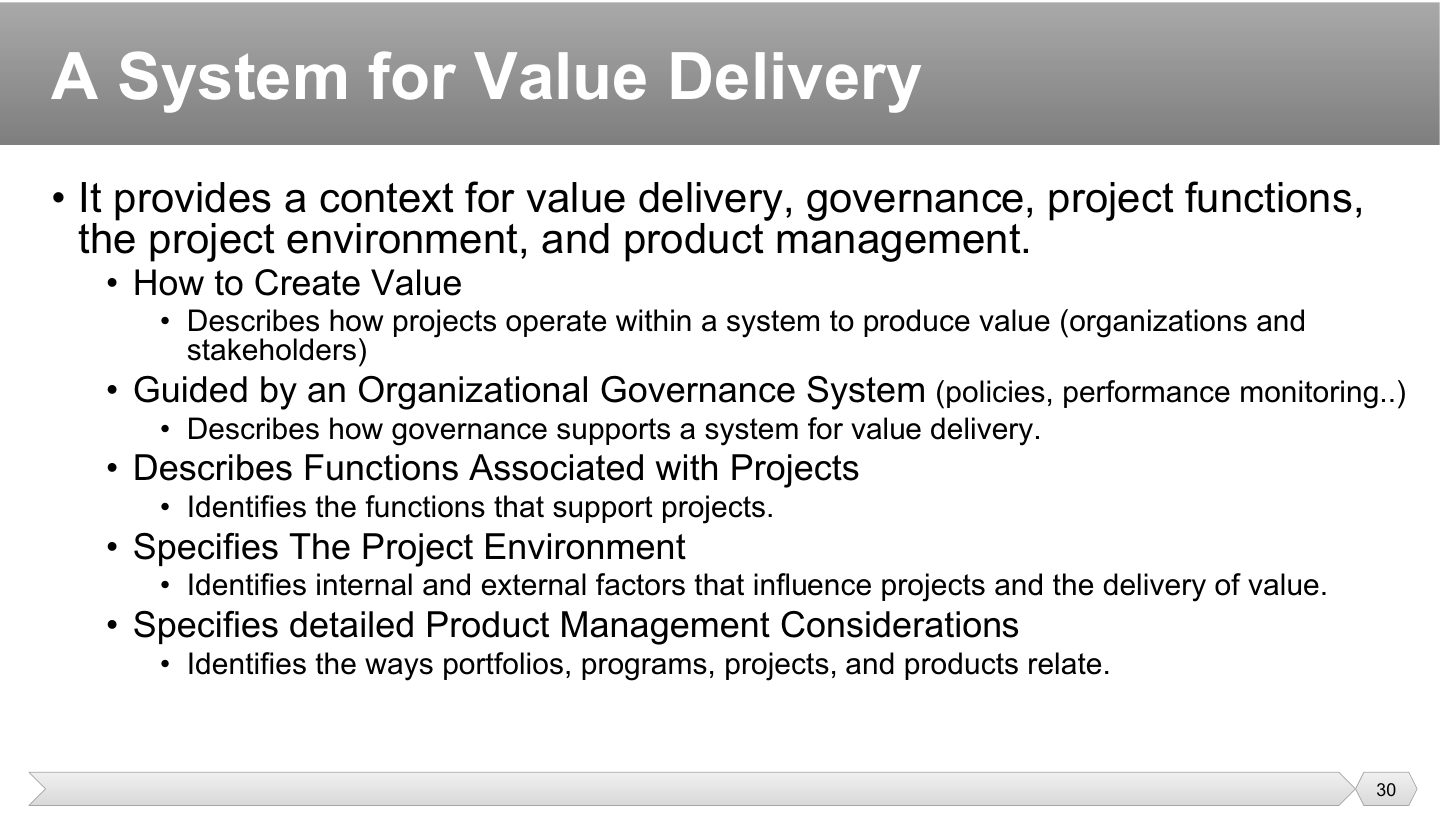
  1. “Context” means this is the map of what surrounds a project. A project isn’t an isolated bubble: it has rules, supporting roles and outside pressures, and it hands its result to someone. The five items below are the sections of this part of the deck.

  2. How to create value: what a project is for. The rest of the system exists to serve this.

  3. Governance: who decides, and by what rules. Policies and performance monitoring keep work aligned with the organization.

  4. Functions: the jobs that need doing. Notice it says functions, not job titles, since one person might do several.

  5. Environment: what you can’t fully control. Internal factors include staff skills, and external ones include laws and the market.

  6. Product management: what happens beyond the project. Projects end, but the product they create continues.

Tips & tricks

  • Slide 20’s FiG PiE plus Value: a fig pie of great value. Functions, Governance, Product, Environment, Value.

Exam angle

PredictionQ1

Which element of the system identifies internal and external factors that influence projects?

PredictionQ2

Policies and performance monitoring that guide project work belong to which part of the system?

PredictionQ3

Which part of the system describes how portfolios, programs, projects and products relate?

PredictionQ4

Which part of the system identifies the functions that support projects?

PredictionQ5

Which part of the system describes how projects operate within a system to produce value for organizations and stakeholders?

Slide 31 / 70

Creating Value

Slide 31: Creating Value

Notes

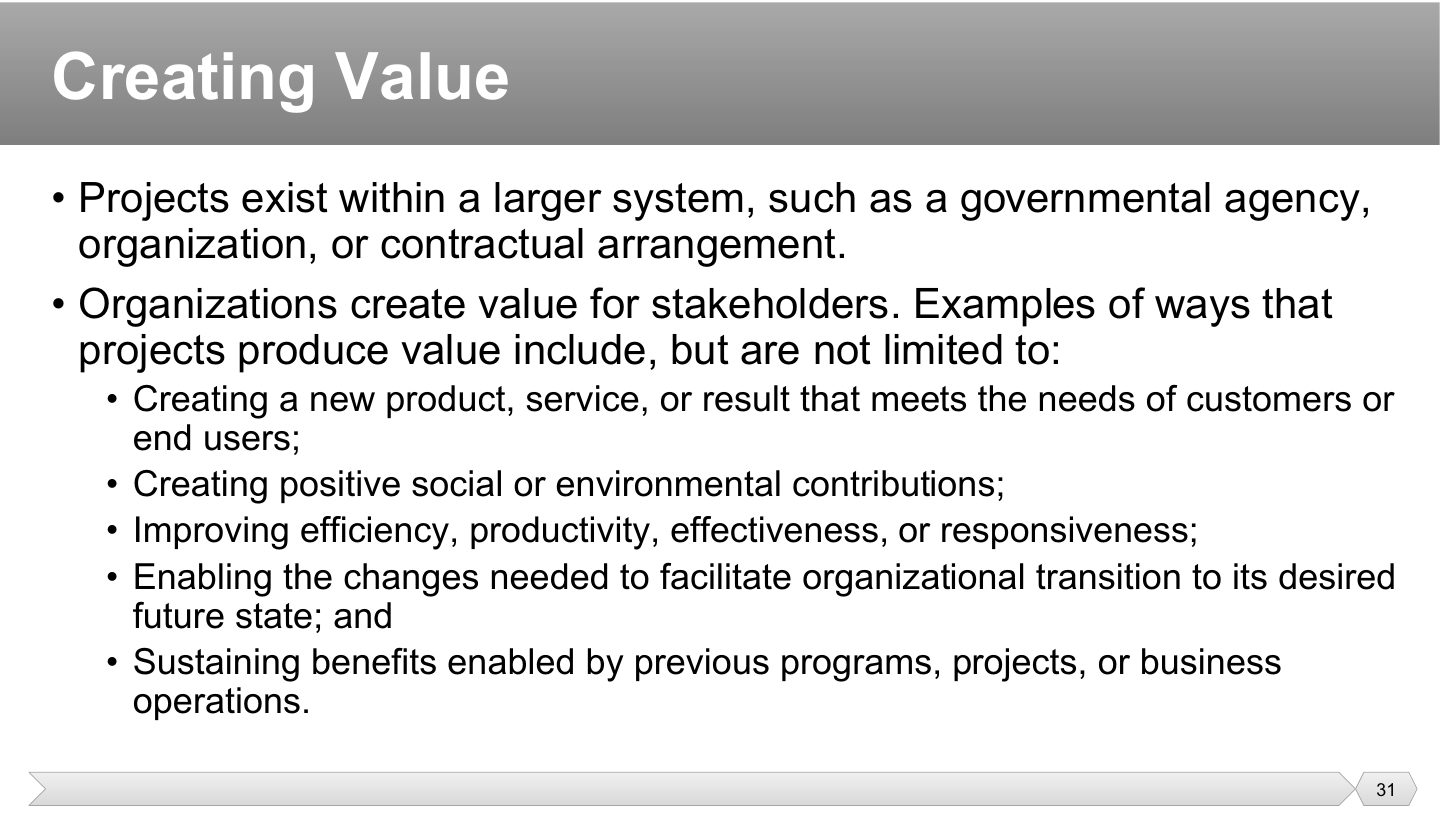
  1. A project is never done for its own sake. “Larger system” means someone outside it, like a ministry, a company or a client under contract, wants the result. So when you’re judging a project, always ask what the larger system needed from it.

  2. These five answers to “why do this project?” are easy to confuse, so look at what actually changes in each case:

    New product, service or result
    Something exists that didn’t before, such as a new banking app.
    Social or environmental contribution
    People or the planet benefit, and profit isn’t the point: a public-health portal.
    Efficiency or responsiveness
    The same work gets done better or faster: tablets replacing nurses’ paper forms.
    Enabling change
    The organization becomes something new. A paper-based ministry moves to digital services.
    Sustaining benefits
    Nothing new is gained, but existing value is protected: upgrading an aging system customers rely on.

Tips & tricks

  • Five ways, SCENeS: Social, Change, Efficiency, New, Sustain.
  • “Efficiency” improves today’s way of working. “Enabling change” moves to a different way of working.

Exam angle

PredictionQ1

A hospital project replaces paper forms with tablets so nurses spend less time on administration. Which way of creating value does it show?

PredictionQ2

A company launches a new mobile banking app for its customers. Which way of creating value is this?

PredictionQ3

A charity builds a solar-powered water system for remote villages. Which way of creating value is this?

PredictionQ4

A ministry’s project moves its whole operation from paper to digital so that it can work in a new way. Which way of creating value is this?

PredictionQ5

A company upgrades an aging billing system so that it can continue serving customers as it has for ten years. Which way of creating value is this?

PredictionQ6

Projects exist as stand-alone efforts, outside any larger system.

Slide 32 / 70

Value Delivery Components

Slide 32: Value Delivery Components

Notes

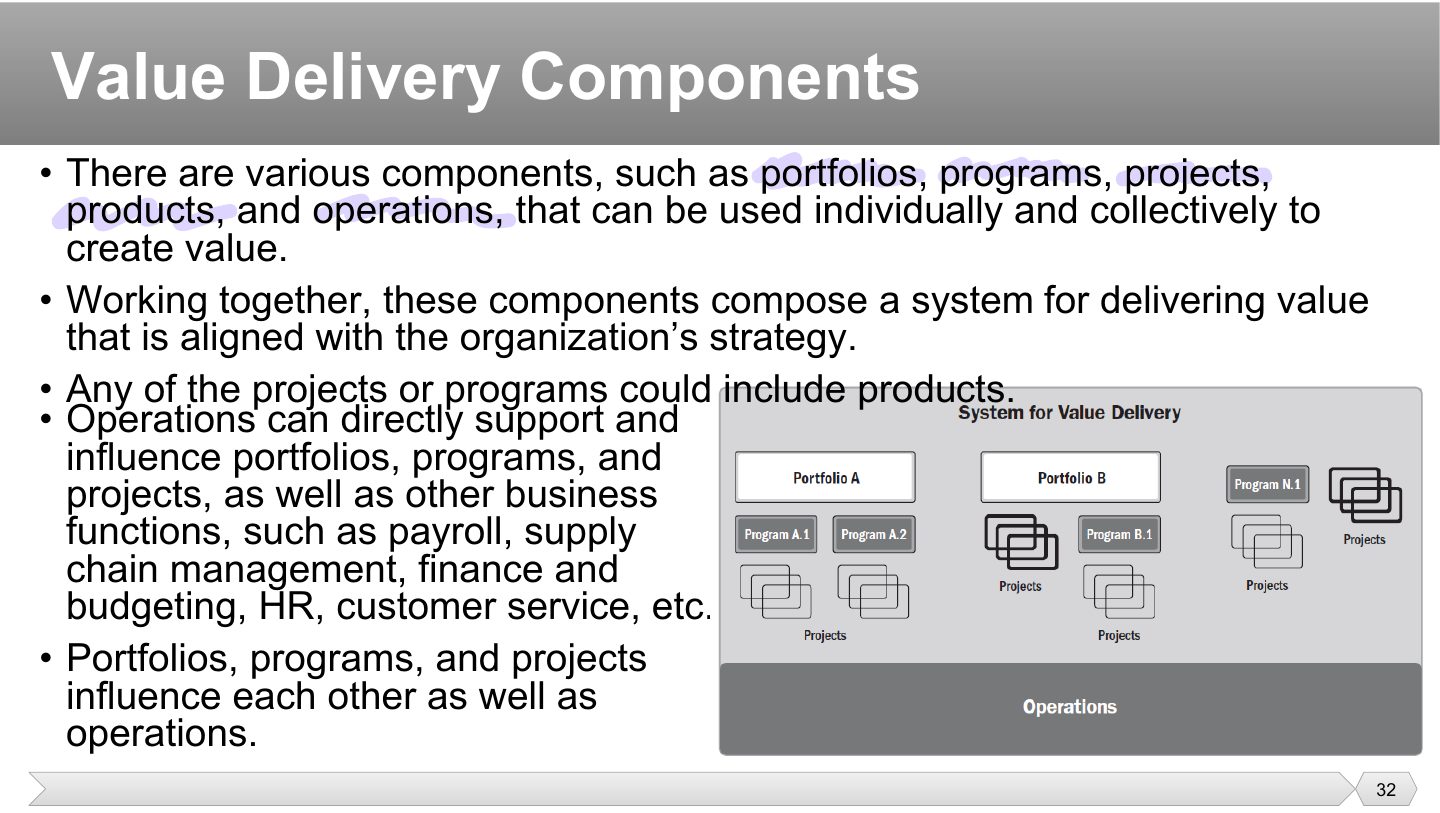
  1. Value can come from one project on its own, or from many pieces working together. A portfolio of average projects that support each other can be worth more than one excellent project in isolation.

  2. “Aligned with strategy” means the pieces aren’t a random set of work, they all point toward what the organization has decided to become. If a project doesn’t help with the strategy, it may be good work that shouldn’t be done.

  3. Operations are the routine, ongoing functions: payroll, supply chain, finance, HR, customer service. They support projects (HR hires for them, finance pays for them) and influence them (customer service reports what users actually complain about). Remember that when a project ends, operations often inherit what it built.

  4. The influence goes in all directions. A portfolio’s budget cut can cancel a project. A project’s new system changes how operations work. A failing project can damage a program’s benefits. That is why the slide’s picture shows connected boxes rather than a chain.

Tips & tricks

  • Think of a family business: projects are the new shop being opened, operations keep the existing shops running, and each affects the other.

Exam angle

PredictionQ1

Which of these is an example of operations, as the slide uses the term?

PredictionQ2

Portfolios, programs, and projects influence each other as well as operations.

PredictionQ3

Value can only be created by the components working together, never individually.

PredictionQ4

Why does it matter that the components are “aligned with the organization’s strategy”?

PredictionQ5

Any of the projects or programs in the system could include products.

PredictionQ6

Customer service tells a project team that users keep failing at one step, and the team changes the design. What does this show?

Slide 33 / 70

Value Delivery Components

Slide 33: Value Delivery Components

Notes

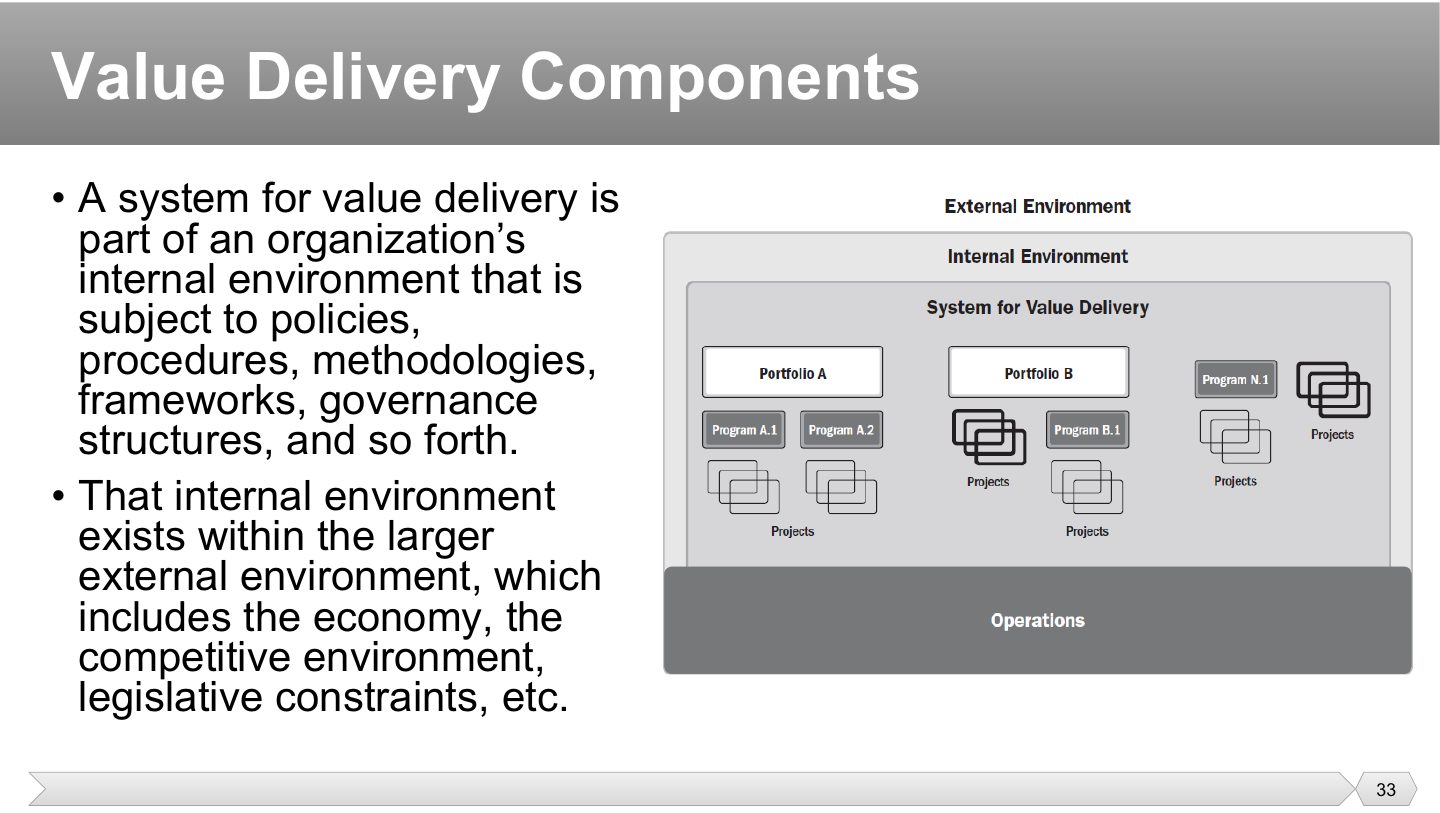
  1. Picture the system sitting inside the organization’s rules. Internal means things the organization itself sets and can change: its policies, procedures, methodologies and governance structures. A PM can’t ignore them, but the organization could change them if it wished.

  2. That whole organization sits inside a wider world it doesn’t control. The economy can shrink, a competitor can launch first, a new law can force a redesign. The nesting matters because anything in the outer box can affect all the inner boxes, and you have to respond because you can’t change it.

Tips & tricks

  • Russian dolls: system inside internal environment inside external environment.
  • Test: can the organization change it by its own decision? Yes means internal. No means external.

Exam angle

PredictionQ1

Which of these belongs to the external environment?

PredictionQ2

Which of these belongs to the internal environment?

PredictionQ3

Which statement correctly describes how these fit together?

Slide 34 / 70

Value Delivery Components

Slide 34: Value Delivery Components

Notes

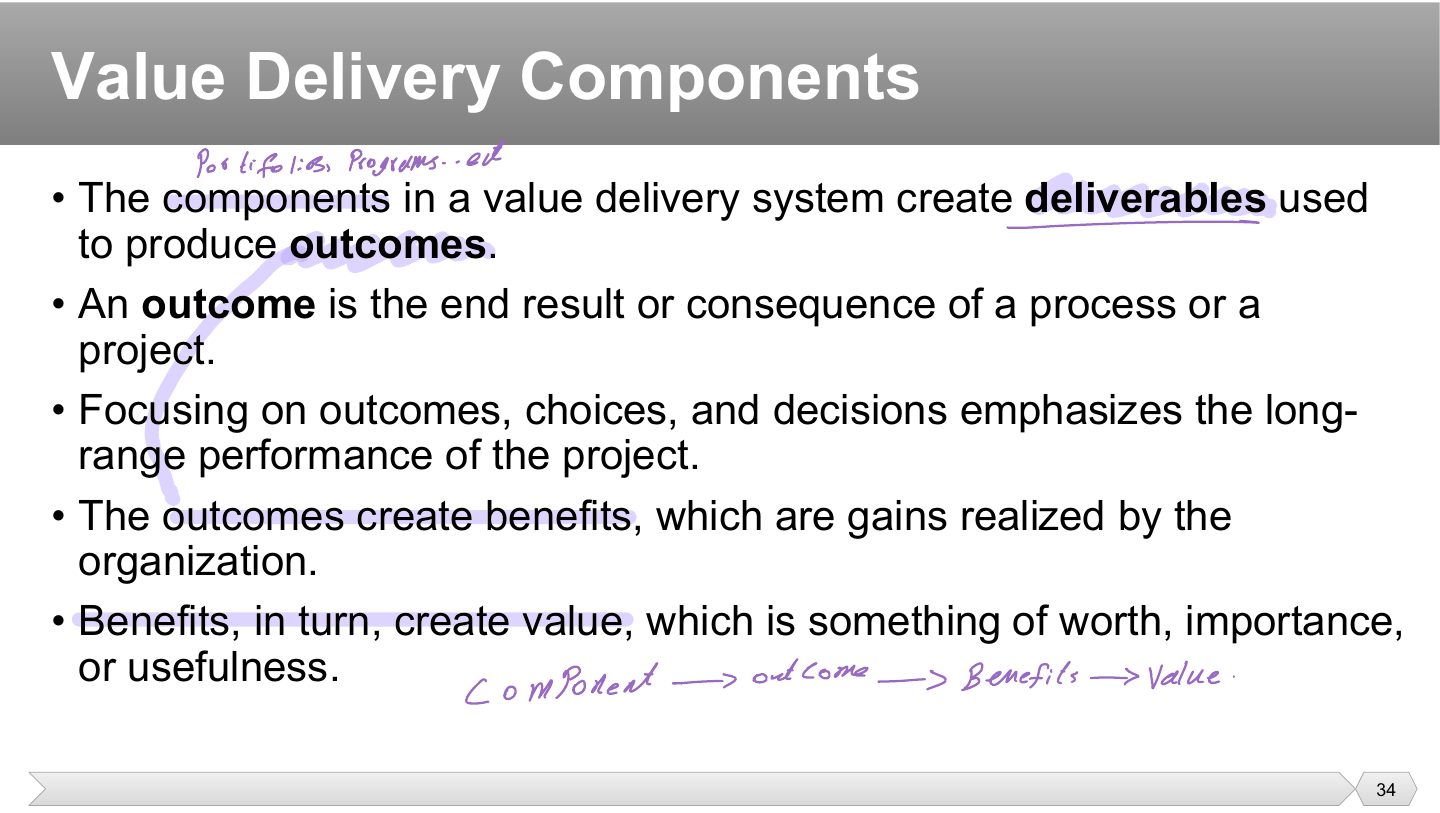
  1. A deliverable is what gets handed over: code, a report, a trained team. The point is that it is “used to produce outcomes”. A deliverable nobody uses has done nothing yet.

  2. Outcomes come after delivery. Deciding by outcome forces a longer view: “Will this help in two years?” instead of “Can we tick this off by Friday?” A team focused only on deliverables might skip documentation to hit a date, even though the outcome suffers later.

  3. A benefit is the gain realized by the organization, once the outcome has happened. Example: the outcome is that customers now serve themselves online, and the benefit is lower call-center costs.

  4. Value is the final judgment of worth, once benefits are weighed. Follow the example through: components build a portal (deliverable) → customers serve themselves (outcome) → costs drop (benefit) → the company can invest in other things and customers are happier (value).

Tips & tricks

  • DOuBle V, in this order: Deliverables → Outcomes → Benefits → Value.
  • Follow one example from start to finish: app → people use it → costs drop → worth it.

Exam angle

PredictionQ1

Which sequence matches the value delivery chain?

PredictionQ2

According to the slide, what are benefits?

PredictionQ3

Why does the slide recommend focusing on outcomes, choices, and decisions?

PredictionQ4

An online portal is launched. Customers begin to use it, and call-center costs fall by 25%. Which is the benefit?

PredictionQ5

Value is defined on the slide as something of worth, importance, or usefulness.

Slide 35 / 70

Information Flow

Slide 35: Information Flow

Notes

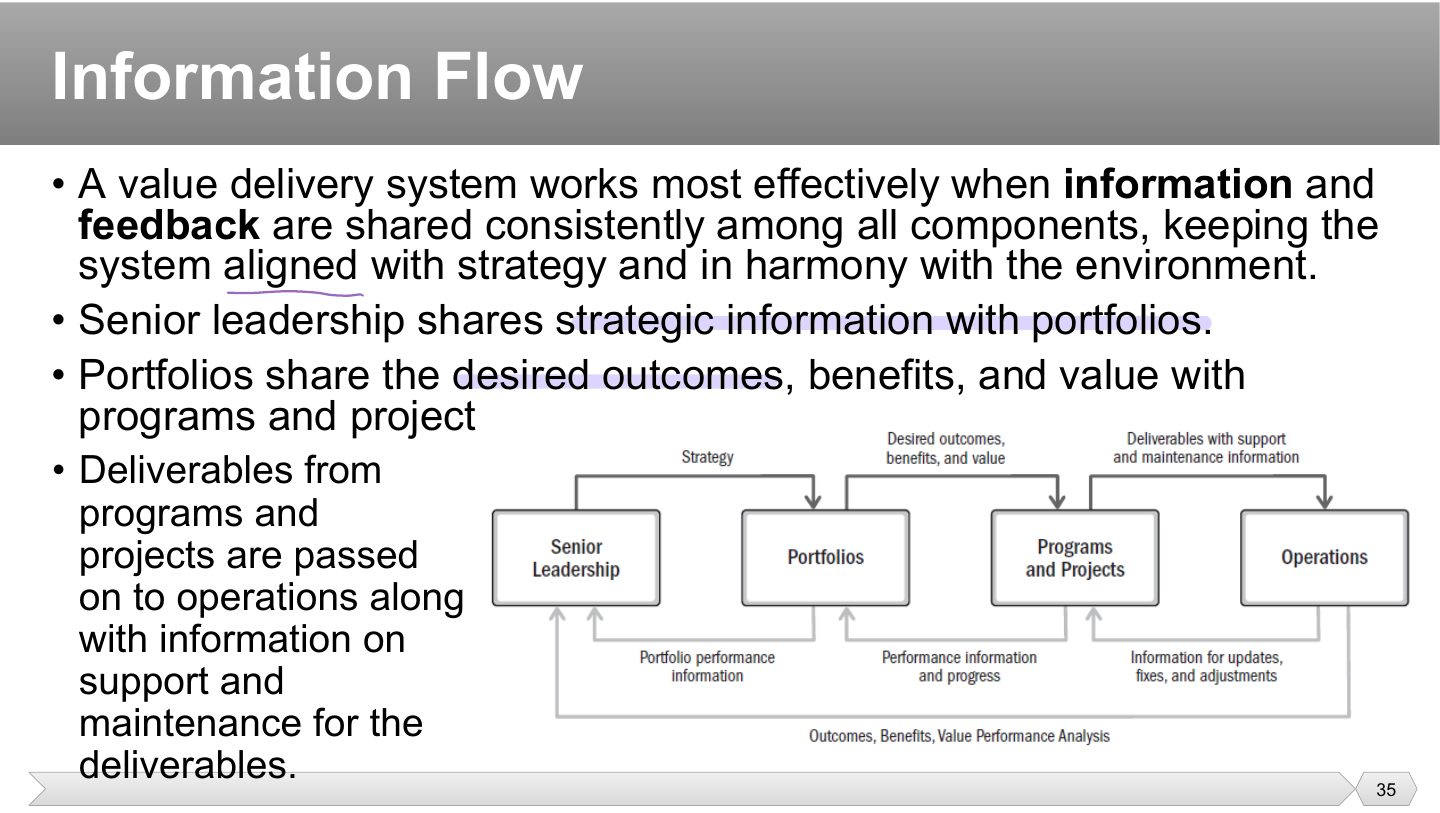
  1. This is the system’s circulation. If leadership changes strategy but doesn’t tell the portfolio, projects keep working toward an old goal. The word consistently matters: occasional updates aren’t enough, since strategy and the environment keep moving.

  2. Top of the chain: senior leaders decide where the organization is going, and they pass strategic information to whoever manages the portfolio. They say why, not how.

  3. Portfolios turn strategy into something a project can act on, the desired outcomes, benefits and value. A project told only “be more customer-focused” is stuck, but one told “cut response time by half” can act.

  4. Deliverables don’t just get thrown over the wall. Operations also need information on support and maintenance, like documentation and training, since they will be running this long after the project has closed.

Tips & tricks

  • Downward flow is “here’s what we want”: Strategy → Outcomes → Deliverables. Next slide’s upward flow is “here’s how it’s going”.

Exam angle

PredictionQ1

What do portfolios share with programs and projects?

PredictionQ2

What does senior leadership share with portfolios?

PredictionQ3

A project hands its system to the IT operations team. What should go with it?

PredictionQ4

When does a value delivery system work most effectively?

Slide 36 / 70

Information Flow

Slide 36: Information Flow

Notes

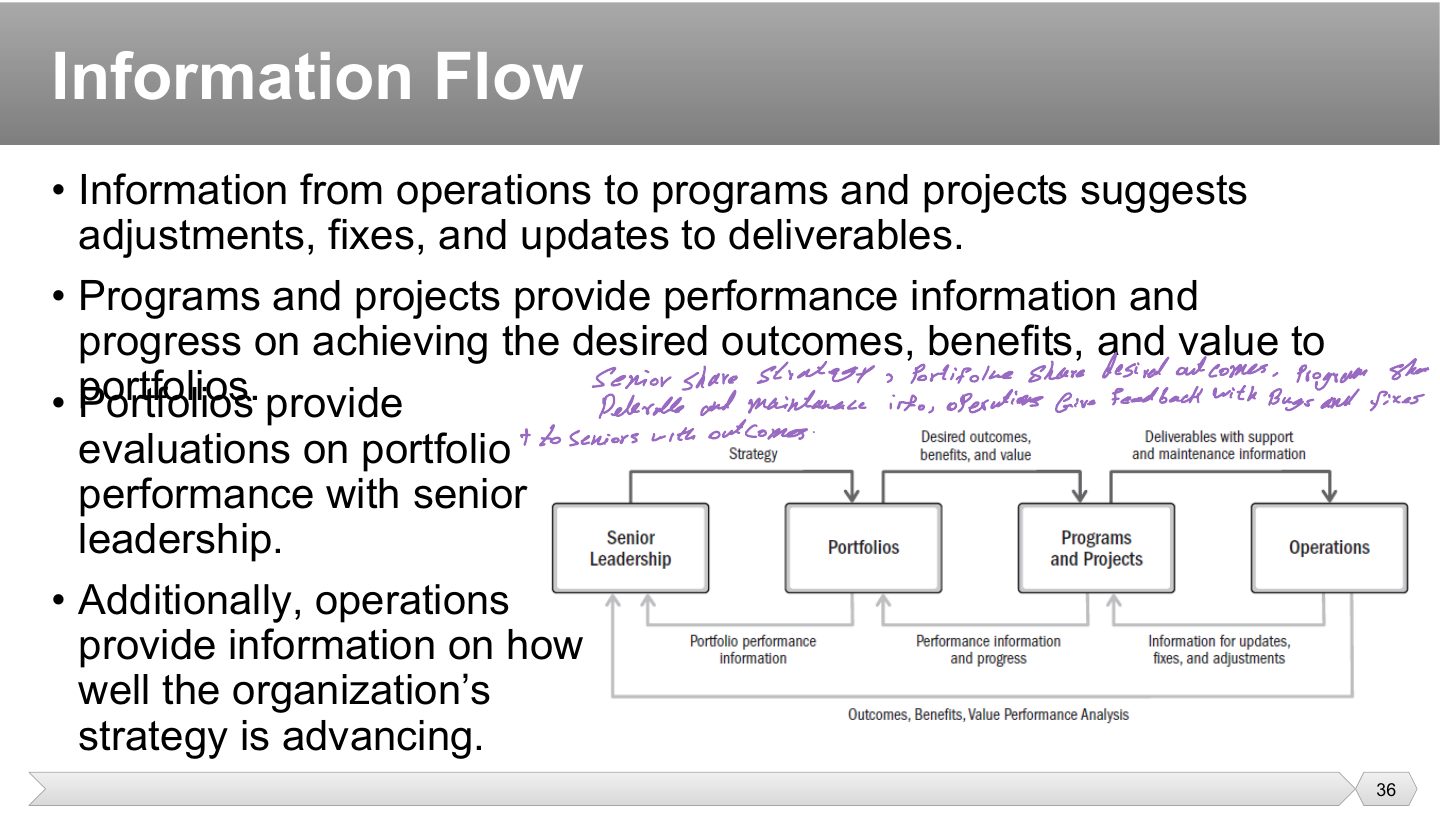
  1. Operations see how the delivered thing behaves in real use, which nobody on the project team could see. So they send back suggested adjustments, fixes and updates. A support team noticing the same complaint every day has information the developers can’t get any other way.

  2. Programs and projects report performance information upward: are we on track, and are we achieving the outcomes we were asked for? This lets the portfolio manager decide whether to continue, adjust or stop a project.

  3. Portfolios then report their overall performance evaluations to senior leadership, summarizing how the whole mix of work is doing rather than the details of each project.

  4. Operations also report how well the strategy is advancing, because operations see the real numbers: sales, complaints, costs. This is how leaders learn whether their strategy is working, so the loop closes.

Tips & tricks

  • Upward: Ops → fixes → Projects → progress → Portfolio → evaluations → Leaders. Each level reports up in the terms the next level needs.
  • Draw the loop once on paper: down on one side (slide 35), up on the other.

Exam angle

PredictionQ1

Information flowing from operations back to programs and projects mainly suggests:

PredictionQ2

What do programs and projects provide to portfolios?

PredictionQ3

What do portfolios provide to senior leadership?

PredictionQ4

What additional information do operations provide, according to the slide?

Slide 37 / 70

Organizational Governance Systems

Slide 37: Organizational Governance Systems

Notes

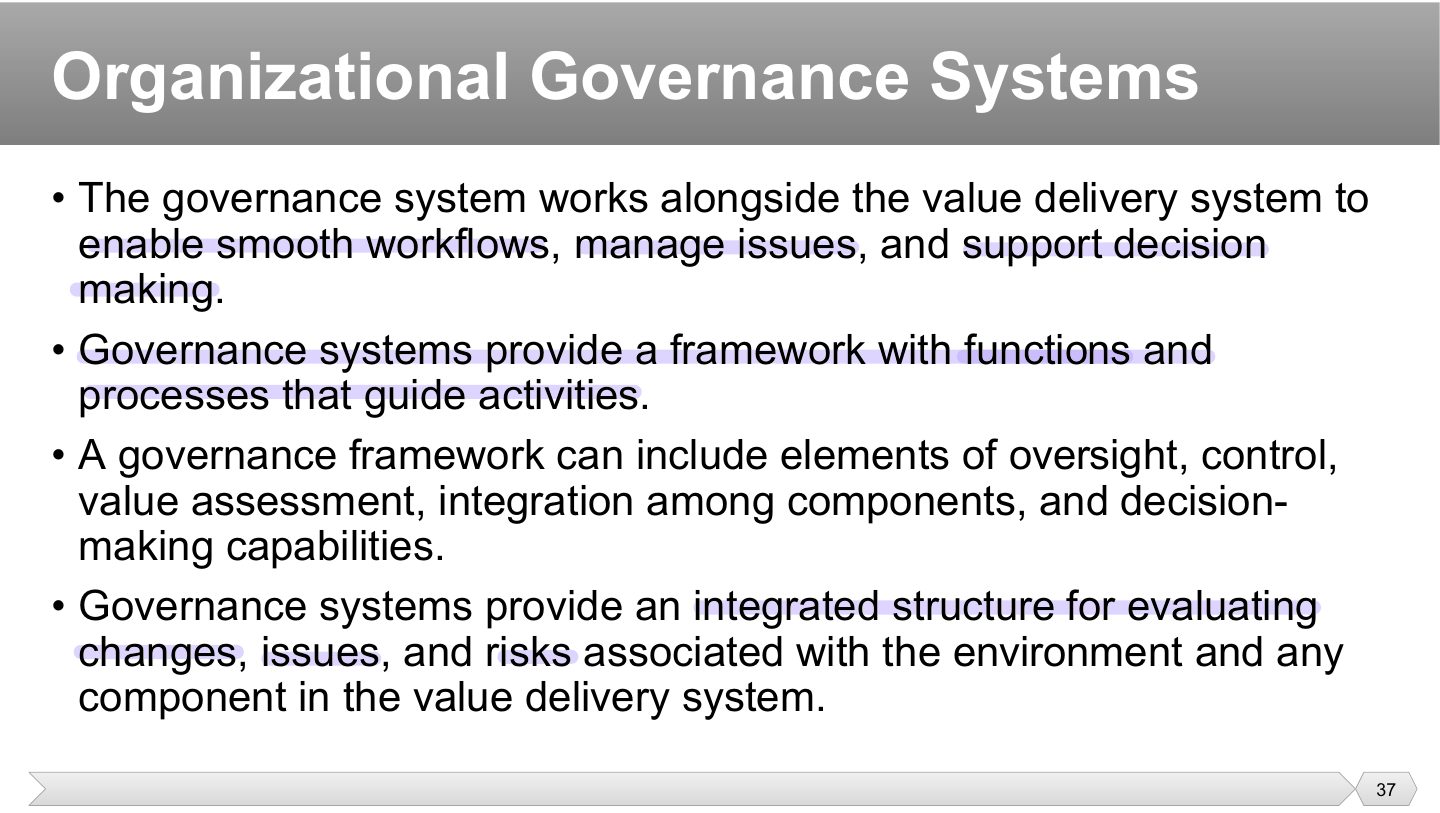
  1. Governance is what stops every decision from turning into a fight. “Works alongside” matters: it doesn’t replace delivery, it runs beside it, so that when a problem arises, people already know who decides and how. Without it, work stops while everyone argues about who is in charge.

  2. A framework with functions and processes means agreed roles and steps, such as a monthly review board, or a rule that spending above a limit needs a director’s signature.

  3. Each of these does a different job. Oversight: someone is watching. Control: someone can stop or correct things. Value assessment: is this still worth doing? Integration: do the components fit together? Decision-making: who gets to choose?

  4. “Integrated structure” means changes, issues and risks get handled by the same system rather than case by case. A new law, a project overrun and a vendor failure all go through one known route, so they can be weighed against each other.

Tips & tricks

  • Governance is traffic rules for the organization. They don’t drive your car, but everyone knows who has right of way.
  • Elements: COVID — Control, Oversight, Value assessment, Integration, Decision-making.

Exam angle

PredictionQ1

What does the governance system work alongside?

PredictionQ2

Which of these is NOT listed as an element of a governance framework?

PredictionQ3

A new regulation appears, and a project reports a major risk. Both are reviewed through the same board. What does this show?

PredictionQ4

Governance systems provide a framework with functions and processes that guide activities.

Slide 38 / 70

Organizational Governance Systems

Slide 38: Organizational Governance Systems

Notes

  1. Governance works at every level, and each level looks after something different: portfolios check objectives, programs check benefits, projects check deliverables. The bigger the unit, the more strategic the question.

  2. A PMO often supports governance here, but only “in some organizations”, since not every company has one. A project can exist without a program or portfolio, which is why “can operate as a stand-alone activity” is on the slide again.

  3. Say the client wants a new feature. Who can say yes? Without an answer, the PM may be pressured into agreeing, and the project slowly grows out of control. Project governance answers the question before it’s asked: changes under a set amount go to the PM, larger ones to the sponsor.

  4. “Aligned” means a project can’t make its own rules that conflict with the organization’s. If the company requires security sign-off for all systems, a project can’t decide it’s unnecessary just because that would be faster.

Tips & tricks

  • Levels: Portfolio → objectives, Program → benefits, Project → deliverables. Remember OBeyeD going down.
  • Project governance’s key question is “who can say yes?”

Exam angle

PredictionQ1

Defining who has the authority to approve changes on a project is part of:

PredictionQ2

At which level does governance look at “benefits”?

PredictionQ3

A project management office must always exist to support projects in a portfolio.

PredictionQ4

Project governance is aligned with program and/or organizational governance.

PredictionQ5

A project can operate:

Slide 39 / 70

Functions Associated with Projects

Slide 39: Functions Associated with Projects

Notes

  1. Methods and tools don’t deliver anything by themselves. People do, and that is why this section is about functions. If a project is failing, look first at whether someone is actually doing each necessary job.

  2. A function is a job to be done, not a job title. In a two-person startup, one person may handle oversight, testing and customer contact. In a large company, a whole department might handle just one of those. What matters is that the function gets done, not how the org chart describes it.

  3. The work of many people only adds up if it is coordinated: otherwise two developers build the same feature while nobody builds another. This is why the slide calls coordination “extremely important”, and why it says different contexts need different types.

  4. In decentralized coordination, the team decides how to organize itself. Nobody assigns tasks from above, so authority and accountability are shared. It works when people are skilled and motivated, and when requirements change often, as on a Scrum team. It works poorly when strict compliance or central accountability is required.

Tips & tricks

  • De-centralized = de-centered: no single person at the center. Decisions are spread across the team.
  • Function ≠ job title. One person can have many functions, and one function can need many people.

Exam angle

Past exam · Midterm 251 · V1 · MCQ 1Q1

In decentralized project management, decision-making authority is primarily:

PredictionQ2

Each project function must be performed by exactly one dedicated person.

PredictionQ3

What actually drives project delivery, according to the slide?

PredictionQ4

What does the slide say about coordinating a collective work effort?

Slide 40 / 70

Functions Associated with Projects

Slide 40: Functions Associated with Projects

Notes

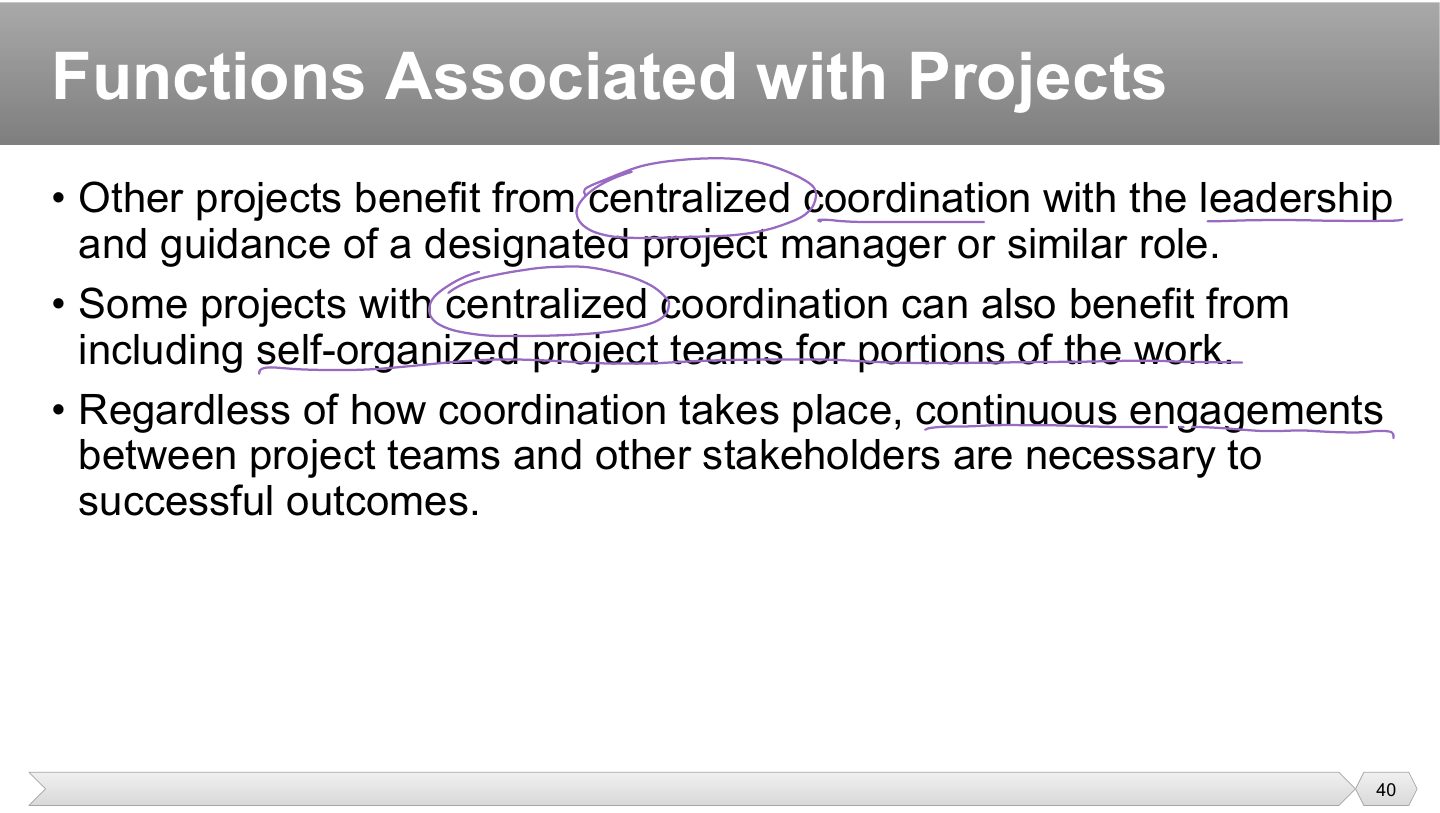
  1. In centralized coordination, one named person leads and guides. It works well when someone must clearly answer for results, as with strict deadlines, regulation or inexperienced teams. It can go wrong when one person becomes a bottleneck for every decision.

  2. This isn’t an either/or choice. A PM can run a government system centrally while the UI team plans its own two-week sprints. Each part of the work uses what suits it. Exam options saying a project must be “entirely” one or the other are false.

  3. Whatever the structure, stakeholders stay involved continuously. A self-organized team that disappears for six months can build the wrong thing, just as a centralized one can. It’s the one thing that doesn’t change with the coordination style.

Tips & tricks

  • Centralized = conductor with an orchestra. Decentralized = jazz band. Both make music, and both listen to the audience.

Exam angle

PredictionQ1

A government system has a strict compliance deadline and a designated PM, but the UI team works in two-week sprints and plans its own tasks. Which coordination style is this?

PredictionQ2

A designated project manager assigns tasks, guides the team and answers for results. What type of coordination is this?

PredictionQ3

Continuous engagement between the project team and other stakeholders is only necessary under decentralized coordination.

Slide 41 / 70

Functions Associated with Projects

Slide 41: Functions Associated with Projects

Notes

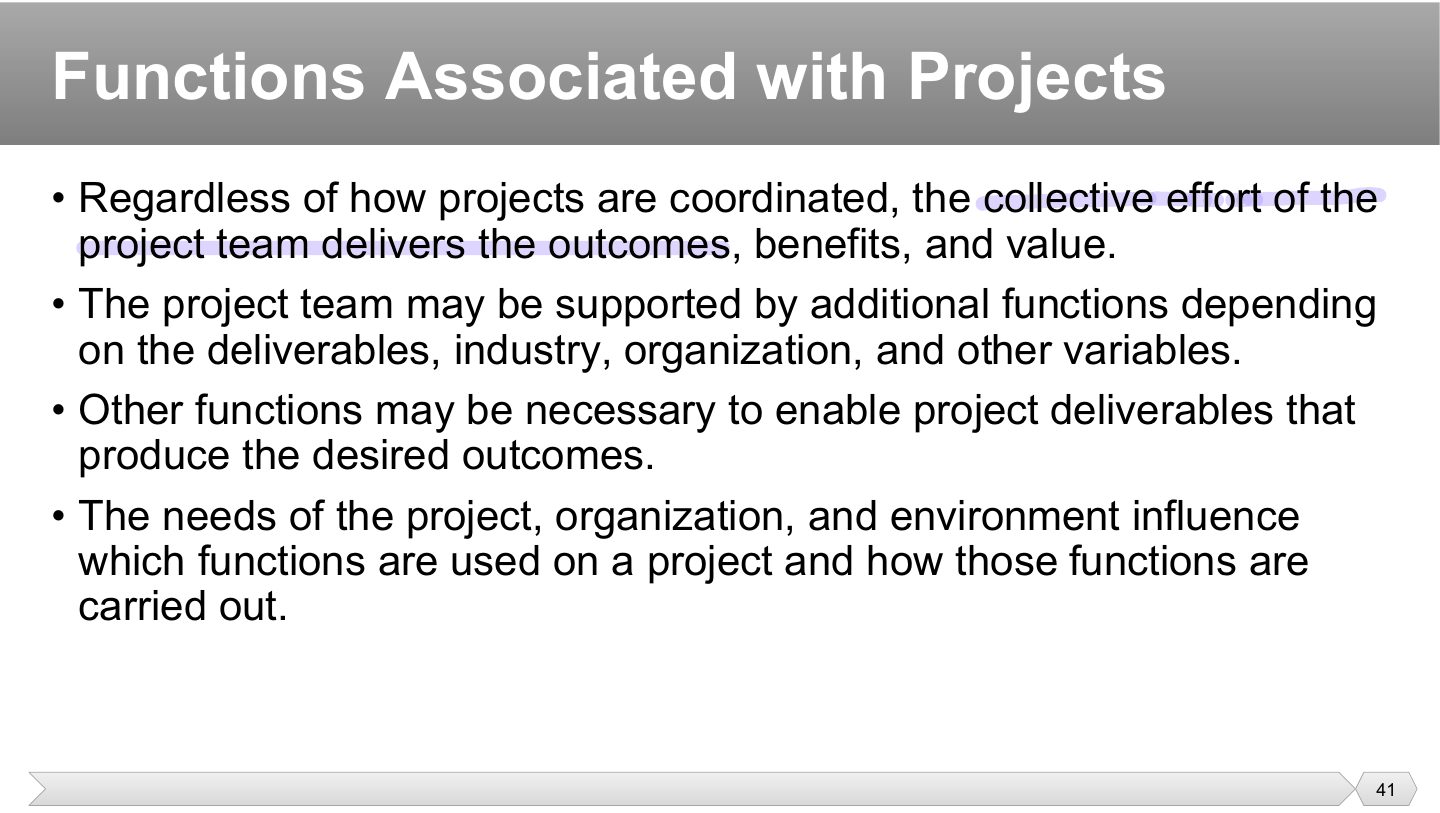
  1. Notice the credit goes to the collective effort: a good PM doesn’t deliver alone, and neither does a star developer. Value comes from all the team’s work adding up.

  2. “Additional functions” appear because the work demands them. A banking project may need legal review, a medical one needs clinical safety checks, and a game may need neither.

  3. There’s no fixed list of functions. Think about why: an internal tool in a five-person startup and a national payment system have completely different needs. So you should ask what this project needs, not what a template says. This is tailoring applied to who does what.

Tips & tricks

  • Ask: “What does this project need that a default team doesn’t have?” That’s your list of additional functions.

Exam angle

PredictionQ1

What delivers the outcomes, benefits, and value, regardless of how a project is coordinated?

PredictionQ2

A medical software project adds a clinical safety reviewer, while a game project doesn’t need one. What does this show?

PredictionQ3

The project team may be supported by additional functions depending on the deliverables, industry, and organization.

Slide 42 / 70

IHow

Slide 42: IHow

Notes

  1. Oversight and coordination is about seeing the whole: are we on track, and does everyone’s work fit together? A PM usually fills this function, or the team collectively in decentralized settings.

  2. Objectives and feedback tells you where you’re heading and how close you are. The handwriting on the slide says it well: “what we’re aiming for” and “how far they’ve come”. Customers and product owners usually do this.

  3. Facilitate and support makes the work easier for others, by hosting meetings, clearing obstacles and encouraging people. Think of a Scrum master. They add no features, but the team would be slower without them.

  4. Apply expertise means giving specialist advice when needed. A security expert who reviews the design for an afternoon is doing this without being a full-time member. Compare it with perform work and contribute insights, the full-time doing of the job.

  5. Business direction and insight tells the team what the market and customers want. A product owner saying “competitors now offer this” is doing this function.

  6. Resources and direction means allocating budget, people and infrastructure, usually a sponsor. It answers “what do we have to work with?”

  7. Maintain governance is enforcing regulatory and internal standards, so the project doesn’t break rules. A PMO or governance board often handles this.

Tips & tricks

  • Ask “what is this person actually doing right now?” rather than “what is their title?” Questions are written so that the title misleads.
  • Paired look-alikes: Business direction = what the market wants; Resources and direction = money and people. Apply expertise = advice; Perform work = doing it.

Exam angle

PredictionQ1

A sponsor approves the budget and assigns two extra engineers to the project. Which project function is this?

PredictionQ2

A product owner tells the team that customers in a new market now expect Arabic support. Which project function is this?

PredictionQ3

A PM reviews the dashboard every morning and checks whether the work is on track. Which function is this?

PredictionQ4

A client defines what “success” will mean and reviews each demo to say how close the team is. Which function is this?

PredictionQ5

A Scrum master runs stand-ups and workshops and removes obstacles. Which function is this?

PredictionQ6

A developer finishes the features assigned to her in this sprint. Which function is this?

PredictionQ7

A cloud architect spends two hours advising the team on a data-storage decision, then returns to her own department. Which function is this?

PredictionQ8

A quality board checks that a project meets national regulations and internal standards. Which function is this?

Slide 43 / 70

The Project Environment

Slide 43: The Project Environment

Notes

  1. Projects don’t happen in a controlled lab. “Varying degrees” is important: some factors barely matter, while others can kill a project. A PM needs to tell which is which, rather than treating all factors alike.

  2. Influences arrive before and during the work. A strict data law shapes your planning from day one, while a market shift might force a change in the middle of the project. So you check the environment throughout the project, not just at the start.

  3. Don’t assume “environment” means “problem”. A strong local talent pool is favorable. A new tax that doesn’t affect your project is neutral. Only some factors are unfavorable, and spotting favorable ones lets you make use of them.

Tips & tricks

  • Environment isn’t always bad: F-U-N — Favorable, Unfavorable, Neutral.

Exam angle

PredictionQ1

Environmental influences on a project can be:

PredictionQ2

A strong local talent pool makes hiring easier for a project. How would you classify this influence?

PredictionQ3

Internal and external environments can influence planning and other project activities.

Slide 44 / 70

The Project Environment

Slide 44: The Project Environment

Notes

  1. “Internal” includes sources you might not think of: another project within your organization competing for the same staff is internal, even though it’s not your project. The test: does this come from inside the organization?

  2. Lessons learned and old artifacts are knowledge your organization already owns. A team that looks up how the last migration went can avoid its mistakes, while one that doesn’t may repeat them. It costs almost nothing, yet teams often skip it.

  3. A useful way to group the list: assets (process, governance documents, data, knowledge), infrastructure (security and safety, facilities, IT software), and people (who is available, and what they can do). The “people” items catch students out: a skills gap feels like an outside problem, but it’s internal.

Tips & tricks

  • Group the nine with TAP: Technical setup (security and safety, infrastructure, IT software) + Assets (process, governance, data, knowledge) + People (availability, capability).
  • Internal test: “Could our own organization fix this by its own decision?”

Exam angle

PredictionQ1

Half of the developers have never used the cloud platform the project depends on. What kind of factor is this?

PredictionQ2

A team reuses templates and lessons learned from a previous project. These are examples of:

PredictionQ3

Your best engineer is reassigned to another project in the same company. How would you classify this?

PredictionQ4

Which of these is NOT an internal environment factor?

PredictionQ5

Factors internal to the organization can arise only from the project itself.

Slide 45 / 70

The Project Environment

Slide 45: The Project Environment

Notes

  1. The key words are enhance, constrain or neutral. External factors can help too: a new open-source library can save you months. And notice the contrast with slide 43’s words: the idea is the same, but the external factors aren’t yours to change, only to respond to.

  2. Marketplace, social and cultural, regulatory, financial and physical: all conditions a project must work within, and none of them are under the organization’s control. A law like Saudi data-privacy rules, a currency shift or a culture’s preferences must be accommodated. You can’t decide them away.

  3. The tricky ones are commercial databases, academic research and industry standards. The team actively uses them, so they feel internal, but they’re produced outside the organization. Ask where something comes from, not who uses it.

Tips & tricks

  • External test: “Who produces it?” If it comes from outside the organization, it’s external, even if your team uses it every day.
  • Group the eight: World (market, social/cultural, regulatory, financial, physical) + Published knowledge (databases, research, standards).

Exam angle

PredictionQ1

A new national data-privacy law forces the team to redesign its storage layer. This is which kind of factor?

PredictionQ2

A team bases its design on a published academic study and an international industry standard. How are these classified?

PredictionQ3

A competitor’s price drop forces a company to rethink its project’s business case. Which external factor is this?

PredictionQ4

A construction site’s extreme summer heat limits working hours. Which factor is this?

PredictionQ5

A currency’s value falls, raising the cost of imported hardware. Which external factor is this?

PredictionQ6

A team buys access to a commercial database of market data. How is this classified?

PredictionQ7

Local customs mean users in a target region expect Arabic-first interfaces. Which external factor is this?

PredictionQ8

External factors can only constrain project outcomes.

Slide 46 / 70

Product Management Considerations

Slide 46: Product Management Considerations

Notes

  1. These four disciplines used to be taught as separate worlds. They are converging because value usually comes from a product that lives for years, while projects come and go around it. A PM who ignores what happens after handover will make poor decisions.

  2. The slide narrows the scope: the course doesn’t teach portfolio, program or product management in depth. It wants you to know how they relate to your project, particularly when your project’s result is a product someone will keep running.

  3. A product is produced (it results from work), quantifiable (it can be counted and measured) and either end item or component (a whole car, or just its engine). So a login module is a product, and a good customer experience isn’t.

Tips & tricks

  • Product definition: EQuiP — End item or component, Quantifiable, Produced.

Exam angle

PredictionQ1

According to the slide, the disciplines of portfolio, program, project, and product management are:

PredictionQ2

Portfolio, program, and product management are beyond the scope of the PMI standard and this course.

PredictionQ3

A product can be:

Slide 47 / 70

Product Management Considerations

Slide 47: Product Management Considerations

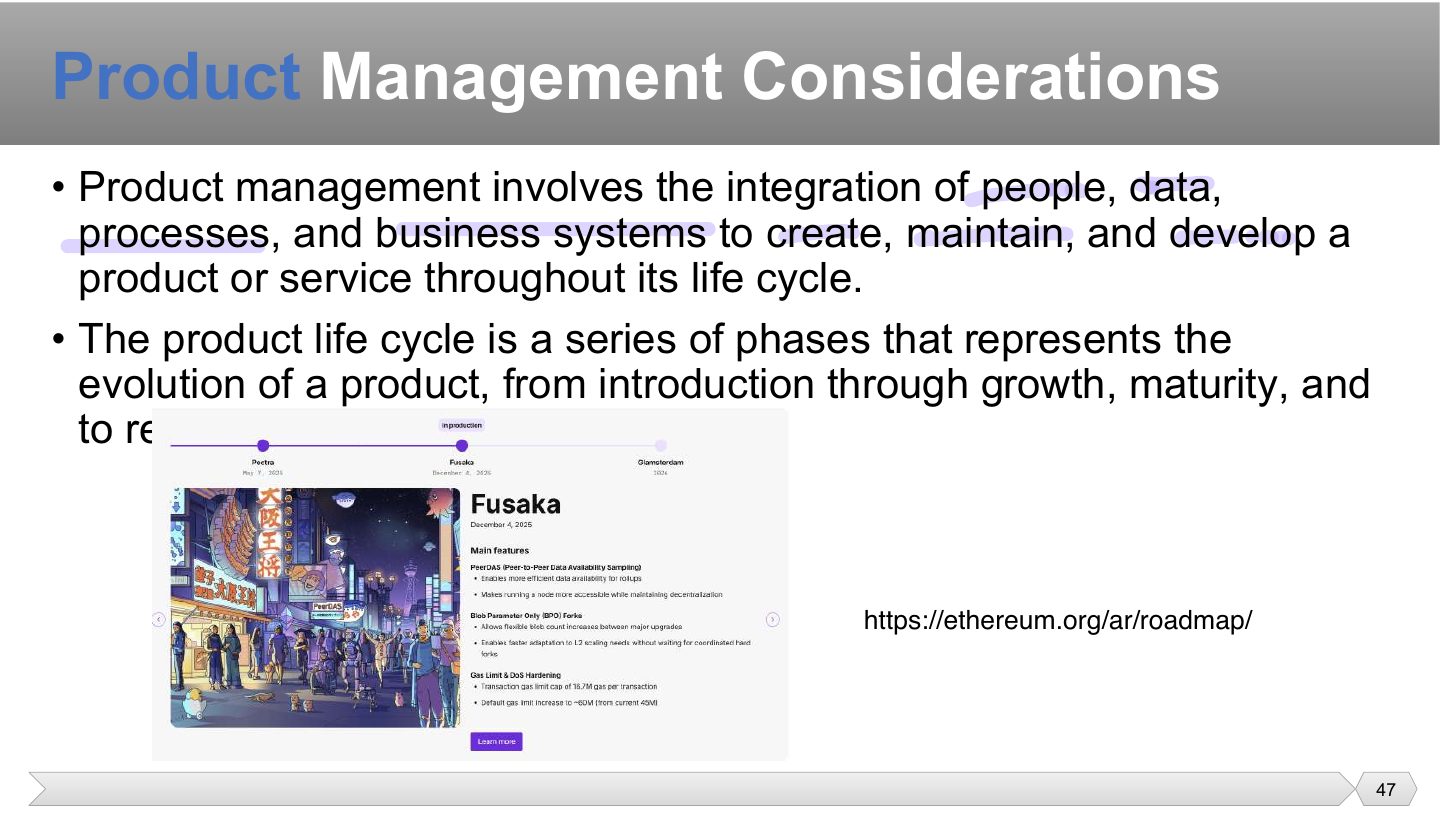
Notes

  1. Compare lifespans. A project team builds version one and disbands. Product management stays with it for years, deciding what to improve and eventually when to retire it. That’s why it combines people, data, processes and business systems, and not only development: it must watch sales data, support tickets and costs too.

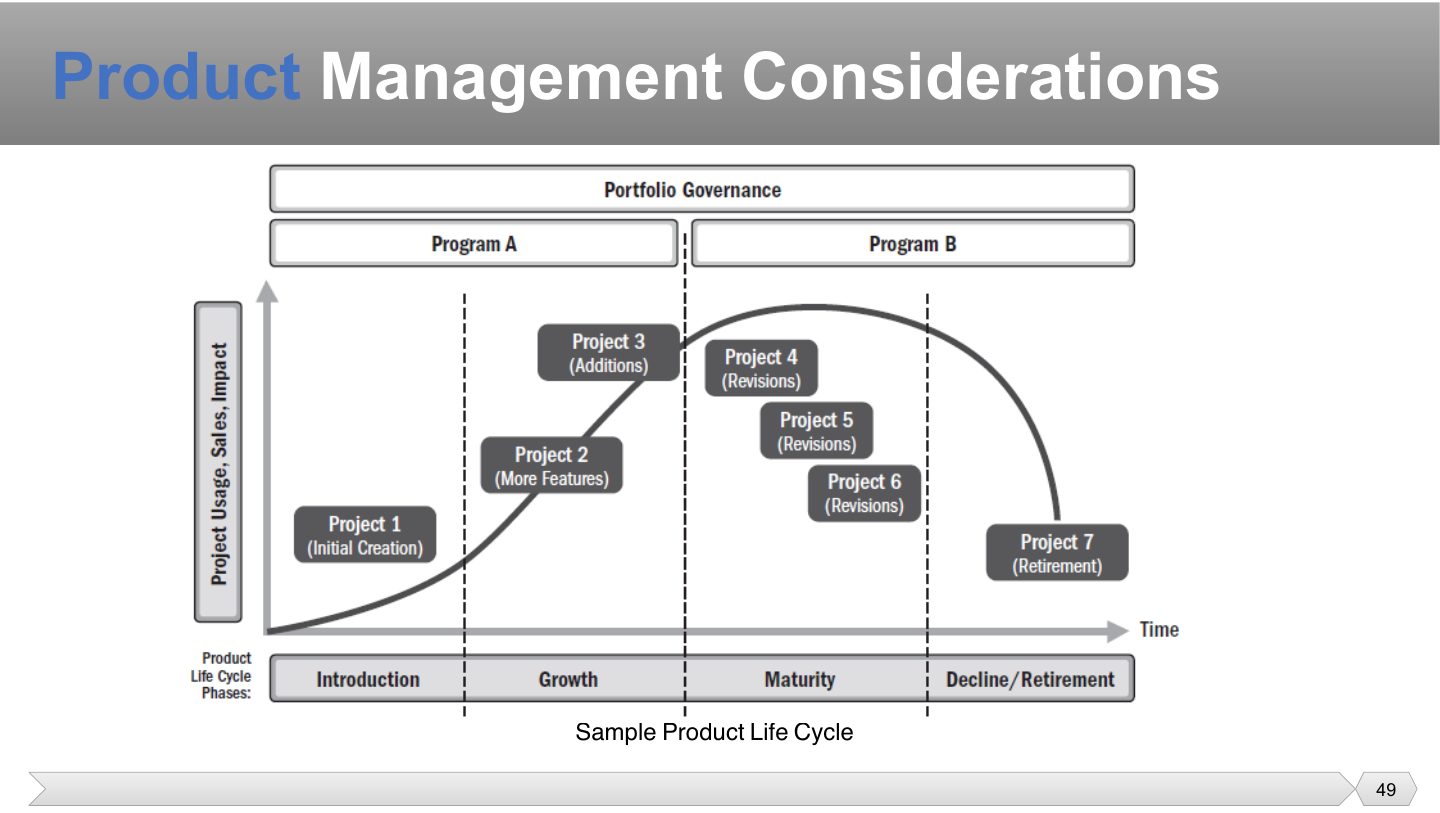
  2. The life cycle works like a living thing. Introduction: new and few users. Growth: users and revenue climb. Maturity: growth levels off, and you defend the position. Retirement: replaced or no longer worthwhile. Each stage calls for different work, which is why different projects appear at each.

Tips & tricks

  • Project ends. Product lives on. A project is one episode, and the product is the whole series.
  • Life cycle: I-G-M-R — “I Got My Reward.”
  • Read the question carefully: the instructor uses project and product on purpose.

Exam angle

Past exam · Midterm 261 · Short answerQ1

Explain the difference between project management and product management. (Careful: product, not project.)

Compare with the model answer

Project management is the application of knowledge, skills, tools and techniques to project activities to meet project requirements; a project is temporary, with a start and an end, and creates a unique result. Product management integrates people, data, processes and business systems to create, maintain and develop a product throughout its whole life cycle (introduction, growth, maturity, retirement). Product management lasts as long as the product does and can start projects or programs at any point in that life cycle to create or improve the product. The instructor’s own question; she uses near-identical terms on purpose, so read “product” carefully.

PredictionQ2

Product management integrates which things to create, maintain and develop a product?

PredictionQ3

What is the correct order of the product life cycle?

PredictionQ4

Sales of a five-year-old app have stopped growing, but it remains profitable and stable. Which stage is it in?

Slide 48 / 70

Product Management Considerations

Slide 48: Product Management Considerations

Notes

  1. “At any point” is the key phrase. Product management doesn’t run one big project. It starts new ones when needed: a project to add a feature in year two, another to modernize in year five. Projects are the product’s tools for change.

  2. A product usually begins as a project’s deliverable. The first version comes from a temporary effort, and then the permanent product life starts when that project closes.

  3. Each later project has a reason, which is to add or improve something that gives customers and the organization more value. If a proposed project wouldn’t do that, there’s no reason to fund it.

  4. Occasionally a product and its program are the same length. Then one program can cover the full life cycle, which keeps managing benefits close to the product. Think of a defense system whose program runs from development through to decommissioning.

Tips & tricks

  • Think of a house (the product) over decades: built by one project, then a kitchen renovation project, then a new roof project. The house remains, and each project ends.

Exam angle

PredictionQ1

When may product management initiate programs or projects?

PredictionQ2

The initial product may begin as a deliverable of a program or project.

PredictionQ3

Three years after launch, a project adds a new payment feature to an app. Why does this fit the slide?

PredictionQ4

A single program runs a product from its first development to its final retirement. What does the slide say about this?

Slide 49 / 70

Product Management Considerations

Slide 49: Product Management Considerations

Notes

  1. Everything sits under portfolio governance, because someone must decide which of these projects get funded. Programs A and B group related work. The rising and falling curve is the product’s usage or revenue over time, which is what the projects are trying to affect.

  2. See how each project matches the product’s need at that stage. Project 1 creates it (introduction). Projects 2–3 add features while it’s growing fast. Projects 4–6 keep it competitive as it matures, because growth has slowed and revisions keep it attractive.

  3. Project 7 retires it. Retiring is a real project with its own work: moving users, archiving data, shutting systems down. Notice the main lesson: one product, seven projects, which is the clearest picture of the difference between product and project management.

Tips & tricks

  • Sketch this from memory: a hill-shaped curve, with project boxes along the bottom and portfolio governance on top. If you can draw it, you understand the section.

Exam angle

PredictionQ1

In the sample product life cycle, what is the purpose of the final project?

PredictionQ2

What does the diagram show about the relationship between products and projects?

PredictionQ3

Which element sits above the programs and projects in the diagram?

Slide 50 / 70

Product Management Considerations

Slide 50: Product Management Considerations

Notes

  1. This is the largest of the three forms. Here a product is so big that even one stage of its life needs its own program, a coordinated set of projects. So the product is the outer container, and the program sits inside one stage of it.

  2. Why does size matter? Modernizing a nationwide banking platform after years in service might involve separate projects for infrastructure, security, each customer channel and data migration. These depend on each other, so they need coordinating as a program. A small change wouldn’t justify this.

Tips & tricks

  • Three forms: read the first word to see what’s inside. “Program management within a product life cycle” = a program in a product’s life. “Project management within…” = a project in a product’s life. “Product management within a program” = a whole product inside a program.

Exam angle

PredictionQ1

Very large or long-running products may have life cycle phases complex enough to need a set of programs and projects working together. Which form of product management is this?

PredictionQ2

A company modernizes a large product years after launch through several related, coordinated projects. Which form is this?

PredictionQ3

This approach “incorporates related projects, subsidiary programs, and program activities.” Which form does that describe?

Slide 51 / 70

Product Management Considerations

Slide 51: Product Management Considerations

Notes

  1. This is the most common form. No big program is needed, because the product simply exists as a normal part of the business.

  2. “Ongoing business activity” is what separates this from a project: nobody expects the product’s improvement to end. It’s treated like running a department, not like a one-off piece of work.

  3. When a specific change is needed, portfolio governance charters a project for it. To “charter” means to formally authorize it. The project does its job, like modernizing the interface, then closes, while the product continues.

Tips & tricks

  • Individual projects, one at a time, as needed, like calling a contractor to fix one thing in your house.

Exam angle

PredictionQ1

After five years, a company charters a single project to modernize its app’s user interface. Which form of product management is this?

PredictionQ2

In this form, what oversees the development and maturing of product capabilities?

PredictionQ3

Who charters the individual projects in this form?

Slide 52 / 70

Product Management Considerations

Slide 52: Product Management Considerations

Notes

  1. This one flips the containers: the program is the outer box, and the whole product’s life sits inside it. So the product is small relative to the program.

  2. “Full life cycle within the purview” means the product is born, used and retired while the program runs, and doesn’t outlive it.

  3. A proof of concept (POC) is a small product built to test an idea. A program building a new payments platform might build a POC to compare two technical directions, use it to decide, and then discard it. It has a complete life, all inside the program. That’s why it’s the slide’s example.

Tips & tricks

  • Size order, biggest product first: Program in a product → Project in a product → Product in a program.
  • POC = a model of a building: made to help decide, then put away.

Exam angle

PredictionQ1

A program develops a proof of concept to explore possible directions, then ends it. Which form of product management is this?

PredictionQ2

“Applies the full product life cycle within the purview and boundaries of a given program” describes:

PredictionQ3

In “product management within a program”, what contains what?

Slide 53 / 70

Project Management Principles (section)

Slide 53: Project Management Principles (section)

Notes

  1. Section divider. You’ve seen the 12 principles in brief on slide 21. These slides explain what kind of thing a principle is, and then give each one its own card.

Slide 54 / 70

Project Management Principles

Slide 54: Project Management Principles

Notes

  1. Standards and methods change, but principles last longer. PMBOK’s methods are built on them. So when no method covers your situation, you can reason from a principle: “What would good stewardship look like here?”

  2. Prescriptive means “you must do exactly this”. Building codes are prescriptive: the regulation says the required beam size. Project management can’t work that way, because every project differs. A rule for a mobile app could be wrong for a hospital system.

  3. Principles guide behavior, so two PMs can follow the same principle differently and both be right. One team might involve stakeholders through weekly demos, another through monthly reviews.

  4. Principles and morals are different things. “Tailor to the context” is good advice, but not a moral issue. Stewardship does touch on morals. That’s why the slide says “can, but do not necessarily” reflect morals.

Tips & tricks

  • Principle = compass, not GPS. It points you in the right direction but doesn’t give you turn-by-turn directions.
  • Trap words: “must”, “always”, “exactly” in a statement about principles usually make it false.

Exam angle

PredictionQ1

The principles of project management are prescriptive rules that must be followed exactly.

PredictionQ2

Project management principles always reflect morals.

PredictionQ3

What do principles for a profession serve as?

PredictionQ4

Two PMs both apply “engage stakeholders” differently: weekly demos and monthly reviews. What does this show?

Slide 55 / 70

Project Management Principles

Slide 55: Project Management Principles

Notes

  1. Unlike principles, a code of ethics is explicitly about morals: it’s how a profession tells its members what conduct is expected. You can adopt a code as an individual or as a whole profession. That’s why it sits next to principles but is different from them.

  2. Think of each value as answering a question. Responsibility: do you own your decisions and their results? Respect: do you treat people and resources well? Fairness: are you impartial, with no hidden interests? Honesty: do you tell the truth, even when it hurts? Together they cover almost any ethical dilemma you’ll face.

Tips & tricks

  • FuRtHeR: Fairness, Respect, Honesty, Responsibility.
  • Integrity is the classic wrong answer. It belongs to stewardship (slide 59), not to the four ethics values.

Exam angle

PredictionQ1

Which of the following is NOT one of the four values of the PMI Code of Ethics and Professional Conduct?

PredictionQ2

A code of ethics is related to:

PredictionQ3

A PM discloses that a bidding vendor belongs to her cousin and steps out of the decision. Which value is she mainly applying?

PredictionQ4

A PM admits to the client that a mistake in her own estimate caused the delay. Which value is this mainly?

PredictionQ5

A PM listens carefully to a junior developer’s concerns and doesn’t talk over them. Which value is this?

PredictionQ6

A PM reports the true status to the sponsor although the news is bad. Which value is this?

PredictionQ7

A code of ethics can be adopted by an individual or a profession to establish expectations for moral conduct.

Slide 56 / 70

Project Management Principles

Slide 56: Project Management Principles

Notes

  1. Because principles guide rather than prescribe, you apply them differently for different situations. A two-person internal tool needs a light touch with stakeholders, while a national system needs a formal plan. Both follow the same principle to different degrees.

  2. Internally consistent means the 12 were designed not to contradict one another. So if two seem to conflict, the cause is usually your situation, not the principles.

  3. That’s the dilemma part. Sharing information helps the team understand the system (systems thinking), but some of it may be confidential (stewardship). Neither principle is wrong. You just have to judge how much to share, perhaps by giving people what they need without the private details.

  4. Some principles apply to any kind of manager: leadership, ethics and focusing on value aren’t unique to projects. The next slide’s Venn diagram shows this overlap.

Tips & tricks

  • Say it as: “No contradictions on paper, but dilemmas in practice.”

Exam angle

PredictionQ1

Because the principles are internally consistent, no practical dilemmas can arise when applying them.

PredictionQ2

“The principles are internally consistent” means:

PredictionQ3

Which of these influences the degree and way principles are applied?

PredictionQ4

Sharing a client’s data would help the team analyze the system, but the data is confidential. What does the slide call this?

PredictionQ5

Project management principles can have areas of overlap with general management principles.

Slide 57 / 70

Management Principles

Slide 57: Management Principles

Notes

  1. Read the diagram as two circles sharing a middle. The overlap includes things like leading people, making decisions and delivering value, because anyone managing others needs these, whether running a project or a department.

  2. The differences show up outside the overlap. A PM has a fixed end date, a temporary team borrowed from other managers and little formal authority, so works by influence. A general manager runs ongoing work with permanent staff and direct authority. Same management basics, but a very different daily reality.

Tips & tricks

  • Four-way comparison for the final exam: Focus (temporary vs. ongoing), Skills (cross-functional vs. deep in one area), Team (borrowed vs. permanent), Authority (influence vs. line authority).

Exam angle

Past exam · Final 251 · Q1.2Q1

What are the key distinctions between project management and general management, particularly concerning their respective focuses, skill sets, and approaches to managing teams and resources?

Compare with the model answer

Focus: project management delivers temporary, unique work with a defined start, end and scope; general management runs the ongoing, repetitive operations of a function. Skills: a PM needs planning, scheduling, risk, stakeholder and integration skills across functions; a general manager needs depth in one function and long-term operational skills. Teams and resources: a PM leads a temporary, cross-functional team, often borrowed from functional managers, so works by influence and negotiation within a fixed budget and schedule; a general manager has permanent staff, line authority and an ongoing budget.

PredictionQ2

What does the Venn diagram show?

PredictionQ3

A manager runs a permanent finance department with long-term staff and direct authority over them. This is closer to:

Slide 58 / 70

PMI Principle Statements

Slide 58: PMI Principle Statements

Notes

  1. These are the principles’ official names, phrased as actions. Slide 21 gave you short labels, and exams may use either. Diligent, respectful and caring tells you what stewardship feels like in practice.

  2. “Collaborative” means working together, and “environment” means the conditions that make it possible. The PM creates those conditions rather than ordering collaboration.

  3. “Effectively engage” is more than informing. It means involving stakeholders in a useful way, with the right amount for each.

  4. Three words, and the plainest statement: keep asking whether the work is still worth doing.

  5. This is the longest name, but the verbs tell you the steps: see it (recognize), judge it (evaluate), act on it (respond).

  6. “Behaviors” is the key word: leadership is what you do, not your job title. So anyone can demonstrate it.

  7. “Based on context” is the reasoning. The second part here, build quality into processes and deliverables, reminds you that quality covers how you work as well as what you produce.

  8. “Navigate” is a careful word choice: you can’t eliminate complexity, only find your way through it.

  9. “Optimize” rather than “eliminate”: some risks are worth taking, and opportunities should be pursued. Embrace adaptability and resiliency then covers what happens when things go off-plan anyway.

  10. “Envisioned future state” reminds you where the project’s change is meant to take people. Delivering a system isn’t enough, since people must actually move to the new way of working.

Tips & tricks

  • Each statement starts with a verb: Be, Create, Engage, Focus, Recognize, Demonstrate, Tailor, Build, Navigate, Optimize, Embrace, Enable. Memorize the verbs, and the rest follows.
  • Match short to long: Stewardship → Be a steward, Team → Create, Stakeholders → Engage, Value → Focus, Systems → Recognize, Leadership → Demonstrate.

Exam angle

PredictionQ1

“Recognize, evaluate, and respond to system interactions” is the full statement of which principle?

PredictionQ2

Which principle’s full statement is “Be a diligent, respectful, and caring steward”?

PredictionQ3

“Enable change to achieve the envisioned future state” matches which short name?

PredictionQ4

Which is an official PMI principle statement?

Slide 59 / 70

Be a Diligent, Respectful, and Caring

Slide 59: Be a Diligent, Respectful, and Caring

Notes

  1. Stewardship means looking after something on someone else’s behalf. The money, people and reputation aren’t yours, so you treat them with care and within the rules. “Inside and outside the organization” means your duty reaches beyond your employer: a PM who saves money by dumping waste or ignoring a privacy law is failing this principle, even if the company benefits.

  2. Four words, each answering something different. Integrity: are you honest and do you follow through? Care: do you look after people and things? Trustworthiness: can people rely on your word? Compliance: do you follow internal rules and external laws?

  3. “Holistic” means you can’t just look at the financial side. A project may be profitable yet harm a community or the environment. Stewards weigh financial, social, technical and environmental impacts together.

Tips & tricks

  • Stewardship includes CrITiC: Care, Integrity, Trustworthiness, Compliance.
  • Think of borrowing a friend’s car: you drive carefully, follow the law and return it in good condition, because it’s not yours.

Exam angle

PredictionQ1

Which is NOT one of the four things stewardship includes?

PredictionQ2

A PM refuses to use personal data in a way that breaks privacy law, even though it would save money. Which part of stewardship is this mainly?

PredictionQ3

A holistic view of stewardship considers:

PredictionQ4

Stewardship covers responsibilities only within the organization.

Slide 60 / 70

Environment

Slide 60: Environment

Notes

  1. The card’s reasoning is that diverse people who cooperate beat individuals working alone. One person can’t hold all the skills a modern system needs. But having skilled people isn’t enough, since they can still get in each other’s way unless they collaborate.

  2. A team has its own local culture: how it runs meetings, how it gives feedback, what “done” means. This exists inside the organization’s culture and the profession’s norms, so a team’s habits should fit with them rather than conflict.

  3. The card gives three results of collaboration. Alignment with the wider organization’s culture and guidelines keeps the team from drifting. Learning: people develop as individuals and as a team. Optimal contributions: each person’s strengths actually get used, not wasted by confusion or conflict.

Tips & tricks

  • Three results: gOAL — Optimal contributions, Alignment, Learning.

Exam angle

Past exam · Final 242 · Q5.2Q1

How does fostering trust and managing conflict within a software project team contribute to improved collaboration and project success?

Compare with the model answer

Trust lets members admit mistakes, share information and ask for help, so problems surface early and people cooperate instead of protecting themselves. Managed (healthy) conflict means ideas are debated openly and respectfully, which gives better technical decisions and avoids groupthink or disputes that turn personal. Together they lead to real commitment and collaboration, which drives quality and project success. Chapter 3 covers trust and conflict in depth; the principle introduces them.

PredictionQ2

A team agrees on its own way of running stand-ups and reviewing code. What is this called on the card?

PredictionQ3

Which is NOT one of the things a collaborative team environment facilitates?

PredictionQ4

Project teams that work collaboratively can accomplish a shared objective more effectively and efficiently than individuals working on their own.

Slide 61 / 70

Effectively Engage with Stakeholders

Slide 61: Effectively Engage with Stakeholders

Notes

  1. Proactively means going to stakeholders before they come to you, as a complaint is much harder to handle than an early conversation. To the degree needed means not treating everyone the same: the sponsor needs detailed updates, while a distant department may need only a monthly note. Chapter 8 gives you a way of working this out.

  2. The card gives a two-way picture: stakeholders influence the project (they can approve, block, fund or complain), and the team serves them by engaging. It’s about a relationship, rather than the team simply pushing out reports.

  3. Why does this advance value? Value is defined by stakeholders, so only they can tell you whether what you’re building is worth it. Discovering in month two that they wanted something different is cheap. Discovering it at launch is very expensive.

Tips & tricks

  • Early + right amount: proactive, to the degree needed. An exam option saying “all stakeholders equally” is wrong.

Exam angle

PredictionQ1

A PM discovers a department head will be affected, and meets with them before any complaint arises. Which words from the card does this show?

PredictionQ2

All stakeholders should be engaged in the same way and to the same degree.

PredictionQ3

According to the card, stakeholder engagement:

PredictionQ4

Stakeholders influence projects, performance, and outcomes.

Slide 62 / 70

Focus on Value

Slide 62: Focus on Value

Notes

  1. Continually matters because the business can change while the project runs. A feature that was valuable in January may not be in June, if a competitor already shipped it. So you keep checking the project against what the business now needs, and adjust.

  2. A project can be on time and on budget and still fail if nobody benefits. And a project running late can succeed if it delivers something worth having. That’s why value, not schedule, is the ultimate indicator.

  3. Value doesn’t all arrive at the end. Agile teams deliver value in each release, while a new road only gives value once it’s open, and a training program’s value may come years later. The value can be quantitative (a 20% cost cut) or qualitative (customers trust you more), so not being able to put a number on it doesn’t make it unreal.

Tips & tricks

  • Value quick check: “If we finished this perfectly, would anyone be better off?”
  • Timing of value: during, at the end, or after the project. Measure: quantitative and/or qualitative.

Exam angle

PredictionQ1

What is the ultimate indicator of project success, according to the card?

PredictionQ2

Value can be realized only at the end of a project.

PredictionQ3

A project’s benefit is that “customers trust us more”, with no number attached. According to the card, this is:

PredictionQ4

Midway through, a team drops a feature because the market has changed, and builds one that users now need more. Which principle is this?

PredictionQ5

What does a focus on outcomes allow project teams to do, according to the card?

Slide 63 / 70

Recognize, Evaluate, and Respond to System

Slide 63: Recognize, Evaluate, and Respond to System

Notes

  1. Holistic means looking at the whole rather than a single part. “Dynamic” means these circumstances keep moving. So this isn’t a single analysis at the start: it’s a habit of watching the whole picture throughout.

  2. A project’s parts depend on each other. Change the database, and the payment module, the reports and the training materials might all be affected. Interdependent means you can’t assume a change stays where you made it. Systems also reach outside: a new law or partner’s API can affect your project. Spotting these interactions early lets you turn them to your advantage, not just avoid harm: a reusable service built by one team can save others months.

Tips & tricks

  • Think of a mobile hanging over a baby’s crib: touch one piece, and everything moves.
  • Scenario signal: when a question describes one change affecting other parts, the answer is usually systems thinking.

Exam angle

Past exam · Midterm 261 · MCQQ1

A team discovers that changing the database will affect the payment system and the registration system. Which principle is most directly demonstrated?

PredictionQ2

Systems need attention only once, during project planning.

PredictionQ3

How does the card describe a project?

PredictionQ4

A team notices another team’s new service could also solve its own problem, and reuses it. What does the card call this?

PredictionQ5

Systems thinking looks at how project parts interact with each other and with:

Slide 64 / 70

Demonstrate Leadership Behaviors

Slide 64: Demonstrate Leadership Behaviors

Notes

  1. Adapt is the key word: there’s no one correct style. A new graduate may need clear direction, while a senior engineer may need space. A leader who treats them identically will fail one of them. The behaviors are chosen to fit individual and team needs.

  2. Leadership and authority are different things. Authority is the formal right to give orders, and leadership is getting people to follow willingly. A junior developer who organizes everyone during an outage is leading with no authority, and a manager with full authority who’s ignored by the team isn’t leading.

  3. Effective leaders adapt to the situation (a crisis needs decisiveness, and brainstorming needs openness). They also recognize that people are motivated differently: recognition for one, learning for another, flexibility for a third. Finally, they lead by example on honesty, integrity and ethics, since a team will copy what it sees.

Tips & tricks

  • Authority is given. Leadership is earned. Anyone can lead, whatever their title.

Exam angle

PredictionQ1

Only the project manager can demonstrate leadership behaviors.

PredictionQ2

Leadership is the same thing as authority.

PredictionQ3

A leader gives detailed guidance to a new graduate and free rein to a senior engineer. Which point on the card does this show?

PredictionQ4

A PM rewards one person with public recognition and another with chances to learn. What does this show?

PredictionQ5

A PM asks the team to report honestly, and she herself openly reports her own errors. Which point does this show?

PredictionQ6

Effective leadership promotes project success and contributes to positive project outcomes.

Slide 65 / 70

Tailor Based on Context

Slide 65: Tailor Based on Context

Notes

  1. Tailoring starts from one fact: every project is different. A method that works for a hospital system might crush a two-person startup, while the startup’s informality could be dangerous in the hospital. So you choose the approach after looking at the project’s objectives, stakeholders and environment.

  2. “Just enough” is the balance point. Too little process means chaos and rework. Too much means forms nobody reads and slowed-down delivery. The test is whether a given step helps achieve the outcome while maximizing value, managing cost and enhancing speed. If it doesn’t, cut it.

  3. Iterative means you don’t decide once and for all. If a project’s daily stand-up has become a waste of time, or if a new regulator requires more documents, you adjust. Tailoring continues throughout, which is why an exam option describing it as “one-time at initiation” is false.

Tips & tricks

  • Goldilocks process: not too much, not too little, “just enough”.
  • Tailoring changes how you work, not what the client asked for.

Exam angle

PredictionQ1

Tailoring is a one-time activity performed when the project is initiated.

PredictionQ2

What does “just enough” process mean on this card?

PredictionQ3

A team working on a regulated medical system keeps formal sign-offs, while a startup team skips them. Both succeed. What does this show?

PredictionQ4

What should the development approach be designed around, according to the card?

PredictionQ5

Each project is unique.

Slide 66 / 70

Build Quality into Processes and

Slide 66: Build Quality into Processes and

Notes

  1. Build into is the important phrase. Quality isn’t something you inspect at the end. Finding a requirement misunderstanding after launch might cost 100 times more than catching it in a review. So quality activities run from the start and match what stakeholders actually need and use.

  2. Quality is measured against acceptance criteria, which are the conditions agreed in advance for accepting a deliverable. Example: “Search returns results within 2 seconds for 95% of queries.” These matter since “high quality” without criteria is only an opinion. Note that a feature can be beautifully engineered yet fail because it doesn’t meet the criteria.

  3. Quality isn’t only about the product: a good process tends to produce a good product repeatedly. So asking whether your code review or testing process is “appropriate and as effective as possible” is also part of quality. Chapter 7 calls this quality assurance (process) versus quality control (product).

Tips & tricks

  • Product + Process: quality covers both what you make and how you make it.
  • Compare with slide 21: “embedded from the start”, not “checked at the end”.

Exam angle

PredictionQ1

Project quality focuses on meeting which of the following for deliverables?

PredictionQ2

Quality applies only to deliverables, not to the processes used to create them.

PredictionQ3

A team finds a requirement misunderstanding in a design review, rather than after launch. Which idea does this show?

PredictionQ4

What does project quality entail, according to the card?

Slide 67 / 70

Navigate Complexity

Slide 67: Navigate Complexity

Notes

  1. Navigate means complexity isn’t a one-time problem to solve. You keep checking where you are, like sailing: the wind changes, and you adjust. The goal is that your plans still let the team get through the project successfully.

  2. The four sources are worth understanding separately. Human behavior: people act unpredictably, and departments have competing interests. System interactions: small changes have surprising effects. Uncertainty: you don’t know what will happen. Ambiguity: you don’t even know what things mean, as in unclear requirements.

  3. At any point means a project can look simple for months, then become complex when a new stakeholder or a new technology arrives. The card lists triggers: events affecting value, scope, communications, stakeholders, risk and technological innovation. Teams stay vigilant and use various methods to reduce complexity or its impact, like breaking the work into smaller pieces, or building prototypes.

Tips & tricks

  • Sources: HAUlS — Human behavior, Ambiguity, Uncertainty, System interactions.
  • Uncertainty = don’t know what will happen. Ambiguity = don’t know what it means.

Exam angle

PredictionQ1

Which of the following is NOT a source of complexity listed on the card?

PredictionQ2

Complexity can only emerge during the planning stage of a project.

PredictionQ3

Requirements are written so vaguely that different teams understand them differently. Which source of complexity is this?

PredictionQ4

A team splits a large, confusing project into smaller prototypes to learn as it goes. What is this an example of?

PredictionQ5

Which of these can introduce complexity, according to the card?

Slide 68 / 70

Optimize Risk Responses

Slide 68: Optimize Risk Responses

Notes

  1. Most people think of risk as only bad. PMBOK’s definition includes opportunities: a vendor might deliver early, which you could use to your advantage. Exposure means how much is at stake. The goal is to get the best overall result, which means maximizing the good as well as minimizing the bad.

  2. Risks exist at two levels. An individual risk might be one supplier failing, while overall risk is how risky the whole project is. And an organization’s attitude, appetite and threshold shape the response: a hospital will accept far less risk than a startup. They’re addressed continually, since new risks appear throughout the project.

  3. Five tests for a good response. Appropriate: don’t spend a fortune on a small risk. Cost-effective: the response shouldn’t cost more than the damage. Realistic: can the team actually do it? Agreed: do stakeholders accept it? Owned: who’s responsible? A risk that everyone owns is a risk nobody handles. Chapter 5 covers the strategies themselves.

Tips & tricks

  • Response tests: mACAROn — Appropriate, Cost-effective, Agreed, Realistic, Owned.
  • Risk ≠ always bad. Opportunities count too.
  • “Optimize”, not “eliminate”: an exam answer saying “remove all risk” is wrong.

Exam angle

Past exam · Final 242 · Q2.5Q1

As the project manager for the smart solar panel system, you’re expected to manage risks proactively throughout the 12-month development cycle. Describe two techniques you would use during the planning phase to identify and document project risks. Explain how a Risk Assessment Matrix helps in making informed decisions about which risks need immediate action.

Compare with the model answer

Brainstorming with engineers, hardware specialists and developers, and expert interviews / Delphi with people who have done regulatory approvals, both recorded in a risk register (risk, cause, owner, response). A checklist from past projects also works. The Risk Assessment Matrix plots each risk’s probability against its impact; the score ranks the risks, so high-probability, high-impact (red) risks get immediate responses and owners, medium ones are planned for, and low ones are just monitored. Detailed in Chapter 5; the principle sets the expectation.

PredictionQ2

In project management, risks are always negative.

PredictionQ3

A team spends $50,000 protecting against a risk that could cost at most $2,000. Which response test does this fail?

PredictionQ4

A risk response is agreed, but nobody is named to carry it out. Which test does this fail?

PredictionQ5

A team’s plan to “hire ten experts next week” for a small project with no budget fails which test?

PredictionQ6

A team has a response plan that the client strongly objects to. Which test does this fail?

PredictionQ7

Hiring a full security team to guard against a minor typo in a help page fails which test?

PredictionQ8

A hospital accepts far less risk than a startup does. What explains this, according to the card?

PredictionQ9

When are risks addressed, according to the card?

Slide 69 / 70

Embrace Adaptability and Resiliency

Slide 69: Embrace Adaptability and Resiliency

Notes

  1. The card says to build these in, so it’s something you prepare ahead of time, not something you hope for. Keeping backups, cross-training staff and working in small increments all make a project able to handle shocks.

  2. Adaptability works before and during a change: it’s adjusting to new conditions. A new law requires different data storage, so you change the design. Note the card’s last point: focusing on outcomes rather than outputs helps, since if you care about the goal more than the original feature list, you can change your route to it.

  3. Resiliency works after a hit: it’s absorbing the blow and getting back up. A server fails, and the team restores from backup and resumes the same day. Exams test the difference between them: changed conditions call for adapting, and setbacks call for recovering.

Tips & tricks

  • Adaptability = bend. Resiliency = bounce back. A tree bends in wind (adapts) and regrows after a storm (recovers).

Exam angle

PredictionQ1

A critical server failure takes the test environment down, and the team restores it from backups and resumes work within a day. Which quality does this show?

PredictionQ2

A new regulation means the team must change its data-storage design midway through. It redesigns and continues. Which quality does this show?

PredictionQ3

Which helps a project adapt, according to the card?

PredictionQ4

Resiliency is the ability to absorb impacts and to recover quickly from a setback or failure.

Slide 70 / 70

Enable Change to Achieve the Envisioned

Slide 70: Enable Change to Achieve the Envisioned

Notes

  1. A system can be delivered perfectly and still fail if nobody uses it. So this principle is about the people affected, not the technology: getting them ready, helping them adopt the new behaviors, and keeping them from sliding back. “Sustainment” is the often-forgotten part: people must stay with the change after the excitement has faded.

  2. A structured approach means planning the transition rather than just announcing it: explain why, train people, support them through the switch, and collect feedback. Change comes from inside (a new CEO) or outside (a new law). Either way, not everyone will welcome it, because people often lose familiarity or status in the process.

  3. Change fatigue is what happens when people get too much change too quickly. They start ignoring announcements and resisting even useful changes, since they’re worn out rather than because the change is bad. The fix is pacing and motivation: spacing out changes, engaging stakeholders, and showing them why it’s worthwhile.

Tips & tricks

  • Deliverable ≠ adoption. Ask: “Are people actually working the new way?”
  • Too much change, too quickly → fatigue. Treat it by slowing down and engaging people, not by pushing harder.

Exam angle

PredictionQ1

A ministry rolls out a new ERP, a new HR system and a new workflow in the same month. Staff start ignoring announcements and avoiding the new tools. What is happening?

PredictionQ2

What should the PM do in that situation, according to the card?

PredictionQ3

All stakeholders will embrace a change if it benefits the organization.

PredictionQ4

Change can originate from:

PredictionQ5

What does a structured approach to change help with?

PredictionQ6

Months after go-live, staff are slowly going back to the old spreadsheets. Which word on the card addresses this?