Which matrix is strictly diagonally dominant?
Iterative Methods for Linear Systems
Why iterative methods for large sparse systems, convergence and diagonal dominance, the Jacobi and Gauss–Seidel methods with worked examples, and successive over-relaxation (SOR).
How to read this page
Every original slide is shown unchanged. Yellow marks on a slide point to a numbered note: hover or tap a mark to jump to its note, and hover a note to see its marks. Questions tagged Past exam appeared on a real paper; Prediction questions are likely angles, not confirmed. Pick an answer to each question: a wrong pick tells you why it is wrong, so you can try again.
All 25 slides
- 1 Slide 1
- 2 Solving linear systems
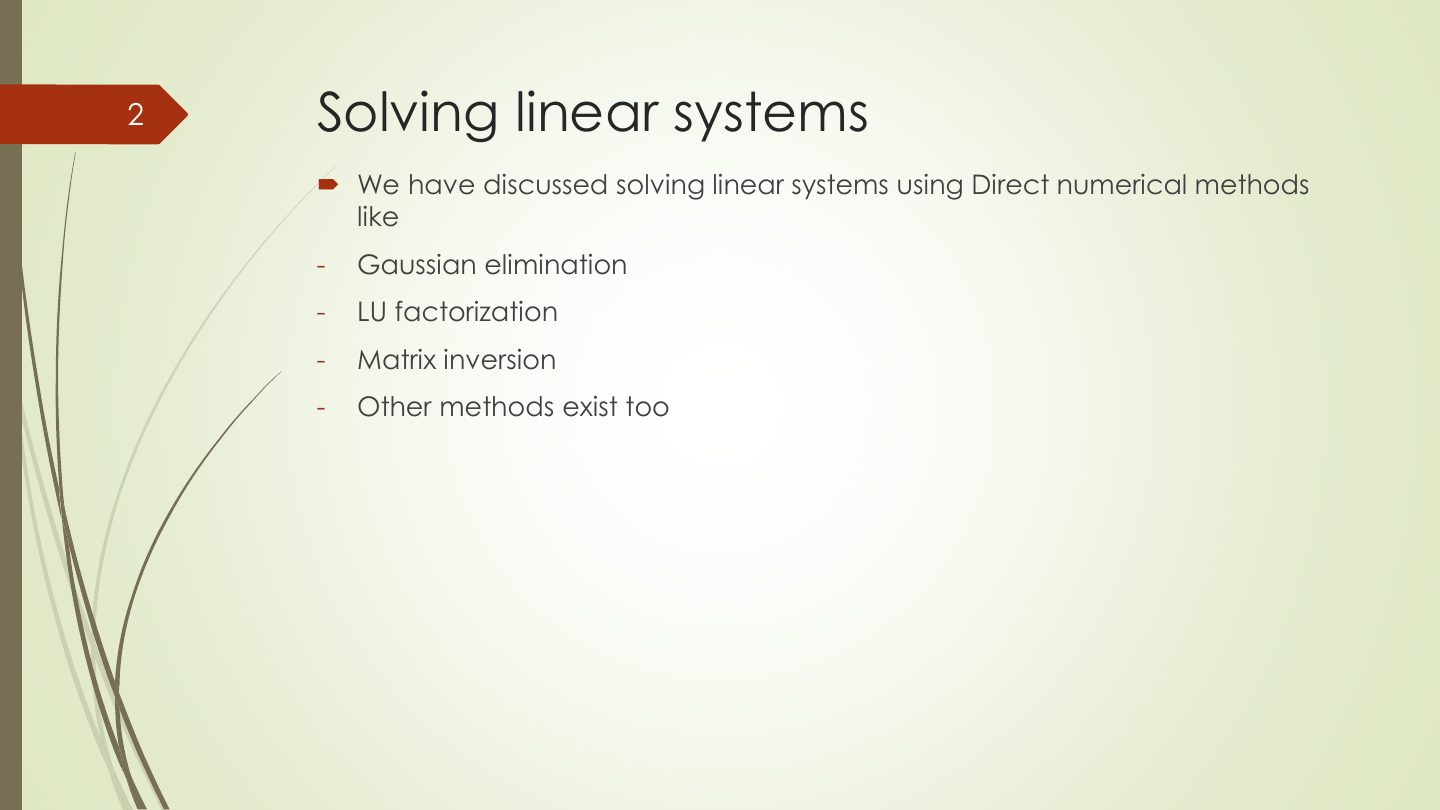
- 3 Why to use iterative methods?
- 4 What are iterative methods?
- 5 What are iterative methods?
- 6 What are iterative methods?
- 7 What are iterative methods?
- 8 What are iterative methods?
- 9 What are iterative methods?
- 10 What are iterative methods?
- 11 What is convergence?
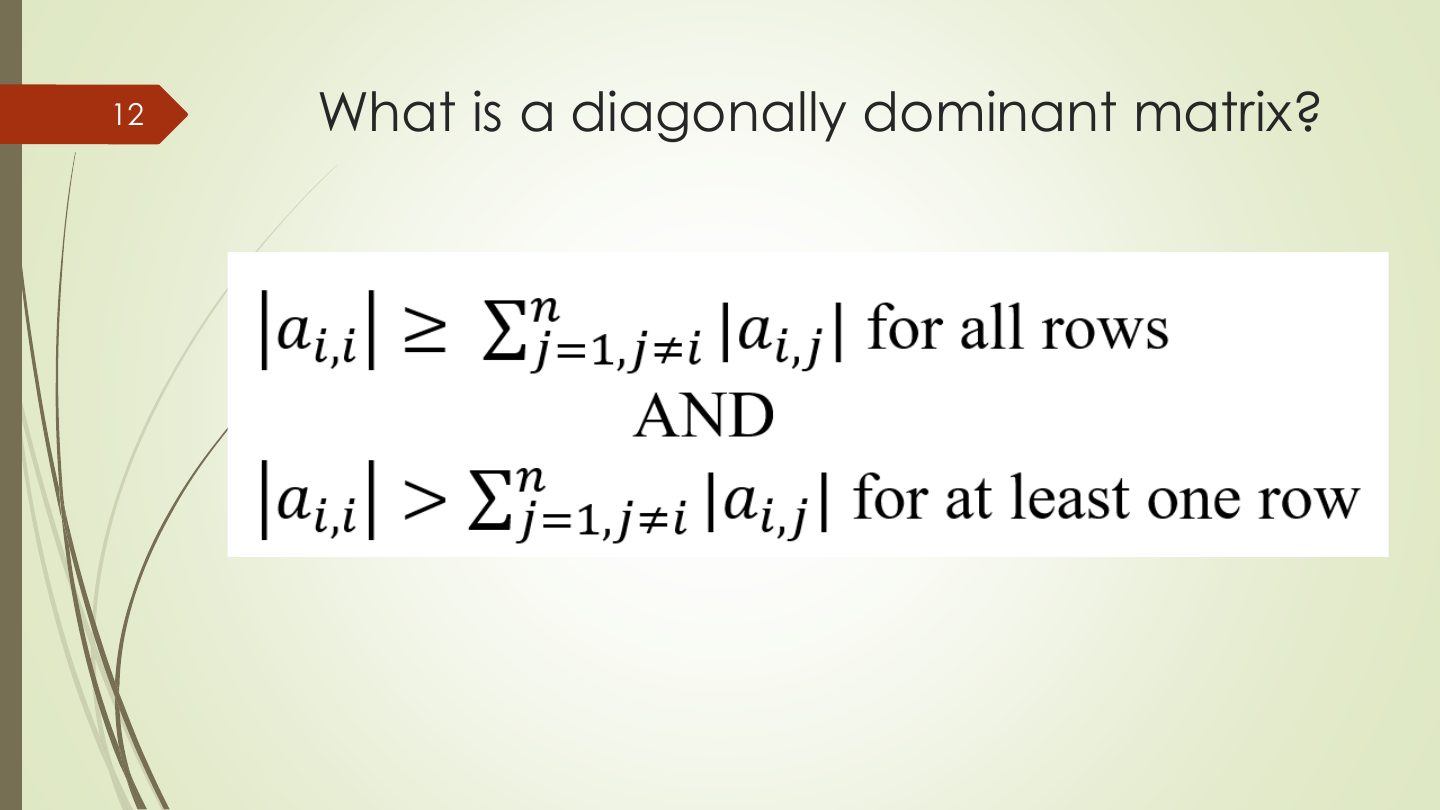
- 12 What is a diagonally dominant matrix?
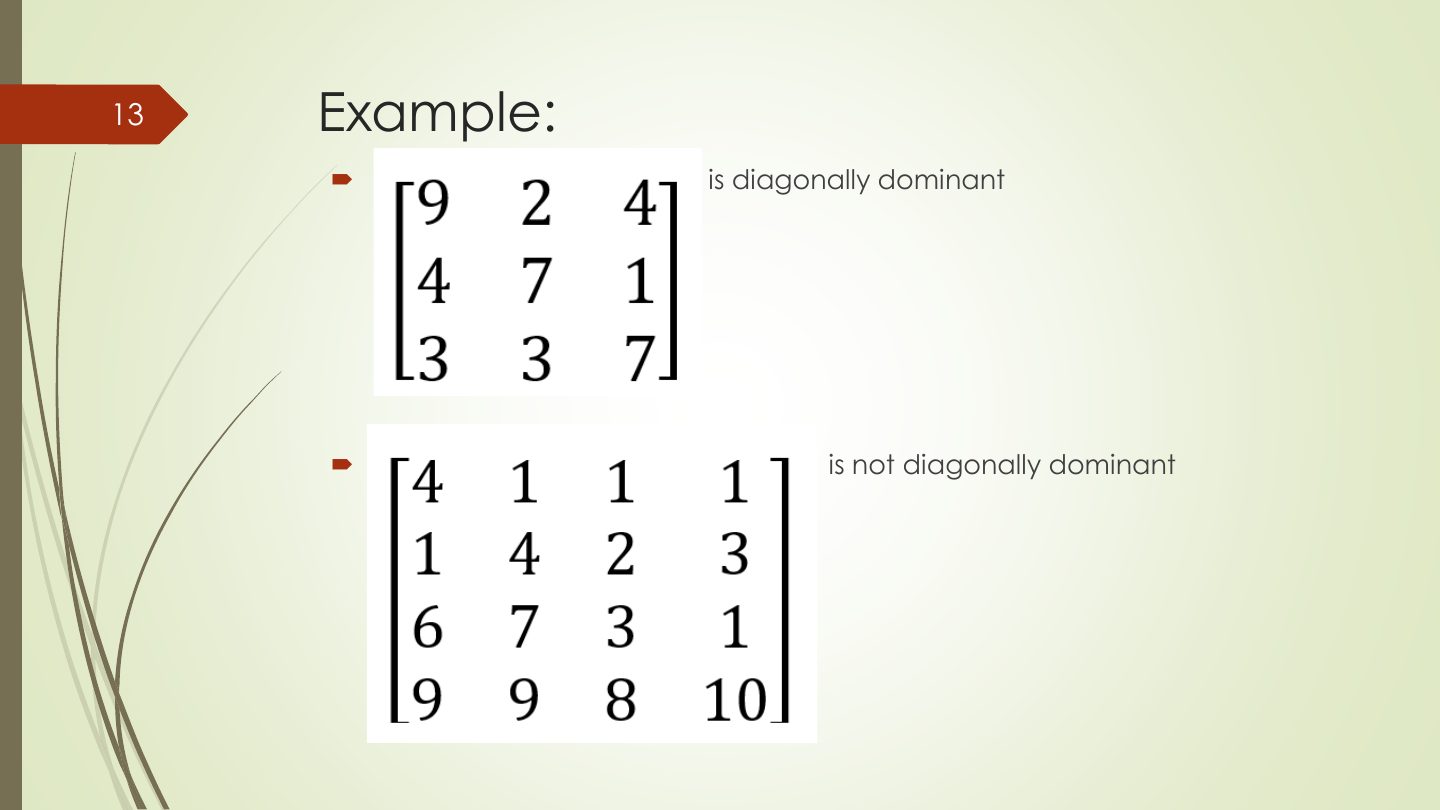
- 13 Example:
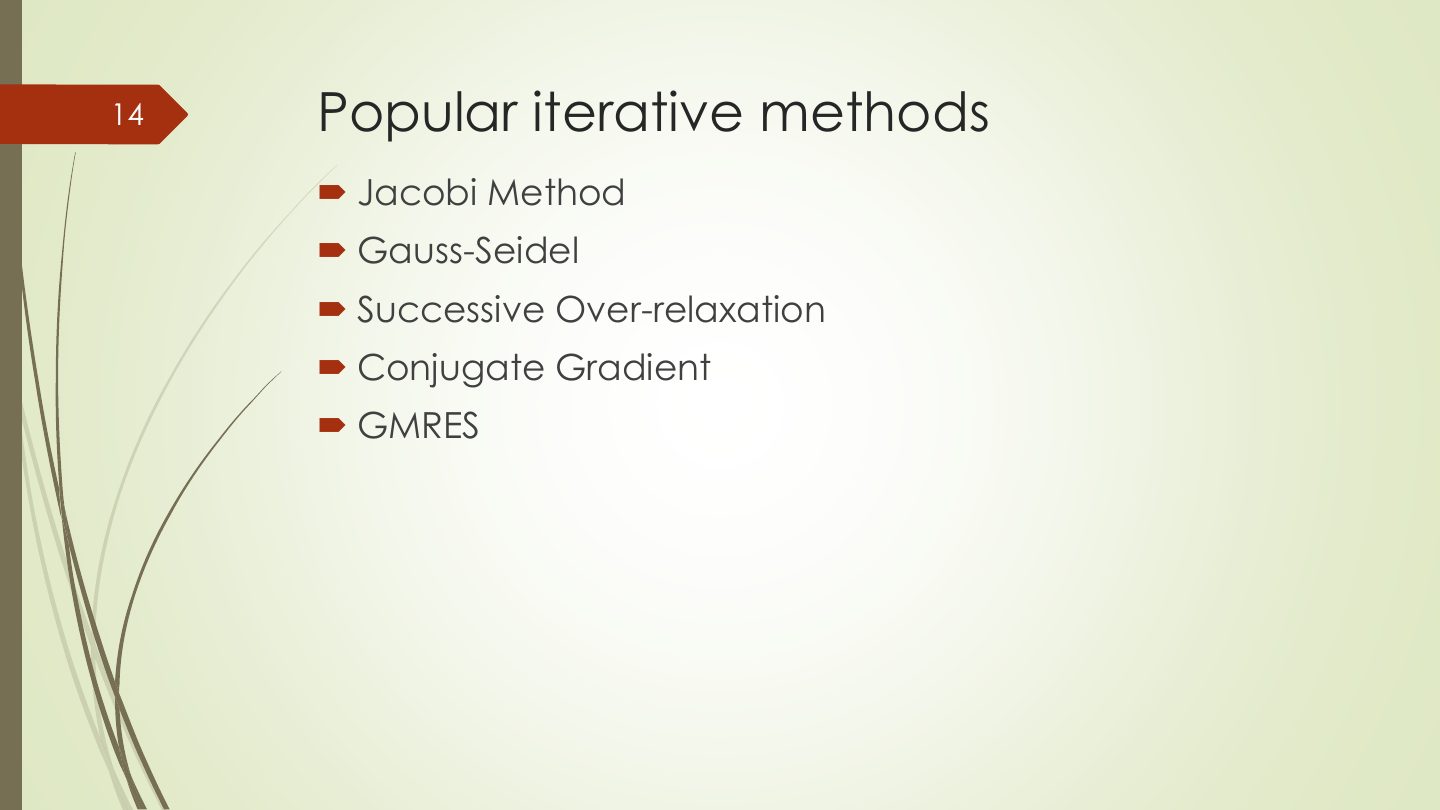
- 14 Popular iterative methods
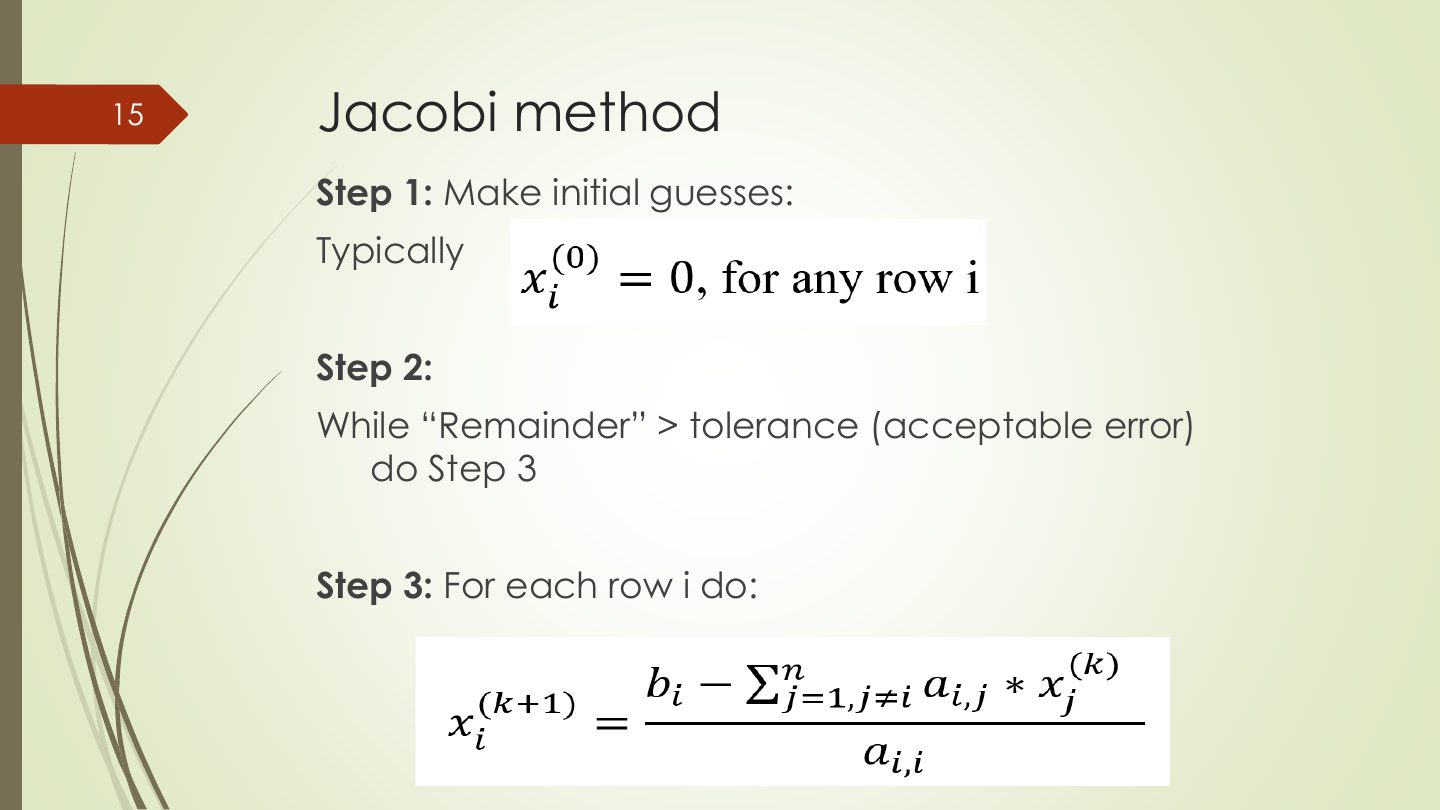
- 15 Jacobi method
- 16 Jacobi method (example)
- 17 Jacobi method (example)
- 18 Jacobi method (example)
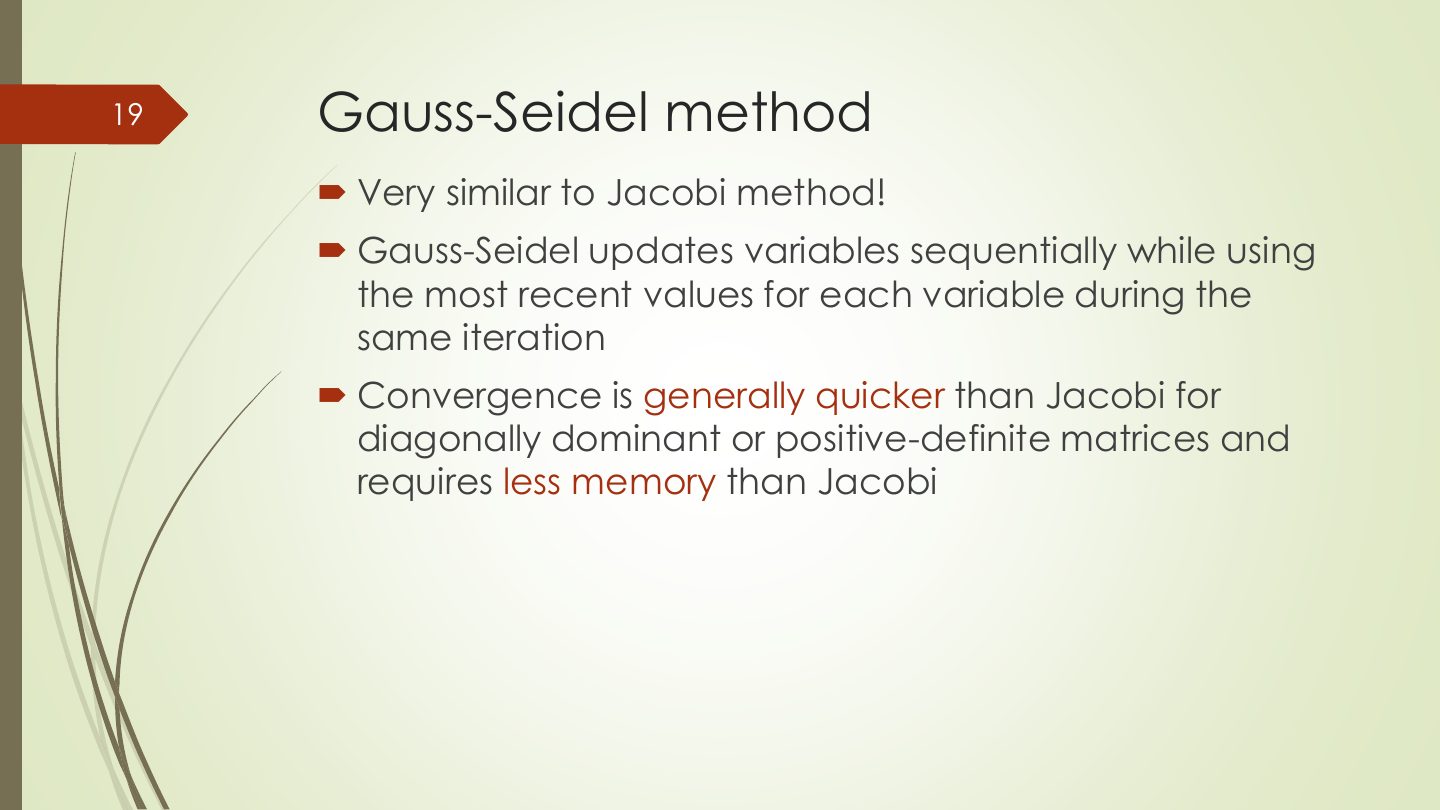
- 19 Gauss-Seidel method
- 20 Gauss-Seidel method
- 21 Gauss-Seidel method (example)
- 22 Gauss-Seidel method (example 2)
- 23 Successive over relaxation method
- 24 Successive over relaxation method
- 25 Beyond basic methods
Slide 1
Solving linear systems
Why to use iterative methods?
Notes
Iterative methods start from a guess and improve it; good for large sparse systems where elimination is too costly.
What are iterative methods?
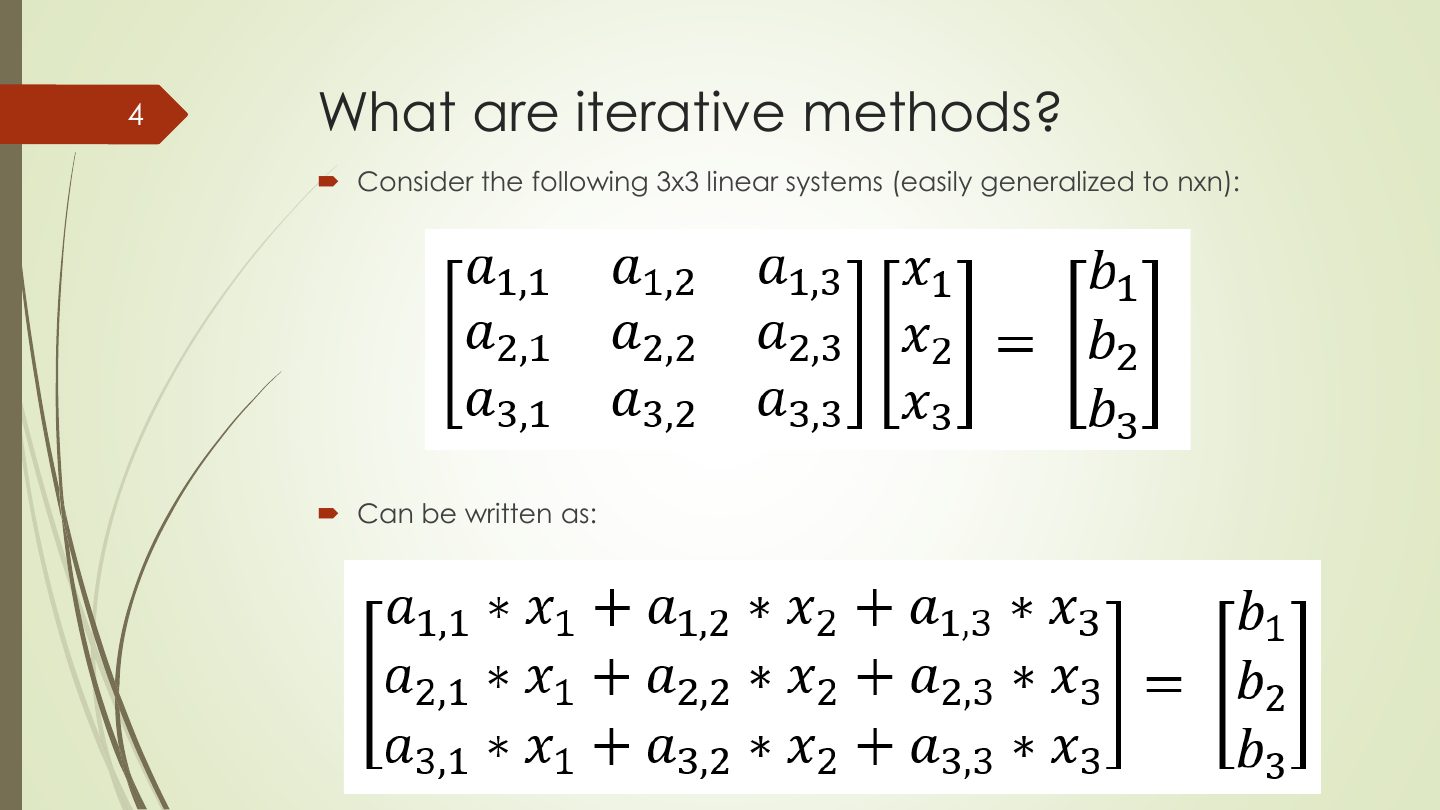
What are iterative methods?
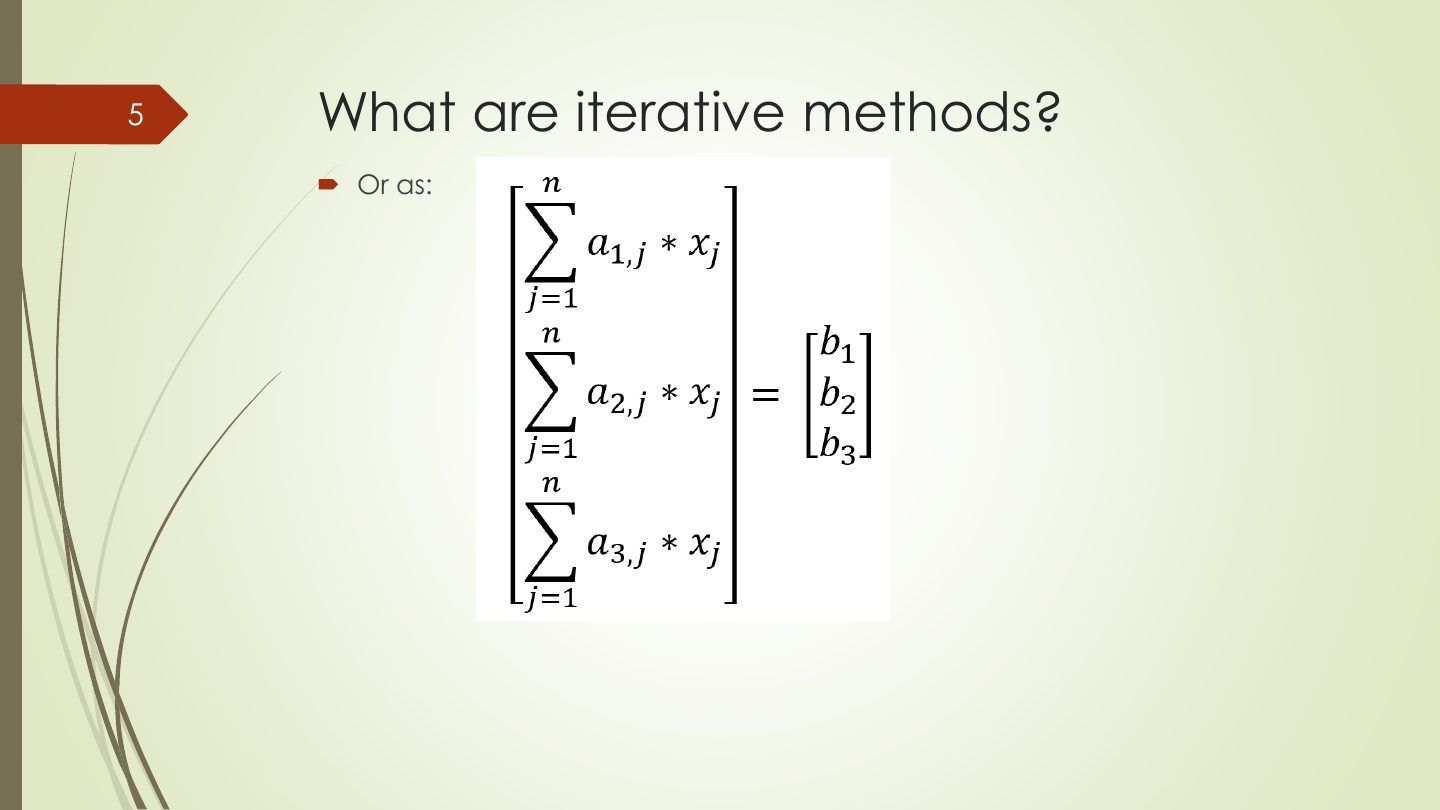
What are iterative methods?
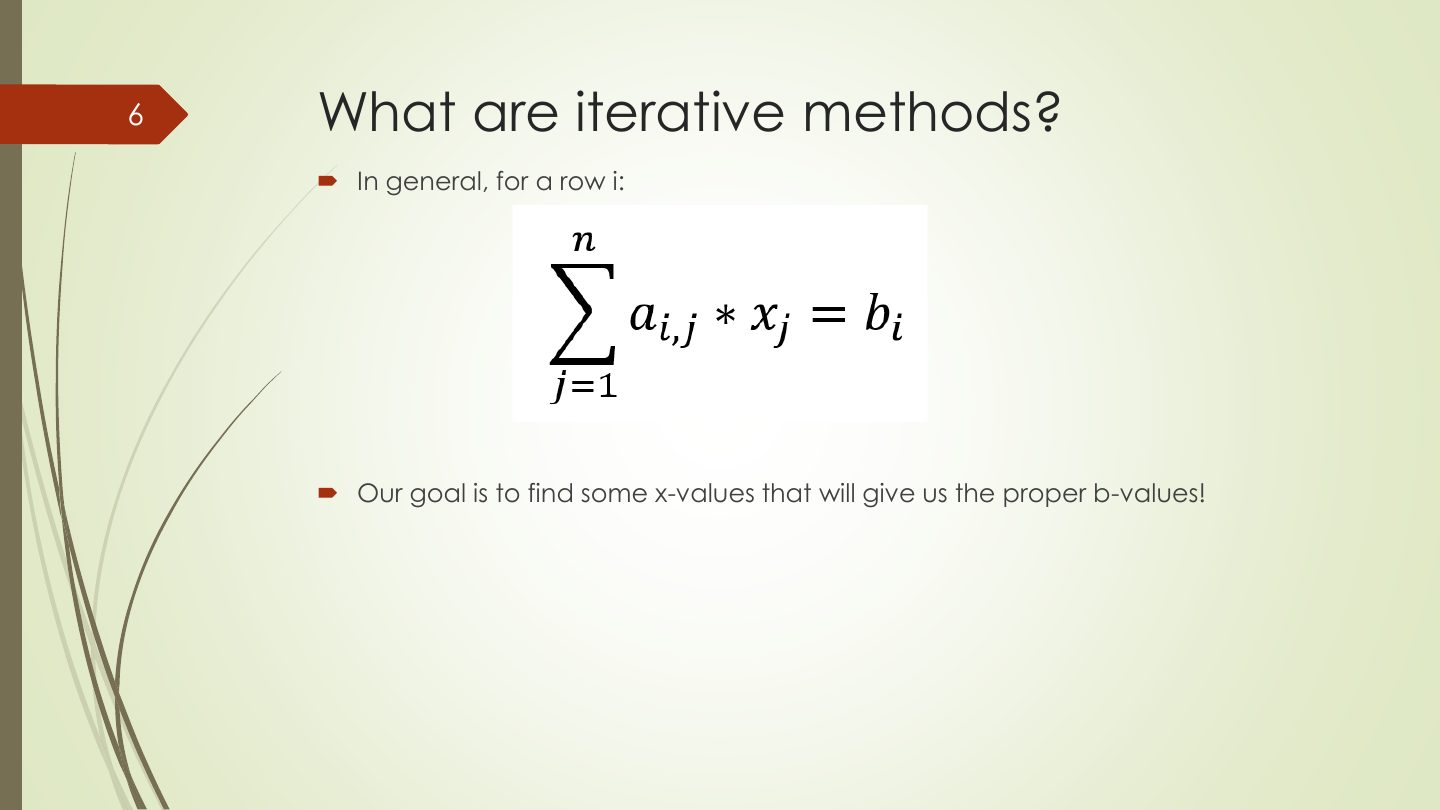
What are iterative methods?
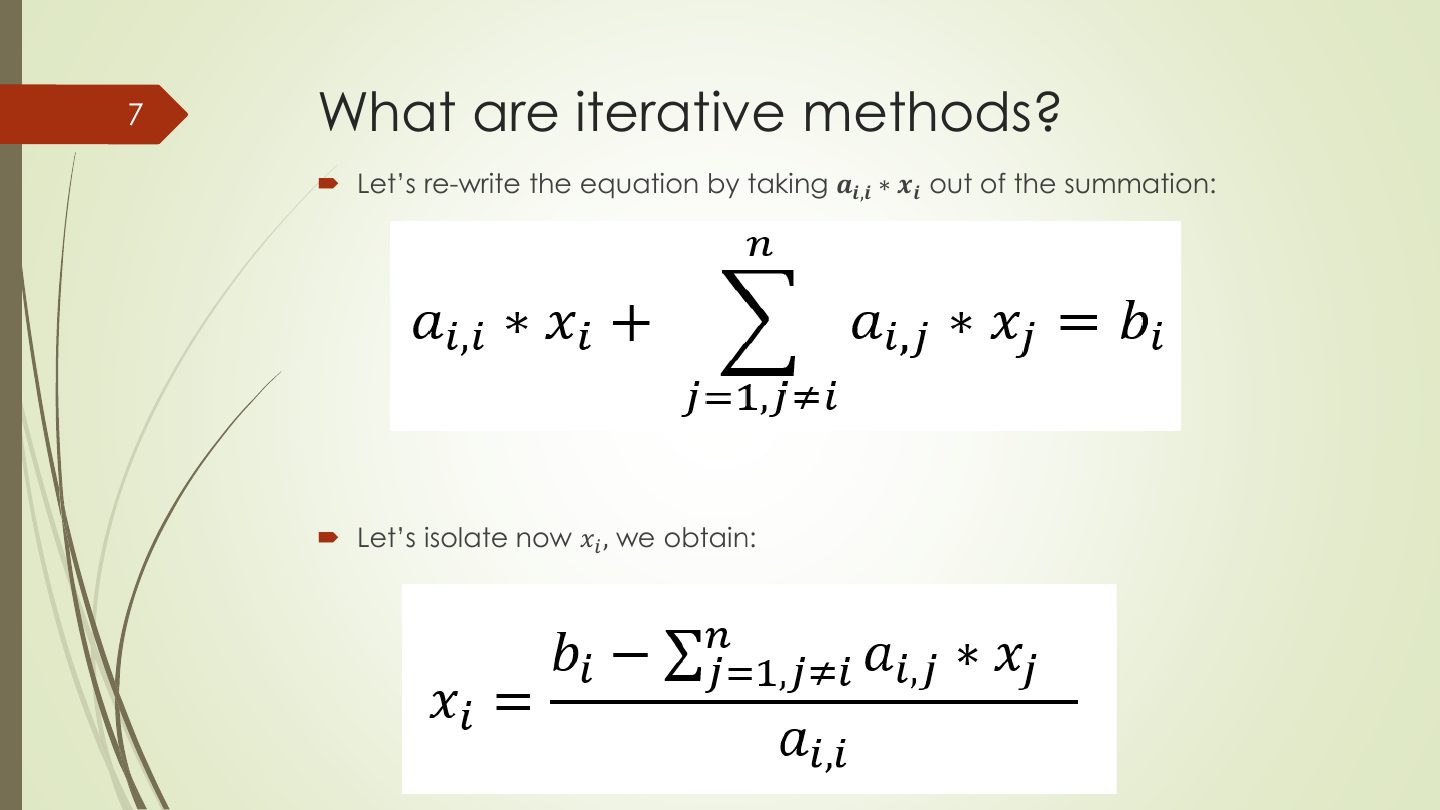
What are iterative methods?
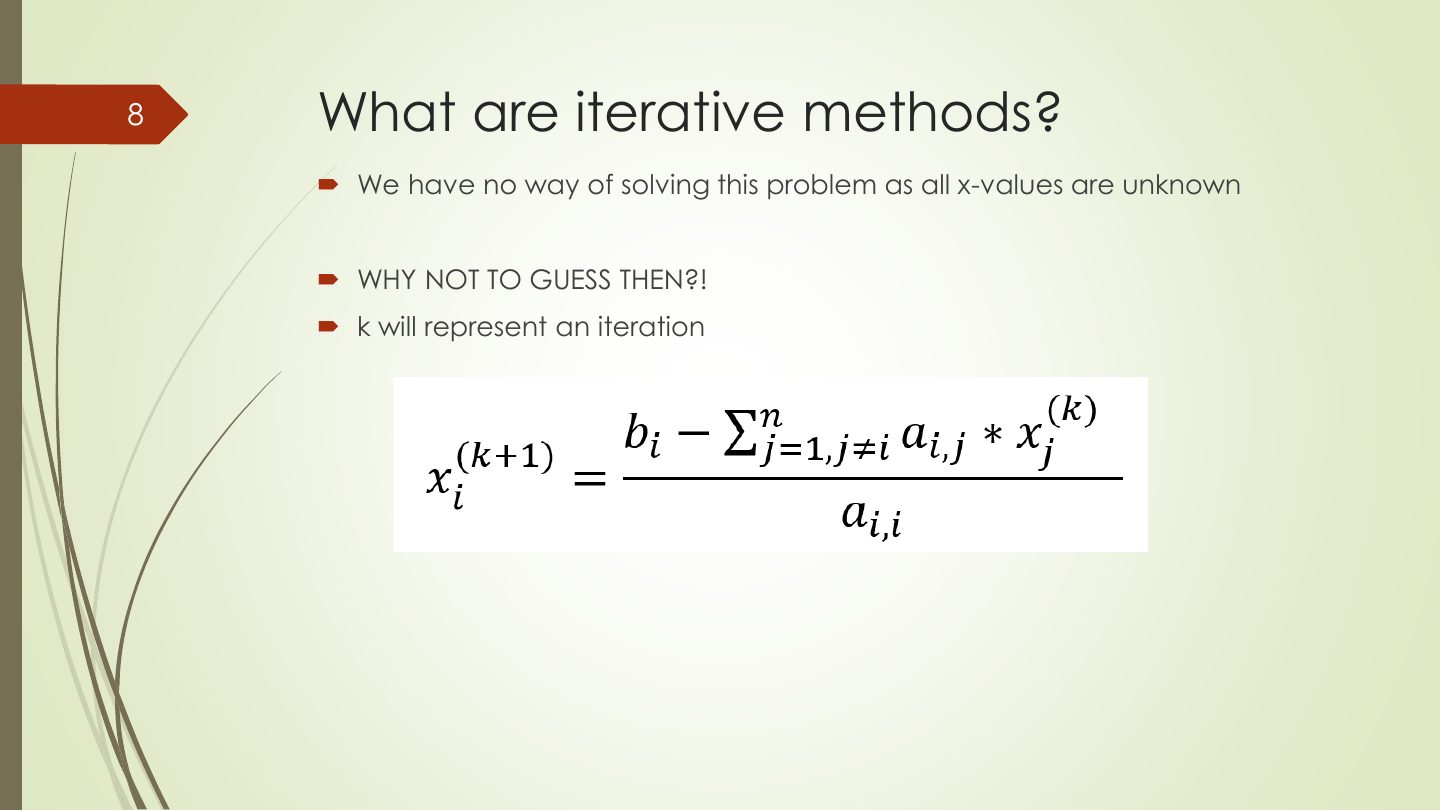
What are iterative methods?
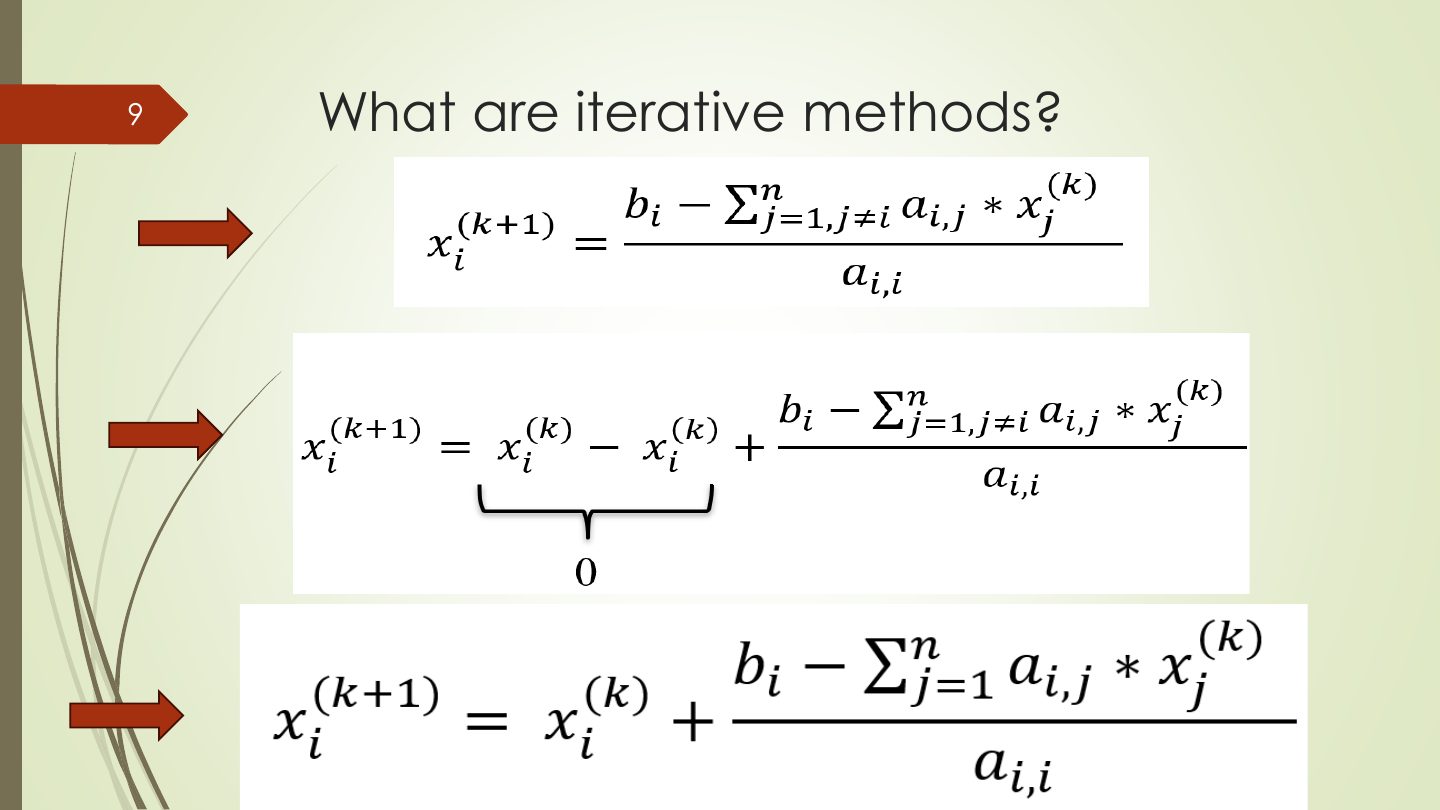
What are iterative methods?
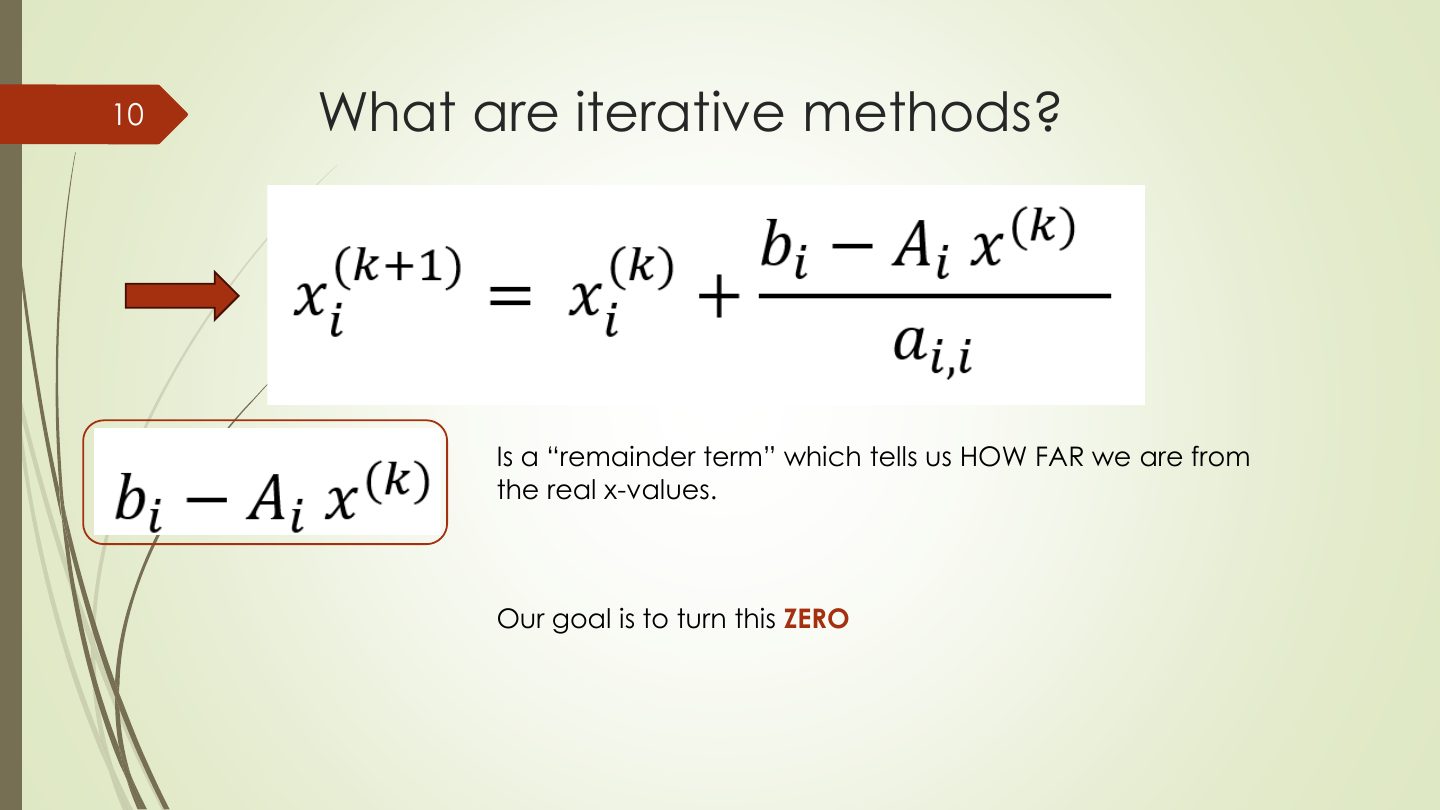
What is convergence?
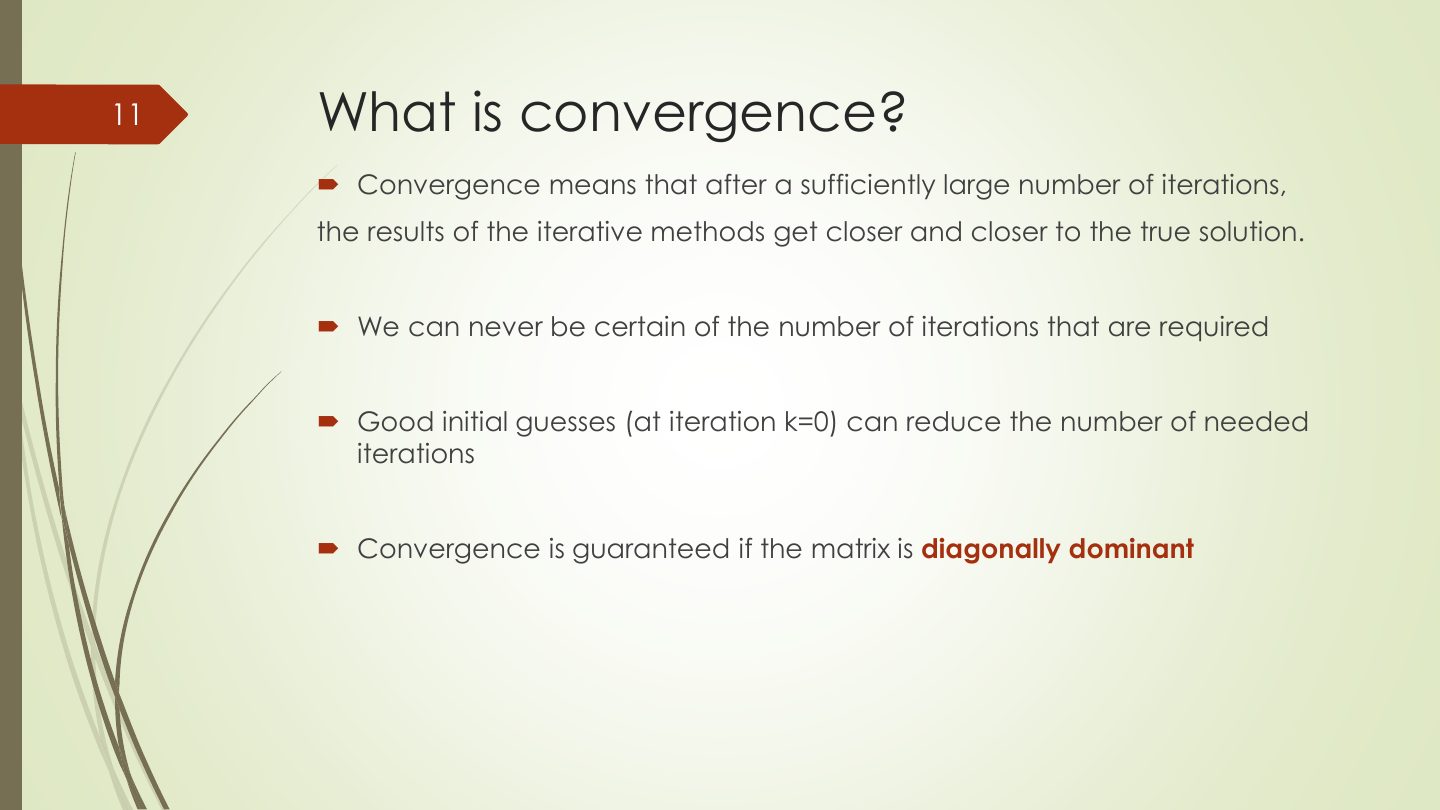
What is a diagonally dominant matrix?
Notes
Strictly diagonally dominant: |aᵢᵢ| > Σ_{j≠i} |aᵢⱼ| in every row. Then Jacobi and Gauss–Seidel converge for any starting vector.
Exam angle
Example:
Popular iterative methods
Jacobi method
Notes
Jacobi: xᵢ⁽ᵏ⁺¹⁾ = (bᵢ − Σ_{j≠i} aᵢⱼxⱼ⁽ᵏ⁾)/aᵢᵢ: every component uses the OLD vector.
Jacobi method (example)
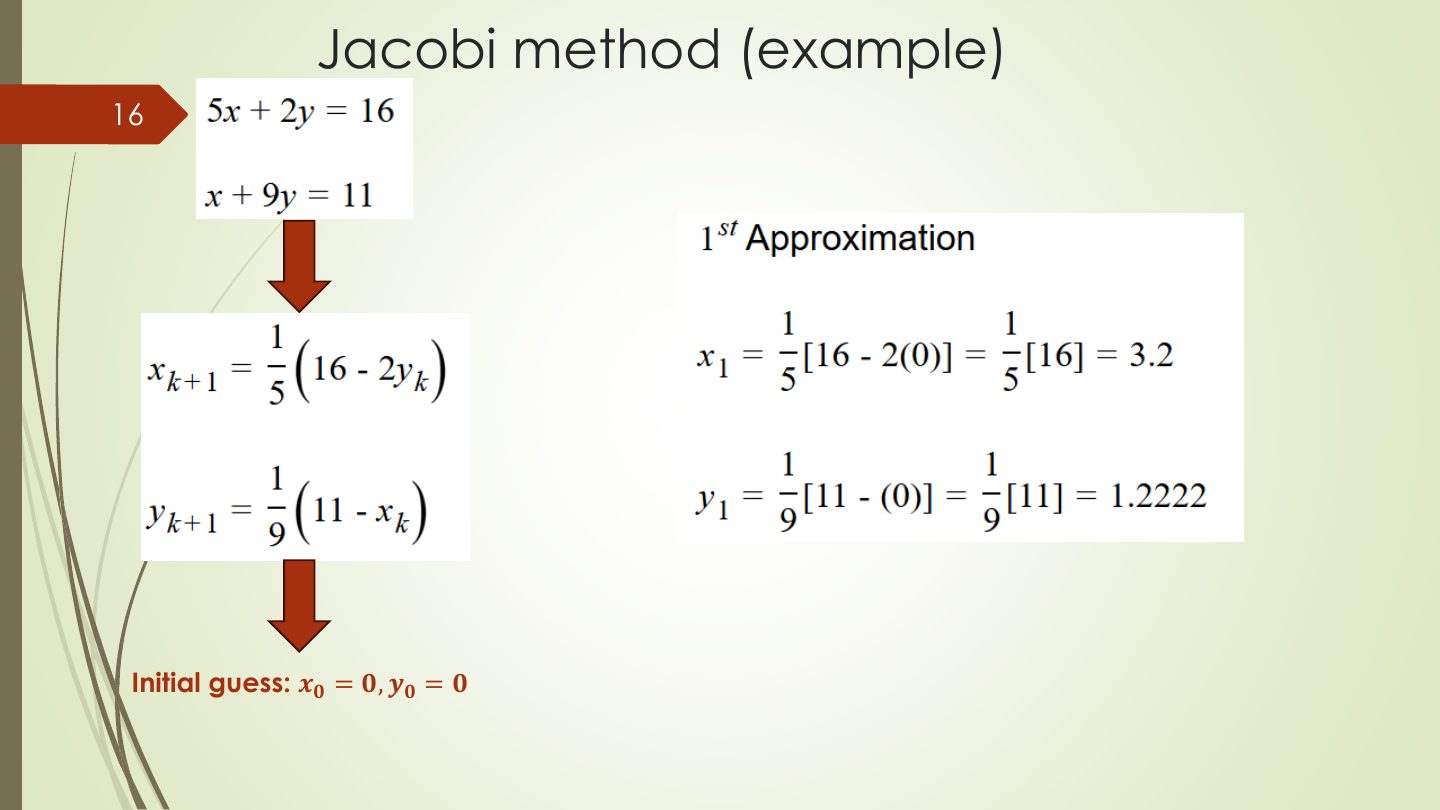
Jacobi method (example)
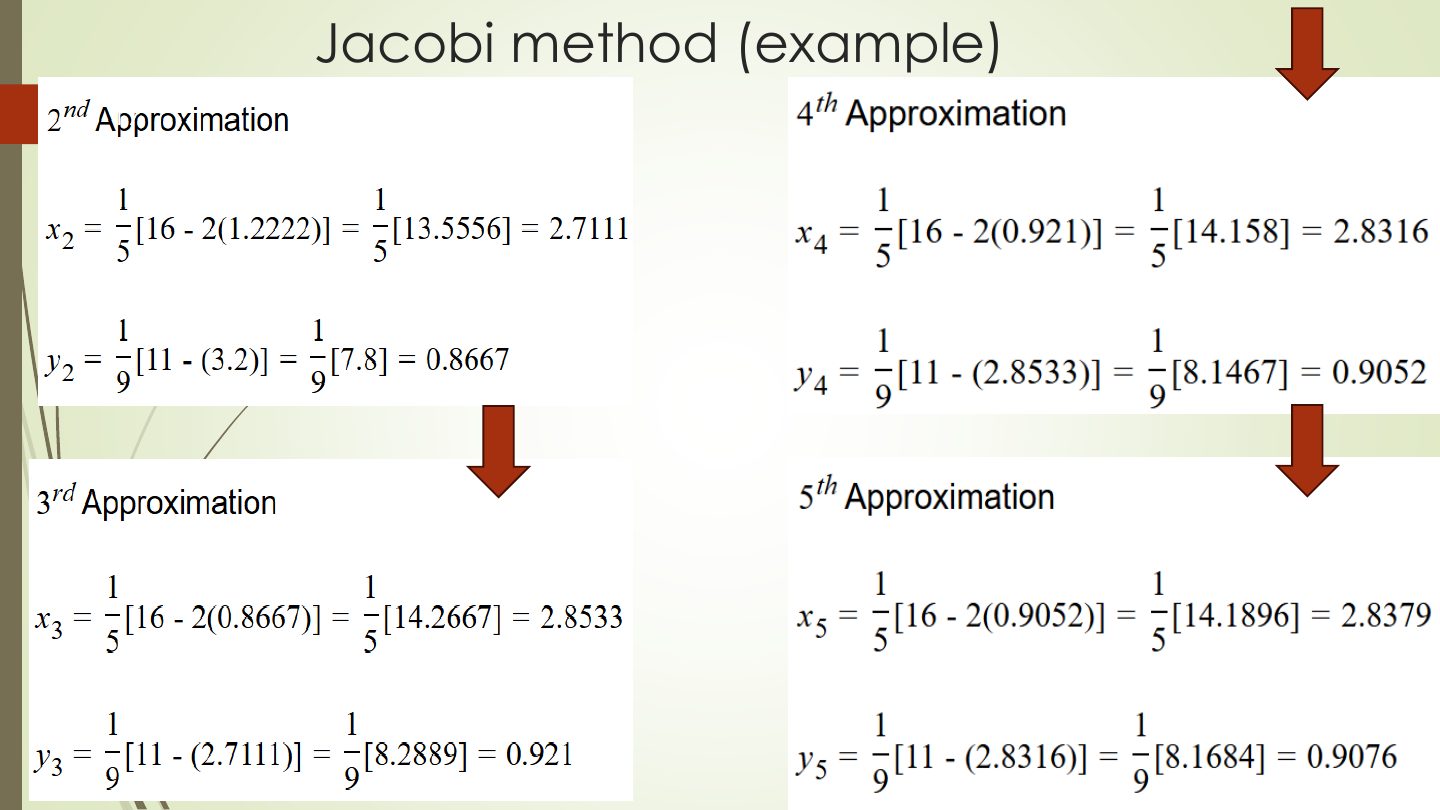
Jacobi method (example)
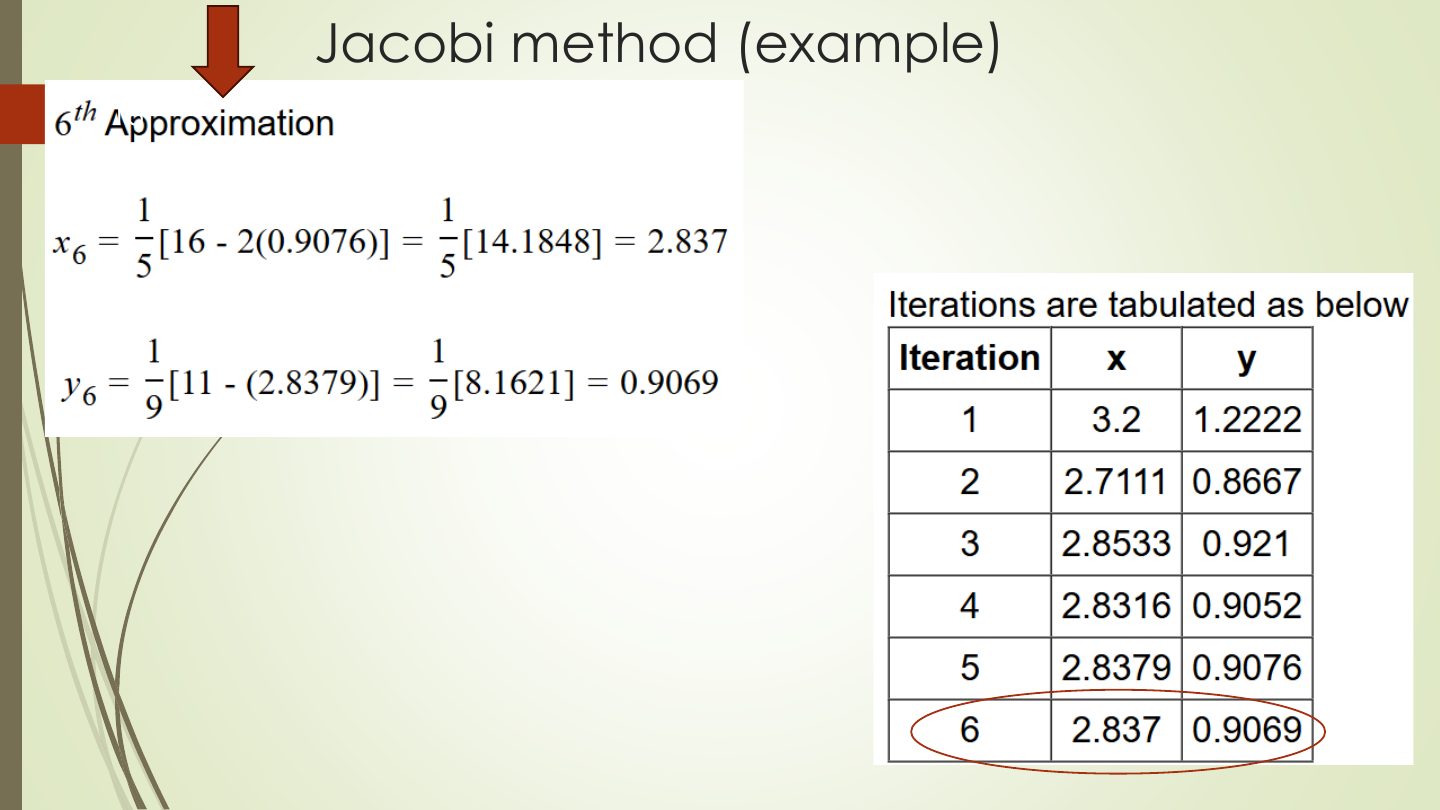
Gauss-Seidel method
Notes
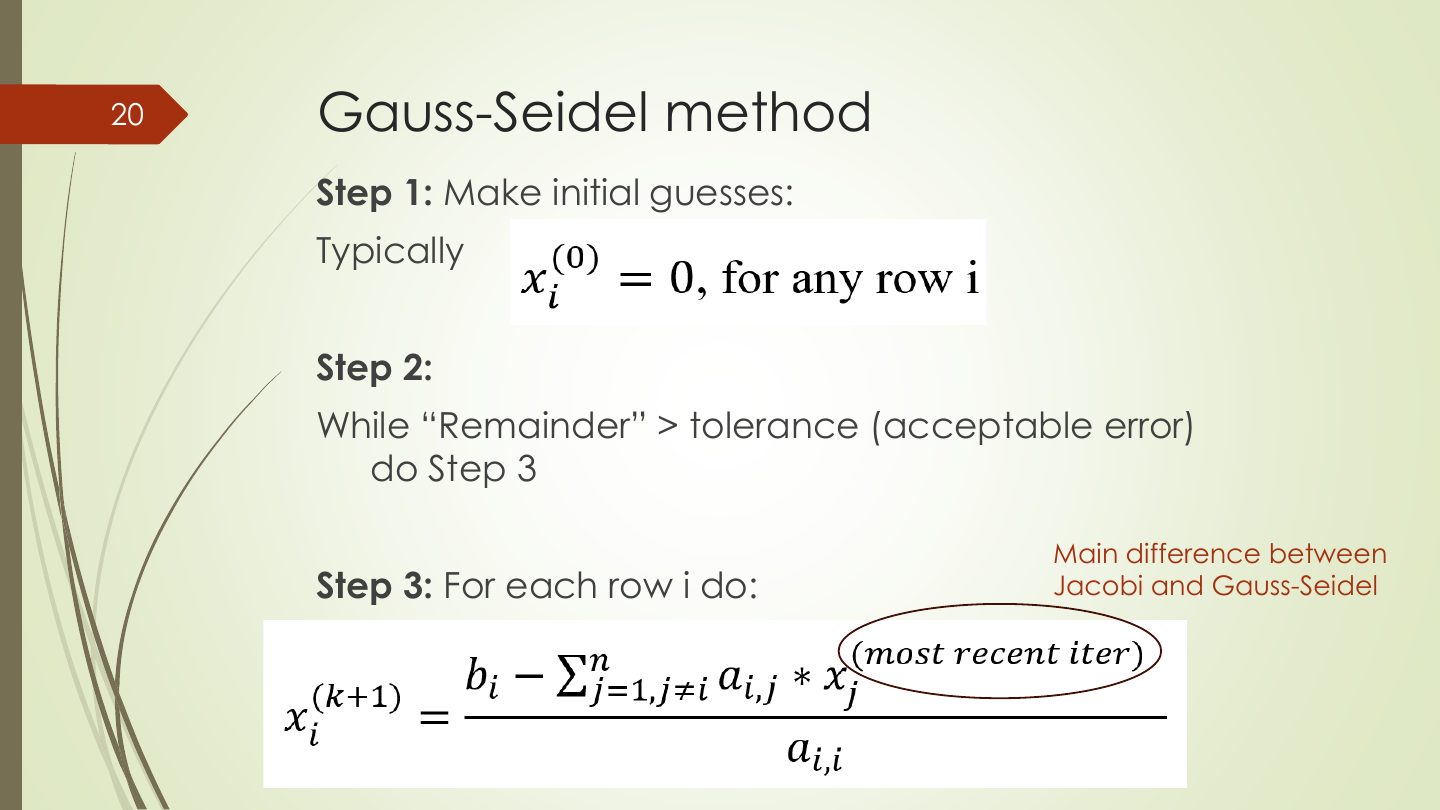
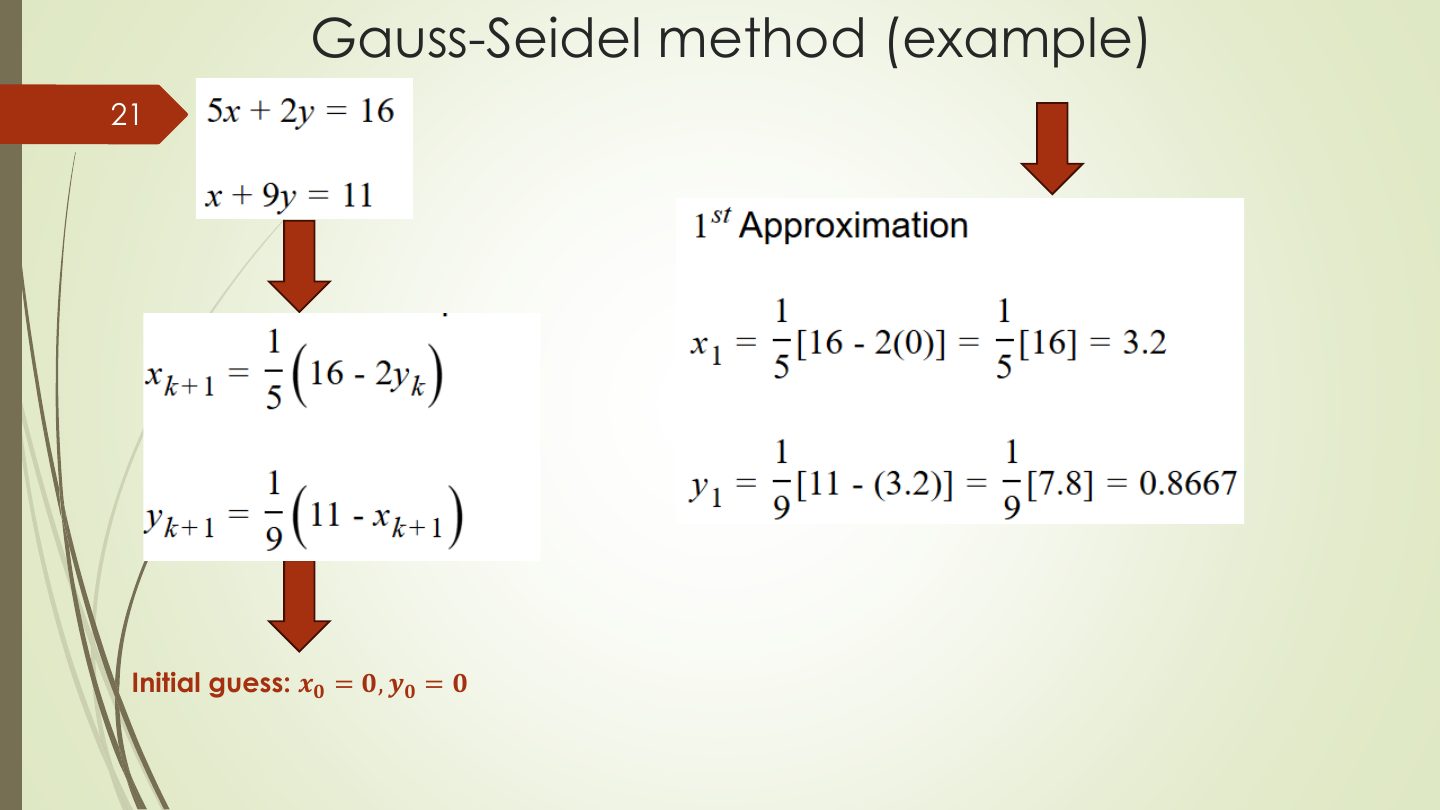
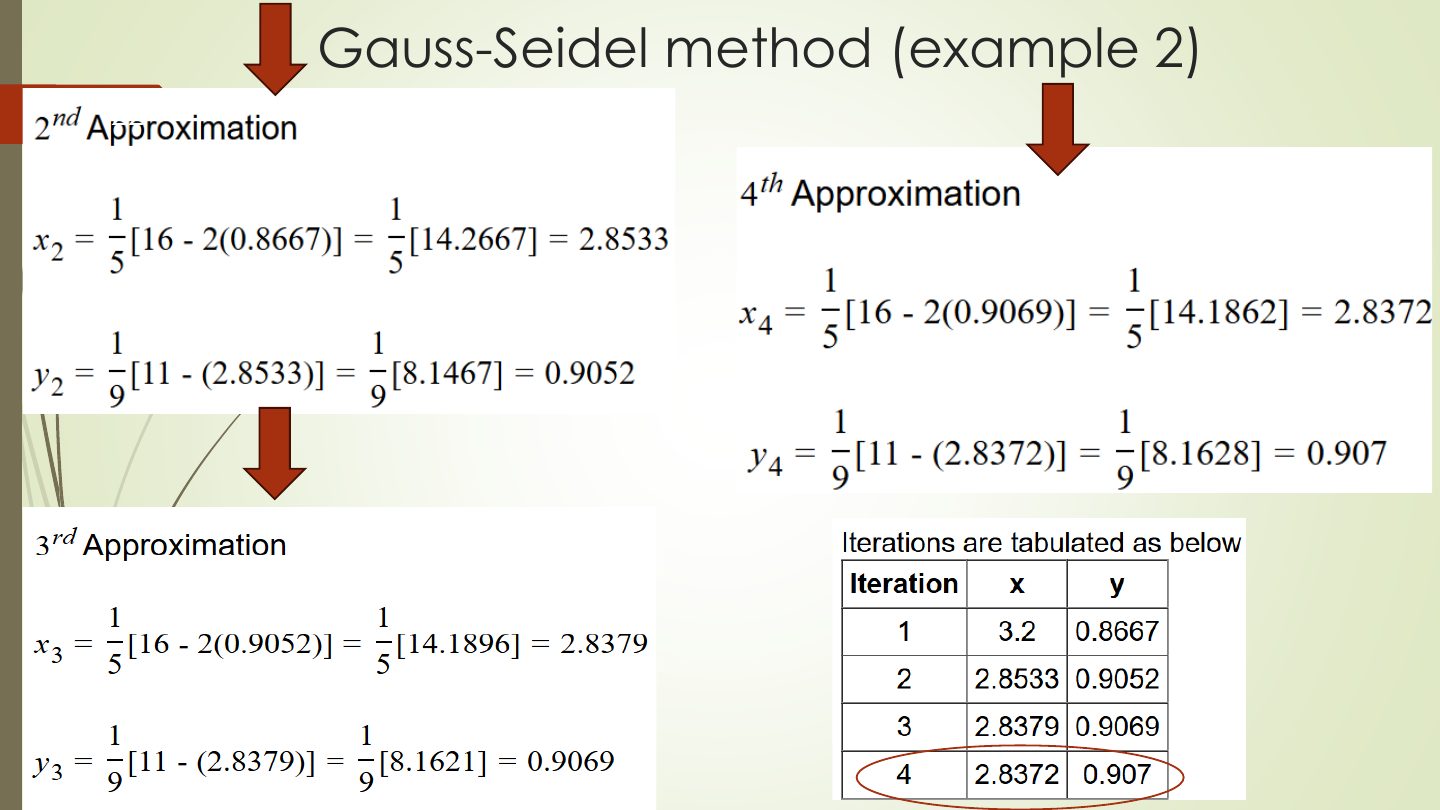
Gauss–Seidel: same formula but uses each NEW component as soon as it is computed; usually converges faster.
Memory trick Jacobi = all old values; Gauss–Seidel = newest values immediately.
Exam angle
One Jacobi step for 4x − y = 3, x + 5y = 6 from (0, 0).
Compare with the model answer
x = (3 + y)/4 = 0.75, y = (6 − x)/5 = 1.2 using the old x = 0, so (0.75, 1.2). (Gauss–Seidel would use x = 0.75: y = (6 − 0.75)/5 = 1.05.)
Gauss-Seidel method
Gauss-Seidel method (example)
Gauss-Seidel method (example 2)
Successive over relaxation method
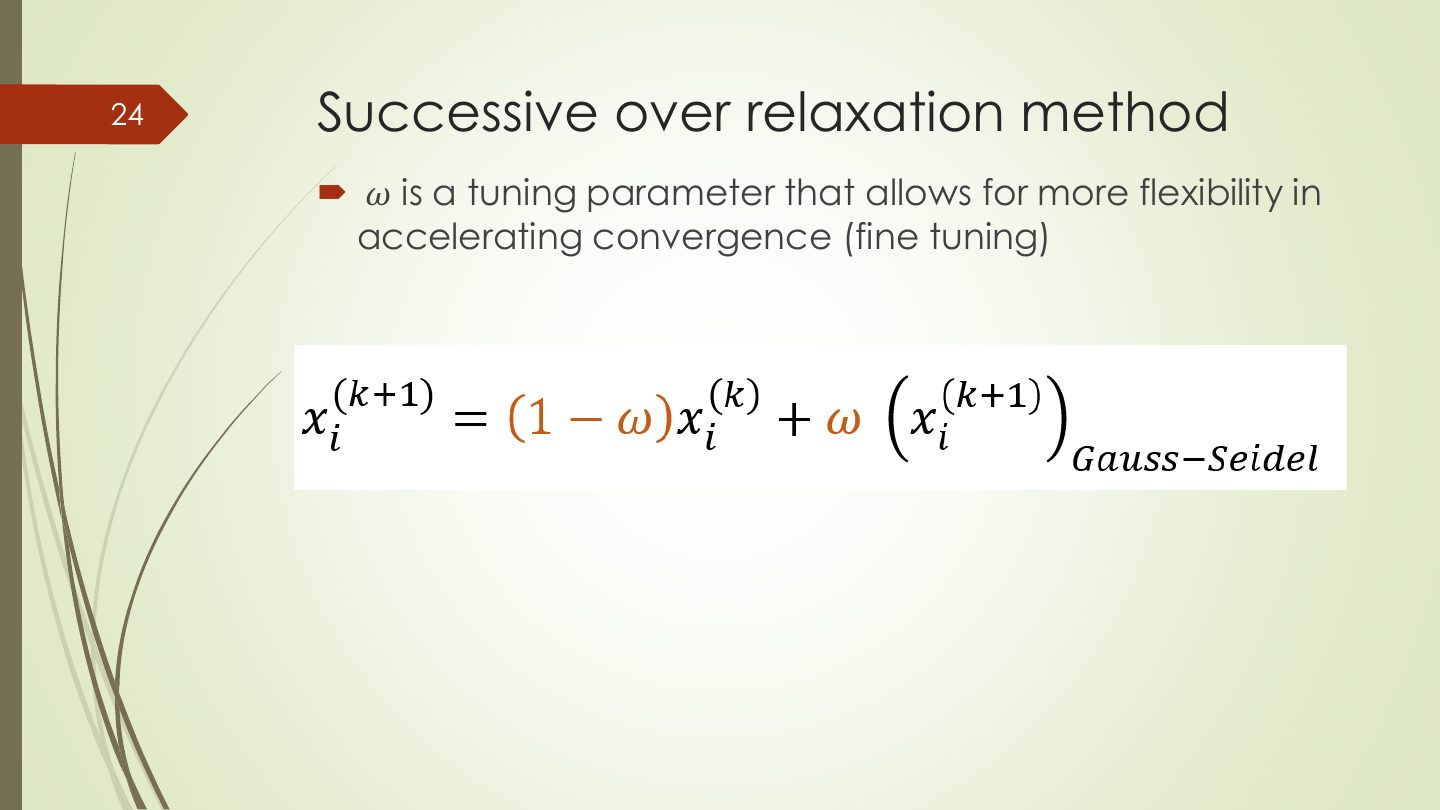
Successive over relaxation method
Beyond basic methods