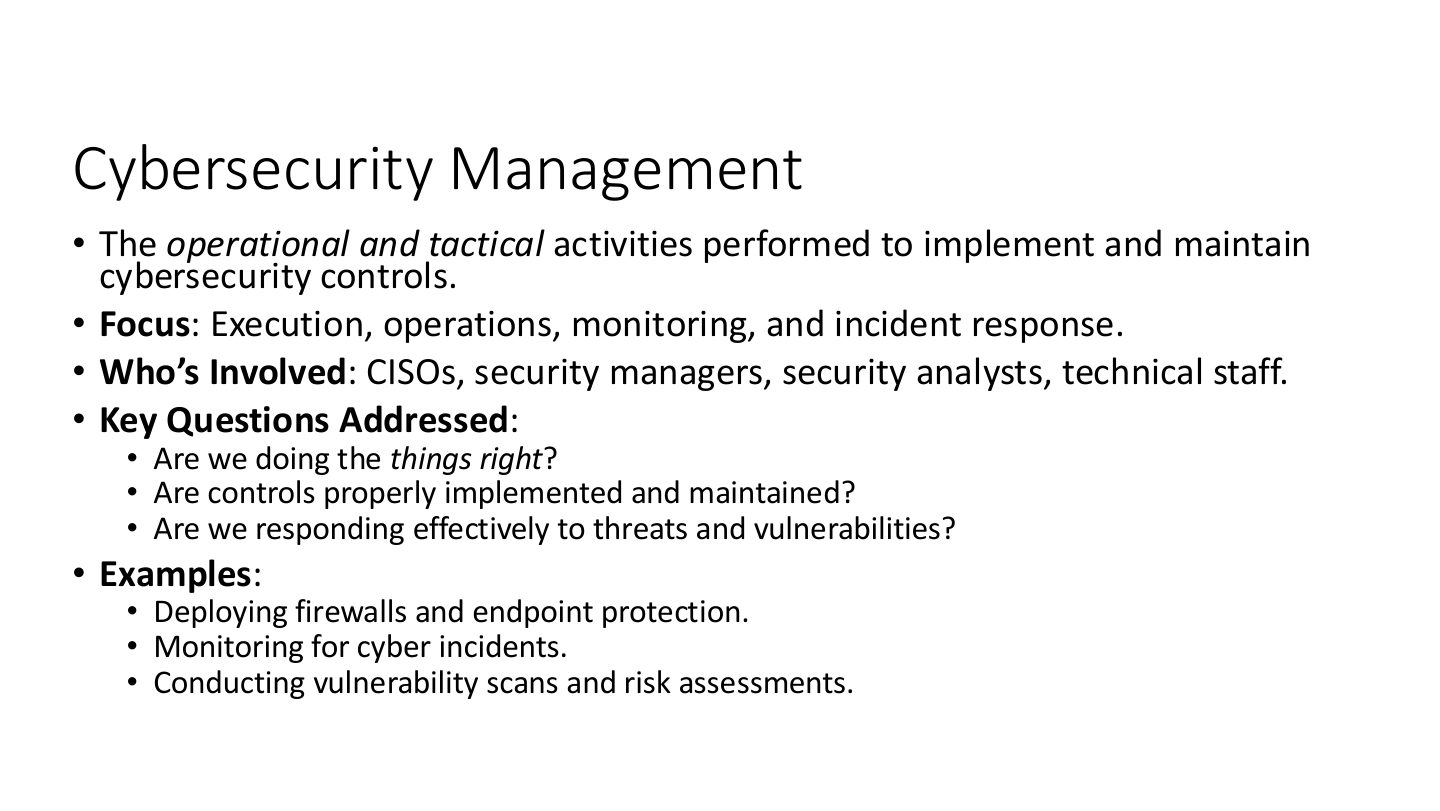
Which describes cybersecurity MANAGEMENT rather than governance?
Protection of Information Assets
Information assets, security governance vs. management, third parties and ASPs, due care vs. due diligence, classification (government and commercial) and its criteria, marking and handling, data at rest/in transit/in use, retention and destruction (erasing, clearing, purging, destruction), privacy laws (GDPR, CCPA, PDPL), ownership roles, and strategic/tactical/operational plans. Majors A, B and C each had a due-care question and a destruction or classification question from here.
How to read this page
Every original slide is shown unchanged. Yellow marks on a slide point to a numbered note: hover or tap a mark to jump to its note, and hover a note to see its marks. Questions tagged Past exam appeared on a real paper; Prediction questions are likely angles, not confirmed. Pick an answer to each question: a wrong pick tells you why it is wrong, so you can try again.
All 71 slides
- 1 Protection of Information Assets
- 2 Learning Objectives
- 3 What Is an Information Asset?
- 4 Main Categories of Information Assets
- 5 Slide 5
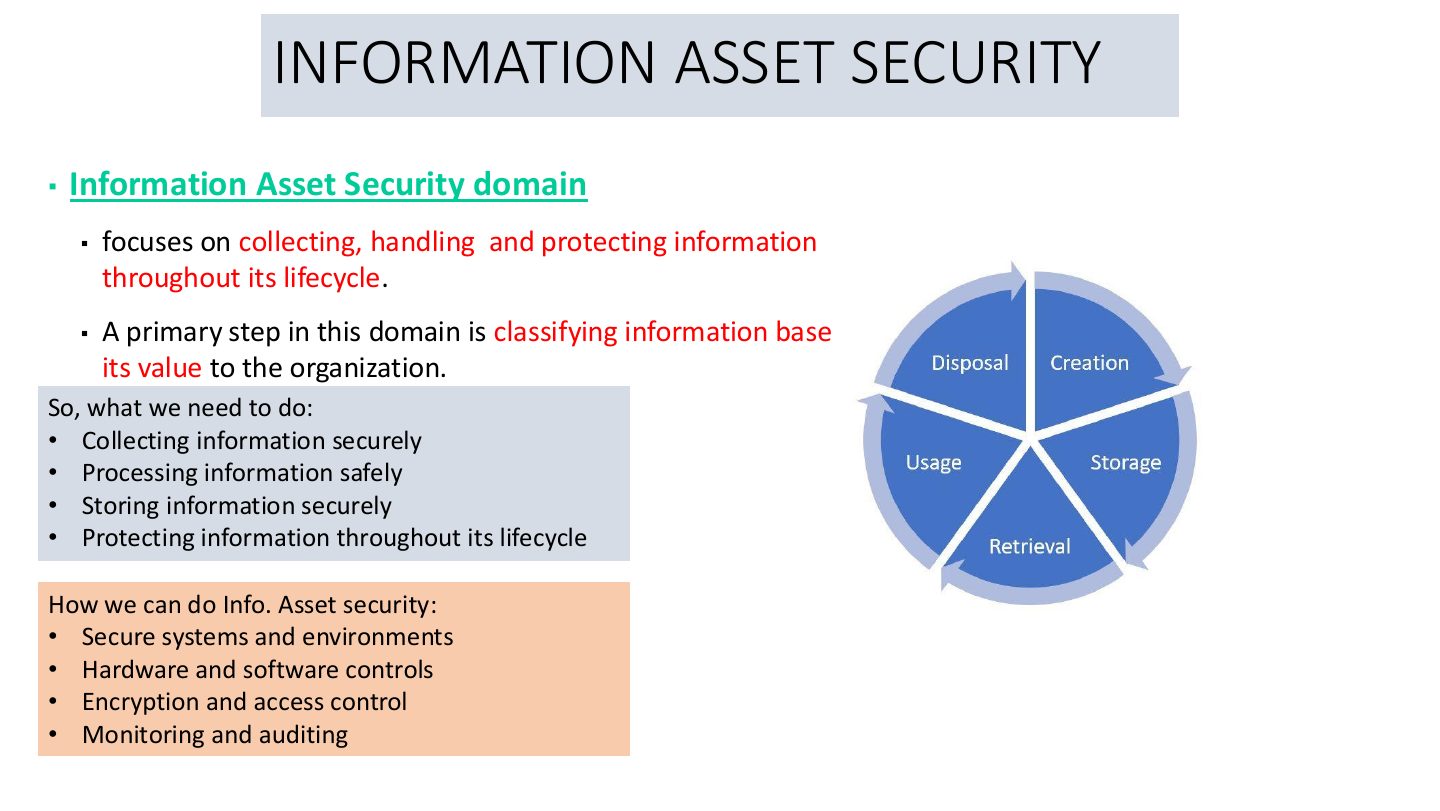
- 6 INFORMATION ASSET SECURITY
- 7 Security Governance and Information Assets
- 8 SECURITY GOVERNANCE PRINCIPLES
- 9 Management :
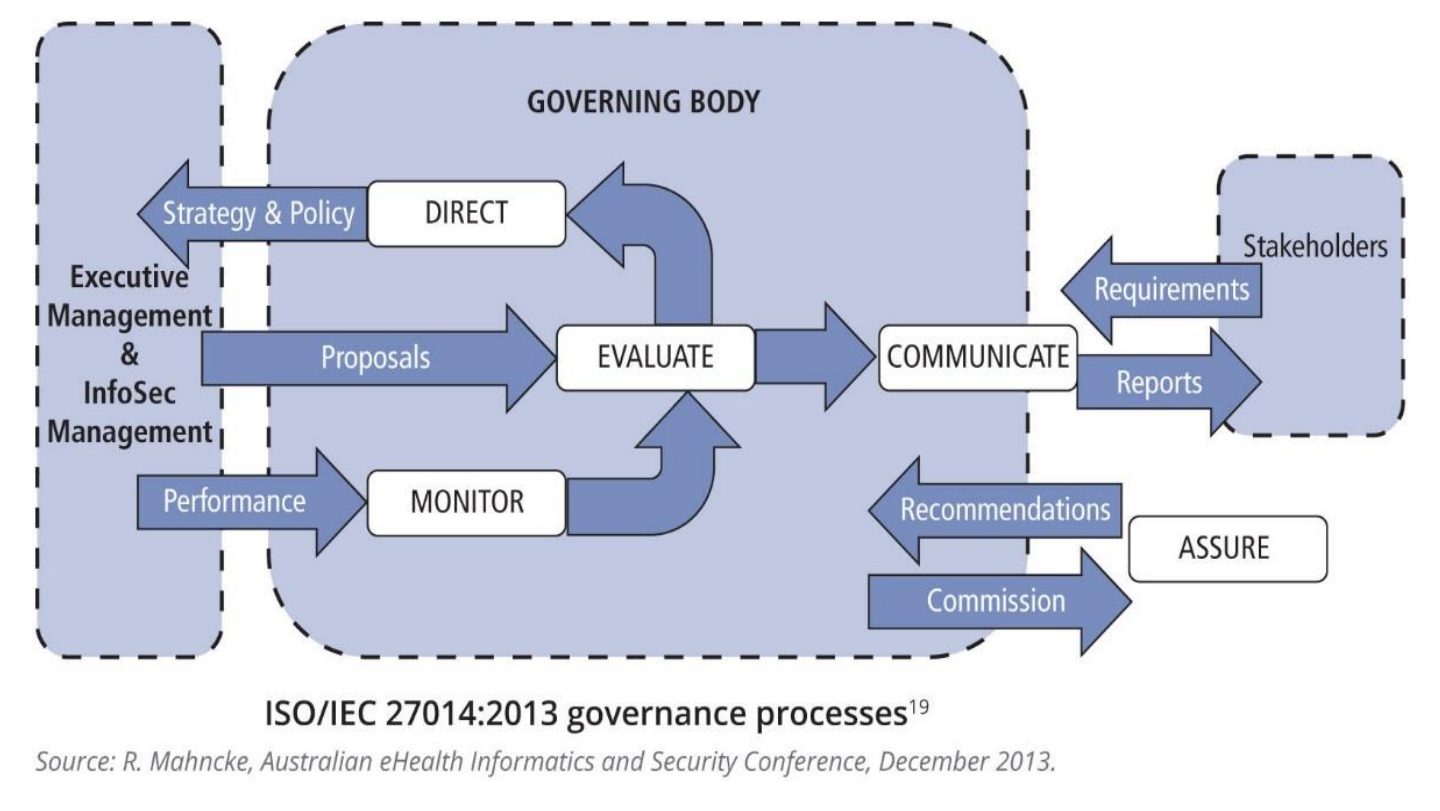
- 10 Cybersecurity Governance
- 11 Cybersecurity Governance
- 12 Cybersecurity Management
- 13 Slide 13
- 14 EVALUATE AND APPLY SECURITY GOVERNANCE PRINCIPLES
- 15 Security is not and should not be treated as an IT issue only.
- 16 ASP: An Application Service Provider (ASP) is a company that delivers software applications over the internet. Instead of hosting the software on your own servers, the ASP hosts and maintains it on their servers.
- 17 Due Care vs. Due Diligence
- 18 Due Care vs. Due Diligence
- 19 Information Classification
- 20 Classification Systems
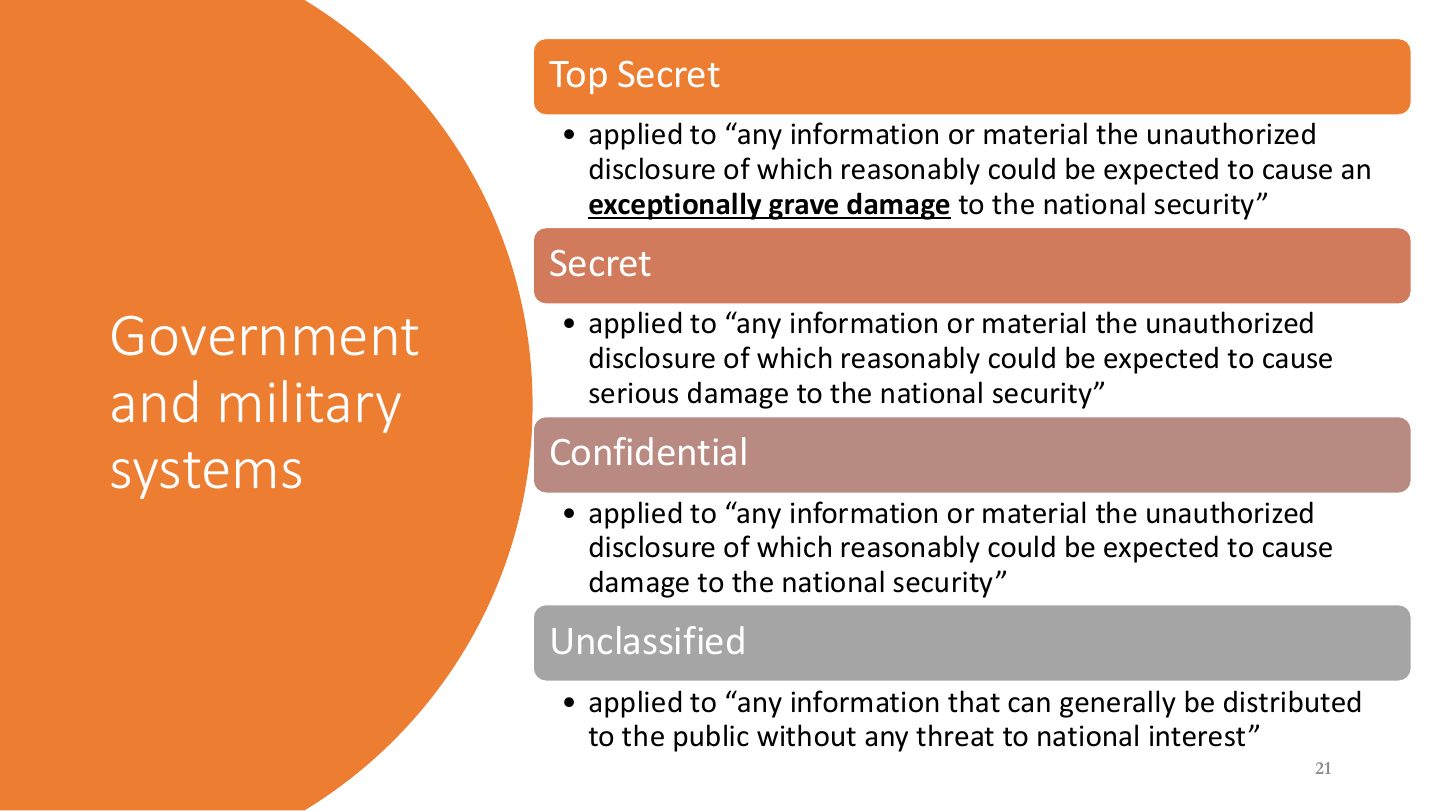
- 21 Top Secret
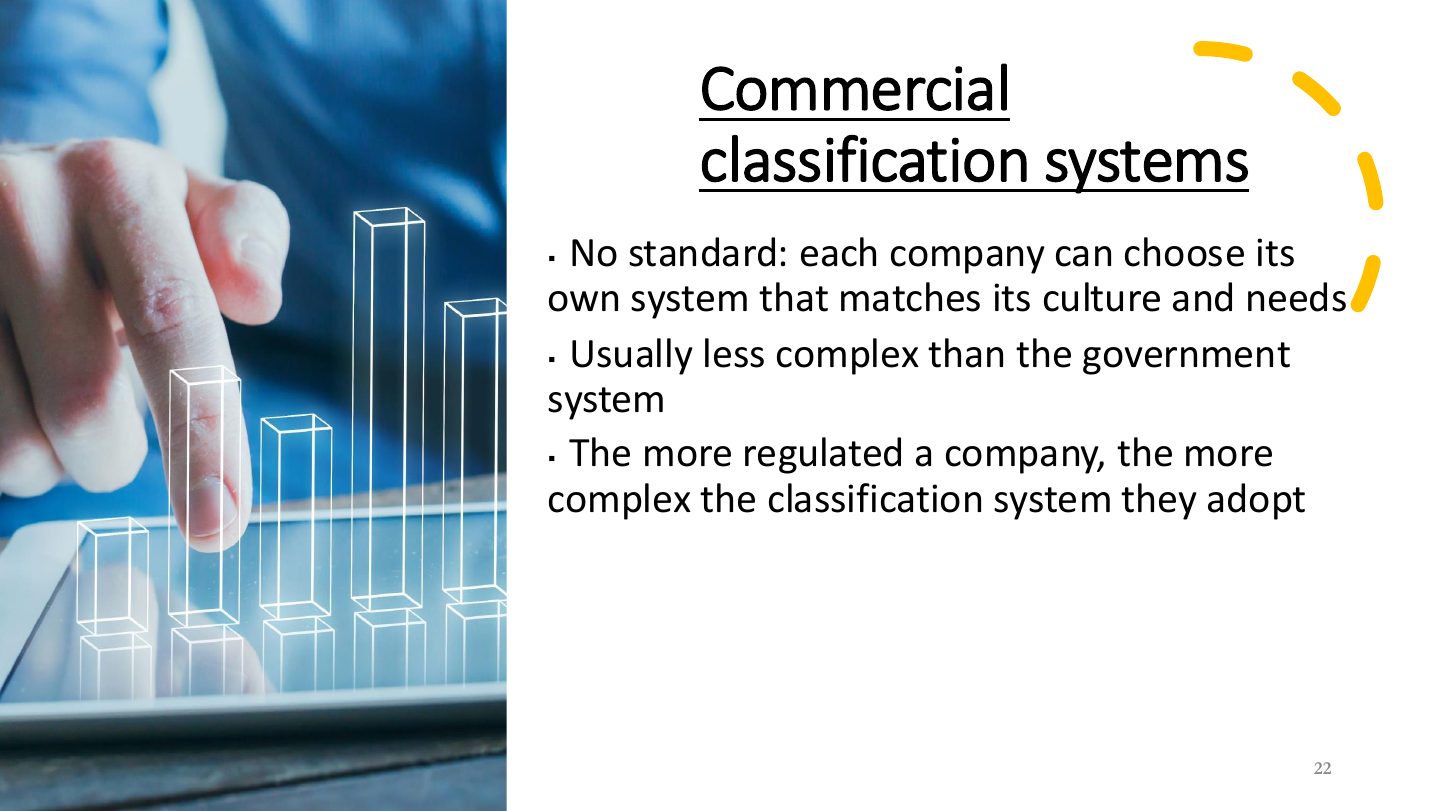
- 22 Commercial classification systems
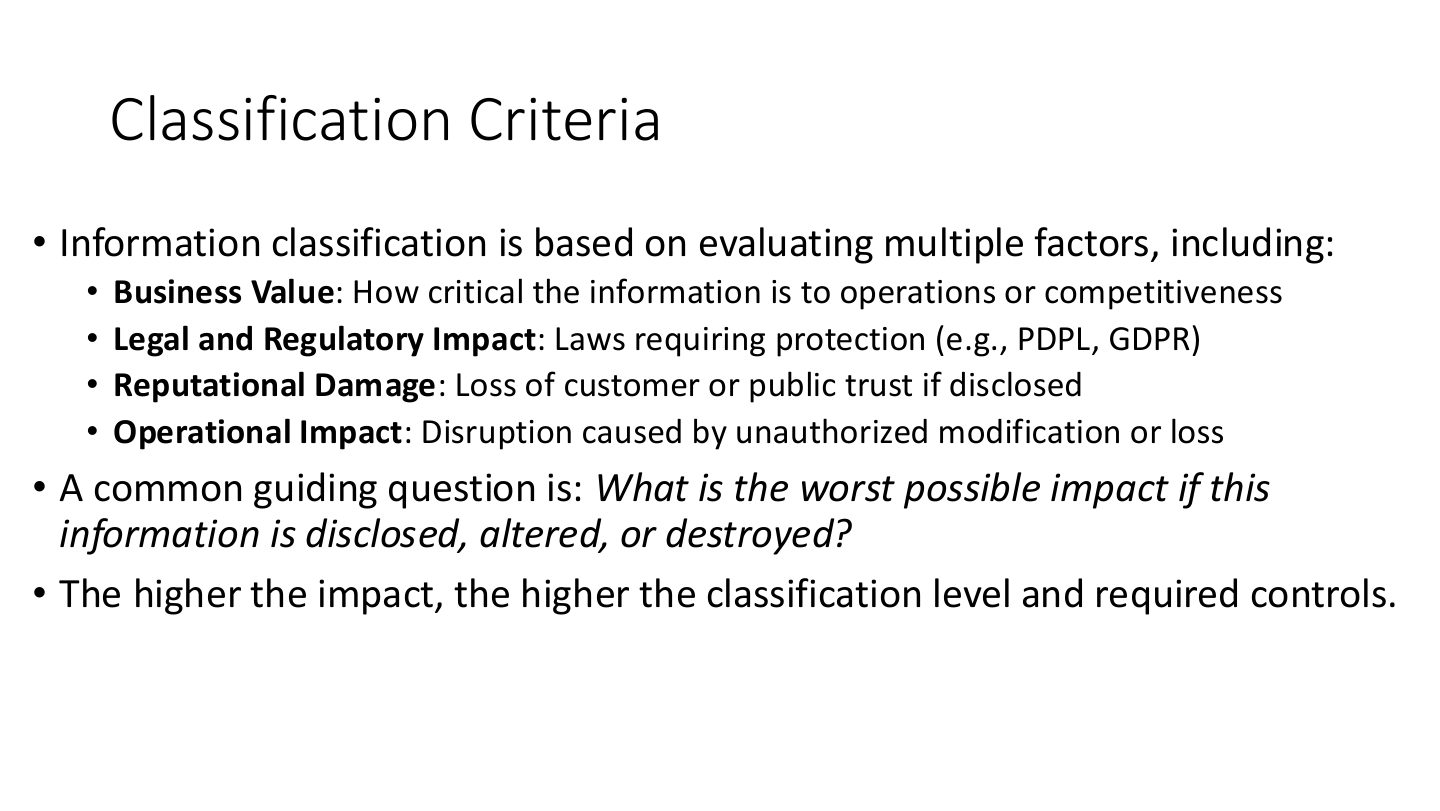
- 23 Classification Criteria
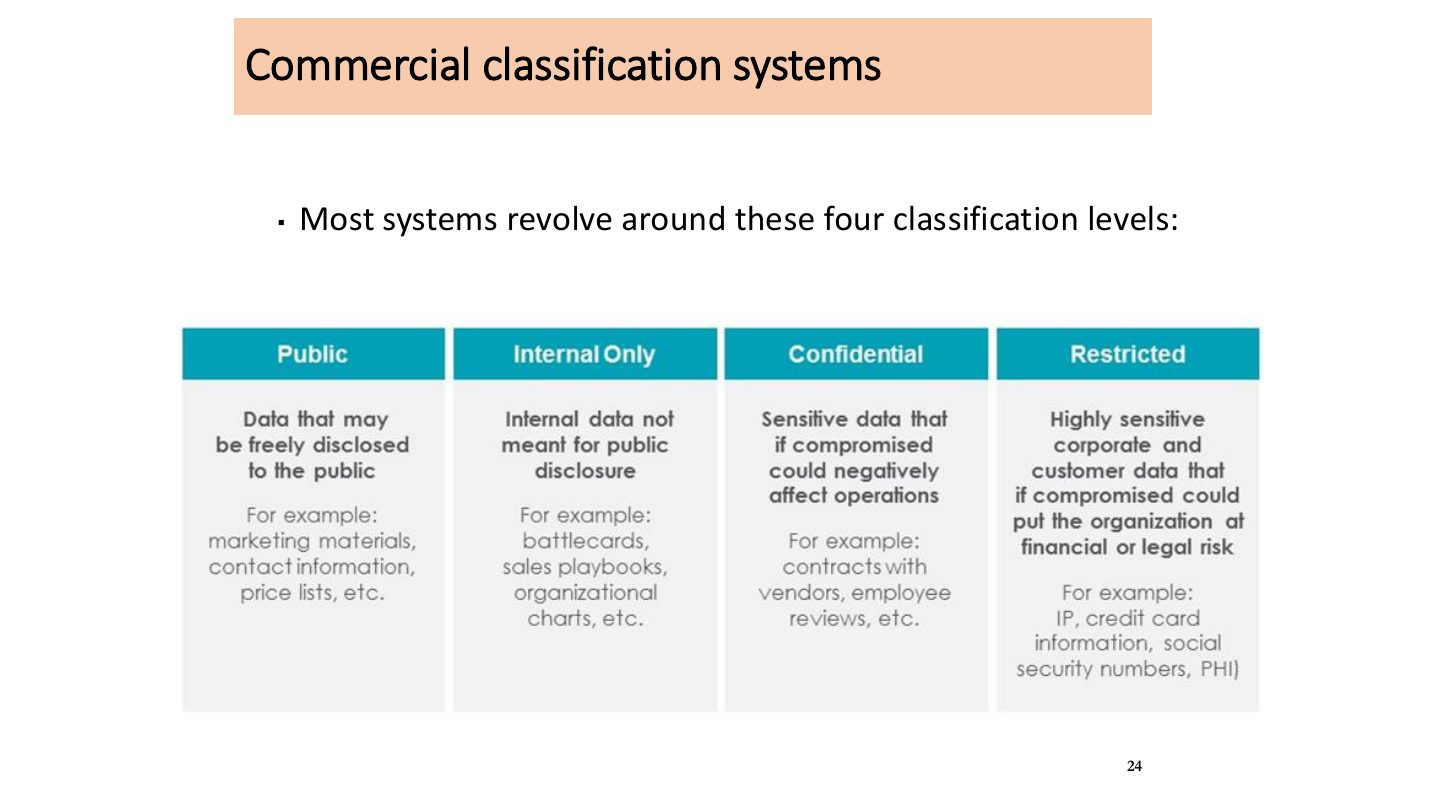
- 24 Commercial classification systems
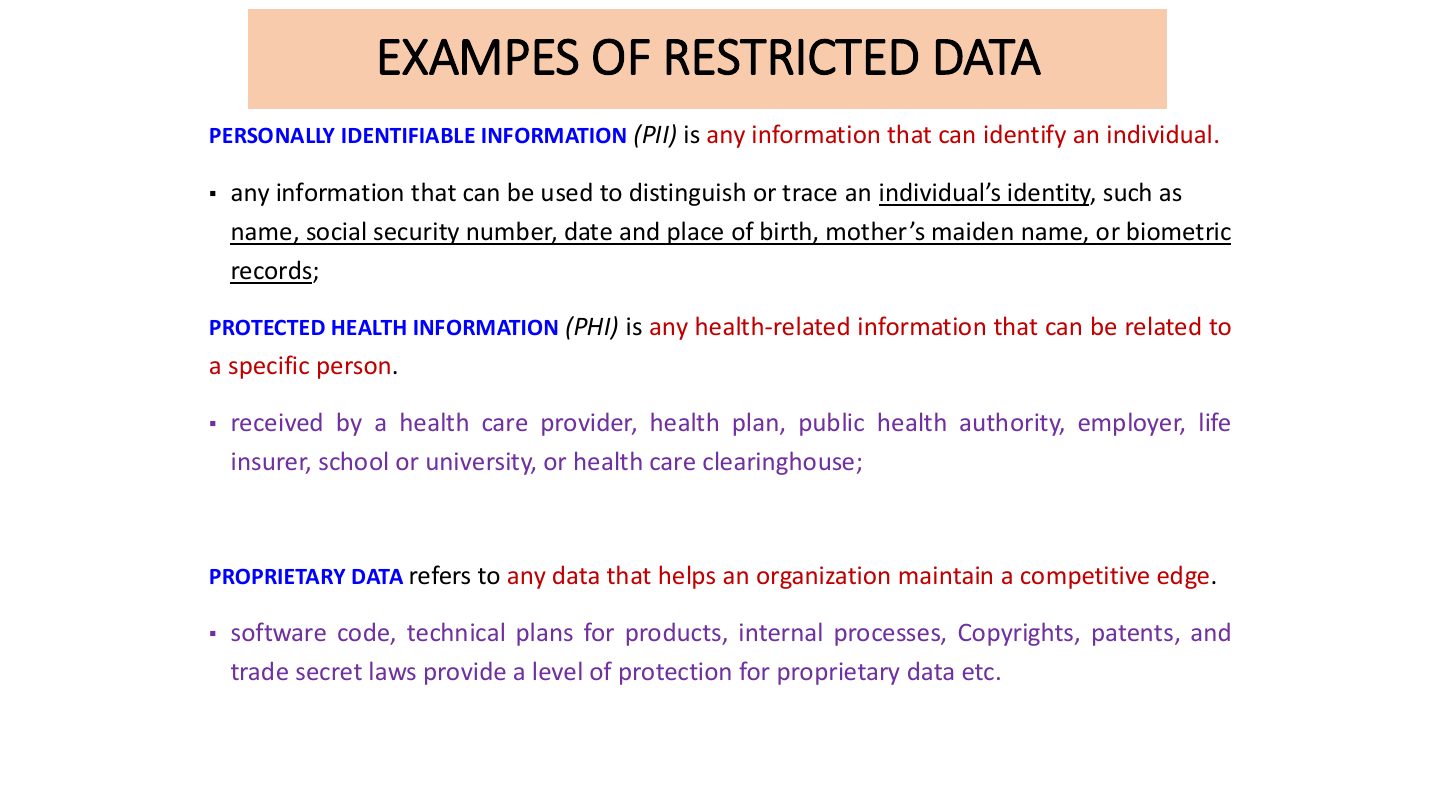
- 25 EXAMPES OF RESTRICTED DATA
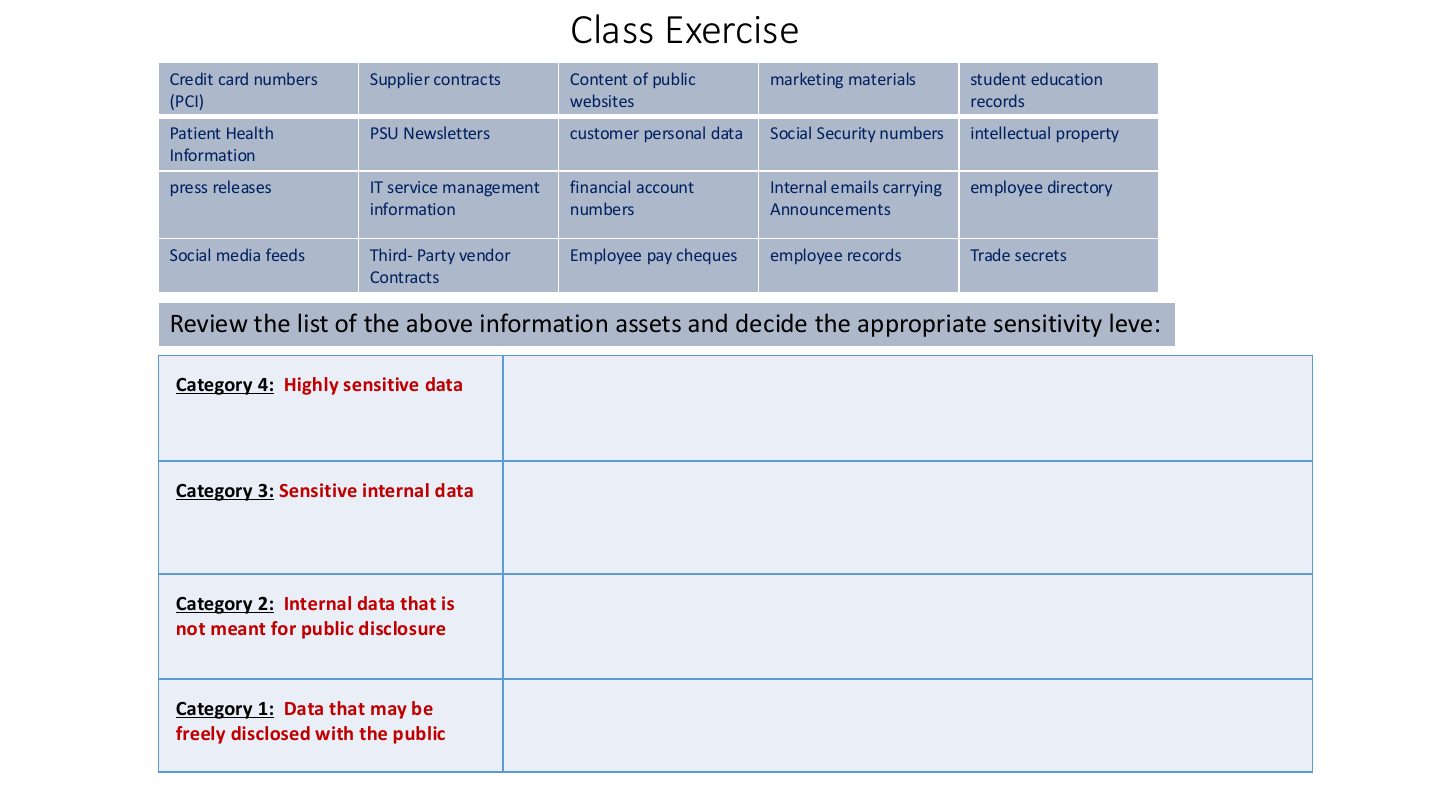
- 26 Class Exercise
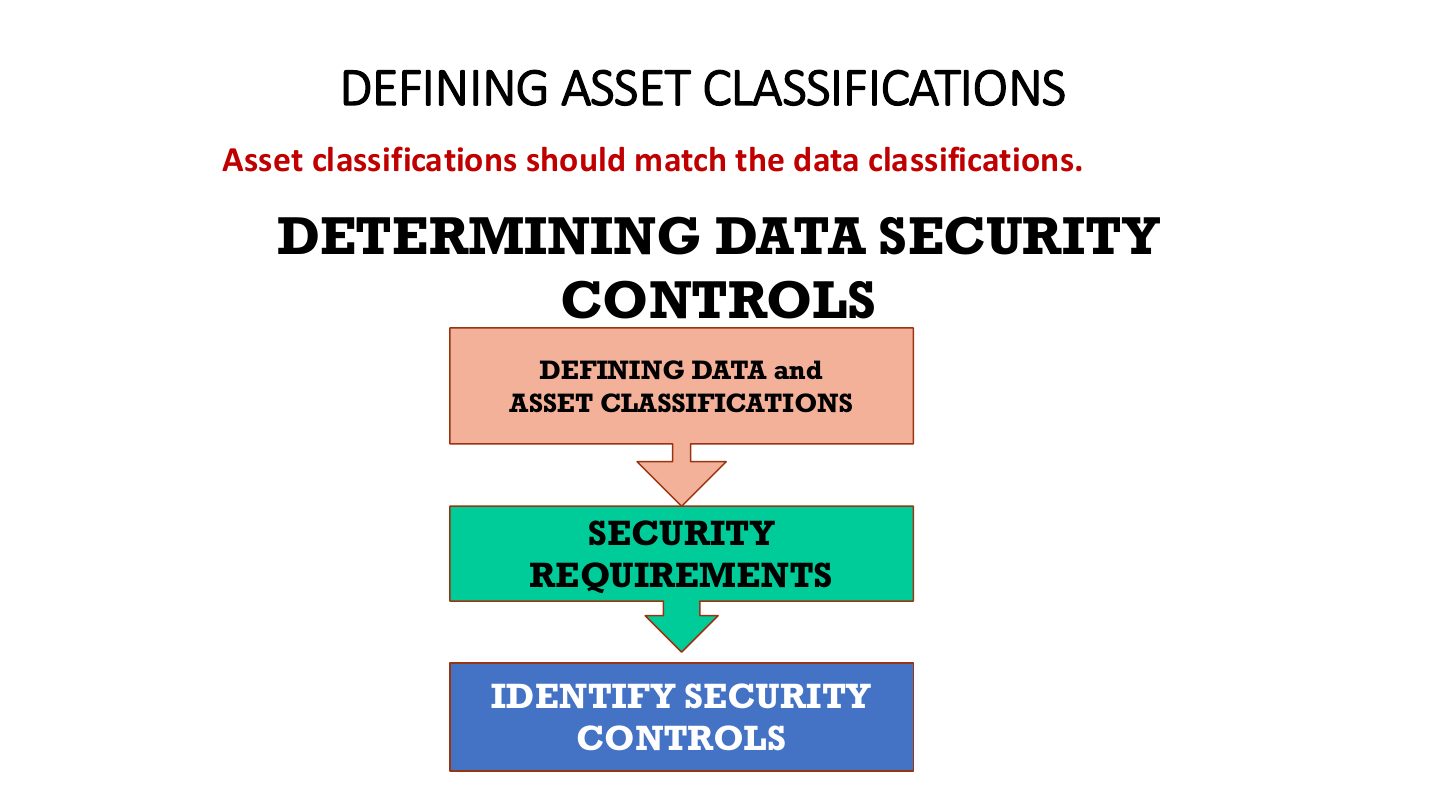
- 27 DEFINING ASSET CLASSIFICATIONS
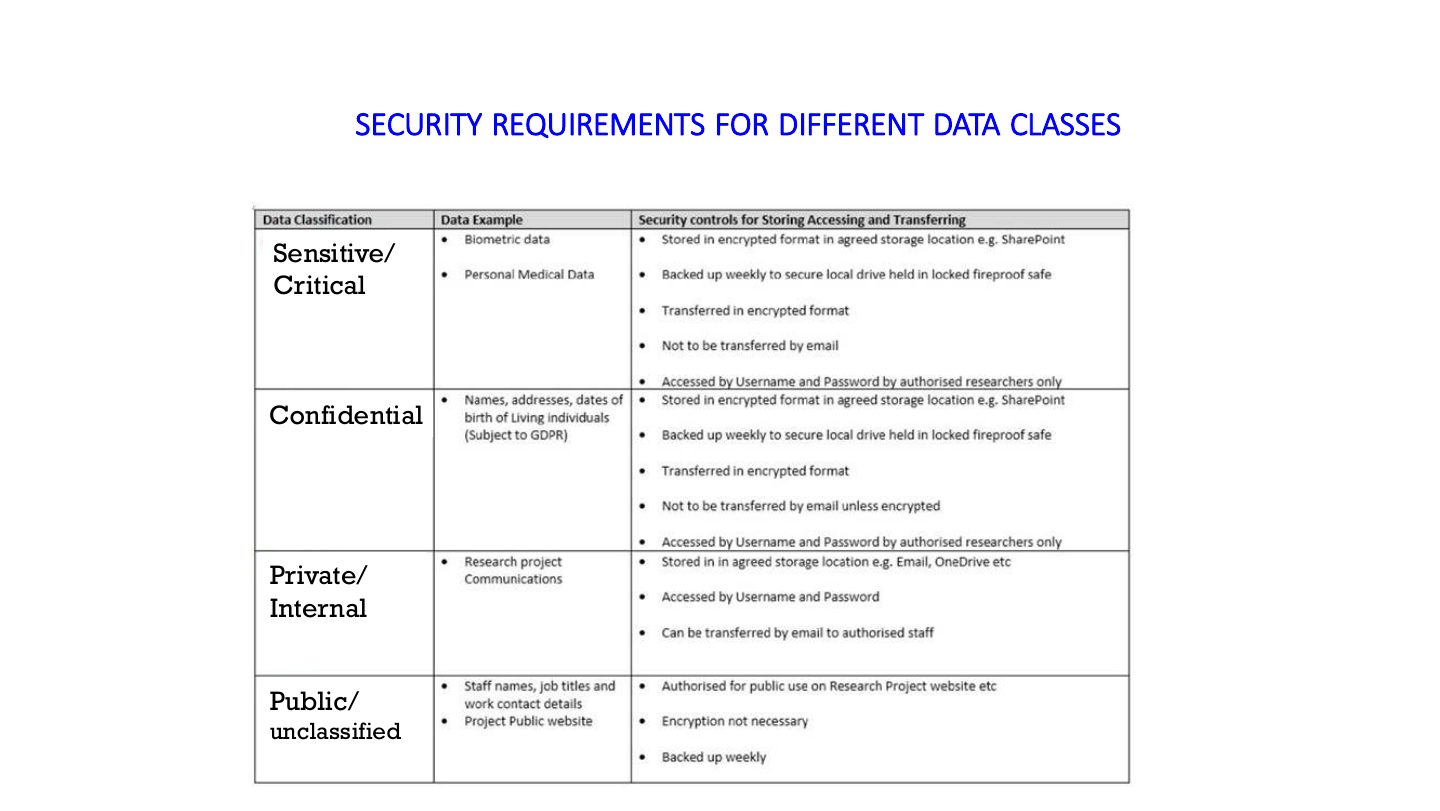
- 28 SECURITY REQUIREMENTS FOR DIFFERENT DATA CLASSES
- 29 Marking Sensitive Data and Assets
- 30 Slide 30
- 31 HANDLING INFORMATION AND ASSETS
- 32 Protecting Data at Rest
- 33 Protecting Data in Transit
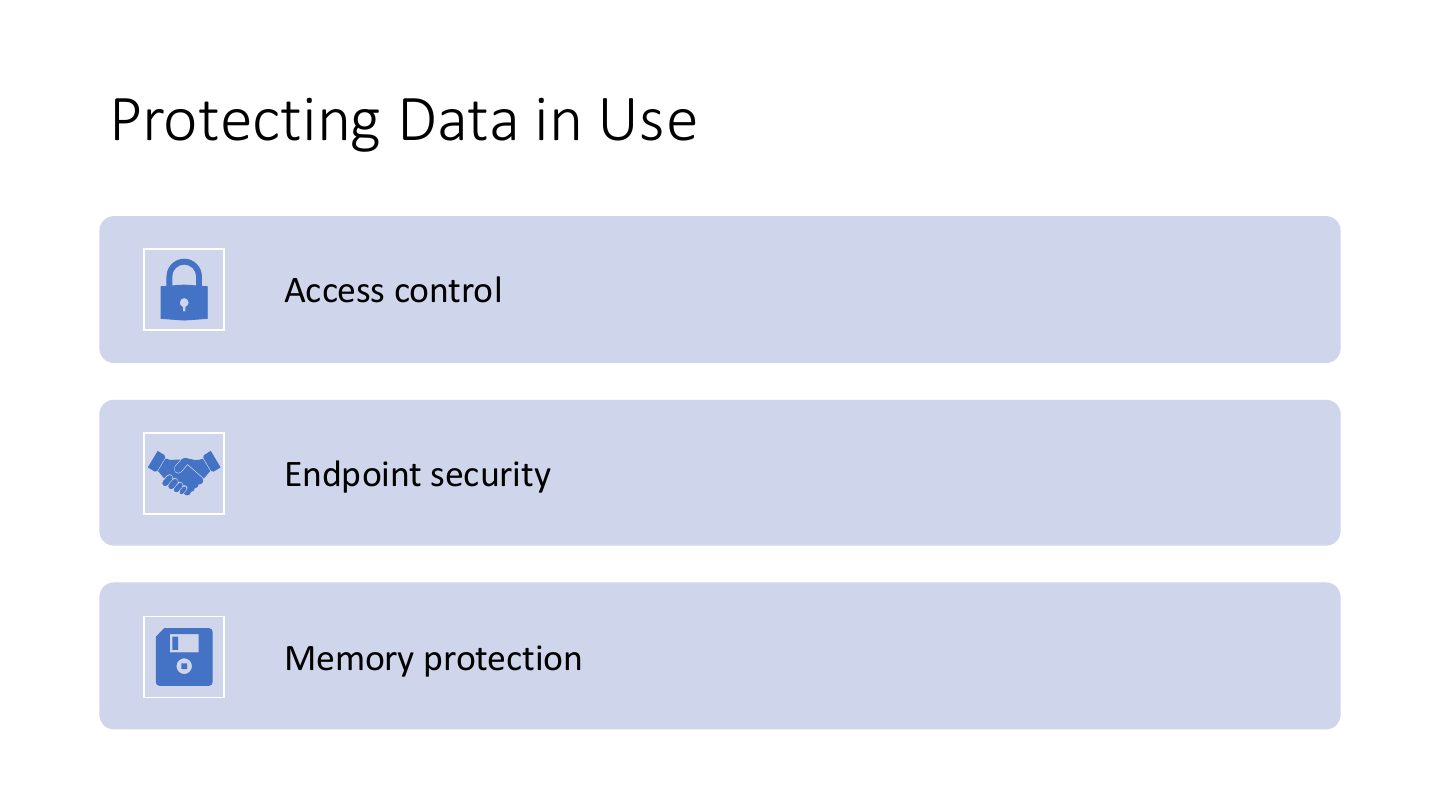
- 34 Protecting Data in Use
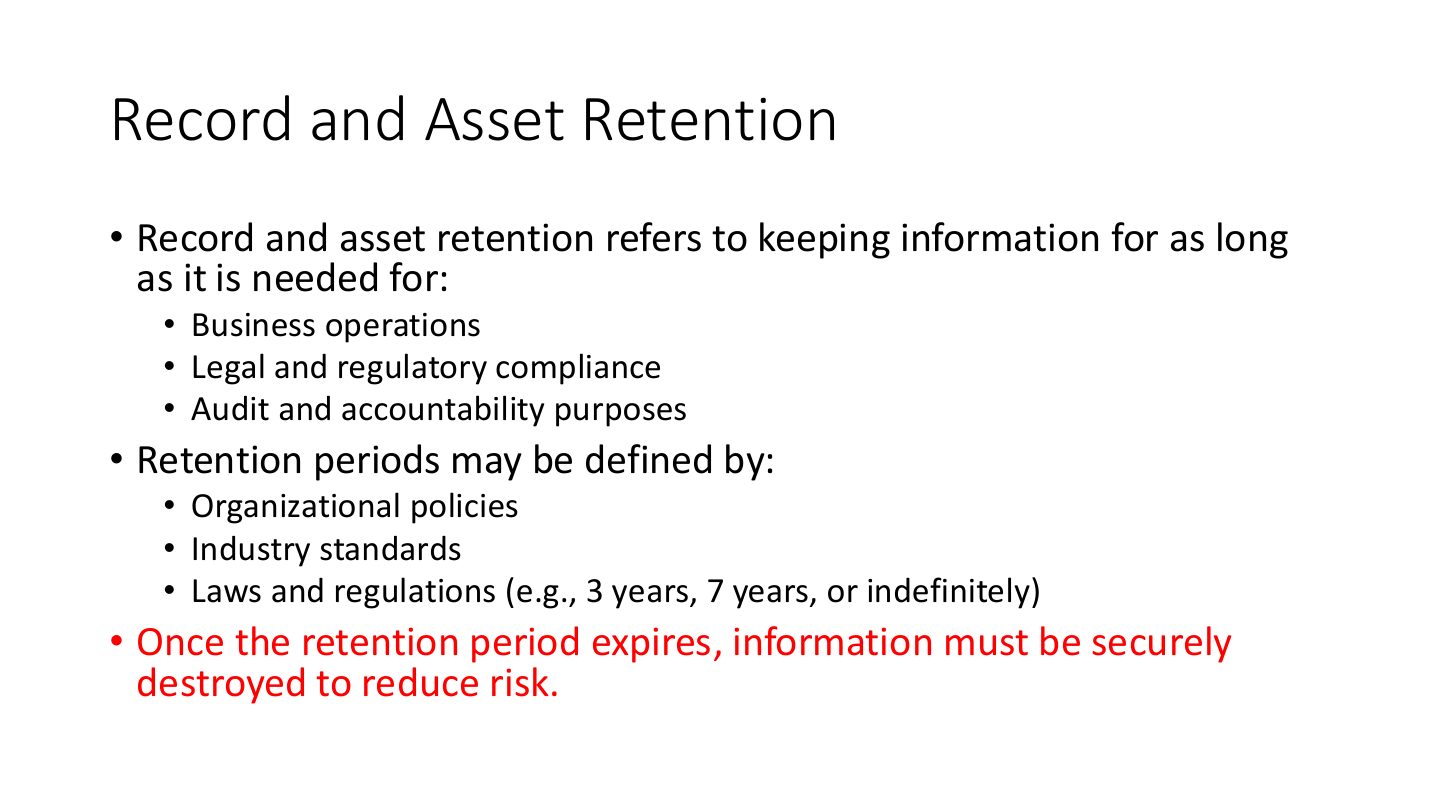
- 35 Record and Asset Retention
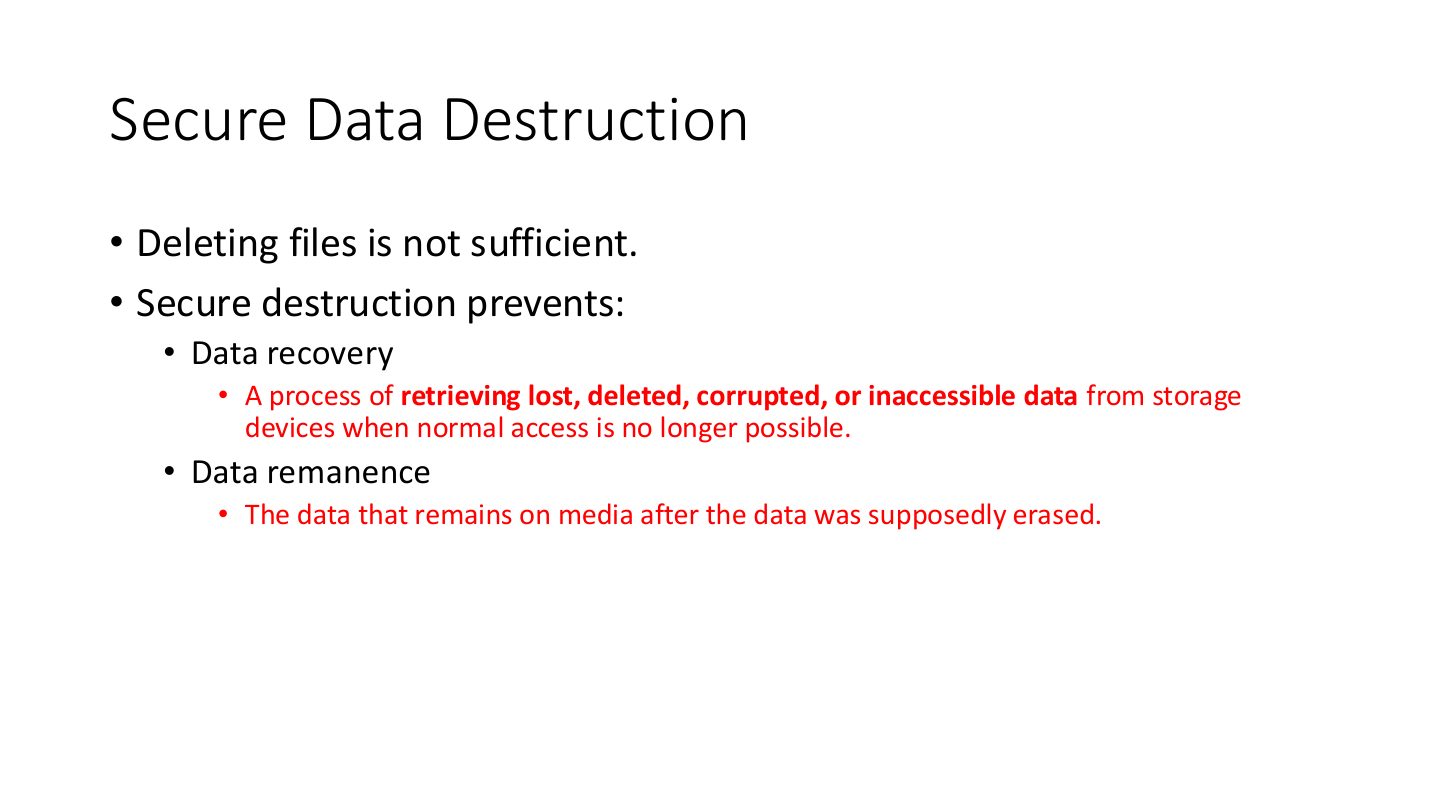
- 36 Secure Data Destruction
- 37 Destroying Sensitive Data
- 38 Common terms associated with Digital Data Disposal:
- 39 DEGAUSSER MACHINES
- 40 DESTROYING DATA MACHINES
- 41 Slide 41
- 42 Legal Compliance as a Governance Driver
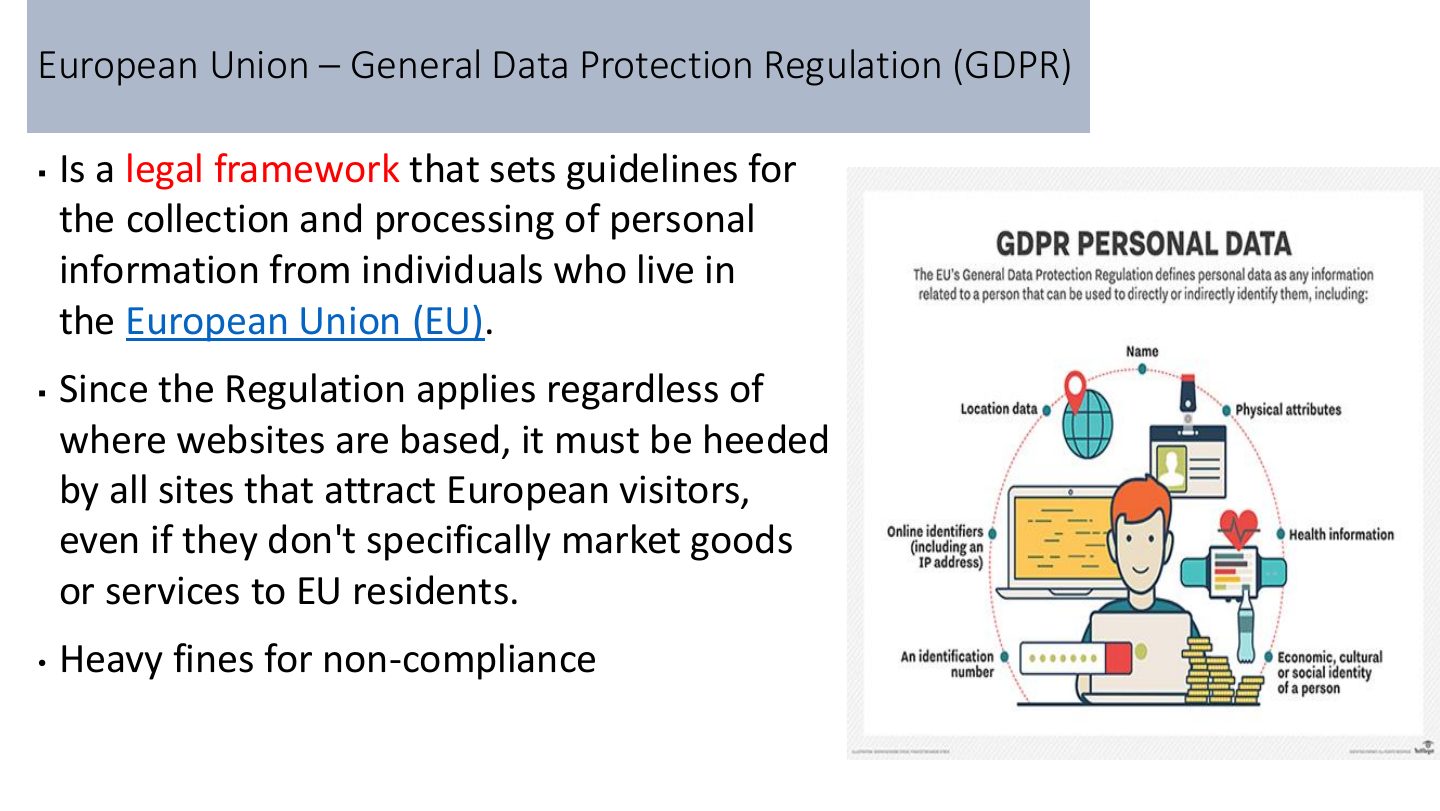
- 43 European Union – General Data Protection Regulation (GDPR)
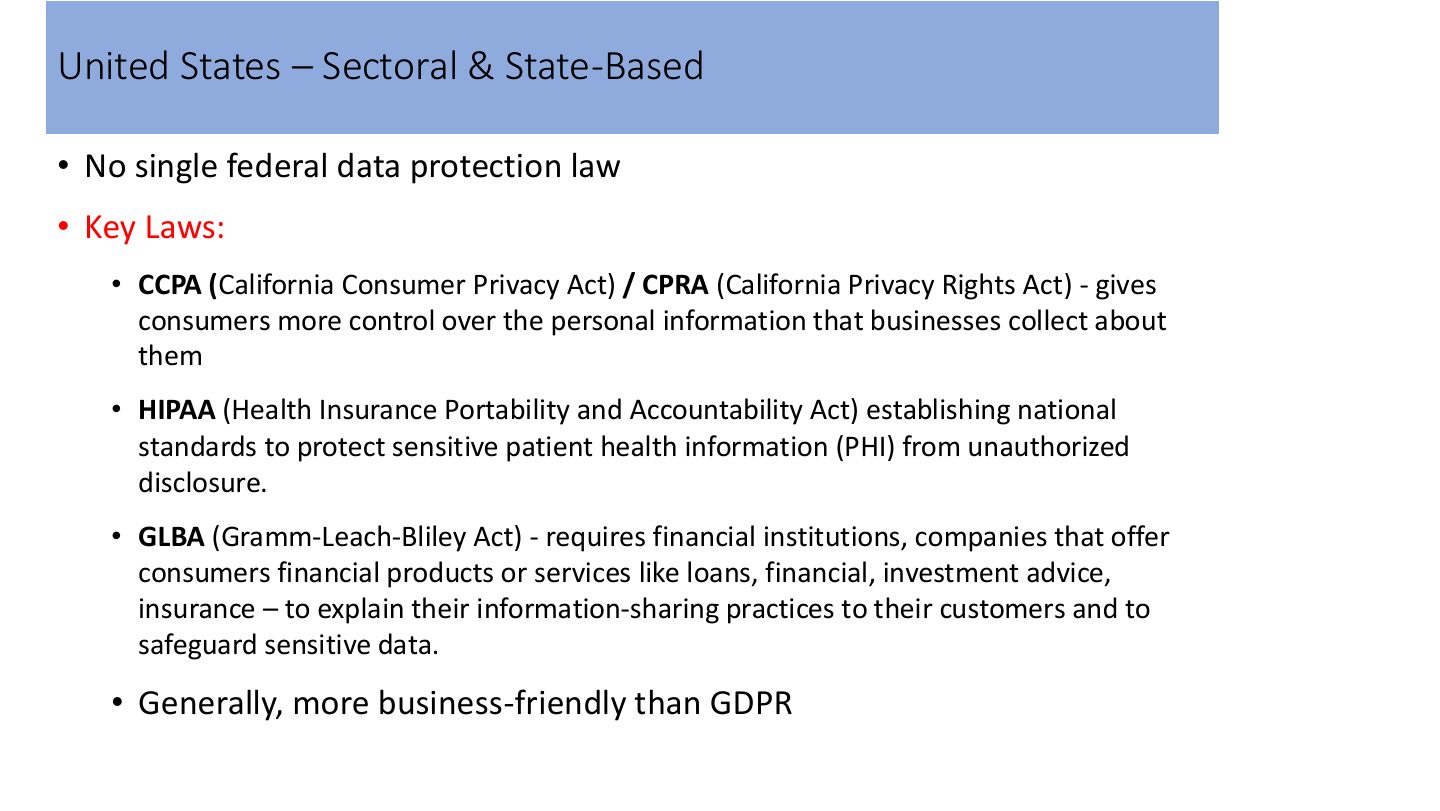
- 44 United States – Sectoral & State-Based
- 45 Saudi Arabia - Personal Data Protection Law (PDPL)
- 46 ASSET OWNERSHIP
- 47 ASSET OWNERSHIP
- 48 ASSET OWNERSHIP
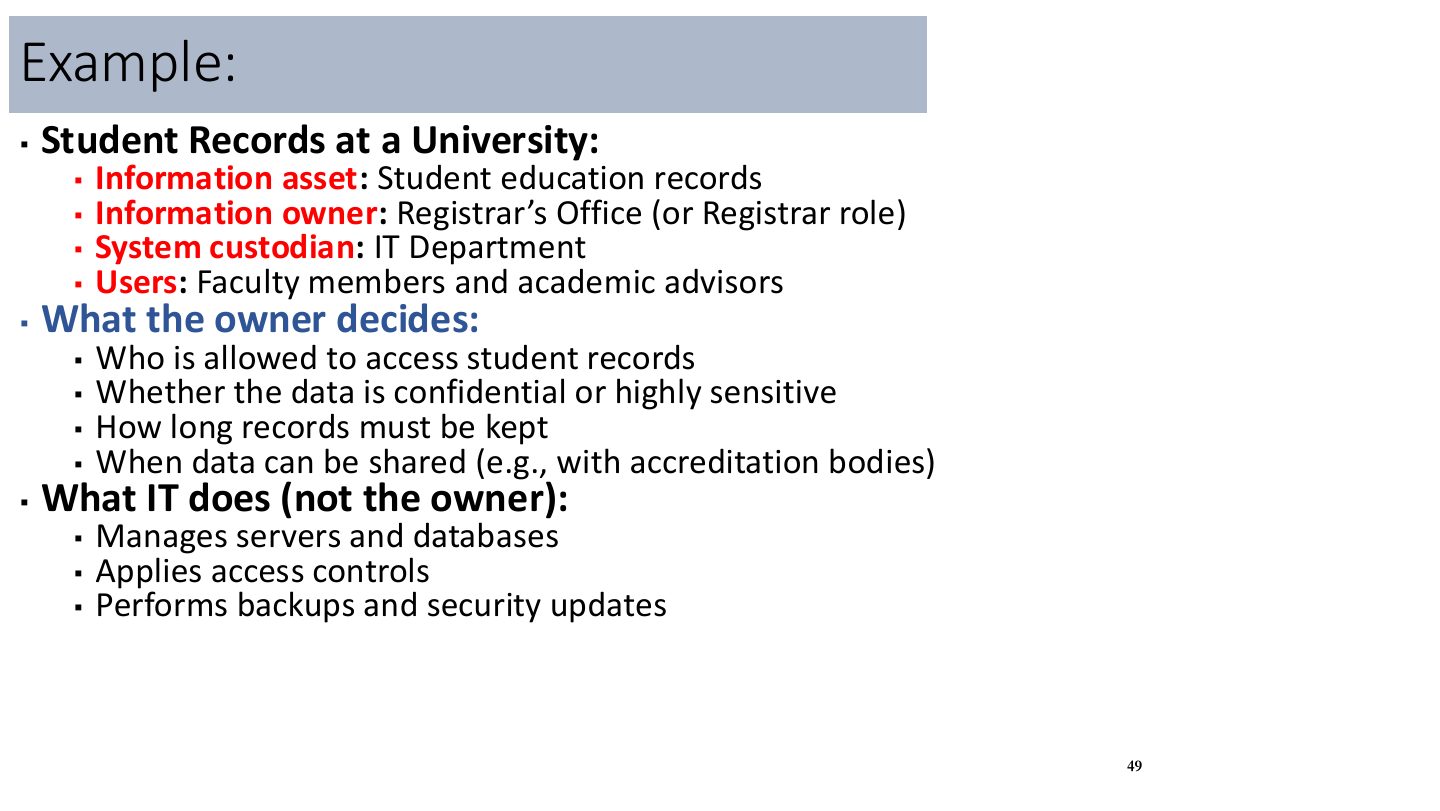
- 49 Example:
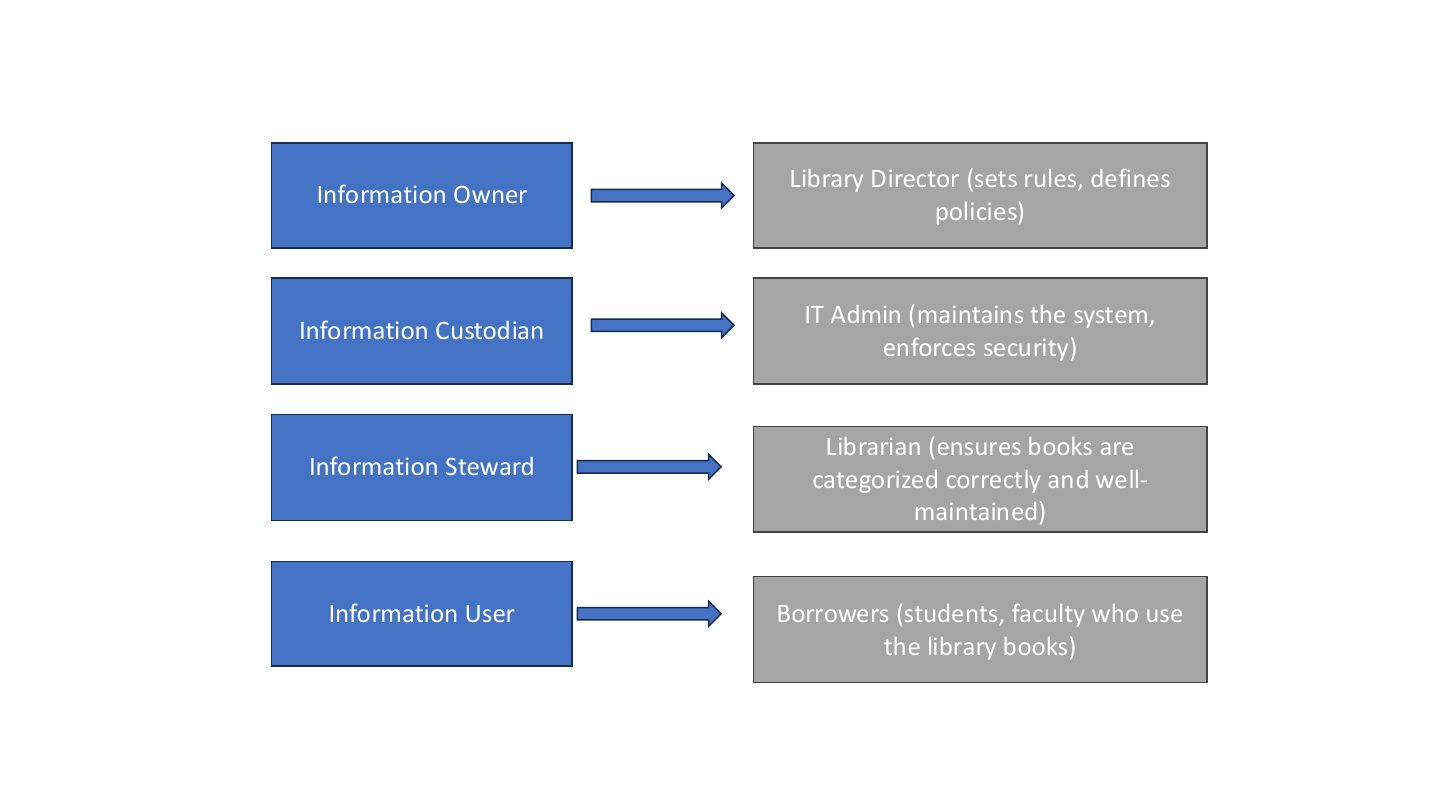
- 50 Information Owner
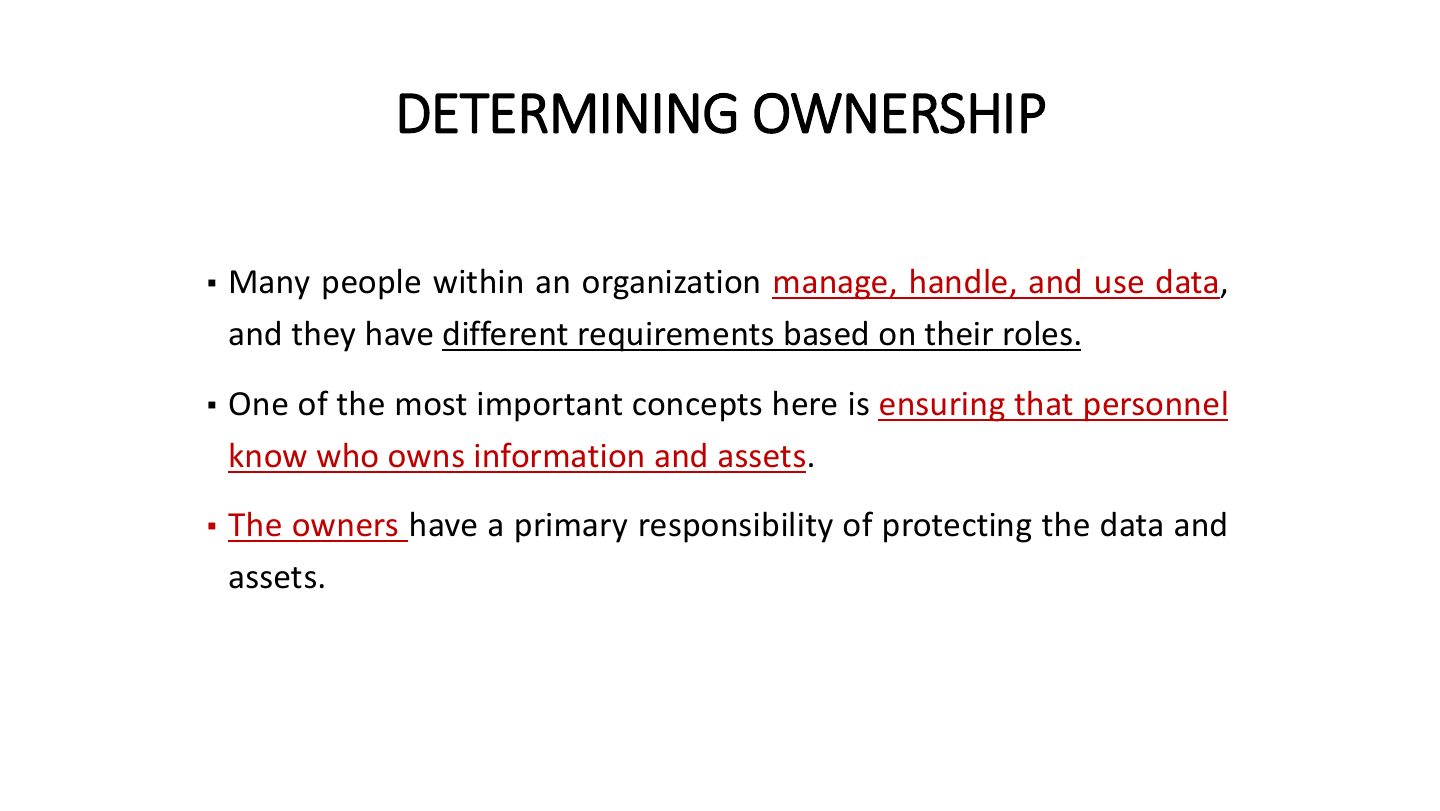
- 51 DETERMINING OWNERSHIP
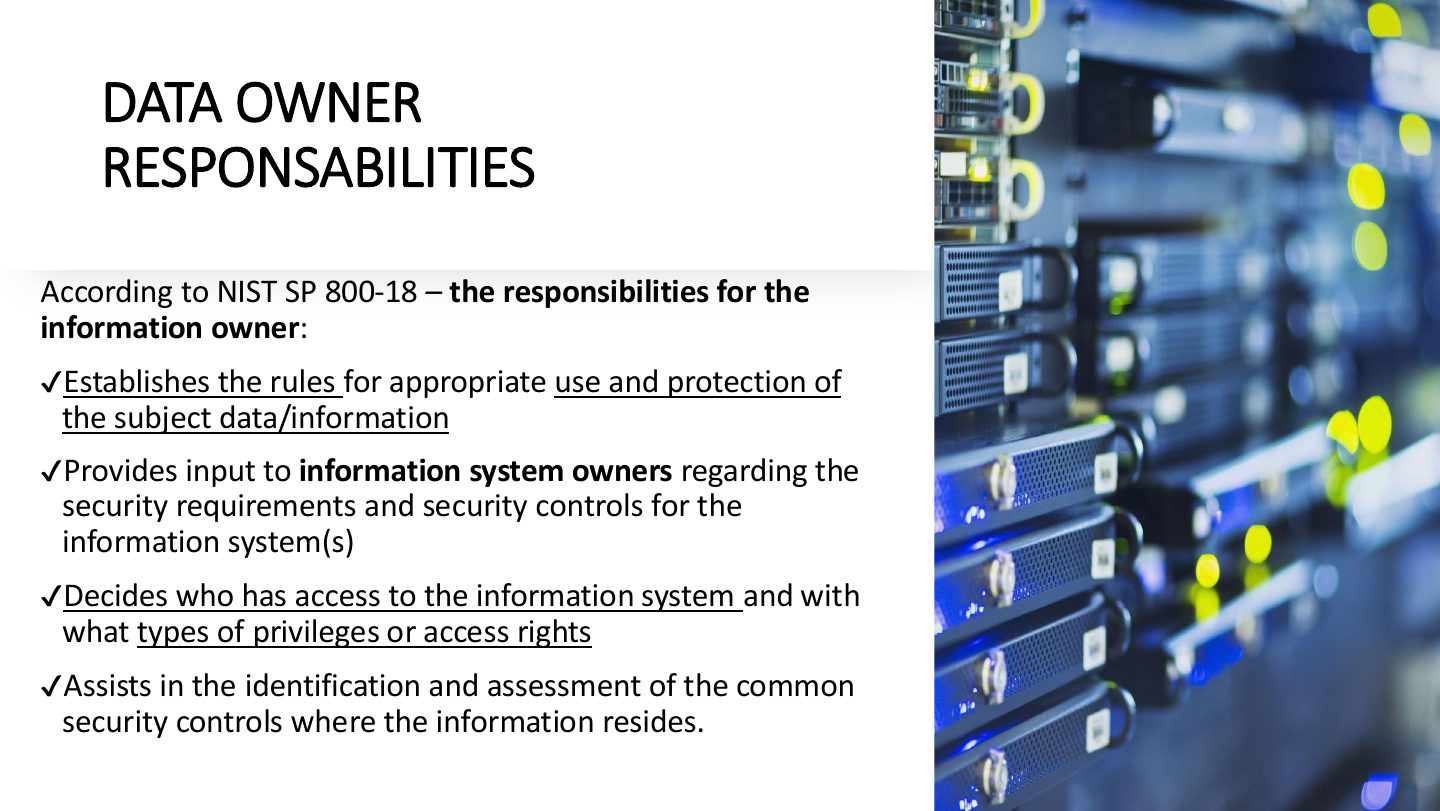
- 52 DATA OWNER
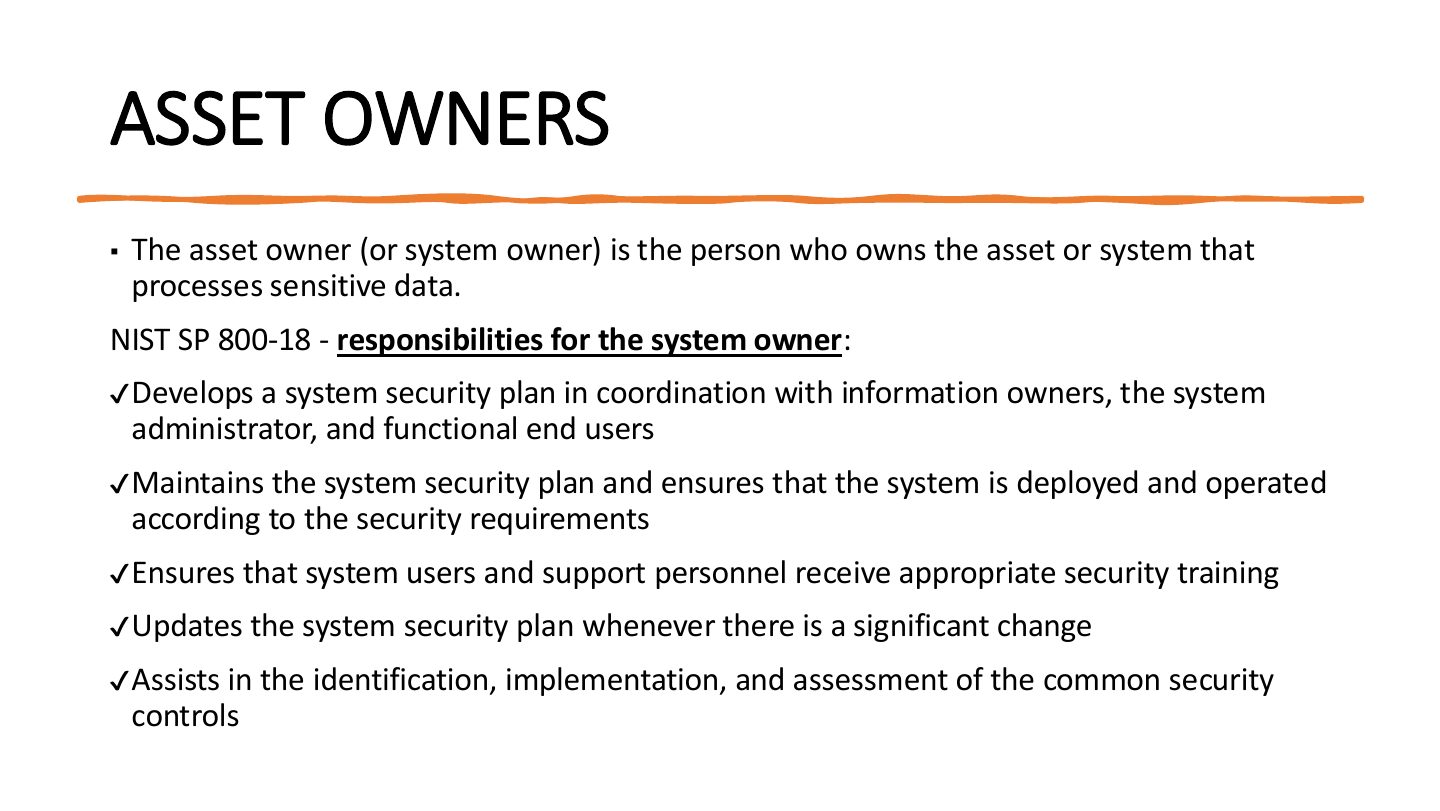
- 53 ASSET OWNERS
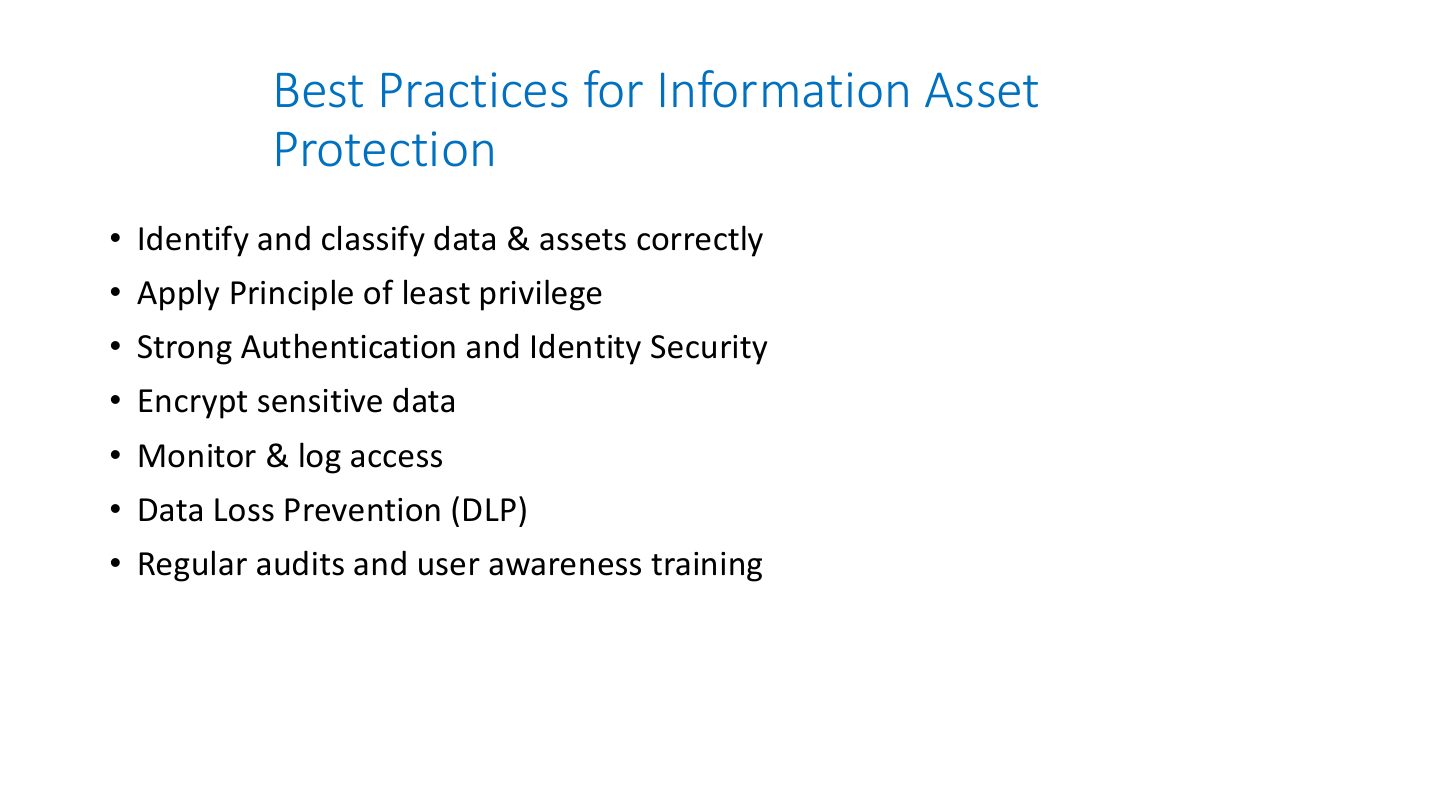
- 54 Best Practices for Information Asset Protection
- 55 ALIGNMENT OF SECURITY FUNCTION
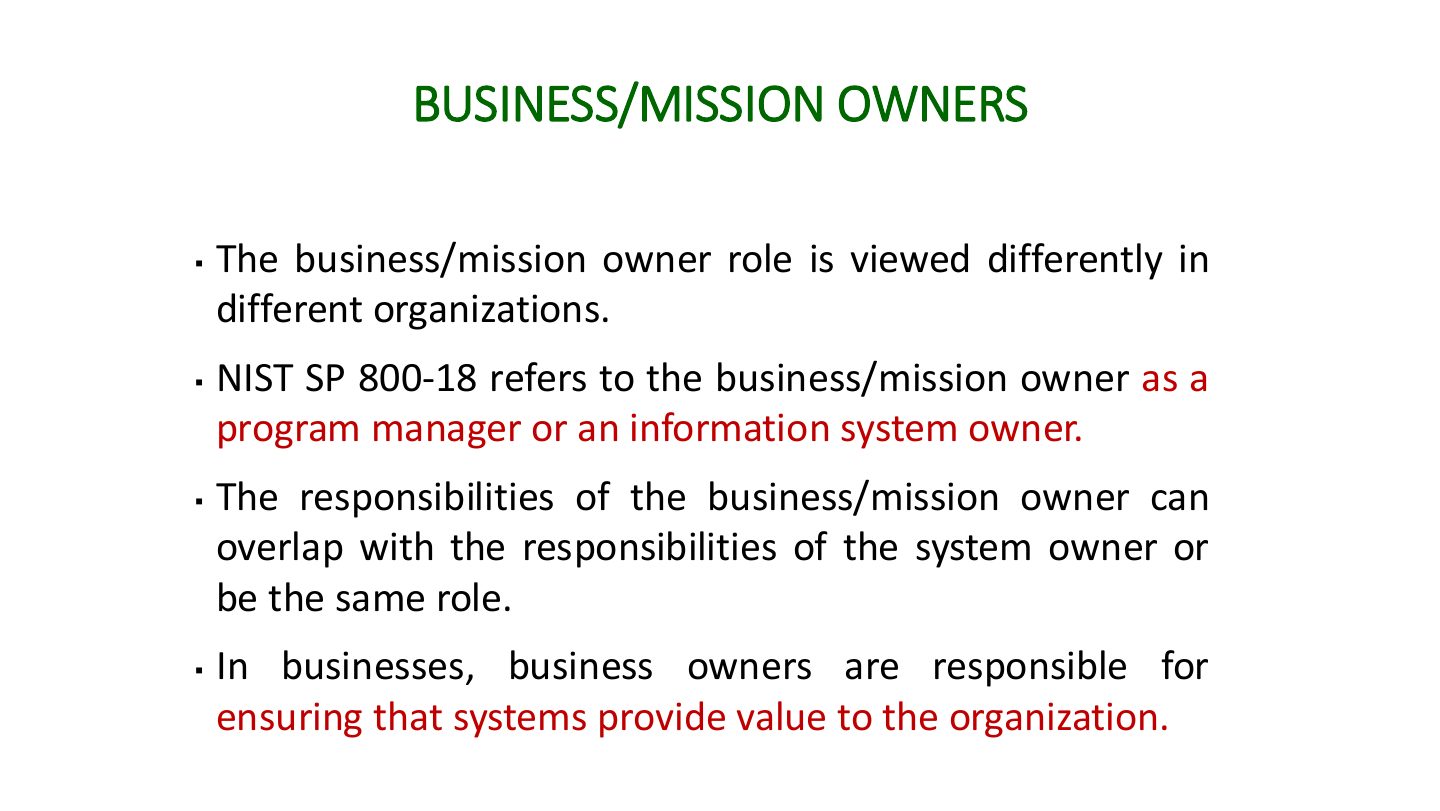
- 56 BUSINESS/MISSION OWNERS
- 57 ALIGNMENT OF SECURITY FUNCTION
- 58 Top-Down Approach
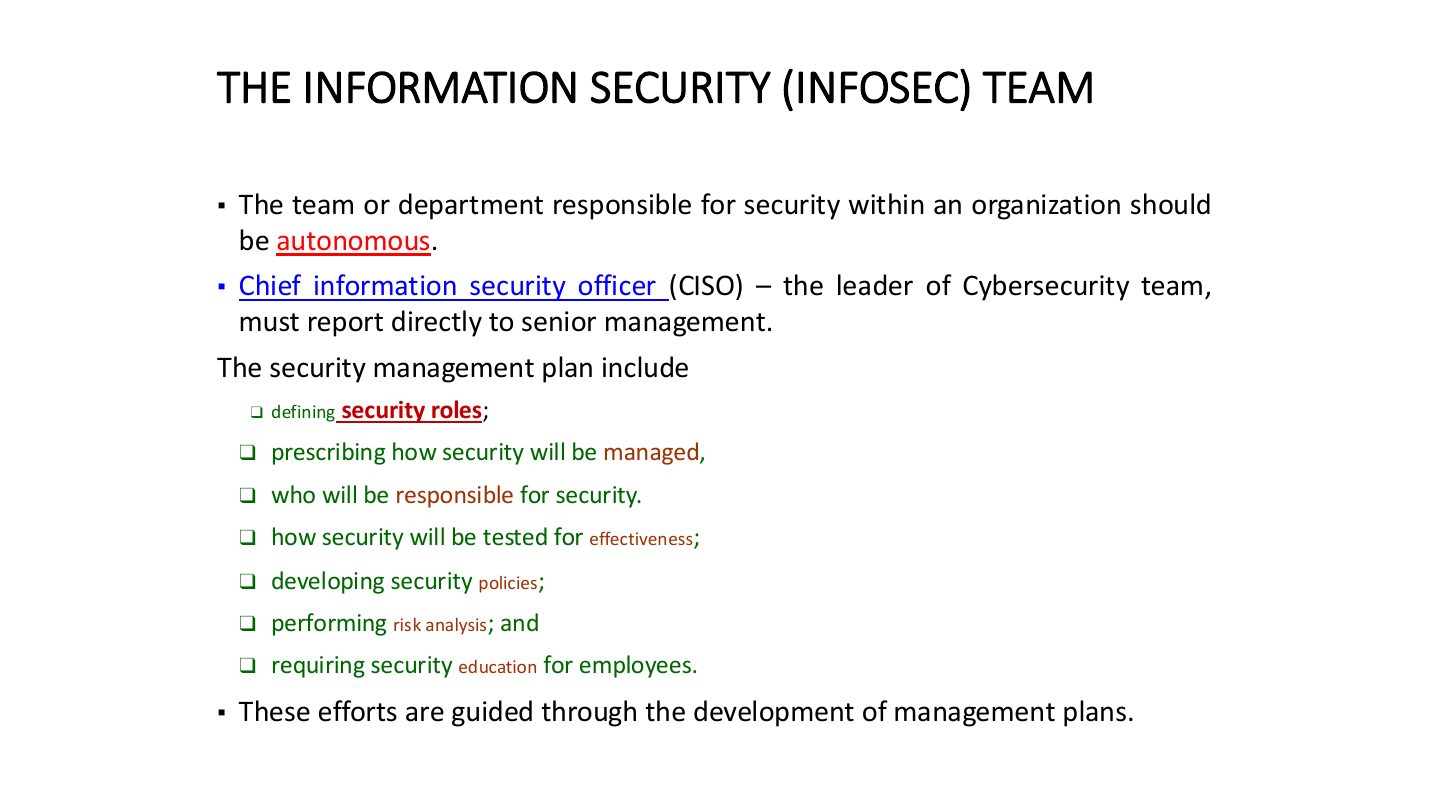
- 59 THE INFORMATION SECURITY (INFOSEC) TEAM
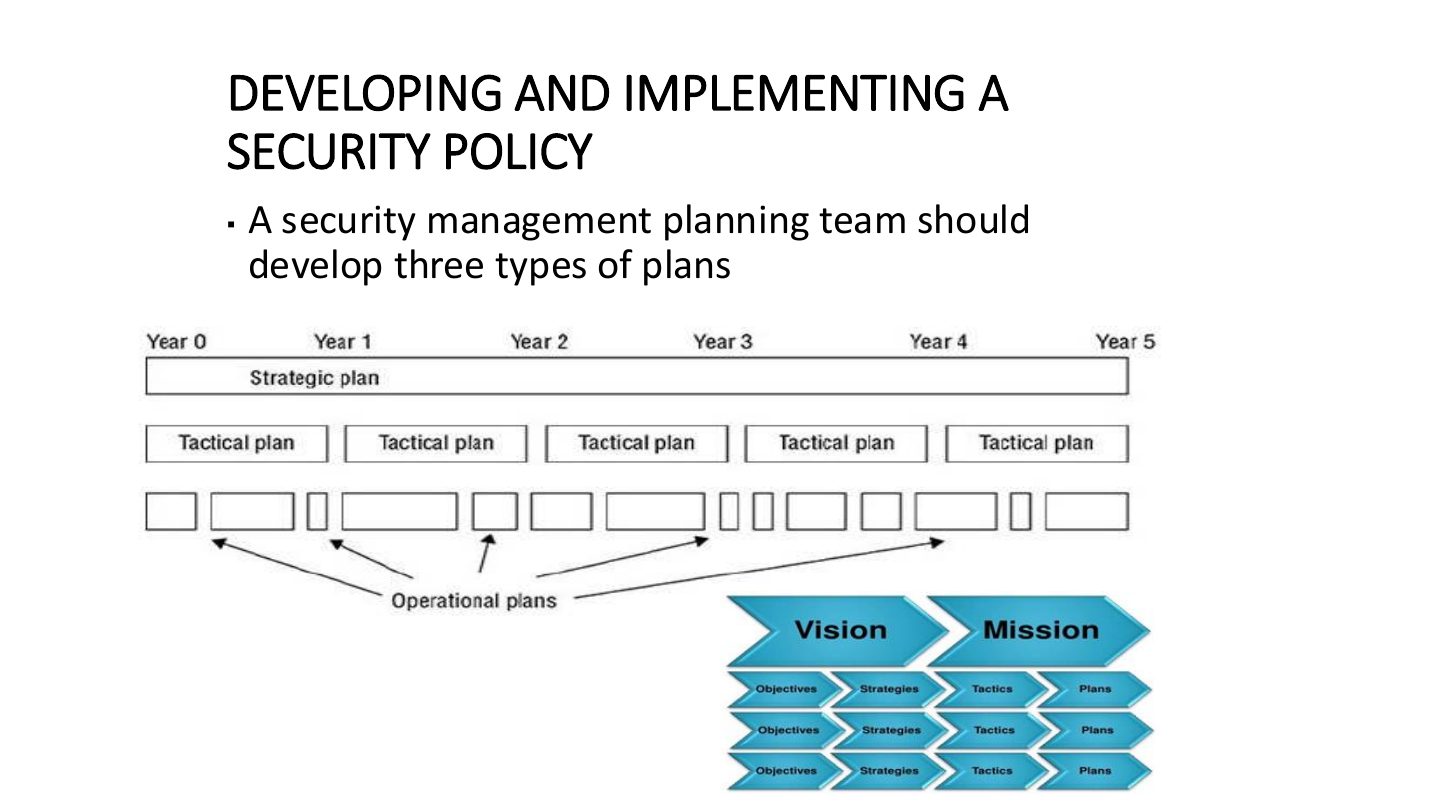
- 60 DEVELOPING AND IMPLEMENTING A SECURITY POLICY
- 61 DEVELOPING AND IMPLEMENTING A SECURITY POLICY
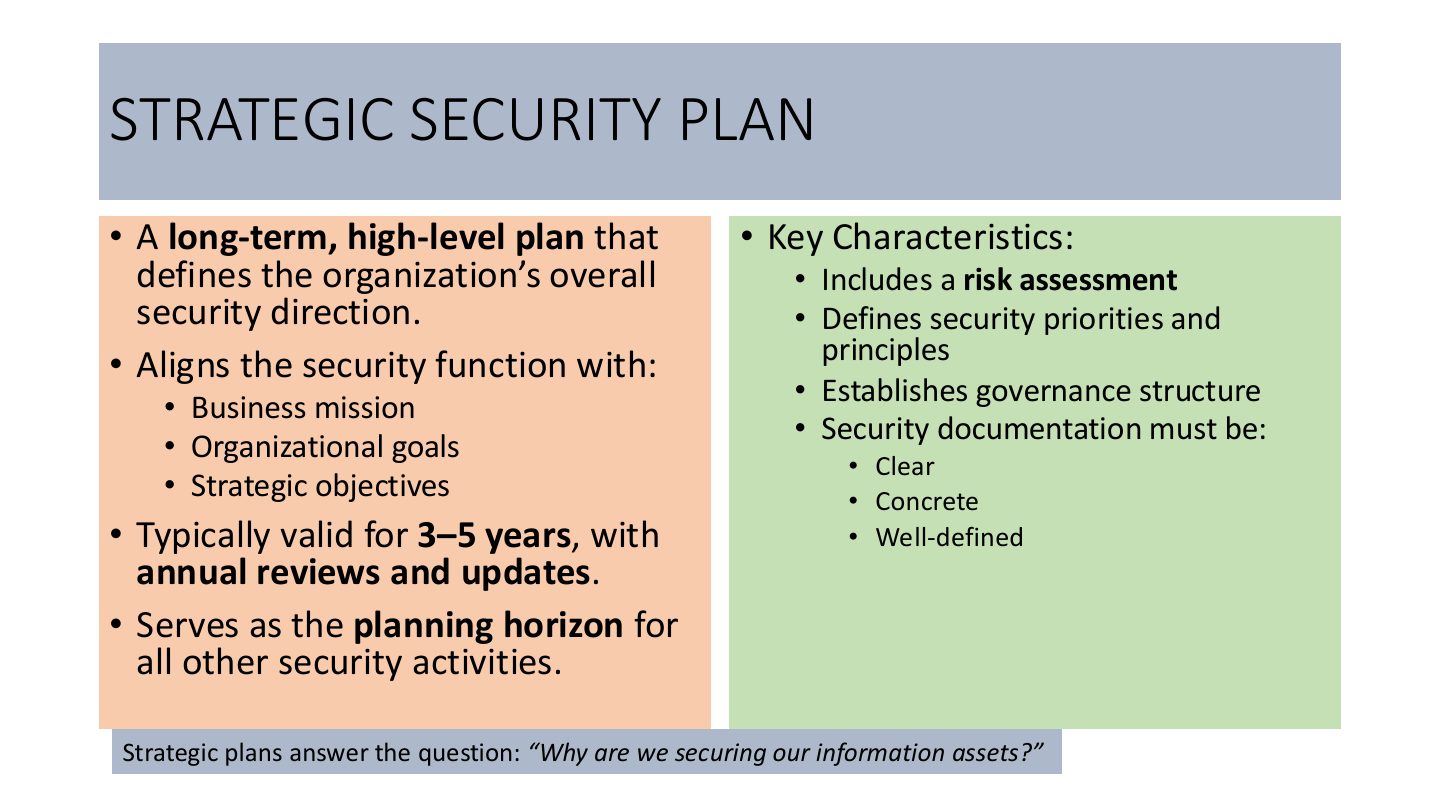
- 62 STRATEGIC SECURITY PLAN
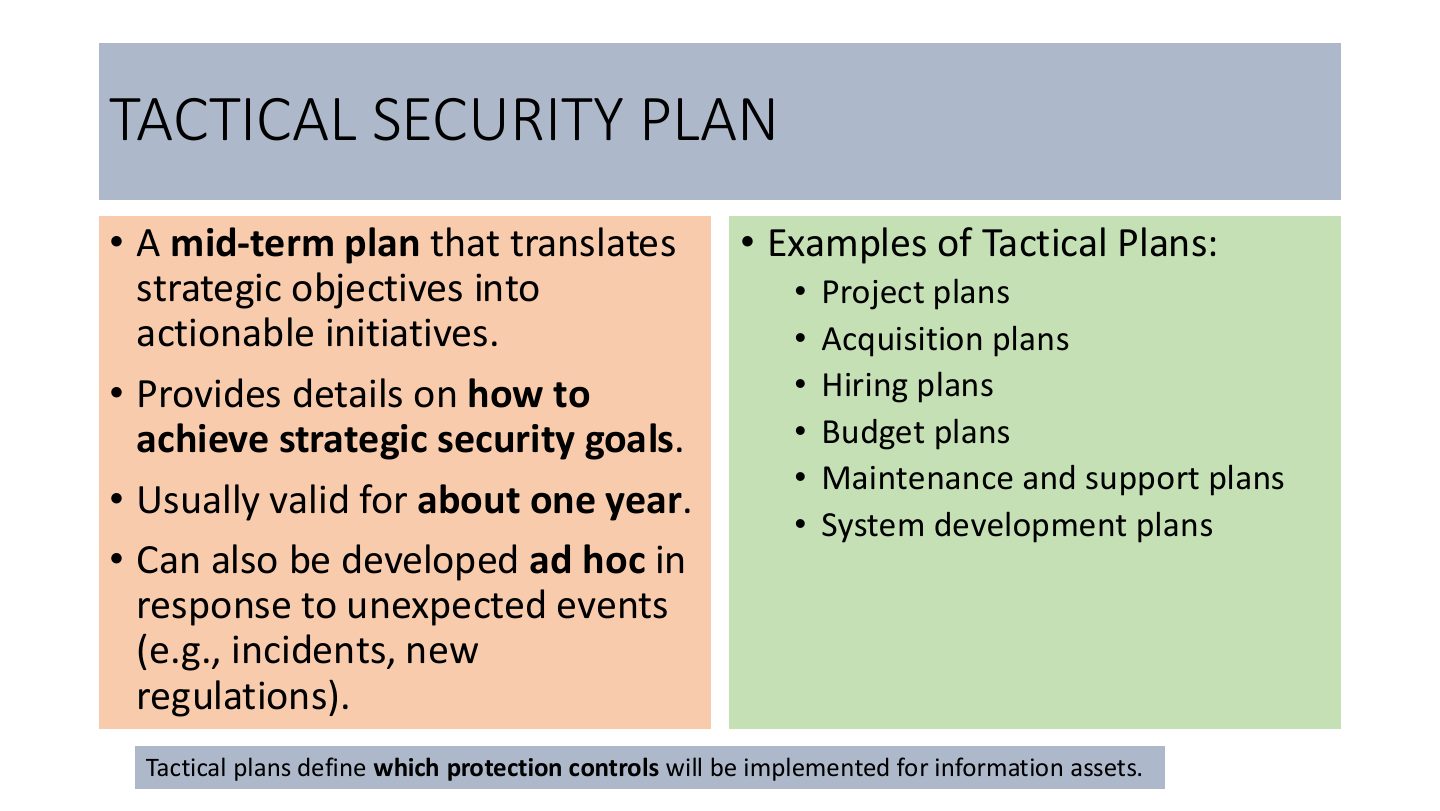
- 63 TACTICAL SECURITY PLAN
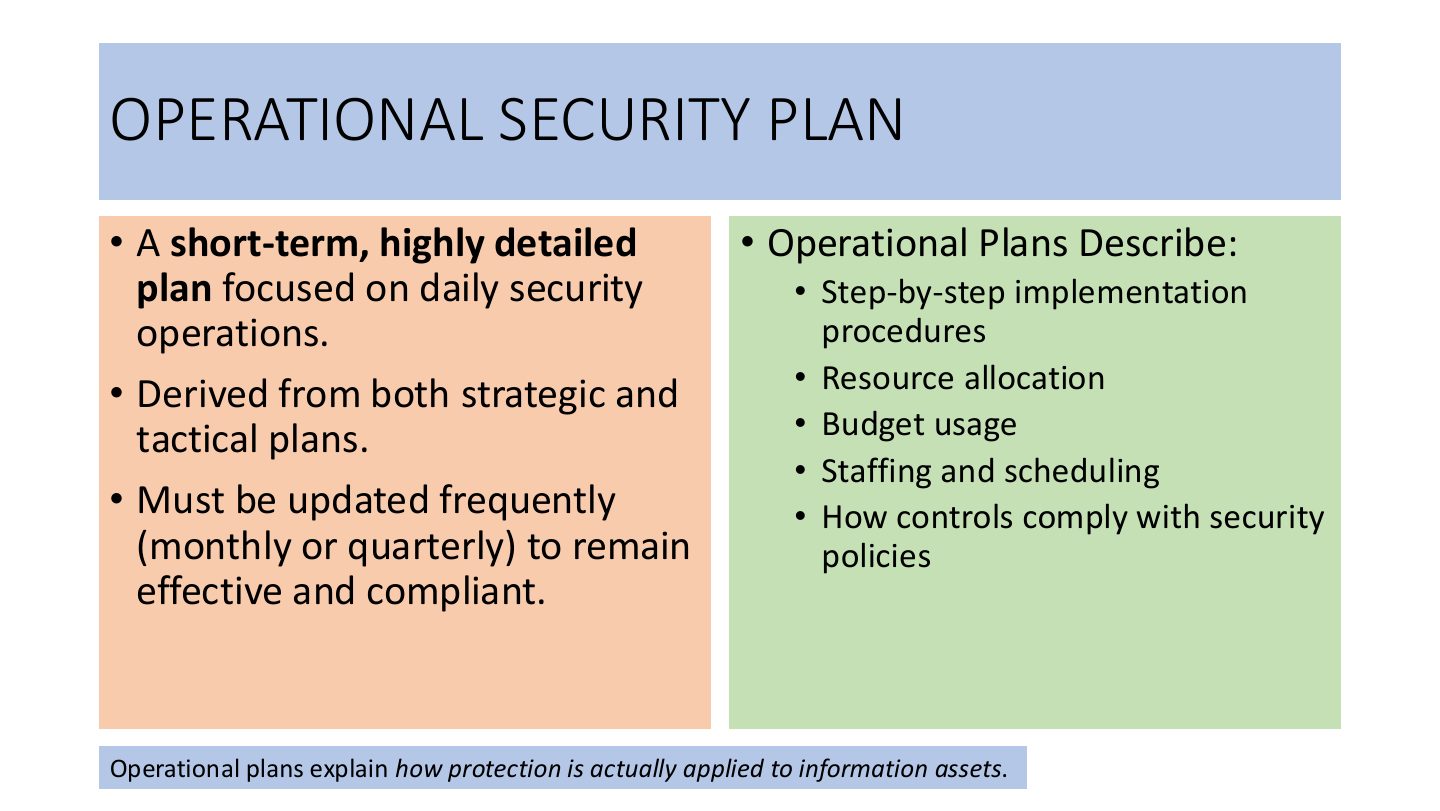
- 64 OPERATIONAL SECURITY PLAN
- 65 Planning Levels vs Asset Protection
- 66 Example
- 67 Ex. Strategic Security Plan (Long-Term WHY ) – “ ”
- 68 Ex. Tactical Security Plan (Mid-Term – “WHAT ”)
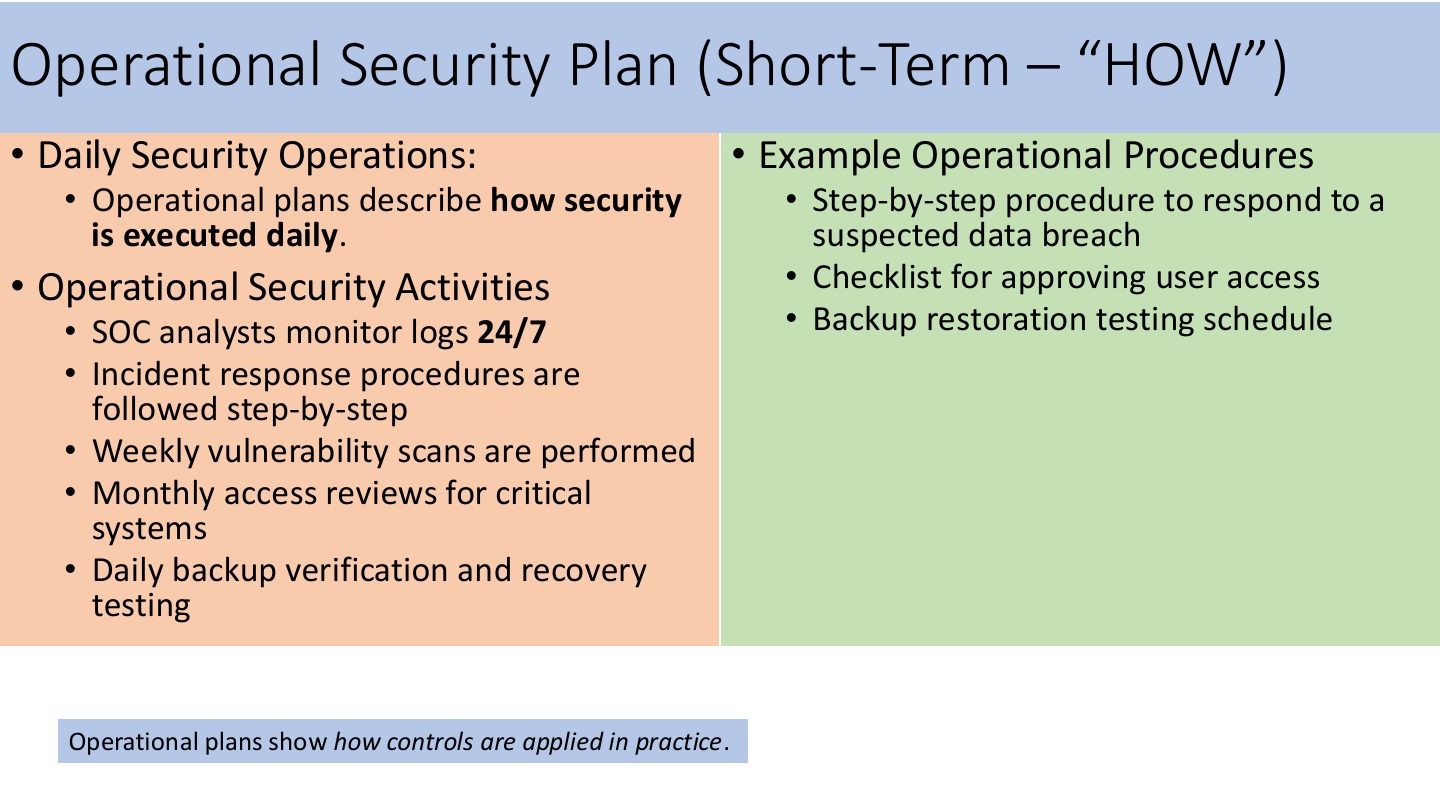
- 69 Operational Security Plan (Short-Term – “HOW”)
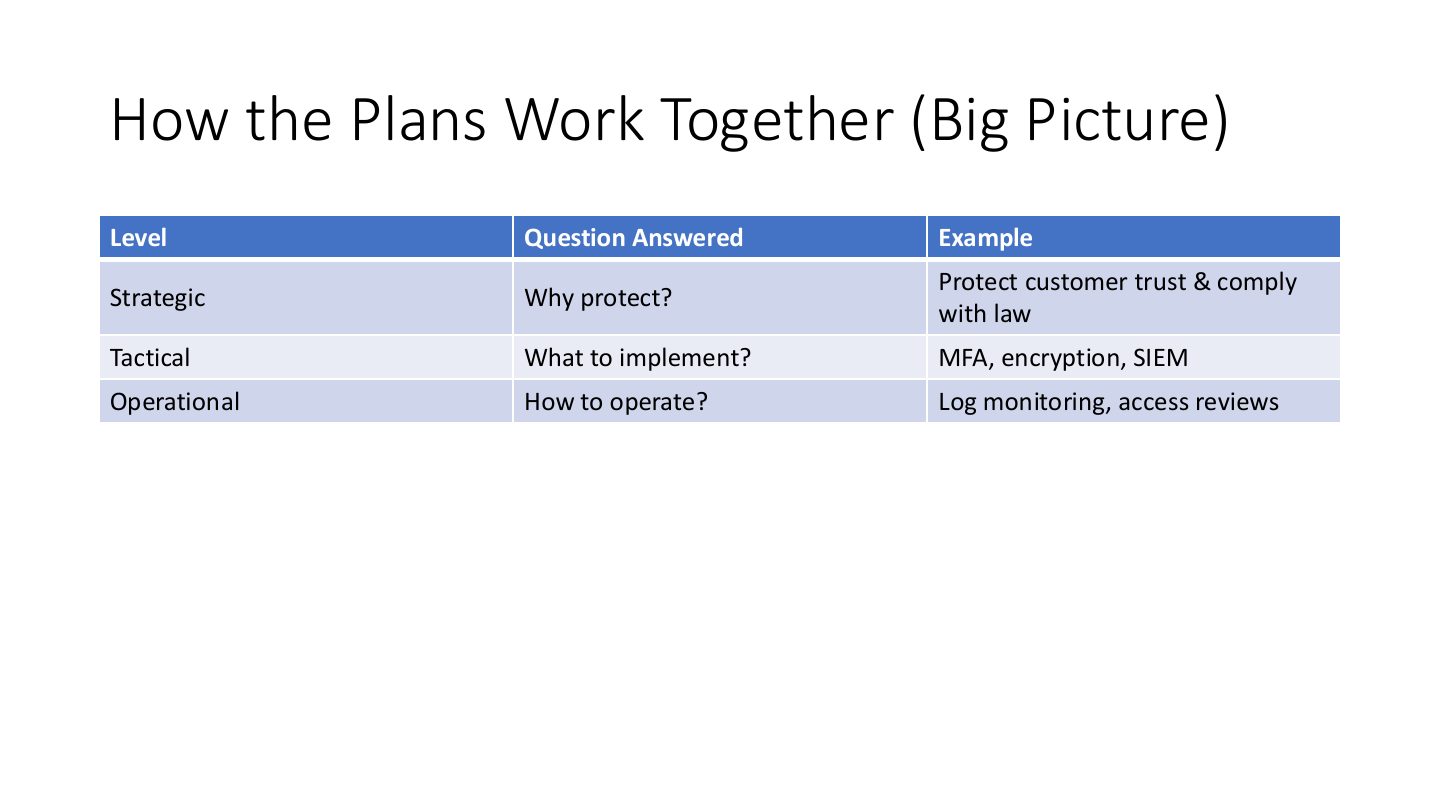
- 70 How the Plans Work Together (Big Picture)
- 71 Slide 71
Protection of Information Assets
Notes
Tip Due care = DOING the right thing (the protective action: training, patching, responding to a breach). Due diligence = RESEARCHING and checking (risk assessments, investigating threats, auditing vendors before access).
Learning Objectives
Notes
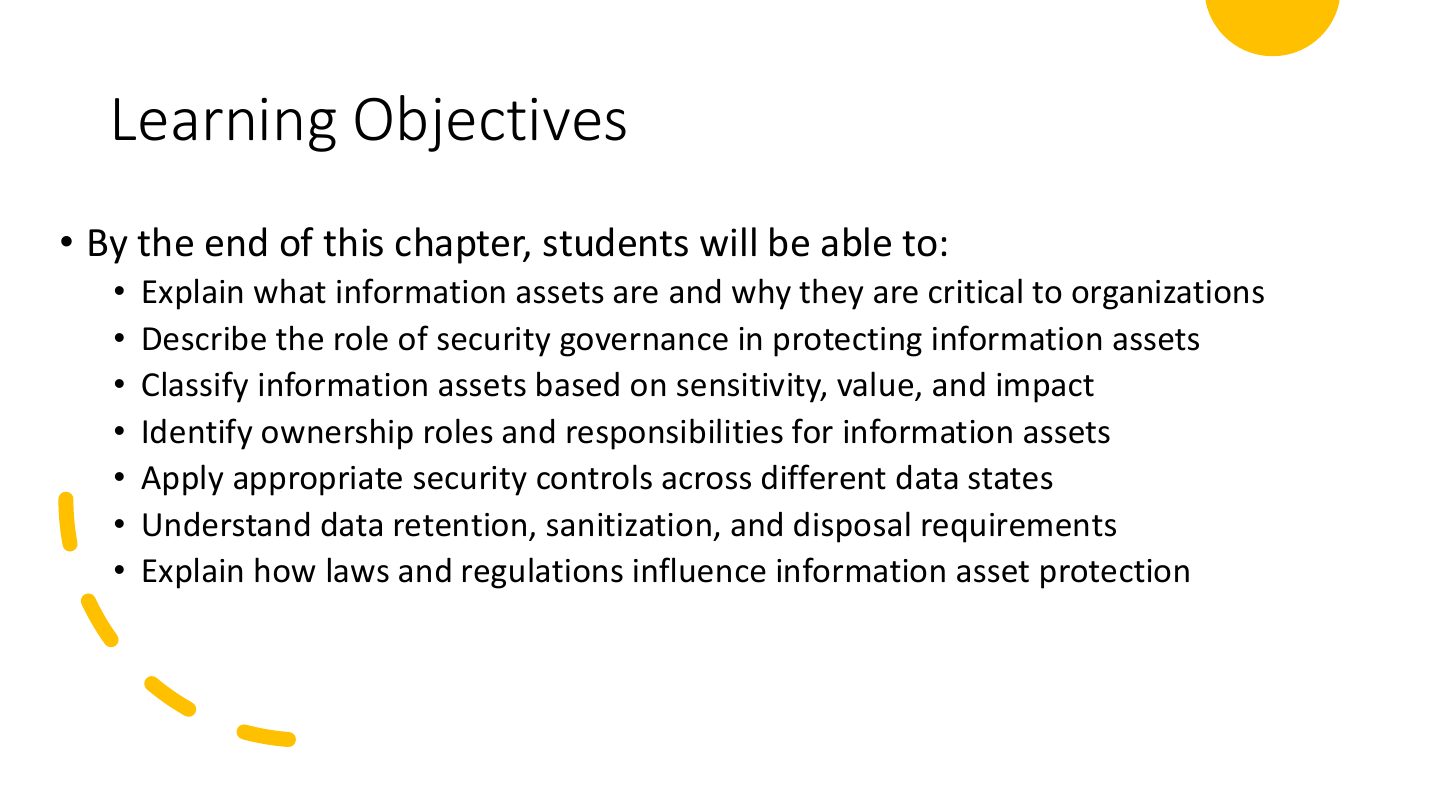
Assets → governance → due care/diligence → classification → handling → destruction → laws → ownership → planning.
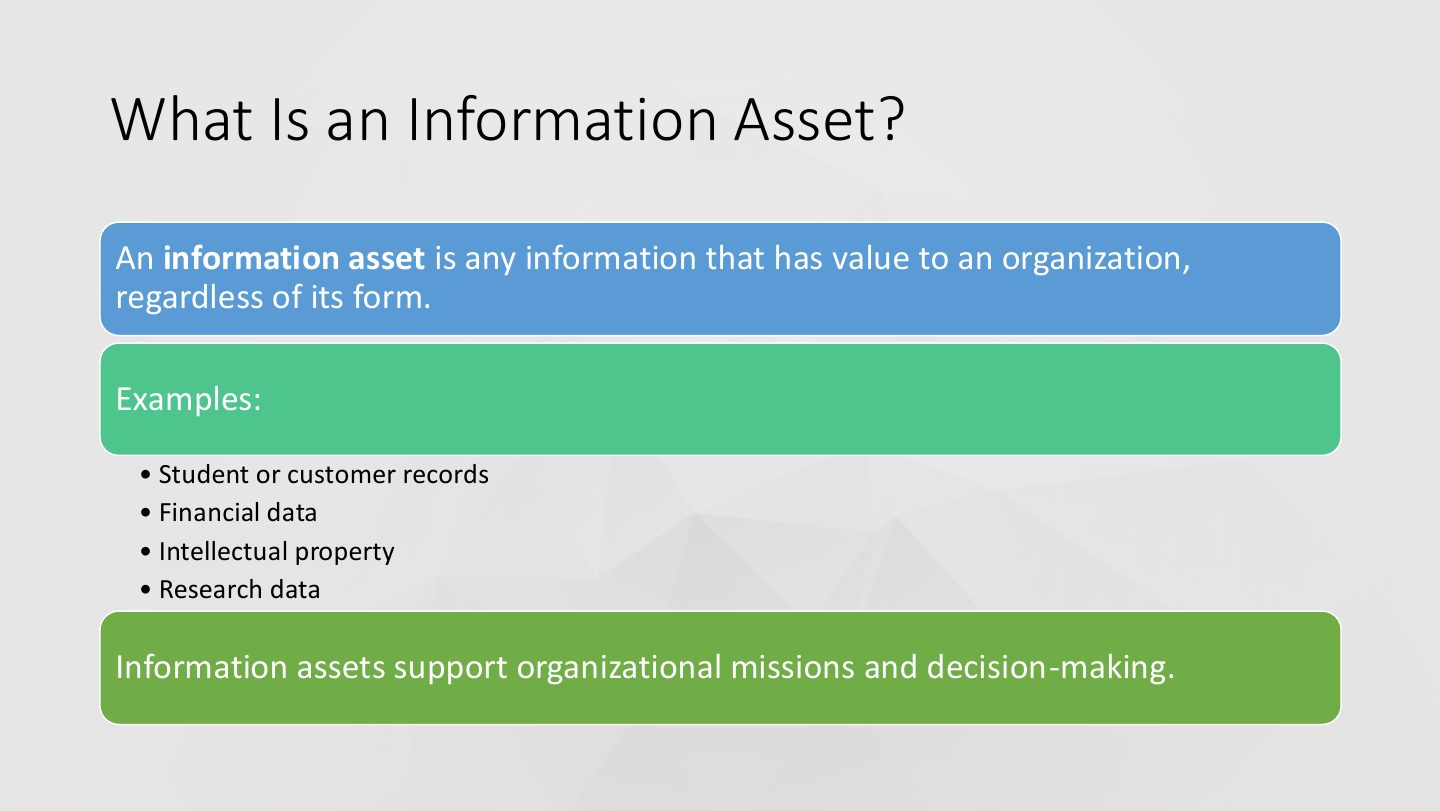
What Is an Information Asset?
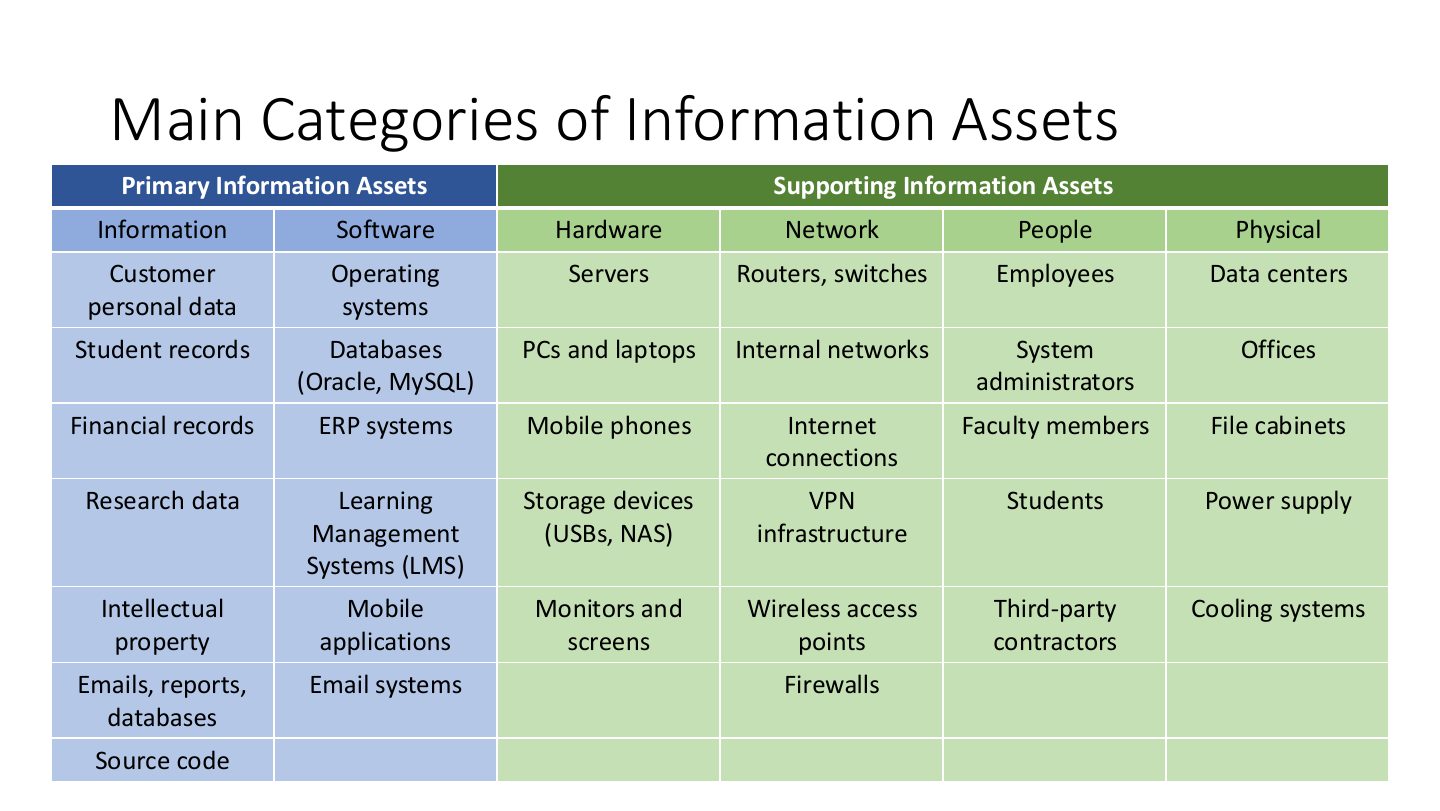
Main Categories of Information Assets
Notes
Primary assets (the information and business processes) vs. supporting assets (hardware, software, networks, people, sites).
Slide 5
Notes
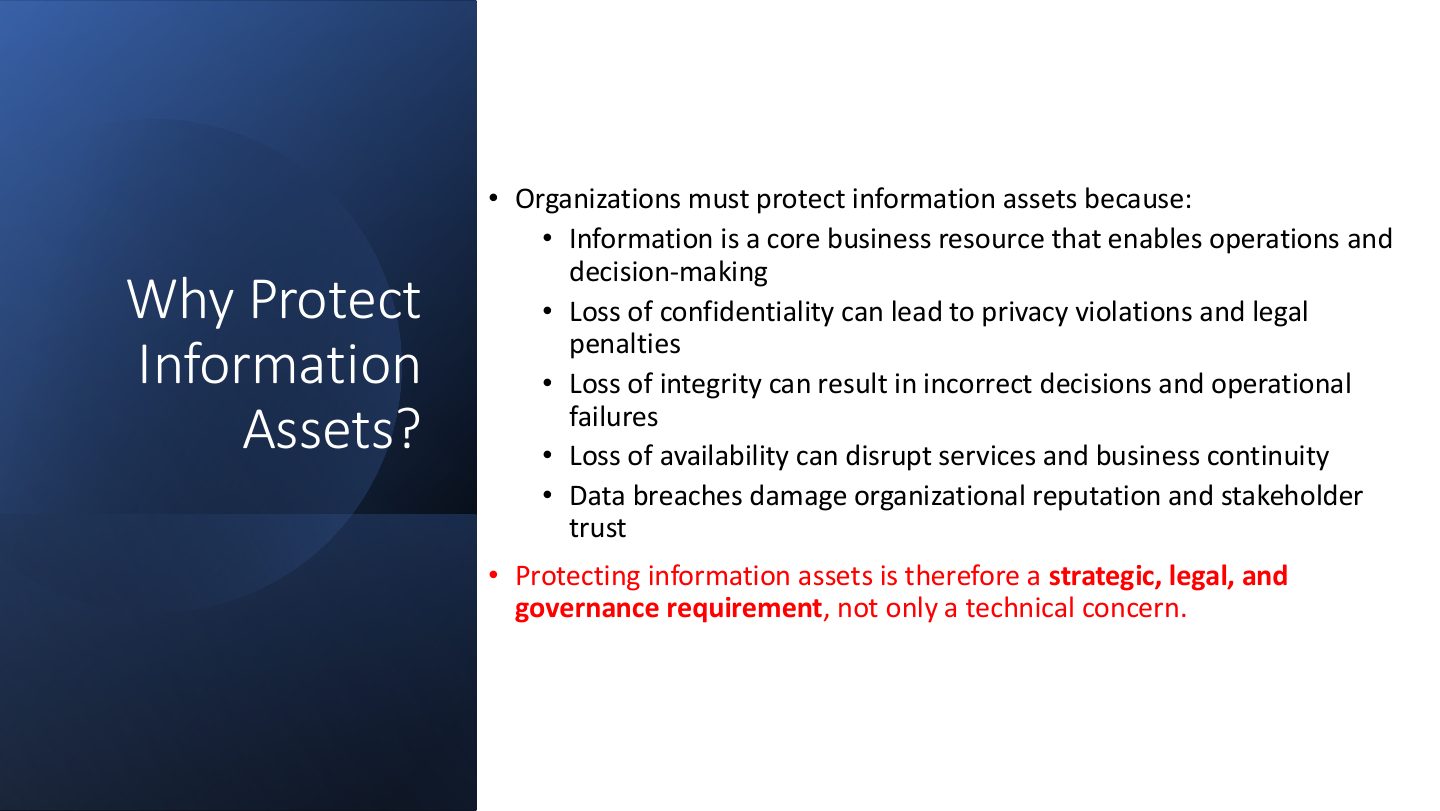
Protect assets because information drives operations and decisions, and loss means financial, legal and reputational damage.
INFORMATION ASSET SECURITY
Security Governance and Information Assets
Notes
Security governance defines how assets are protected: accountability, alignment with business, compliance, risk-based decisions.
SECURITY GOVERNANCE PRINCIPLES
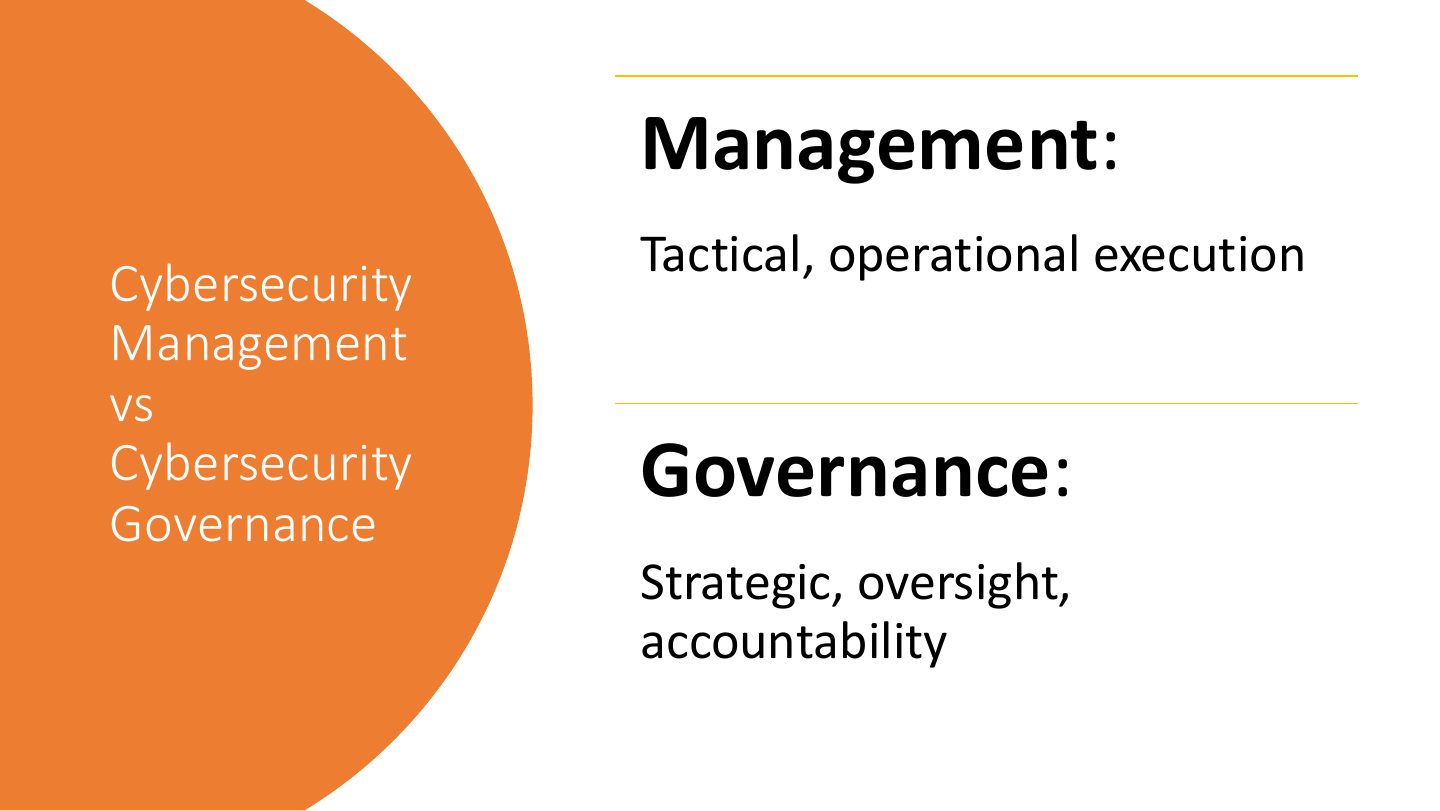
Management :
Notes
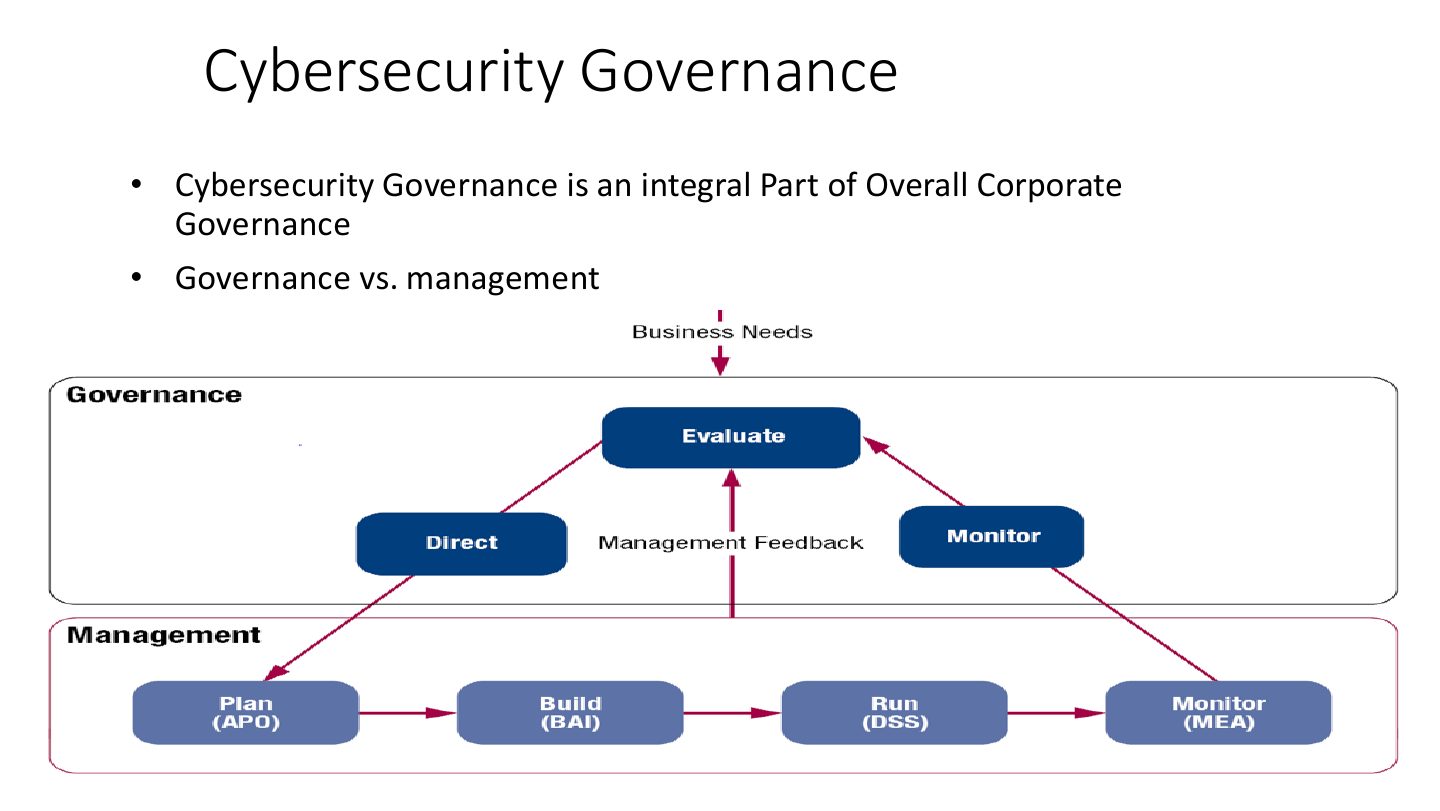
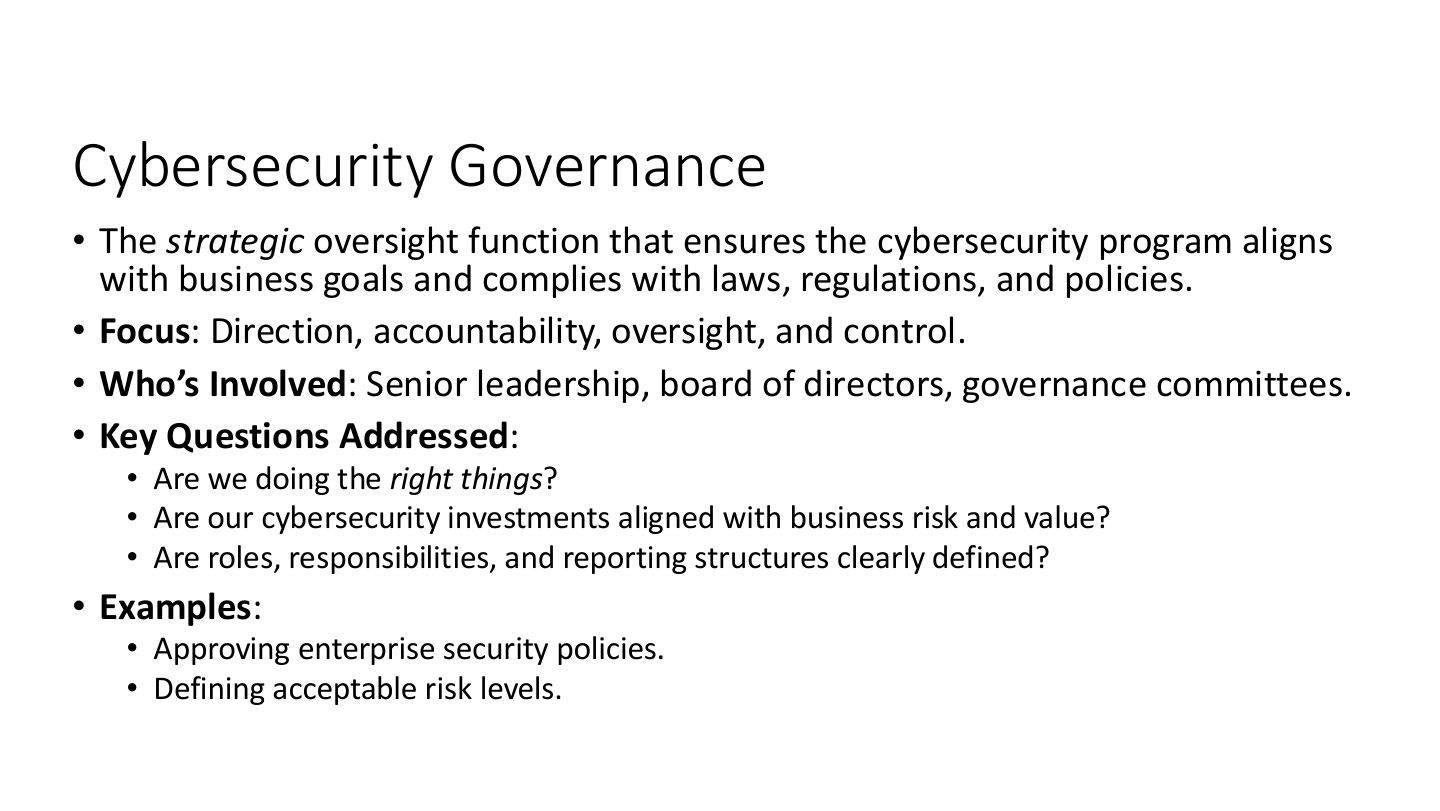
Governance = “doing the right things” (direction, oversight). Management = “doing things right” (tactical, operational execution).
Memory trick Governance decides WHAT and WHY; management does HOW.
Exam angle
Cybersecurity Governance
Cybersecurity Governance
Cybersecurity Management
Slide 13
EVALUATE AND APPLY SECURITY GOVERNANCE PRINCIPLES
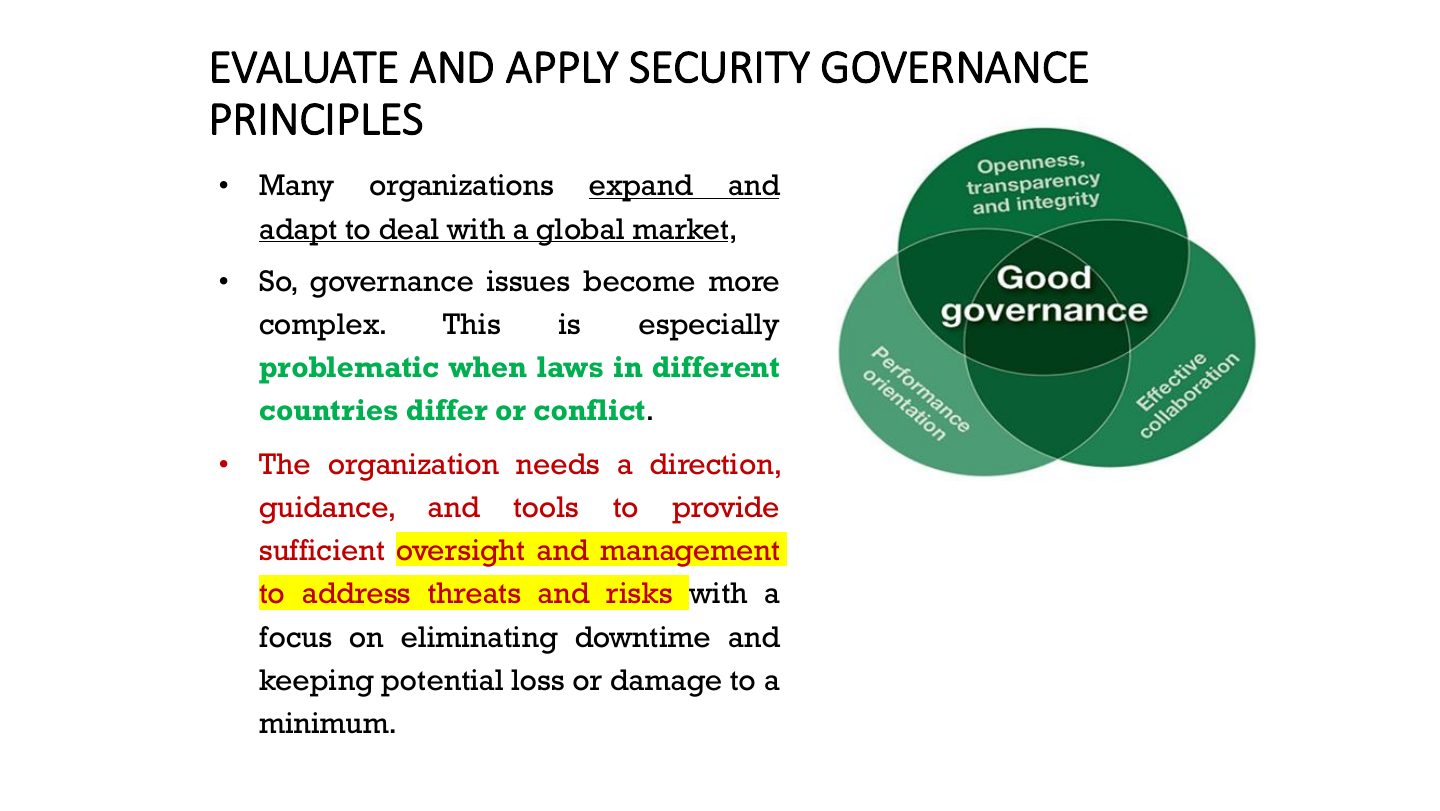
Notes
Global organizations face conflicting laws across countries; governance gives direction and oversight.
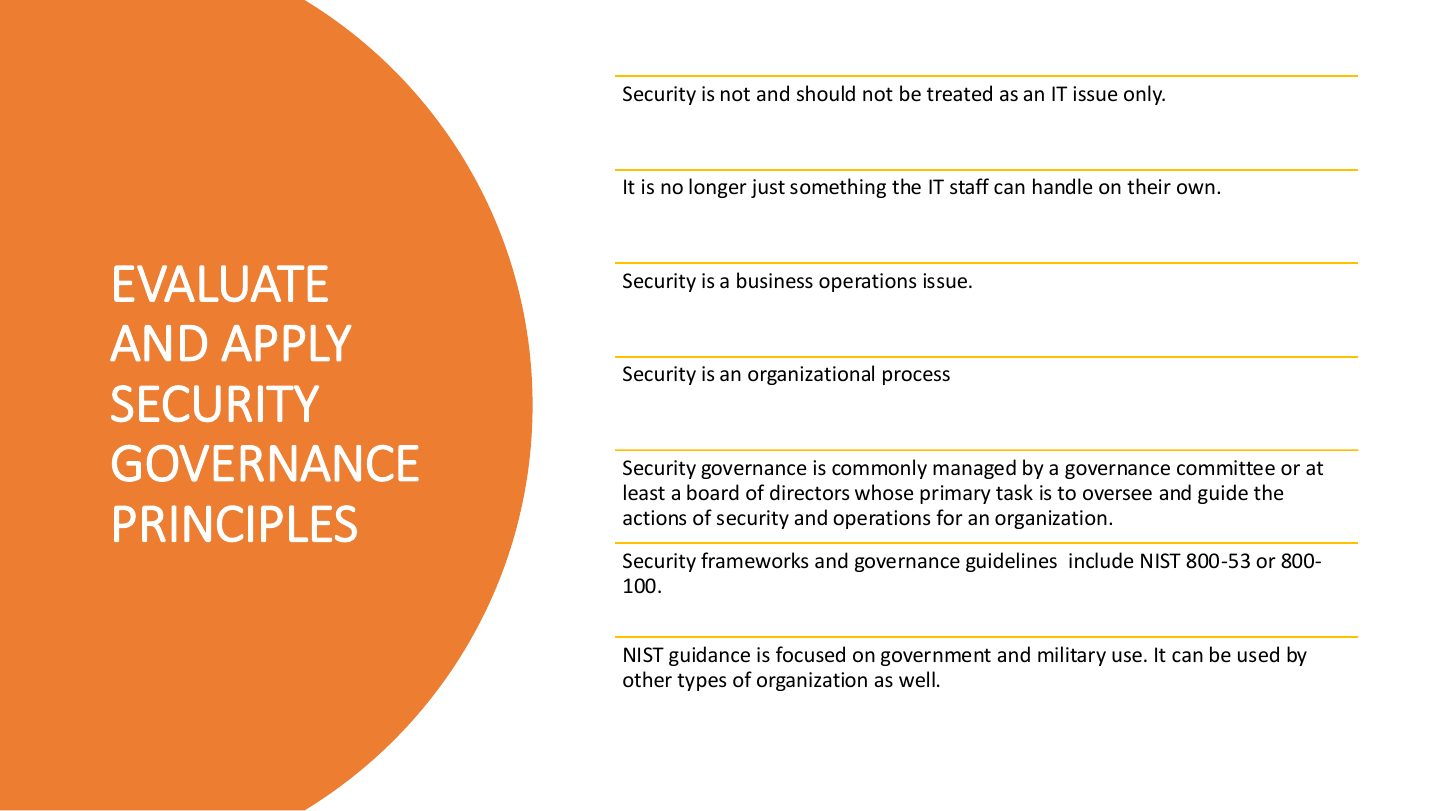
Security is not and should not be treated as an IT issue only.
ASP: An Application Service Provider (ASP) is a company that delivers software applications over the internet. Instead of hosting the software on your own servers, the ASP hosts and maintains it on their servers.
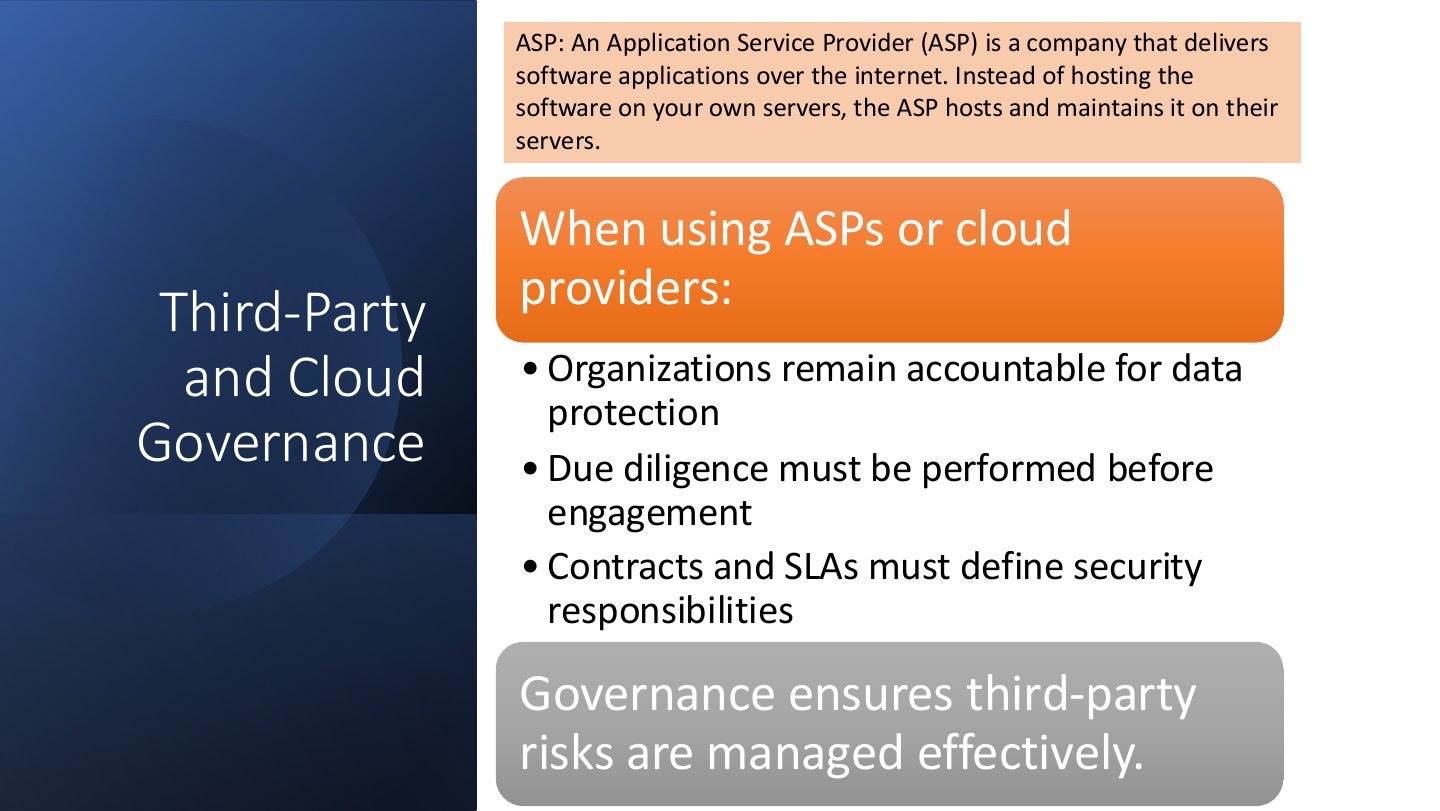
Notes
ASP (Application Service Provider): delivers applications over the internet from its own servers. The organization stays accountable for its data → review the provider’s security and set an SLA with security requirements, responsibilities and breach notification.
Exam angle
B · what is an ASP and what to do to protect data
What is an ASP, and what should be done to protect data when using one? (Major C)
Compare with the model answer
An Application Service Provider hosts and maintains software on its own servers and delivers it to customers over the internet. The organization remains accountable for its data, so it must review the provider’s security (due diligence) before engaging, and sign an SLA covering security requirements, responsibilities and breach notification, then audit the provider’s controls.
Due Care vs. Due Diligence
Notes
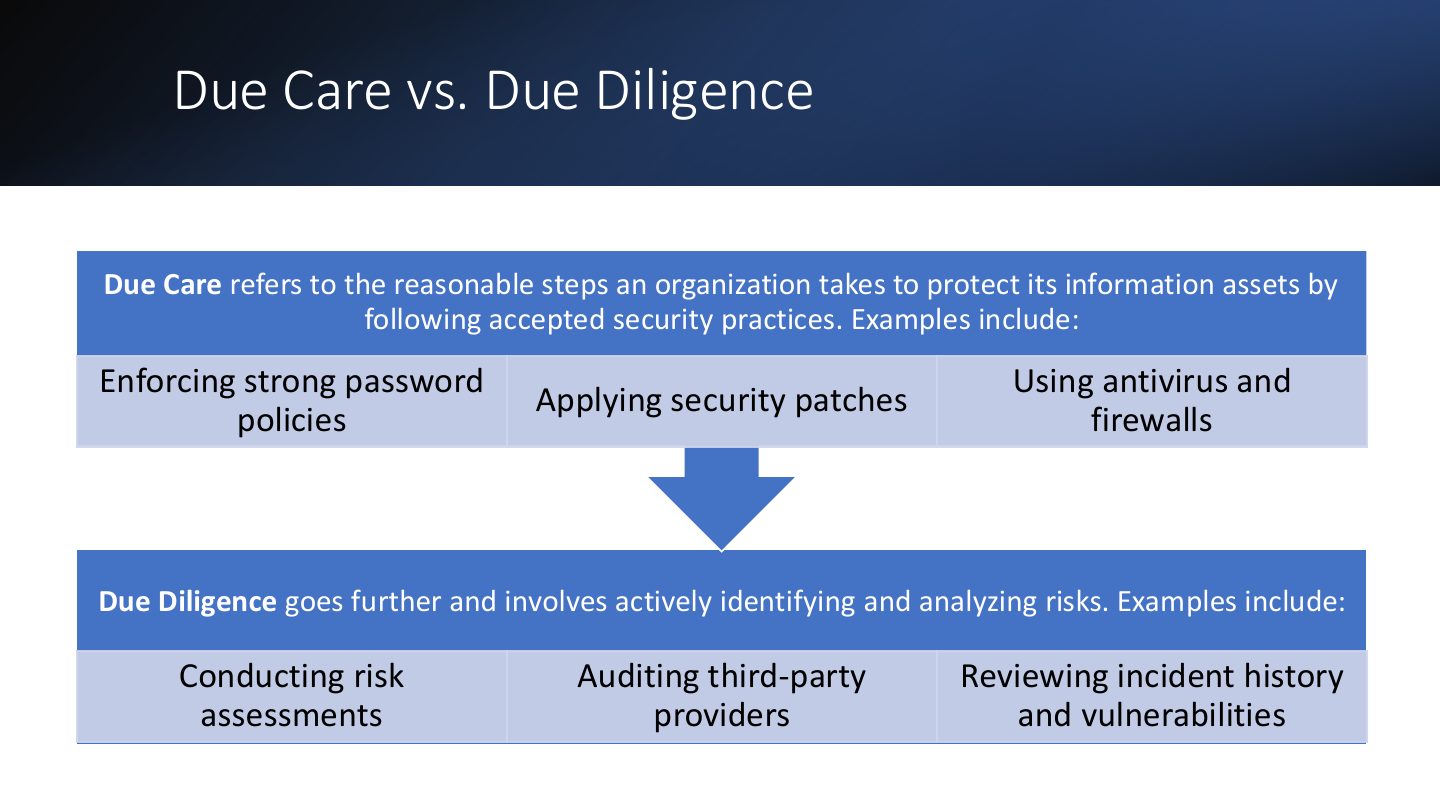
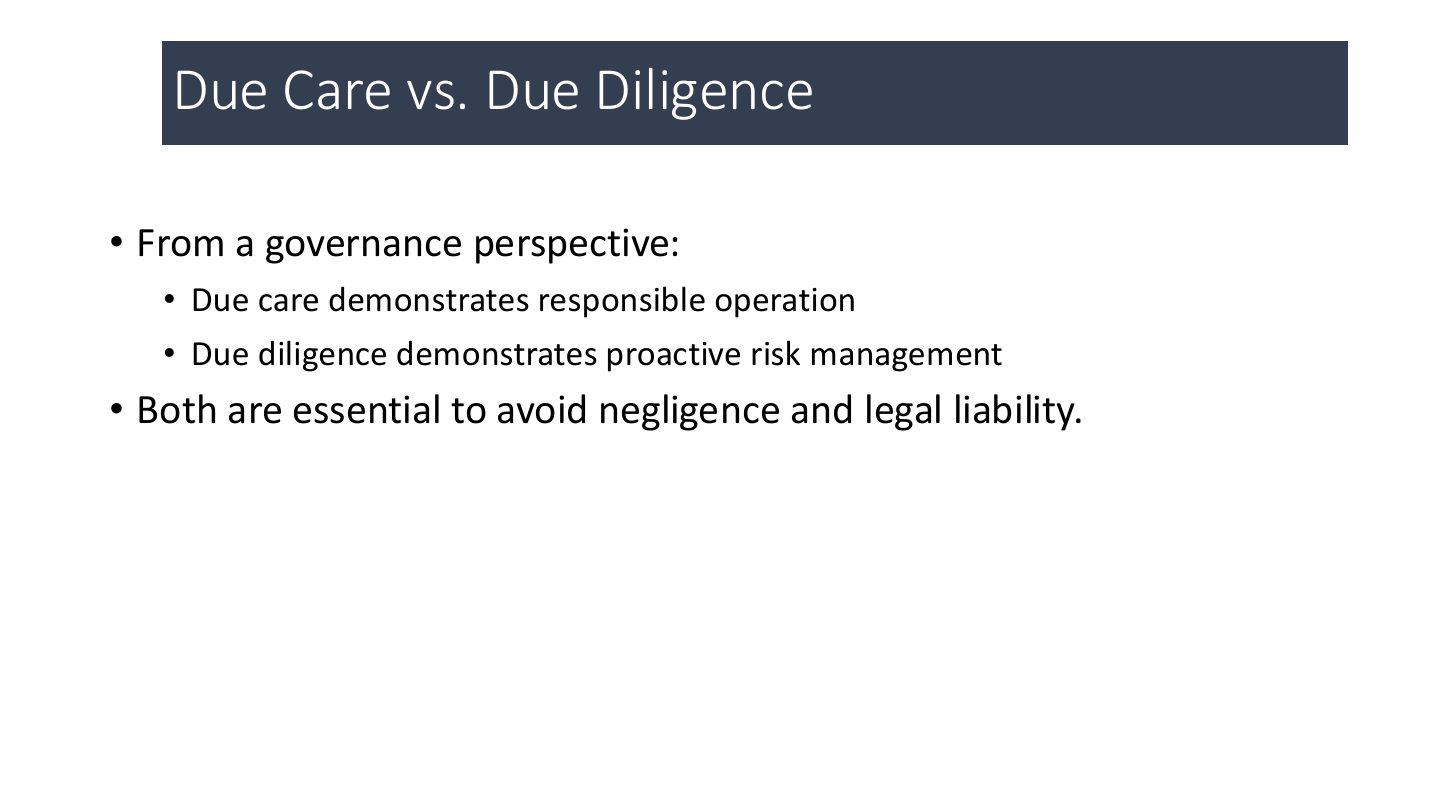
Due care: the reasonable steps taken to protect assets (enforce passwords, patch, train). Due diligence: the research and assessment that finds what is needed (risk assessments, audits).
Tip Due care = DOING the right thing (the protective action: training, patching, responding to a breach). Due diligence = RESEARCHING and checking (risk assessments, investigating threats, auditing vendors before access).
Exam angle
D · due care or due diligence
E · due care or due diligence
E · due care, diligence or both
A company runs workshops on security practices to comply with NCA standards. This is:
- Major A and B.
A company conducts risk assessments every two months to identify threats. This is:
- Major B.
A company requires vendors to sign a data protection agreement and pass security audits before access. This is:
- Major C.
Ransomware encrypts a company’s files. It had not updated its antivirus for a year and ignored its vendors’ security advice. Which failures does this show? (Major C)
Compare with the model answer
Both: not updating the antivirus is a failure of due care (the protective action), and ignoring the vendors’ security examination advice is a failure of due diligence (the investigation).
Due Care vs. Due Diligence
Information Classification
Classification Systems
Exam angle
MCQ · governmental classes except
Related question: match · top secret + engineering label = MAC
Which is NOT a government classification level?
- Final 221 A.
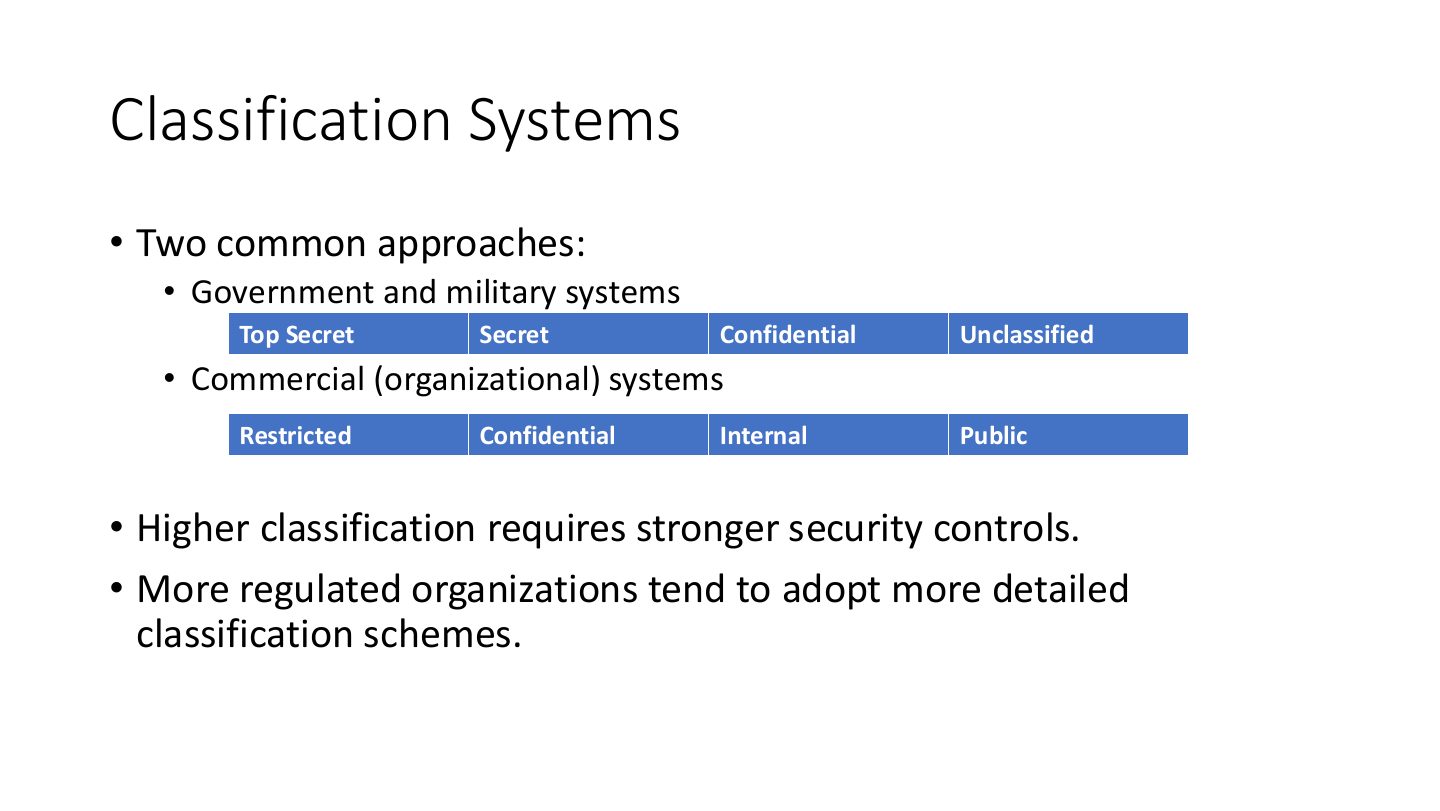
Top Secret
Exam angle
Unauthorized disclosure that could cause “exceptionally grave damage” to national security defines:
Commercial classification systems
Classification Criteria
Notes
Criteria: business value, legal/regulatory impact, sensitivity, impact if disclosed/altered/lost, age/useful life.
Trap Strategic/tactical/operational are kinds of PLANS, not classification criteria.
Exam angle
C · three commercial classification criteria
Give three criteria used to classify information in commercial systems. (Major C)
Compare with the model answer
Business value; legal and regulatory requirements; damage or impact if the information is disclosed, altered or lost (also age/useful life and personal association).
Commercial classification systems
EXAMPES OF RESTRICTED DATA
Class Exercise
DEFINING ASSET CLASSIFICATIONS
SECURITY REQUIREMENTS FOR DIFFERENT DATA CLASSES
Marking Sensitive Data and Assets
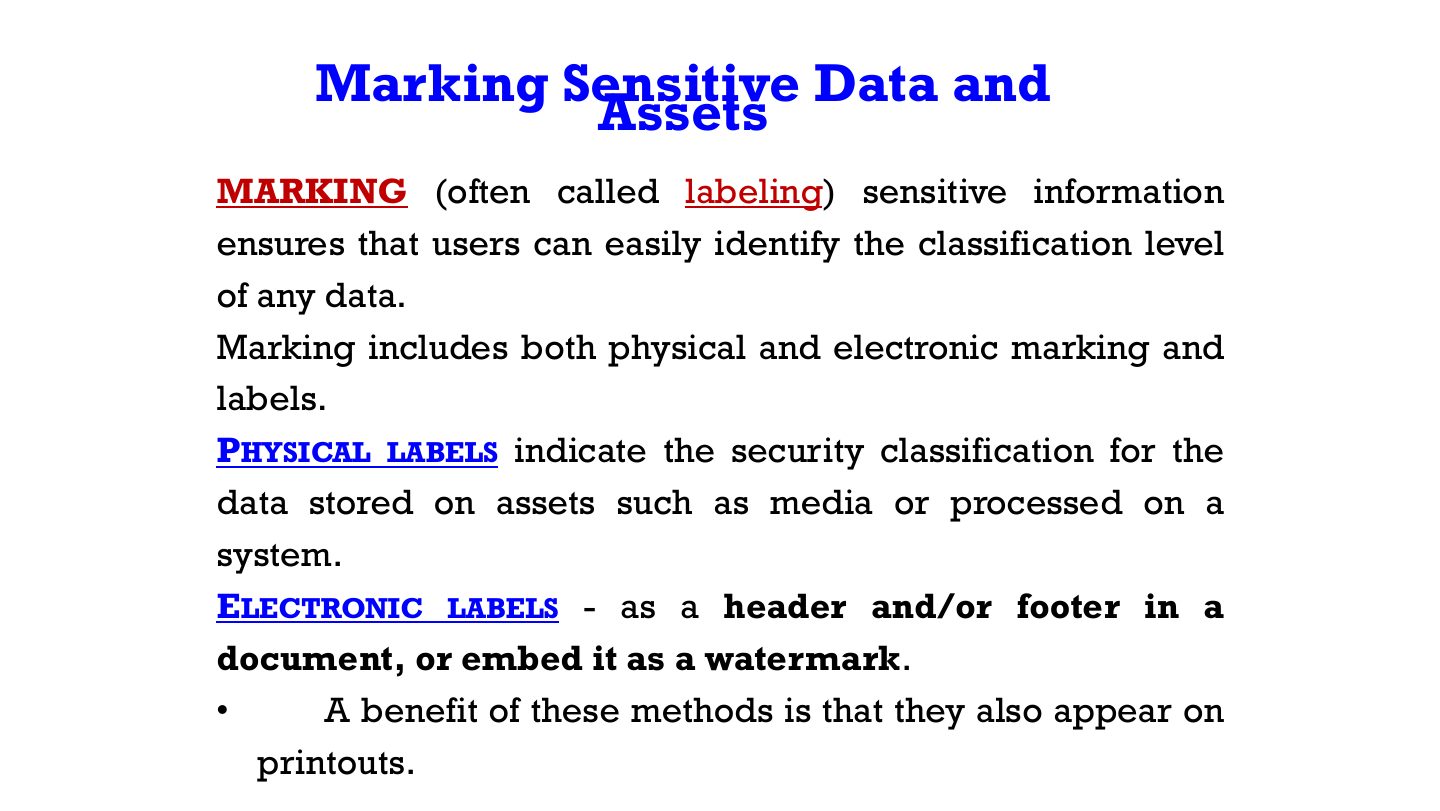
Slide 30
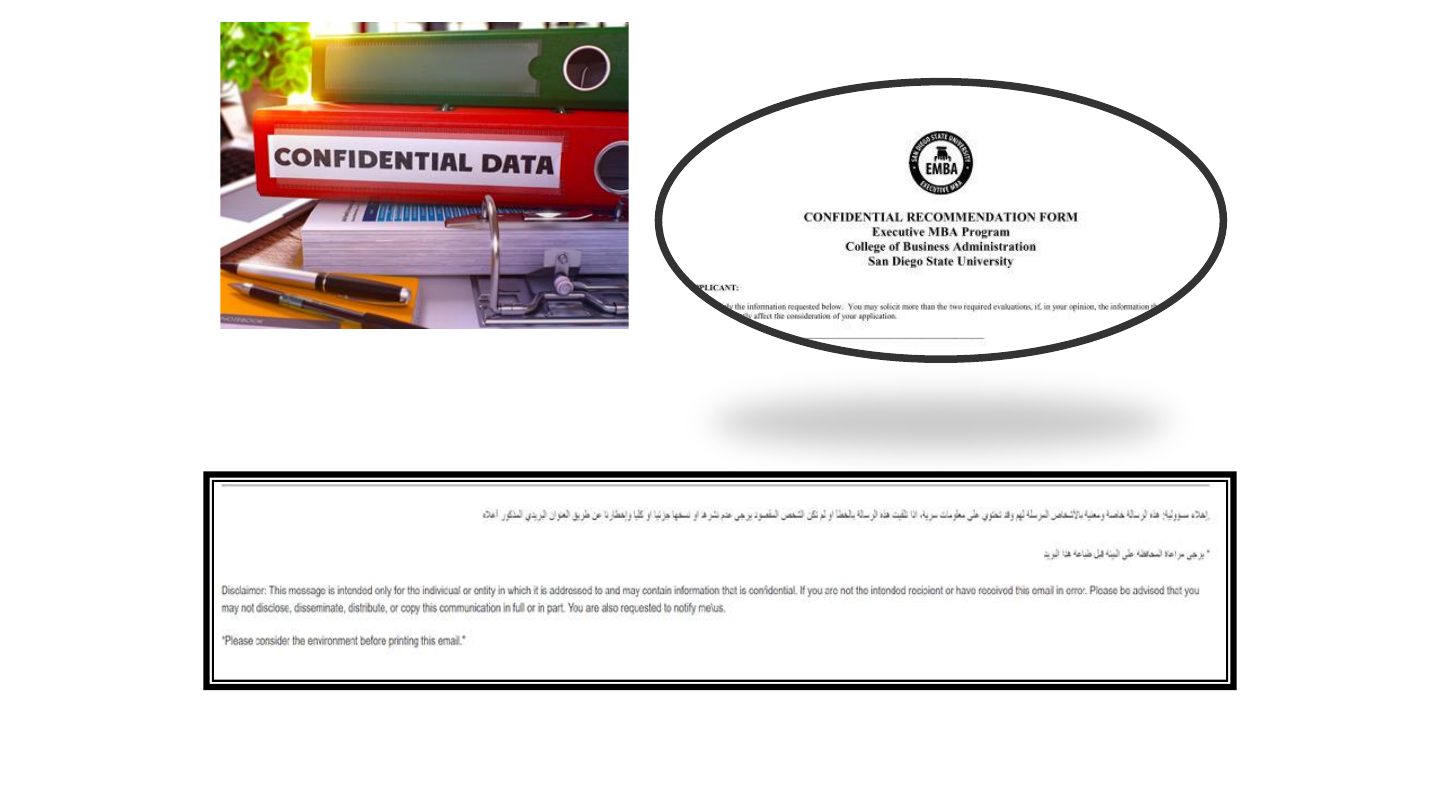
Notes
Examples of labels.
HANDLING INFORMATION AND ASSETS
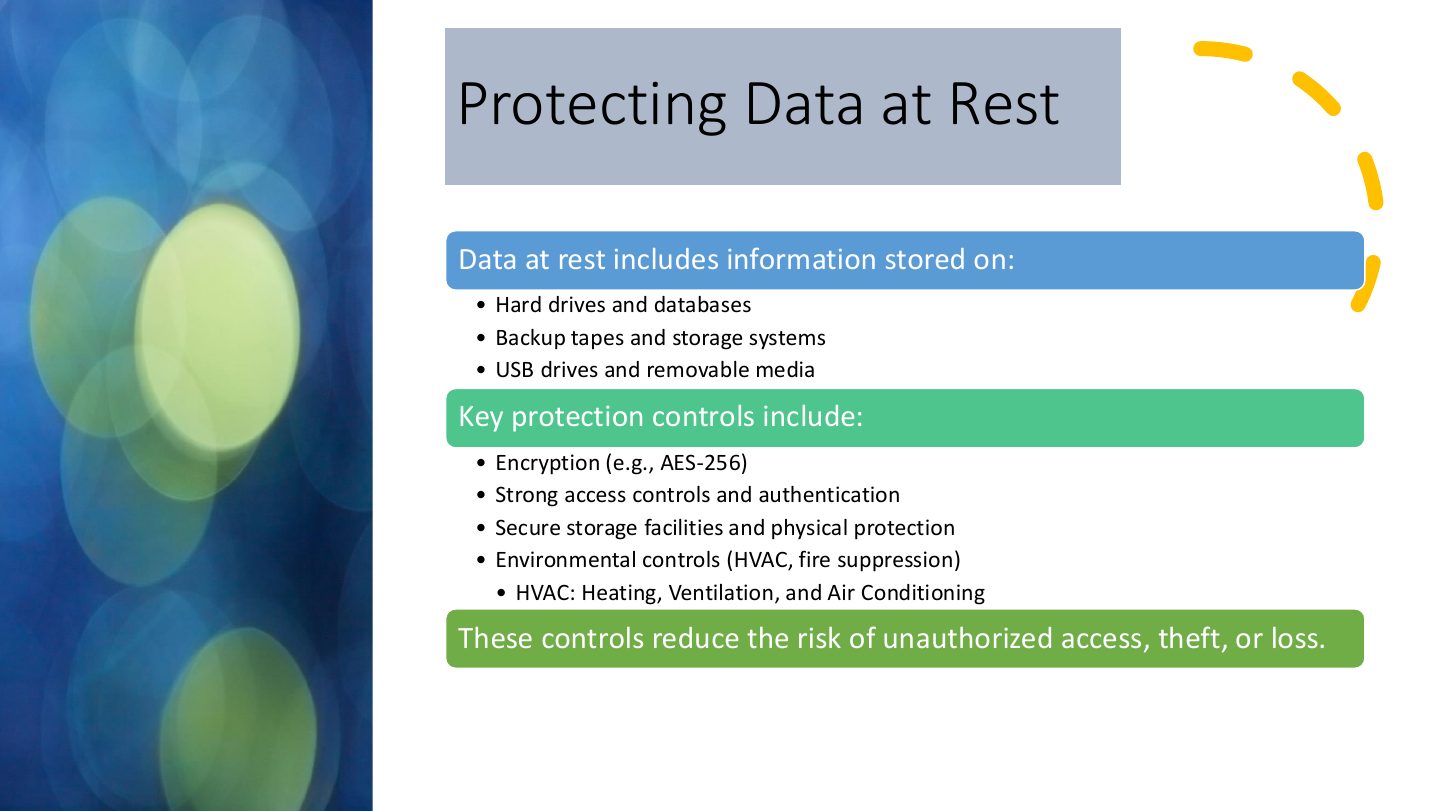
Protecting Data at Rest
Protecting Data in Transit
Protecting Data in Use
Notes
Seen again Ch 1, slide 19: Information states
Record and Asset Retention
Secure Data Destruction
Destroying Sensitive Data
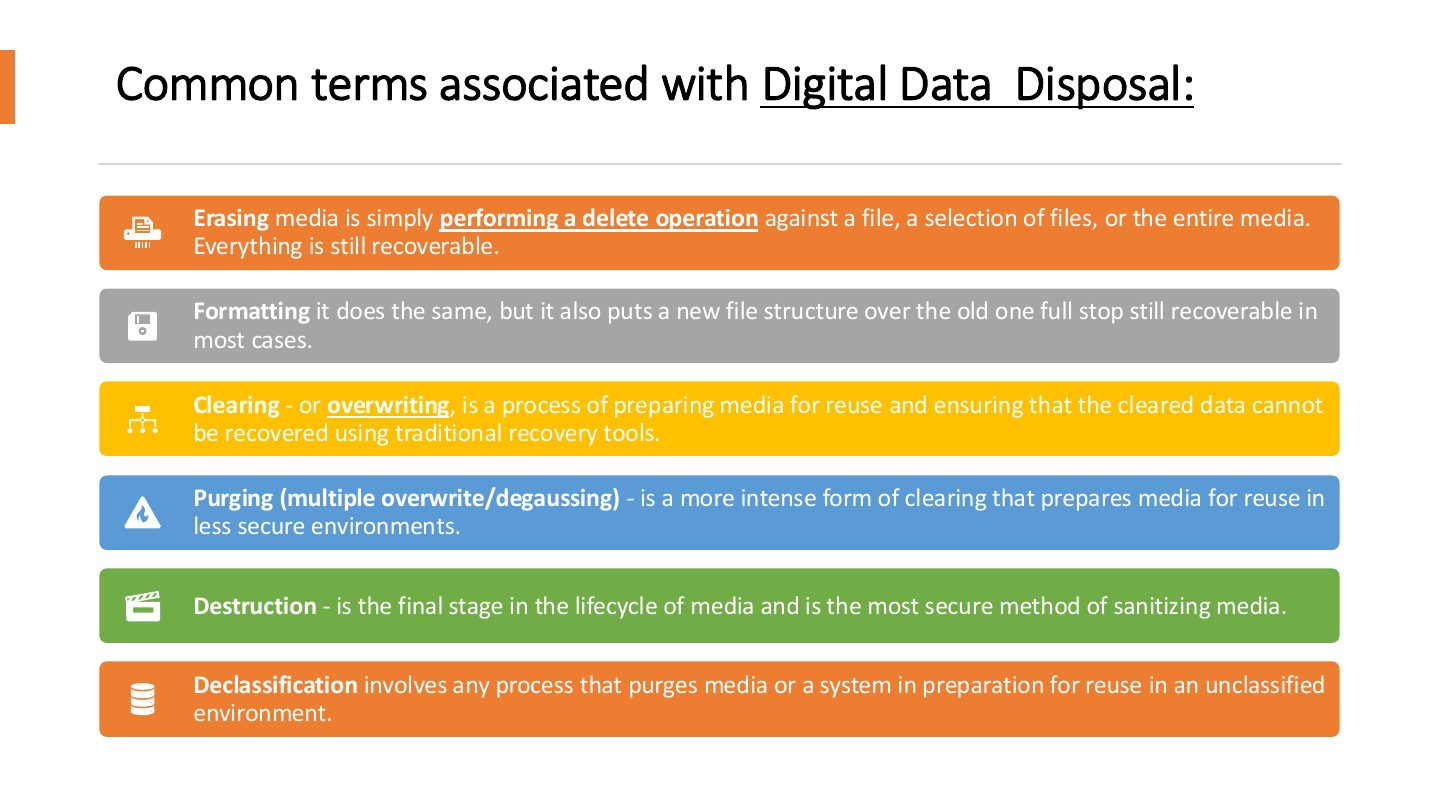
Common terms associated with Digital Data Disposal:
Notes
Erasing = delete (recoverable). Formatting = new file structure (mostly recoverable). Clearing/overwriting = beats normal recovery tools (media can be reused). Purging = stronger (degaussing, crypto-erase). Destruction = most secure.
Tip Weakest → strongest: erasing (delete, recoverable) · formatting · clearing/overwriting (beats normal recovery tools) · purging (degaussing, crypto-erase) · destruction (shred, incinerate, disintegrate, pulverize).
Exam angle
A · clearing, erasing, most secure method
written · ways to sanitize media
Overwriting media so traditional recovery tools can’t recover the data, allowing reuse, is:
- Major C.
Simply performing a delete operation against files is:
- Major C.
The most secure method of sanitizing media is:
- Major C.
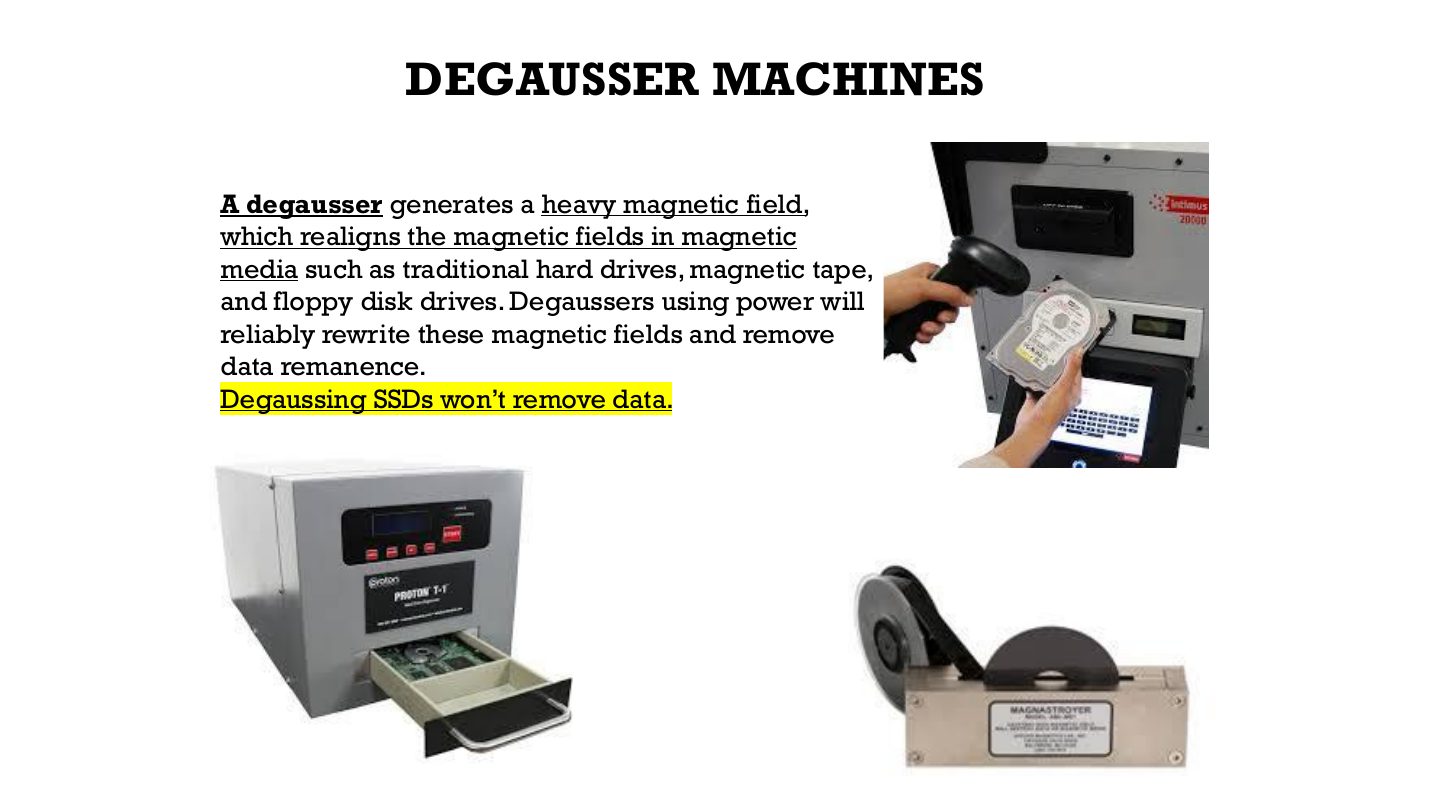
DEGAUSSER MACHINES
Notes
A degausser realigns magnetic fields on HDDs and tapes. It does NOT work on SSDs.
Exam angle
Degaussing reliably removes data from SSDs.
- SSDs are not magnetic.
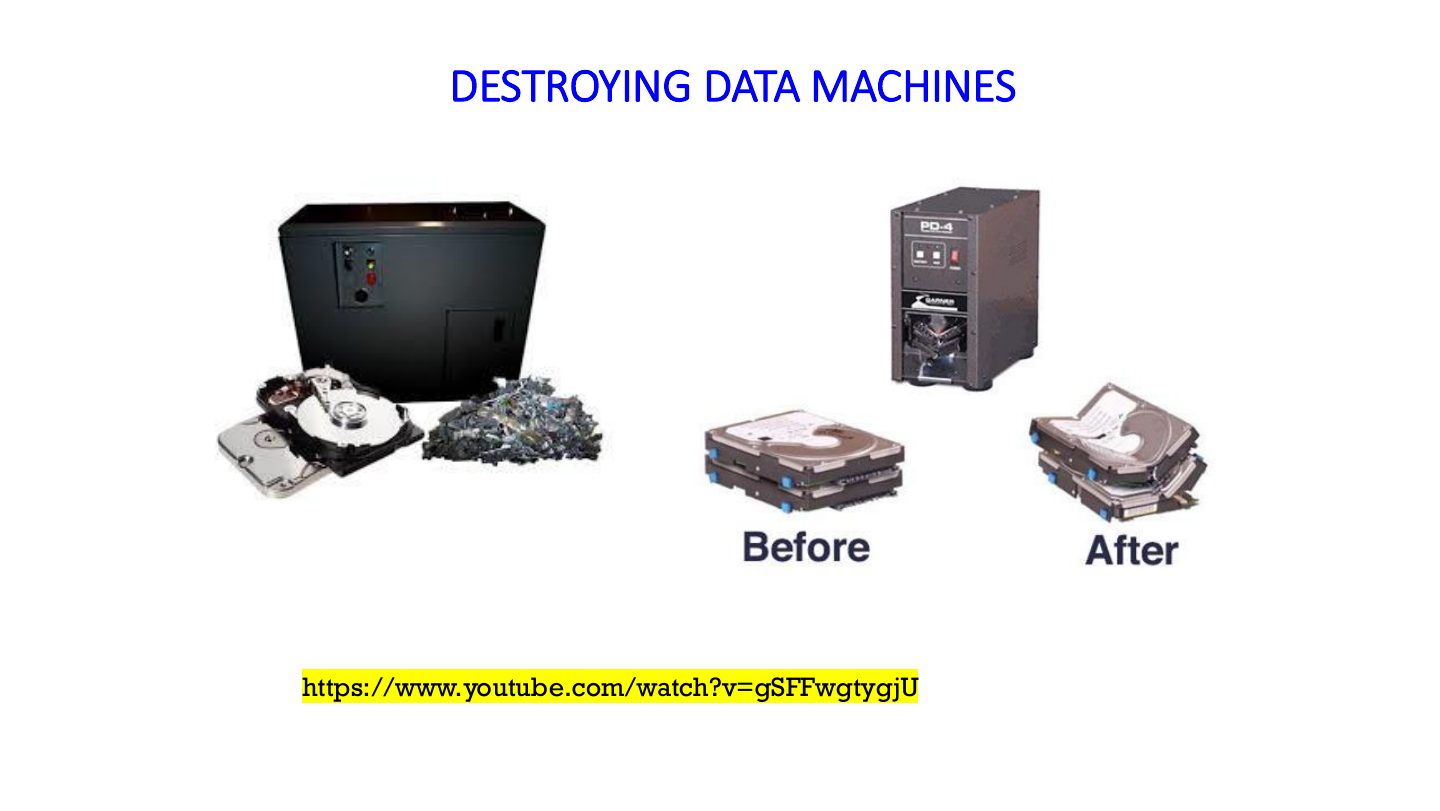
DESTROYING DATA MACHINES
Notes
Destruction machines (shredders, disintegrators).
Slide 41
Notes
Legal compliance figure.
Legal Compliance as a Governance Driver
European Union – General Data Protection Regulation (GDPR)
Exam angle
The GDPR applies to:
United States – Sectoral & State-Based
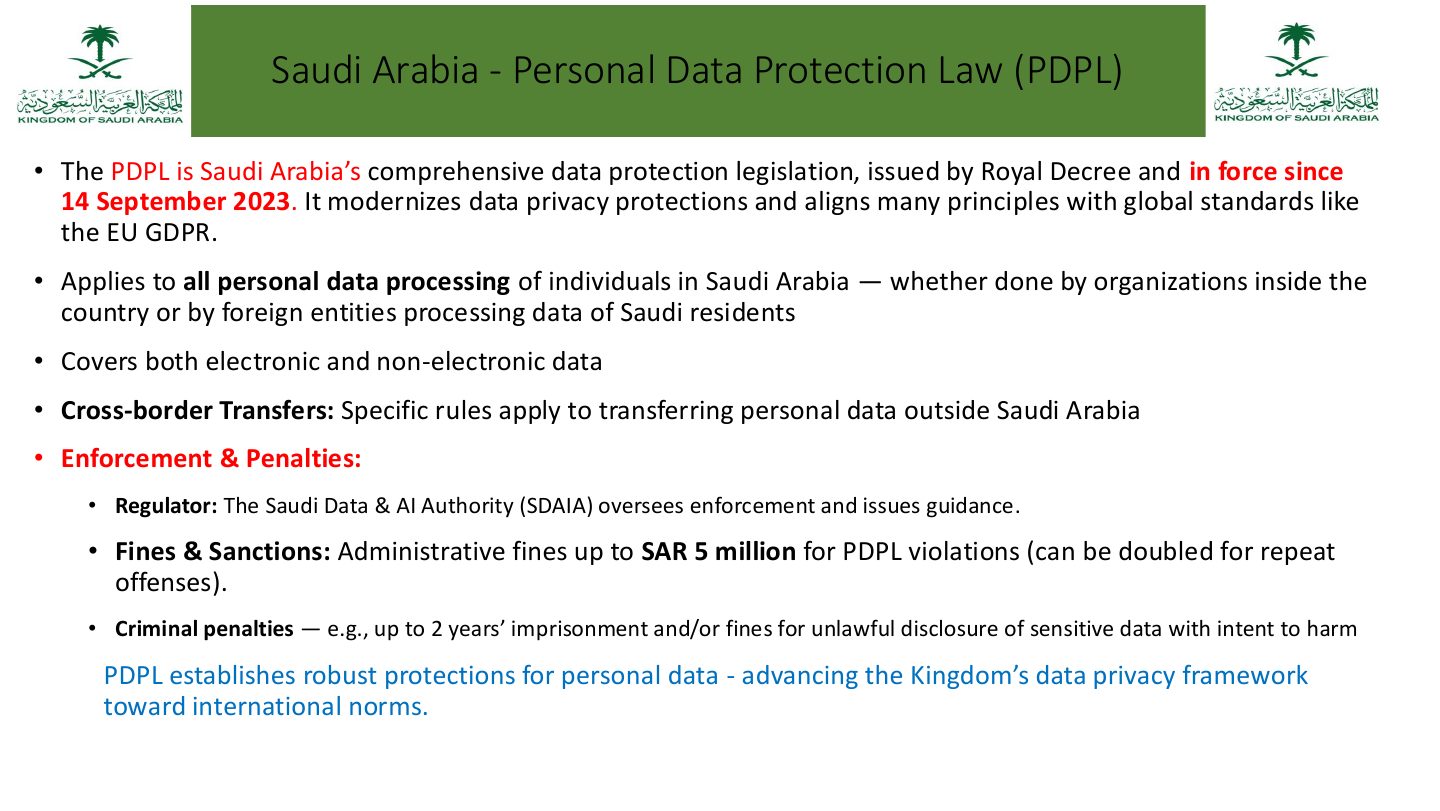
Saudi Arabia - Personal Data Protection Law (PDPL)
Exam angle
Saudi Arabia’s comprehensive personal data law is the:
ASSET OWNERSHIP
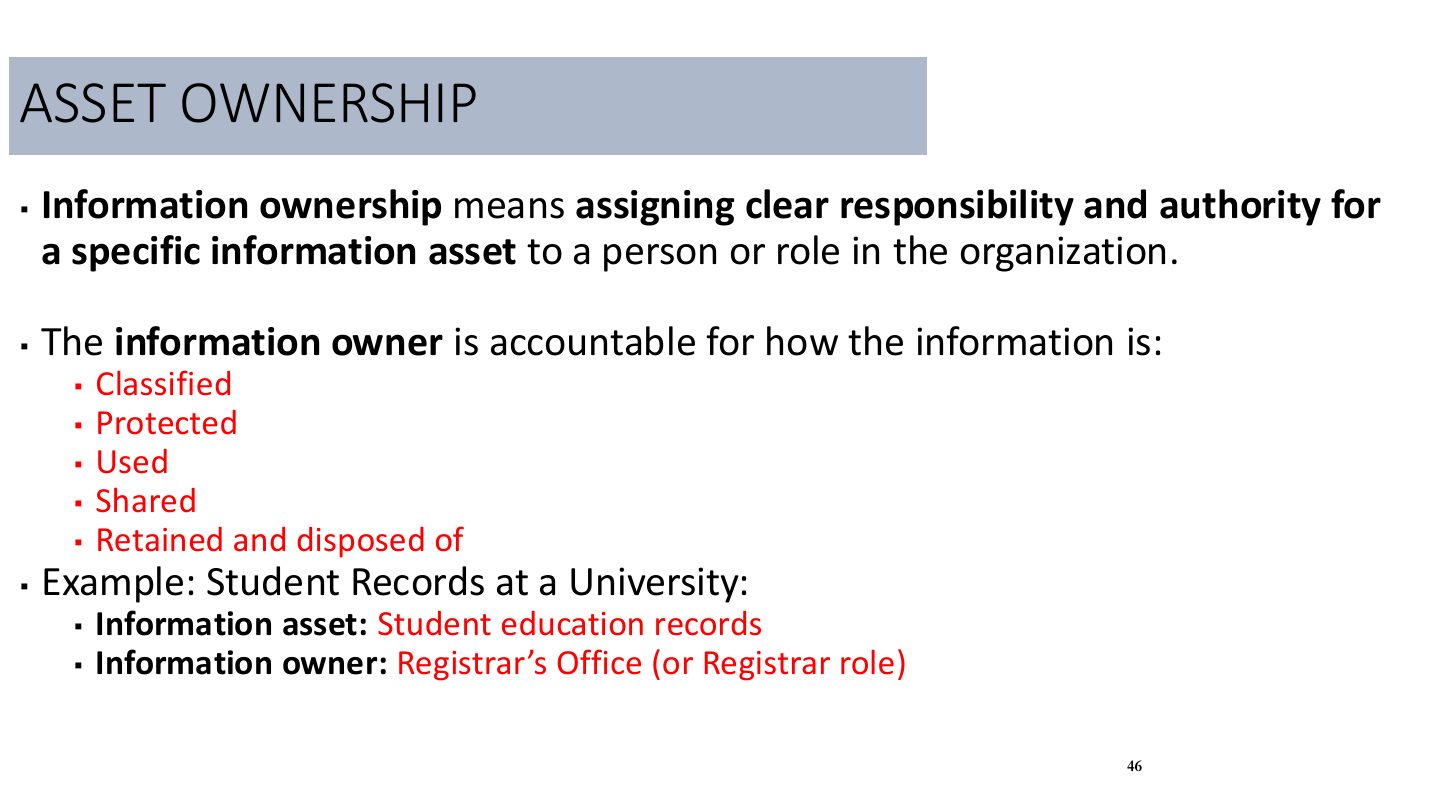
ASSET OWNERSHIP
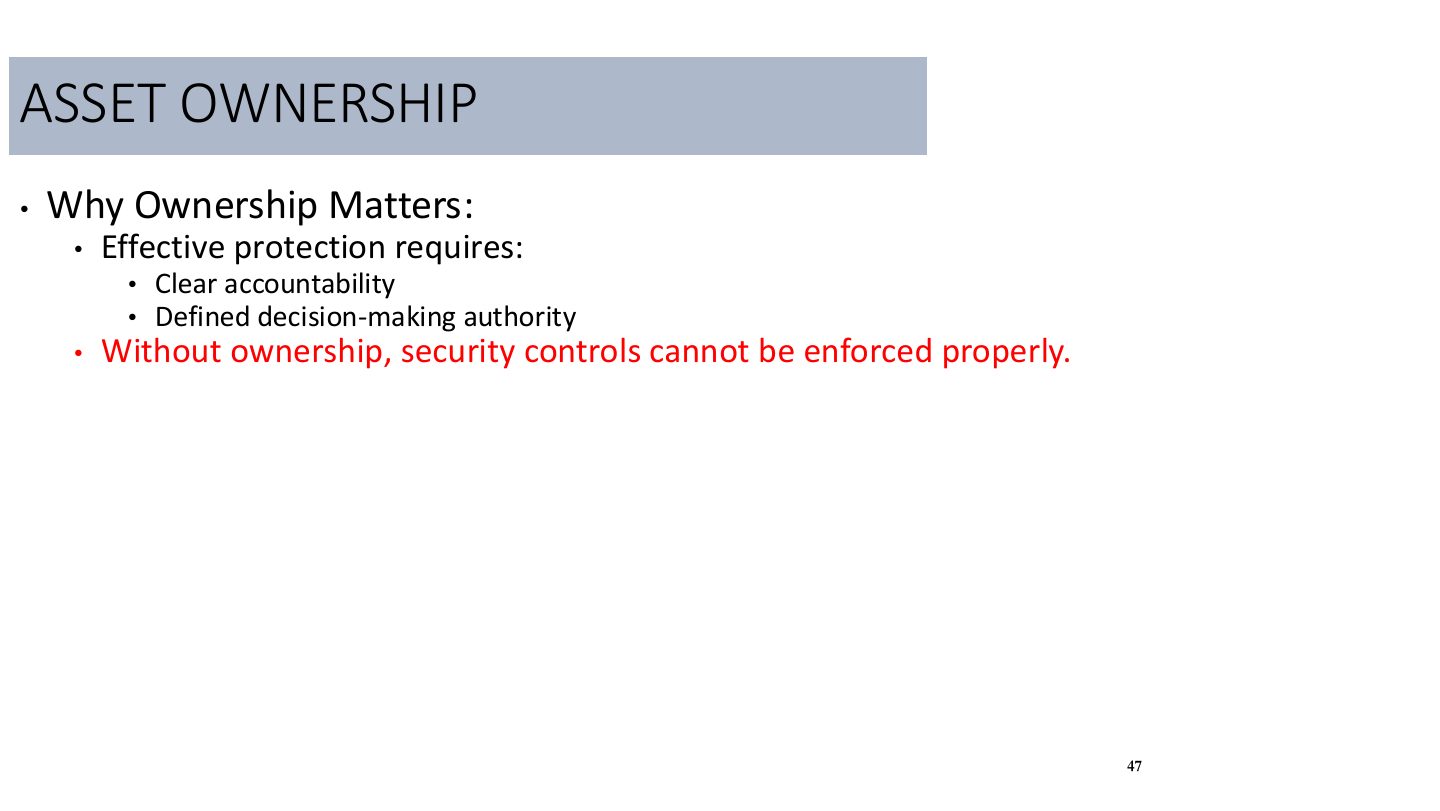
ASSET OWNERSHIP
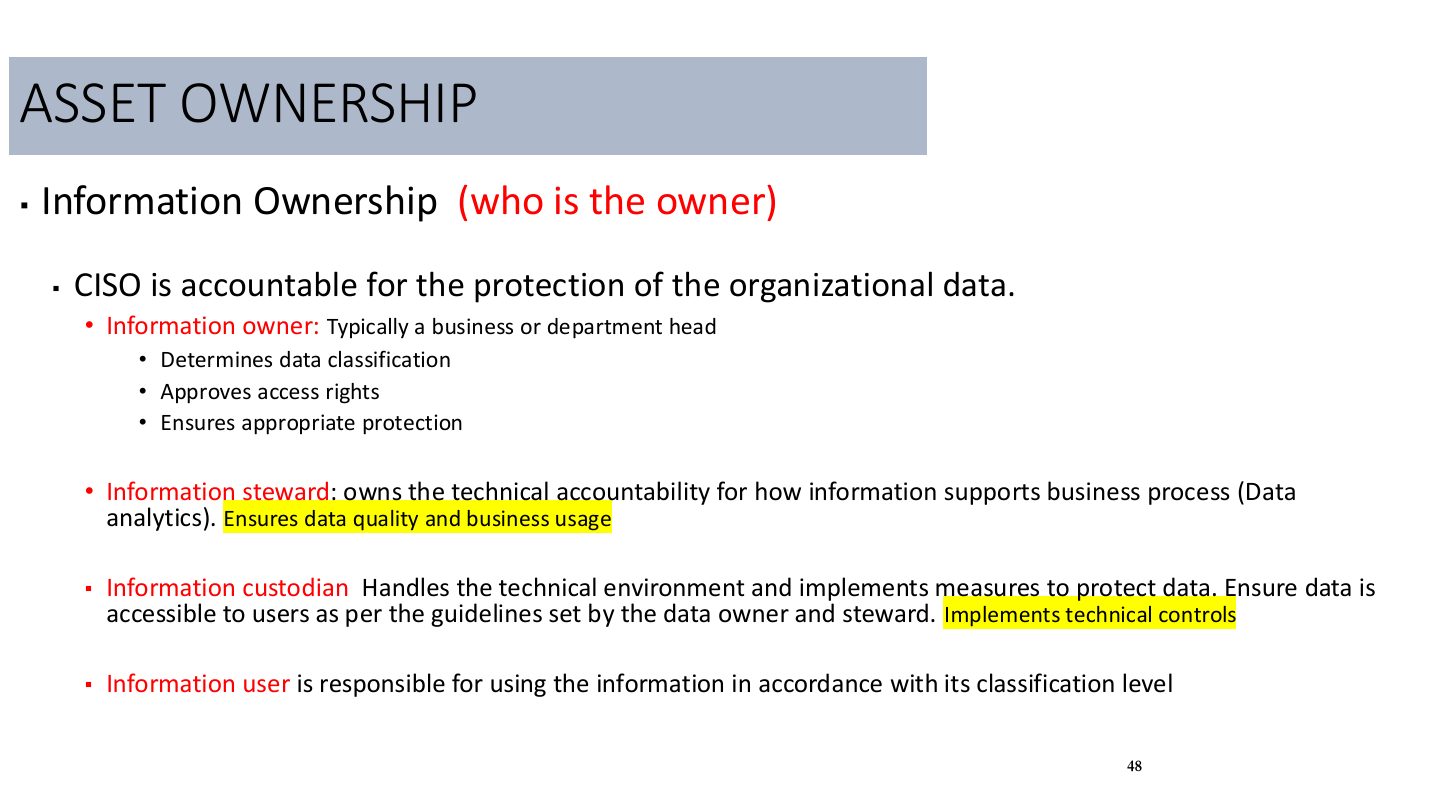
Example:
Information Owner
Notes
Library example: director = owner, IT = custodian, staff = users.
DETERMINING OWNERSHIP
DATA OWNER
Notes
Trap The data OWNER decides access; the CUSTODIAN only implements it.
Exam angle
A · who decides access and privileges (data owner)
According to NIST SP 800-18, who decides who has access to an information system and with what privileges?
- Major A.
ASSET OWNERS
Best Practices for Information Asset Protection
ALIGNMENT OF SECURITY FUNCTION
BUSINESS/MISSION OWNERS
ALIGNMENT OF SECURITY FUNCTION
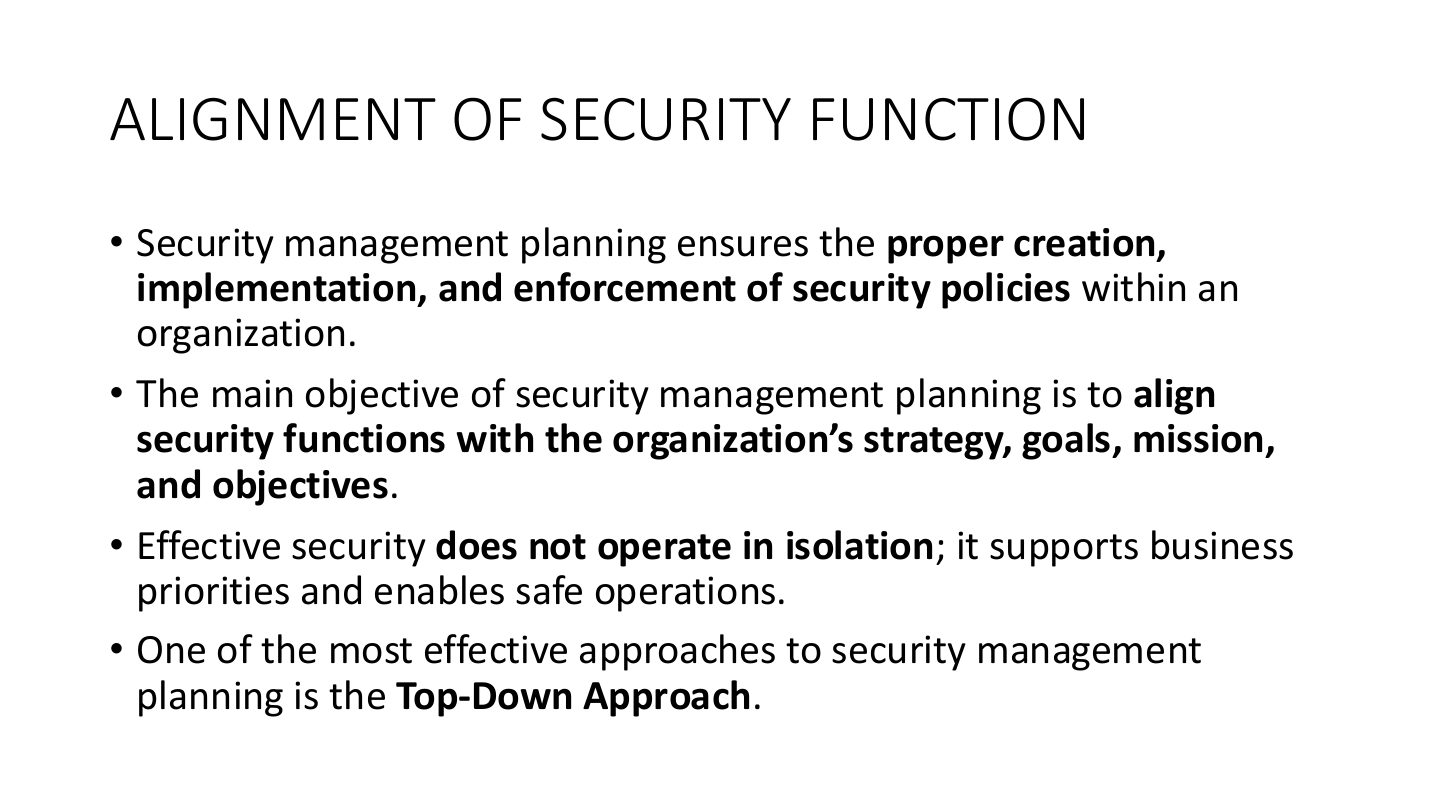
Top-Down Approach
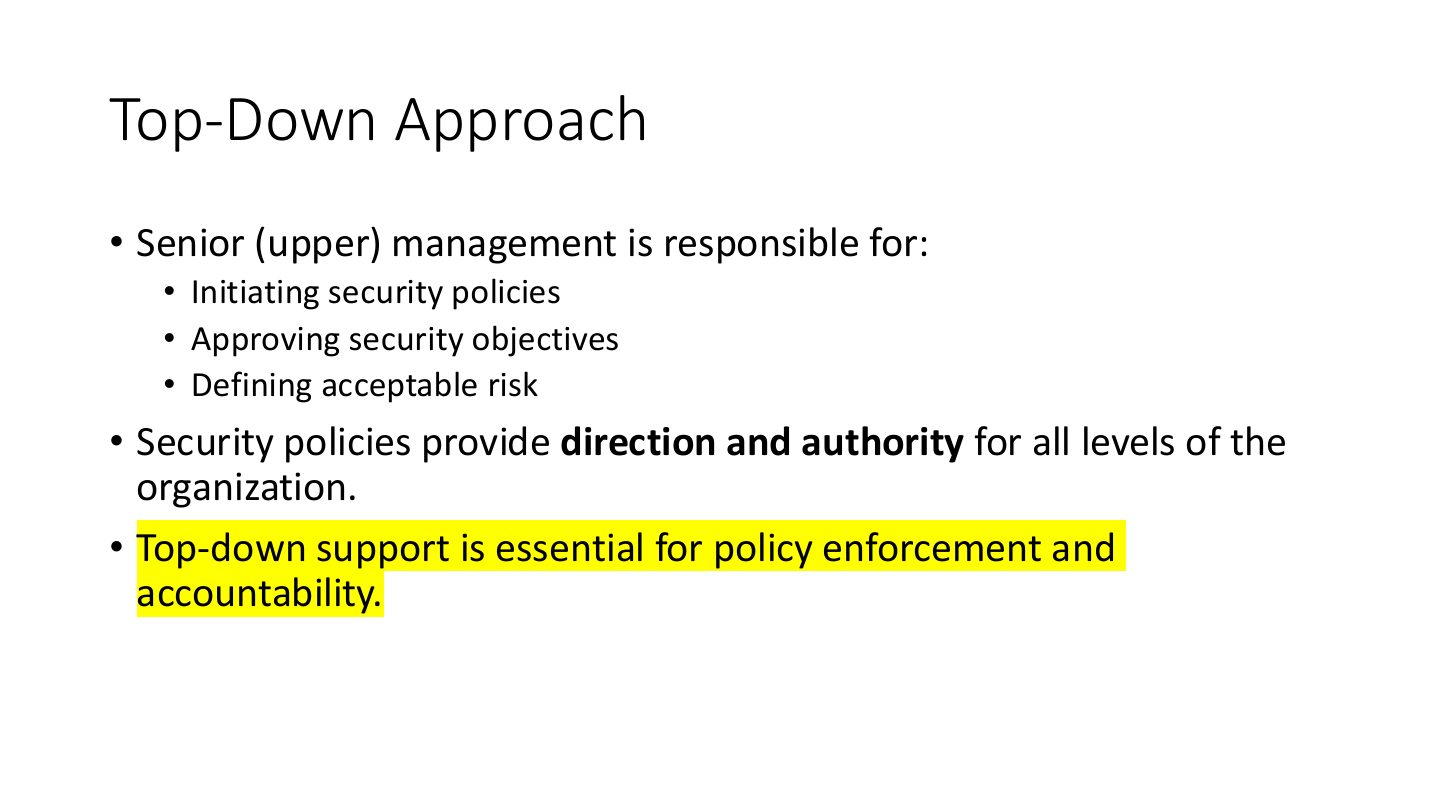
Exam angle
In the top-down approach, security policy is initiated by:
THE INFORMATION SECURITY (INFOSEC) TEAM
DEVELOPING AND IMPLEMENTING A SECURITY POLICY
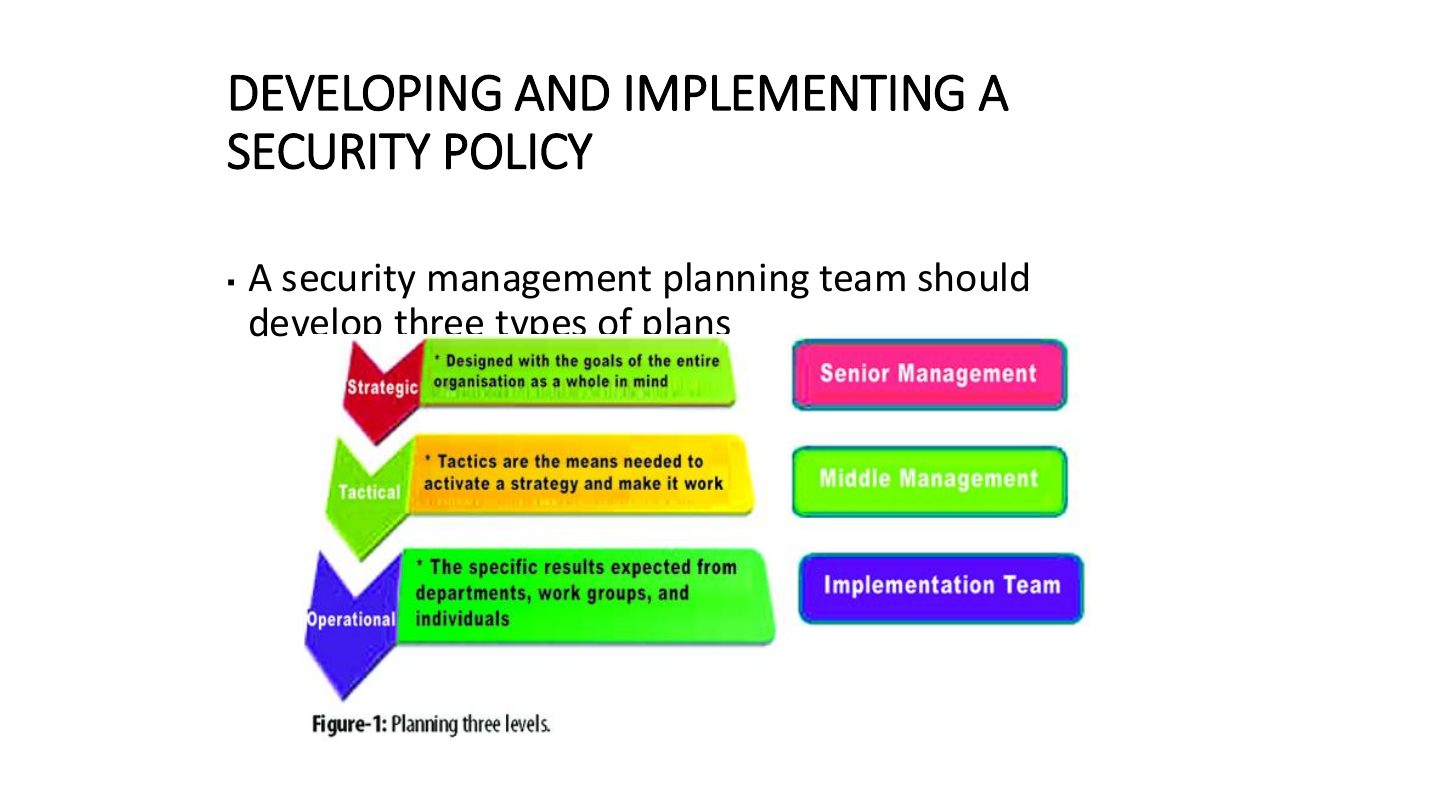
Notes
Three plans: strategic, tactical, operational.
DEVELOPING AND IMPLEMENTING A SECURITY POLICY
STRATEGIC SECURITY PLAN
Exam angle
B · T/F strategic plan is short-term and detailed (false)
A strategic plan is a short-term plan with many details.
- Major A. It is long-term and high-level; operational plans hold the detail.
TACTICAL SECURITY PLAN
OPERATIONAL SECURITY PLAN
Exam angle
Which plan is short-term, highly detailed and updated often?
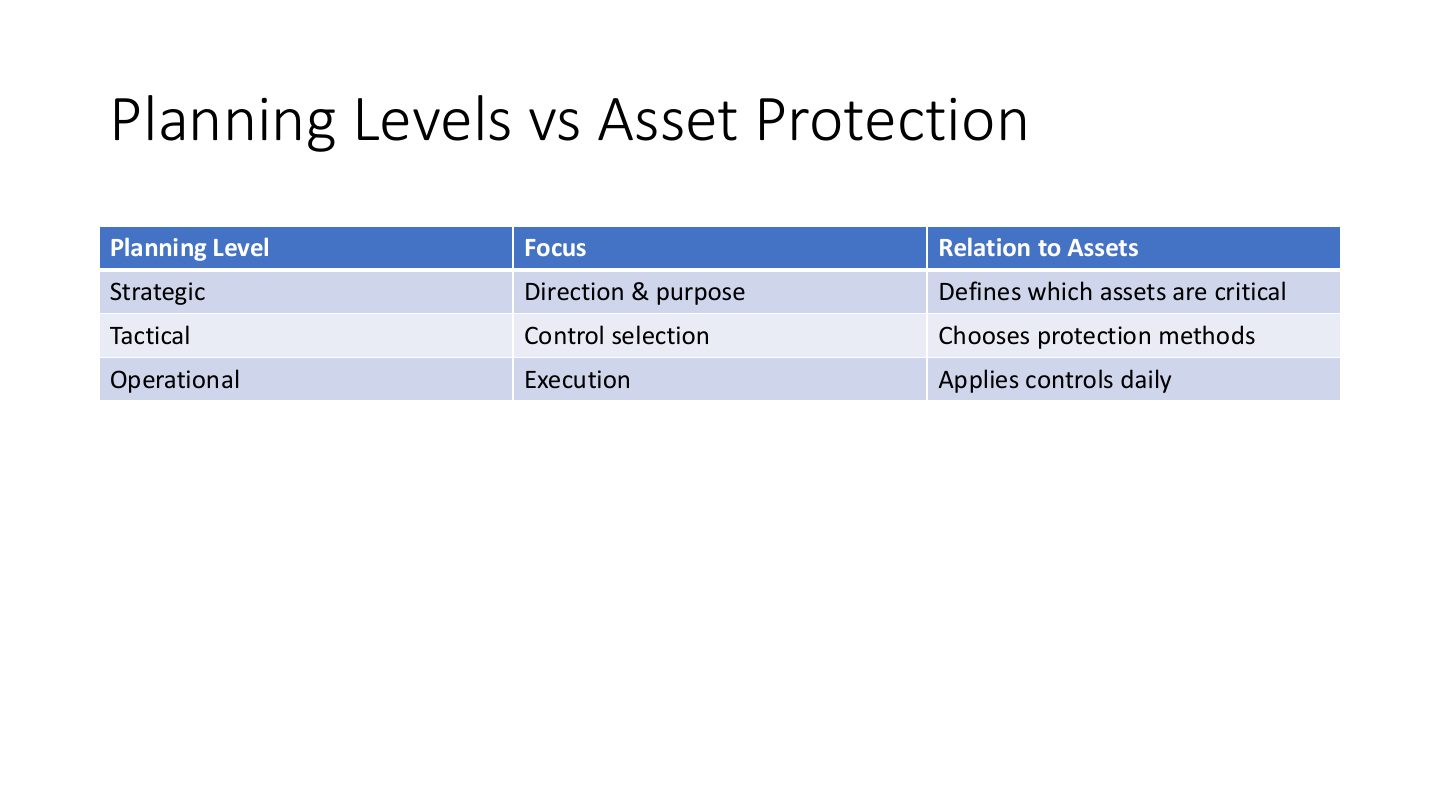
Planning Levels vs Asset Protection
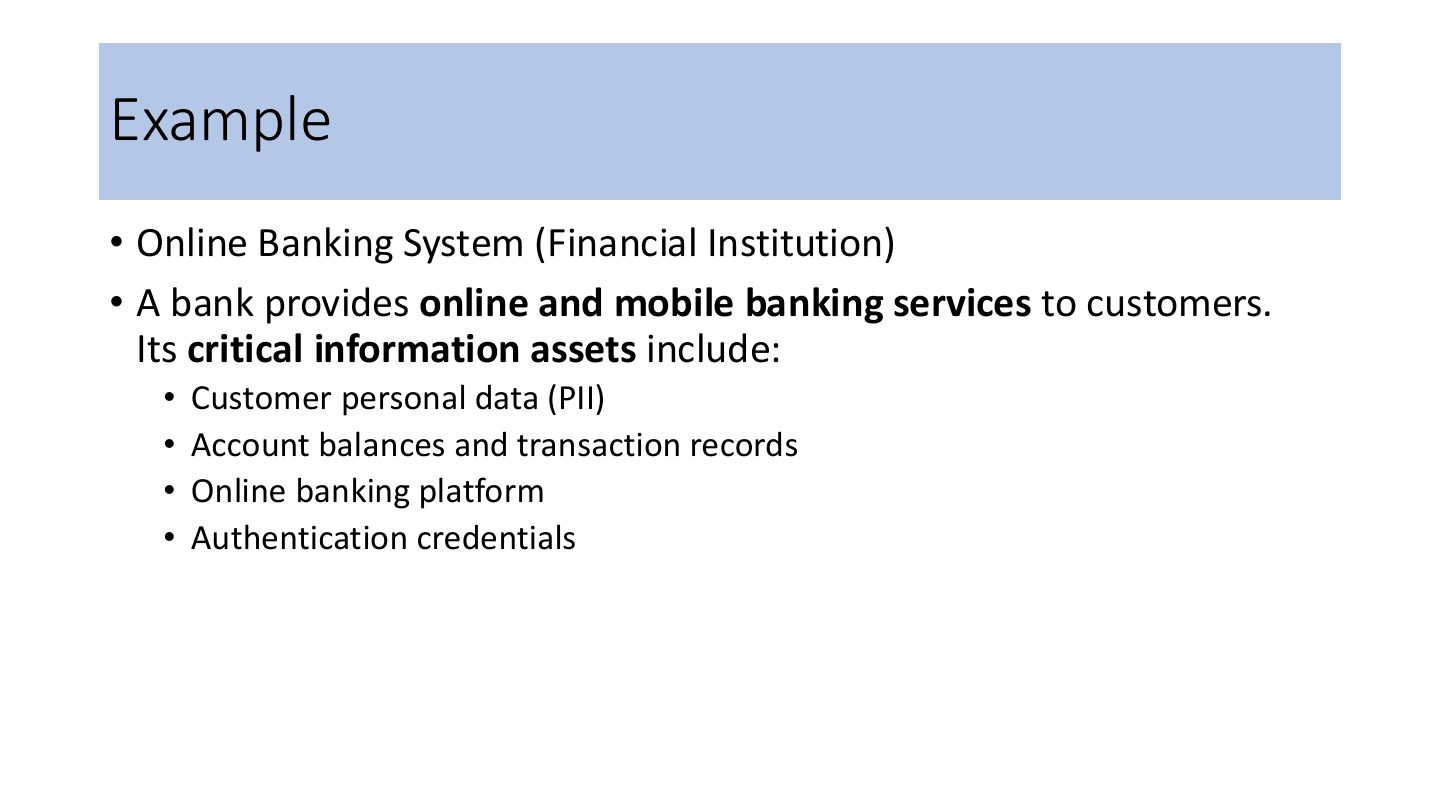
Example
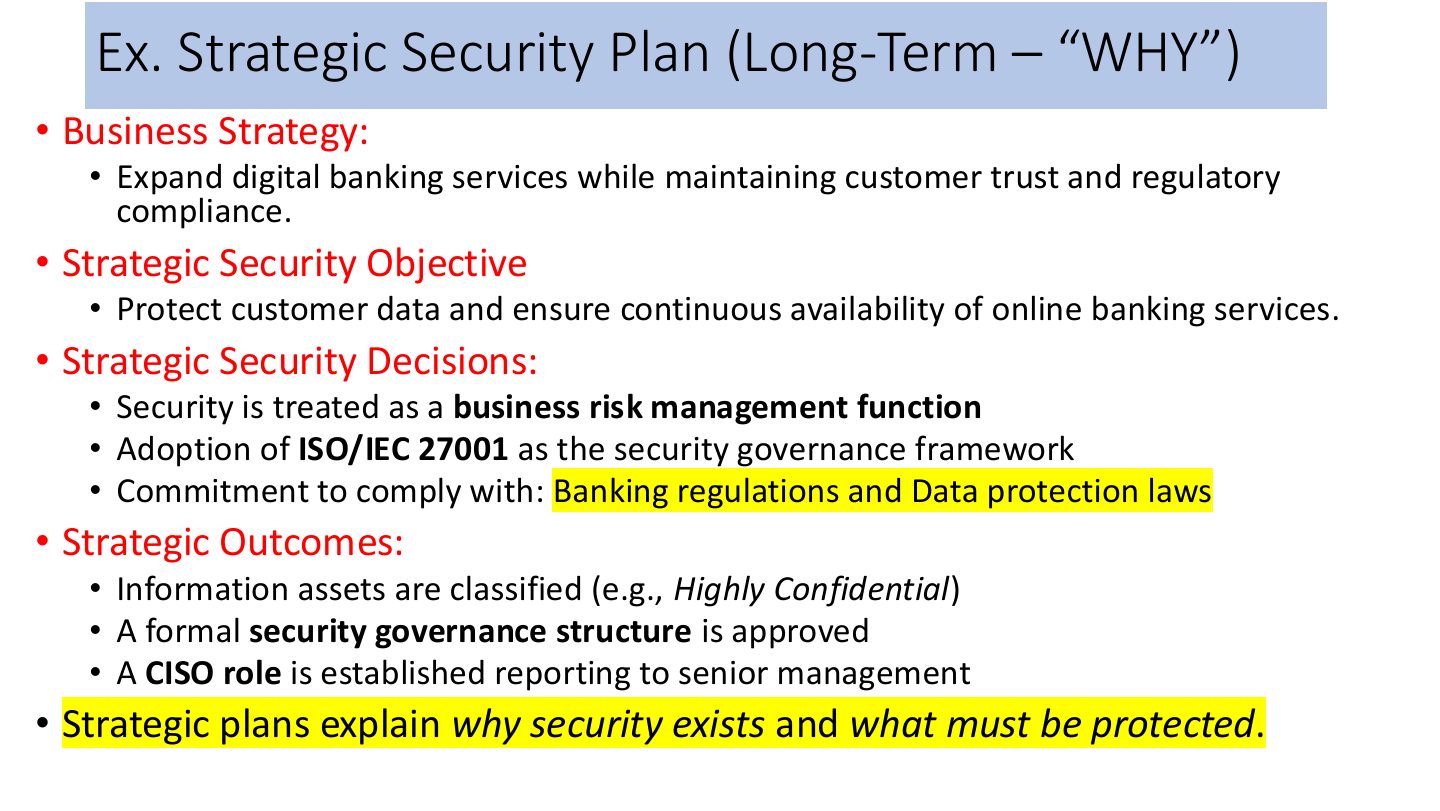
Ex. Strategic Security Plan (Long-Term WHY ) – “ ”
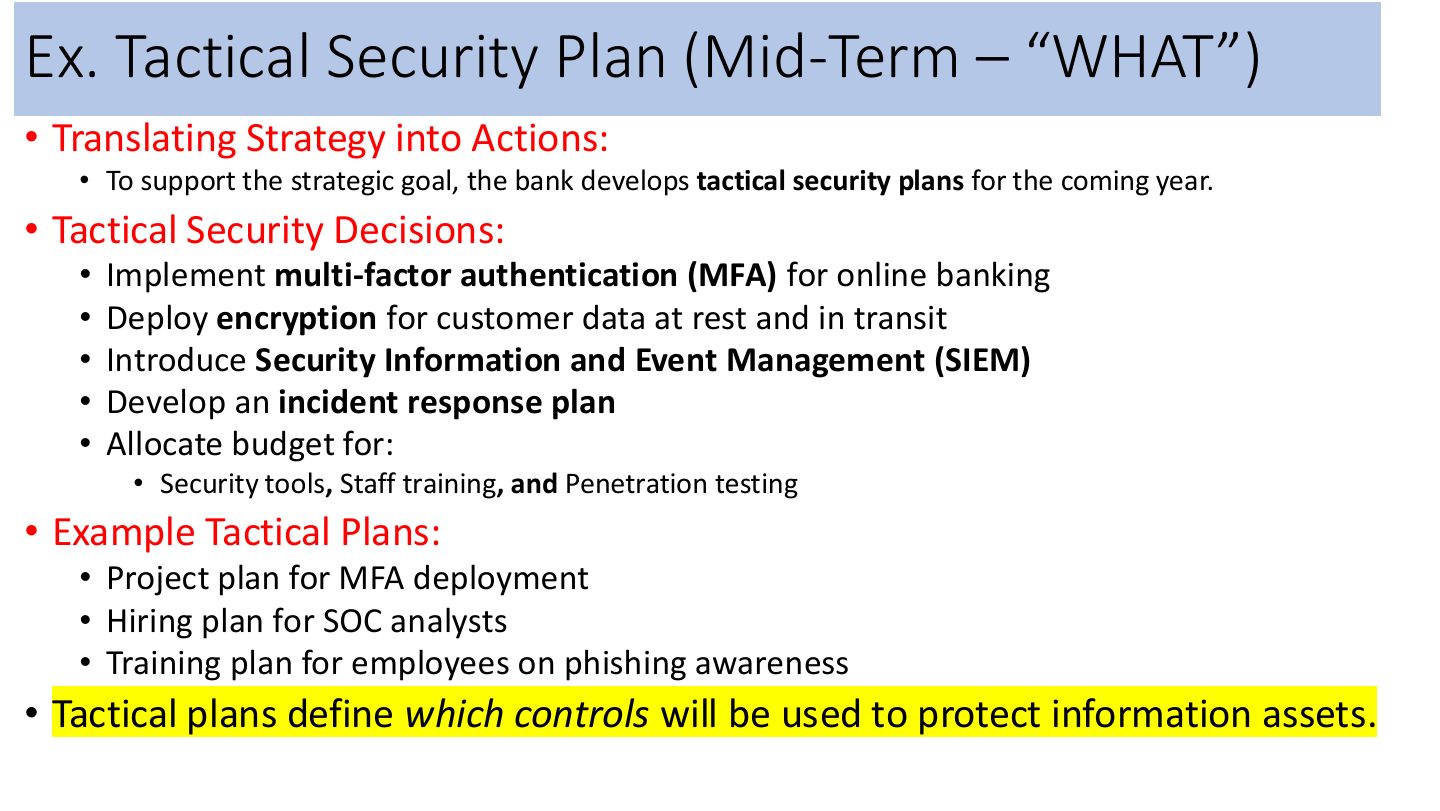
Ex. Tactical Security Plan (Mid-Term – “WHAT ”)
Operational Security Plan (Short-Term – “HOW”)
How the Plans Work Together (Big Picture)
Notes
WHY → WHAT → HOW.
Memory trick Strategic = WHY, Tactical = WHAT, Operational = HOW.
Slide 71
Notes
End of chapter.