identify assets, threats, vulnerabilities, controls
Threat Modeling
Threat-modelling vocabulary (asset, threat, vulnerability, exposure, risk, control), proactive vs. reactive modelling, the ways to identify threats, the threat models (STRIDE, PASTA…), STRIDE with worked examples, and supply-chain security. A STRIDE table was a full question on Majors A, B and C.
How to read this page
Every original slide is shown unchanged. Yellow marks on a slide point to a numbered note: hover or tap a mark to jump to its note, and hover a note to see its marks. Questions tagged Past exam appeared on a real paper; Prediction questions are likely angles, not confirmed. Pick an answer to each question: a wrong pick tells you why it is wrong, so you can try again.
All 33 slides
- 1 Understand and Apply Threat Modeling
- 2 Learning Outcomes
- 3 What Is Threat Modeling?
- 4 DICTIONARY
- 5 Slide 5
- 6 Slide 6
- 7 Slide 7
- 8 DICTIONARY
- 9 RISK ELEMENTS
- 10 When Is Threat Modeling Performed?
- 11 When Is Threat Modeling Performed?
- 12 IDENTIFYING THREATS Key Approaches
- 13 Slide 13
- 14 IDENTIFYING THREATS Key Approaches
- 15 Other Approaches in Modern Threat Modeling
- 16 Other Approaches in Modern Threat Modeling
- 17 Other Approaches in Modern Threat Modeling
- 18 Other Approaches in Modern Threat Modeling
- 19 Example:
- 20 IDENTIFYING THREATS
- 21 Threat Models
- 22 STRIDE THREAT MODEL
- 23 STRIDE THREAT MODEL – CONT.
- 24 STRIDE
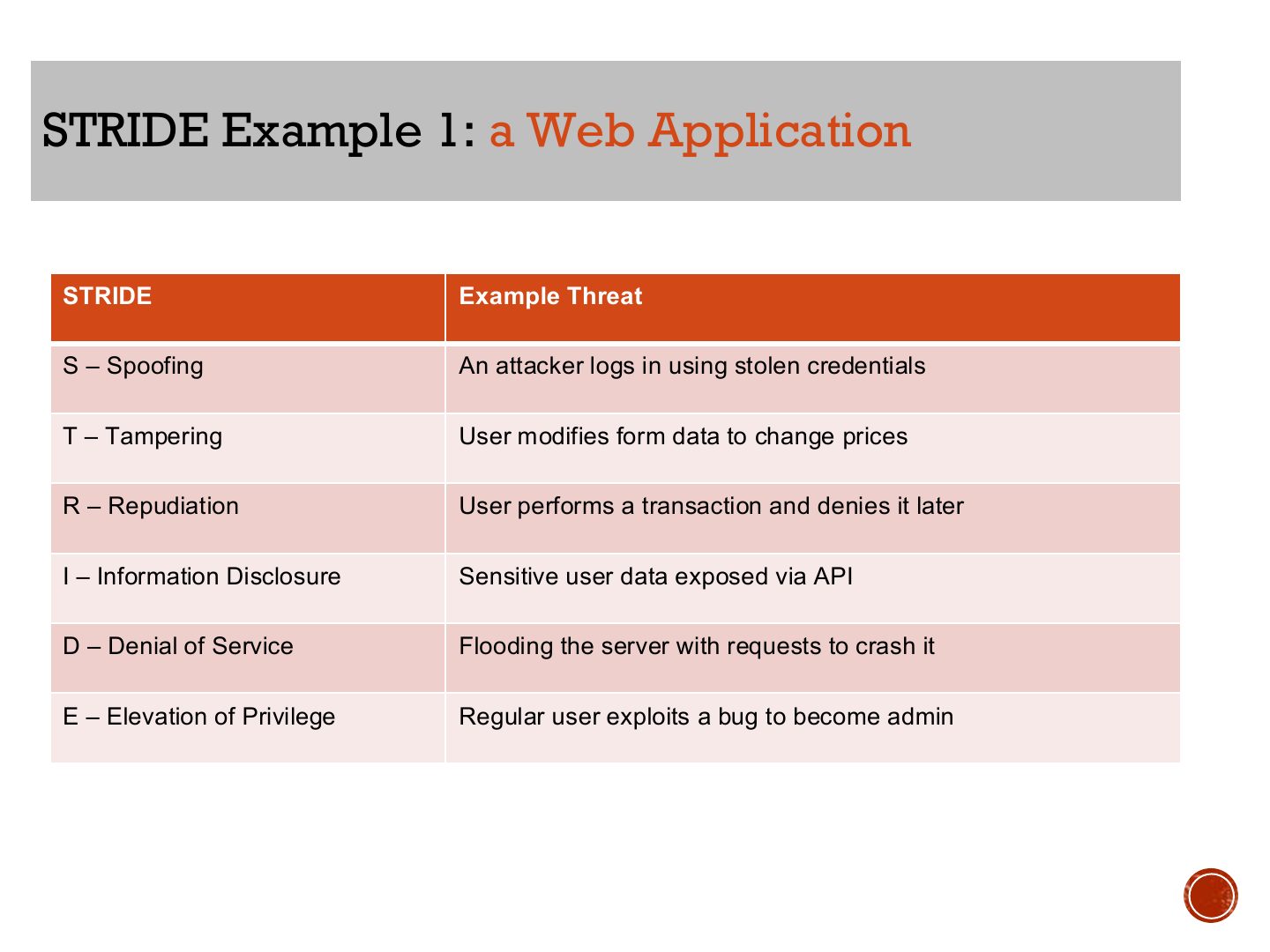
- 25 STRIDE Example 1: a Web Application
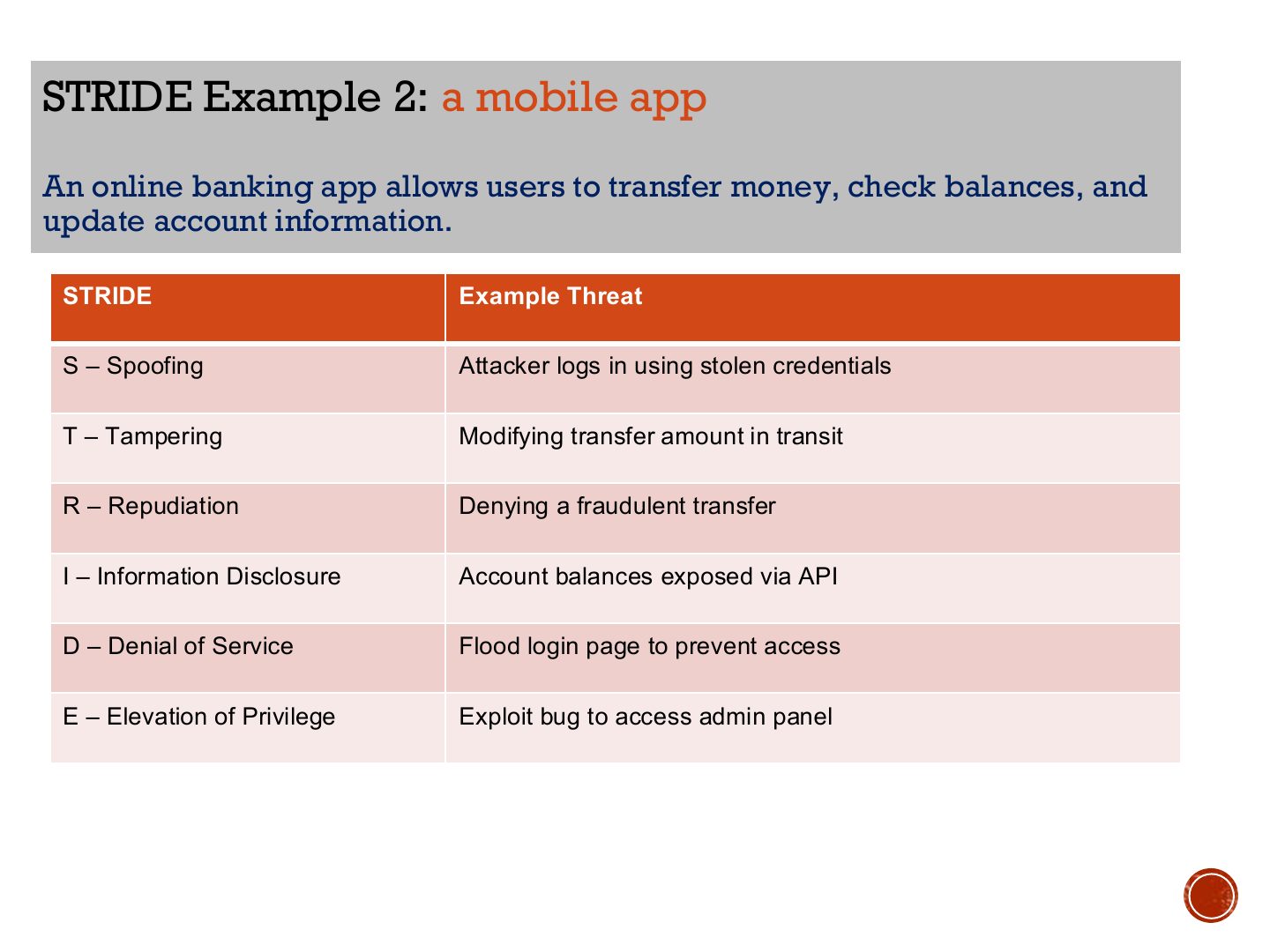
- 26 STRIDE Example 2: a mobile app
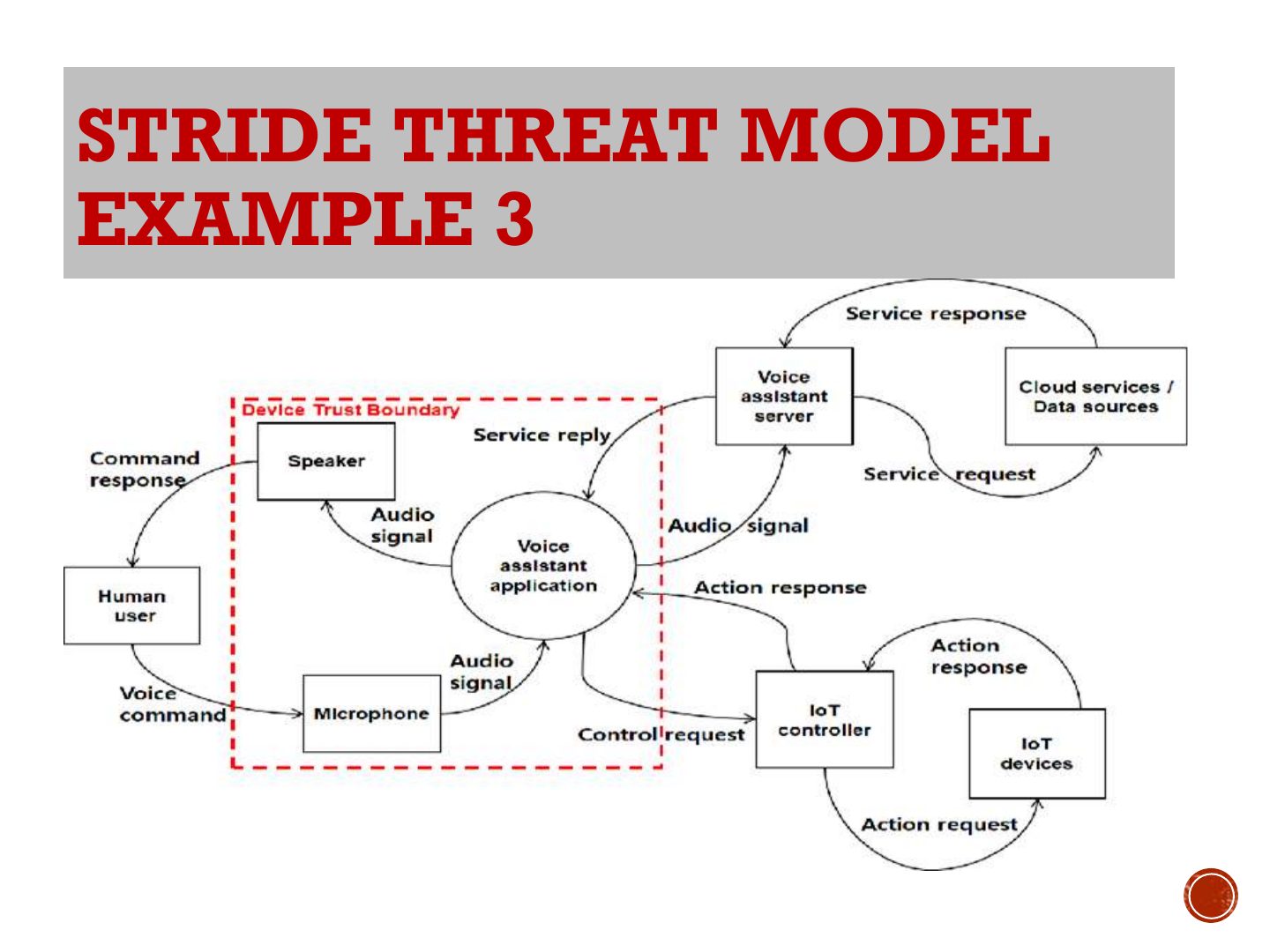
- 27 STRIDE THREAT MODEL EXAMPLE 3
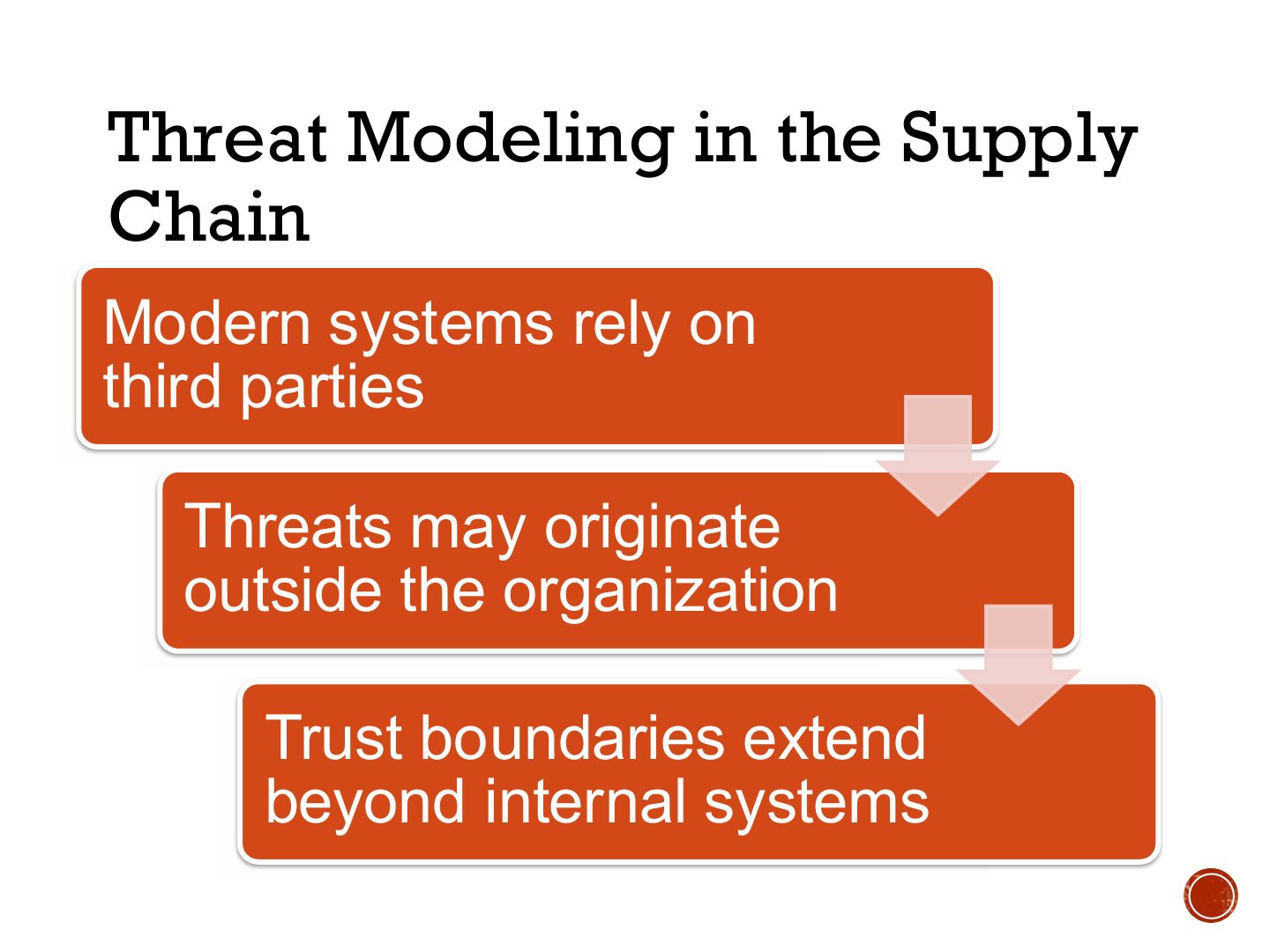
- 28 Threat Modeling in the Supply Chain
- 29 APPLY CYS CONCEPTS TO THE SUPPLY CHAIN
- 30 APPLY CYS CONCEPTS TO THE SUPPLY CHAIN
- 31 APPLY CYS CONCEPTS TO THE SUPPLY CHAIN
- 32 APPLY CYS CONCEPTS TO THE SUPPLY CHAIN
- 33 Thank you
Understand and Apply Threat Modeling
Notes
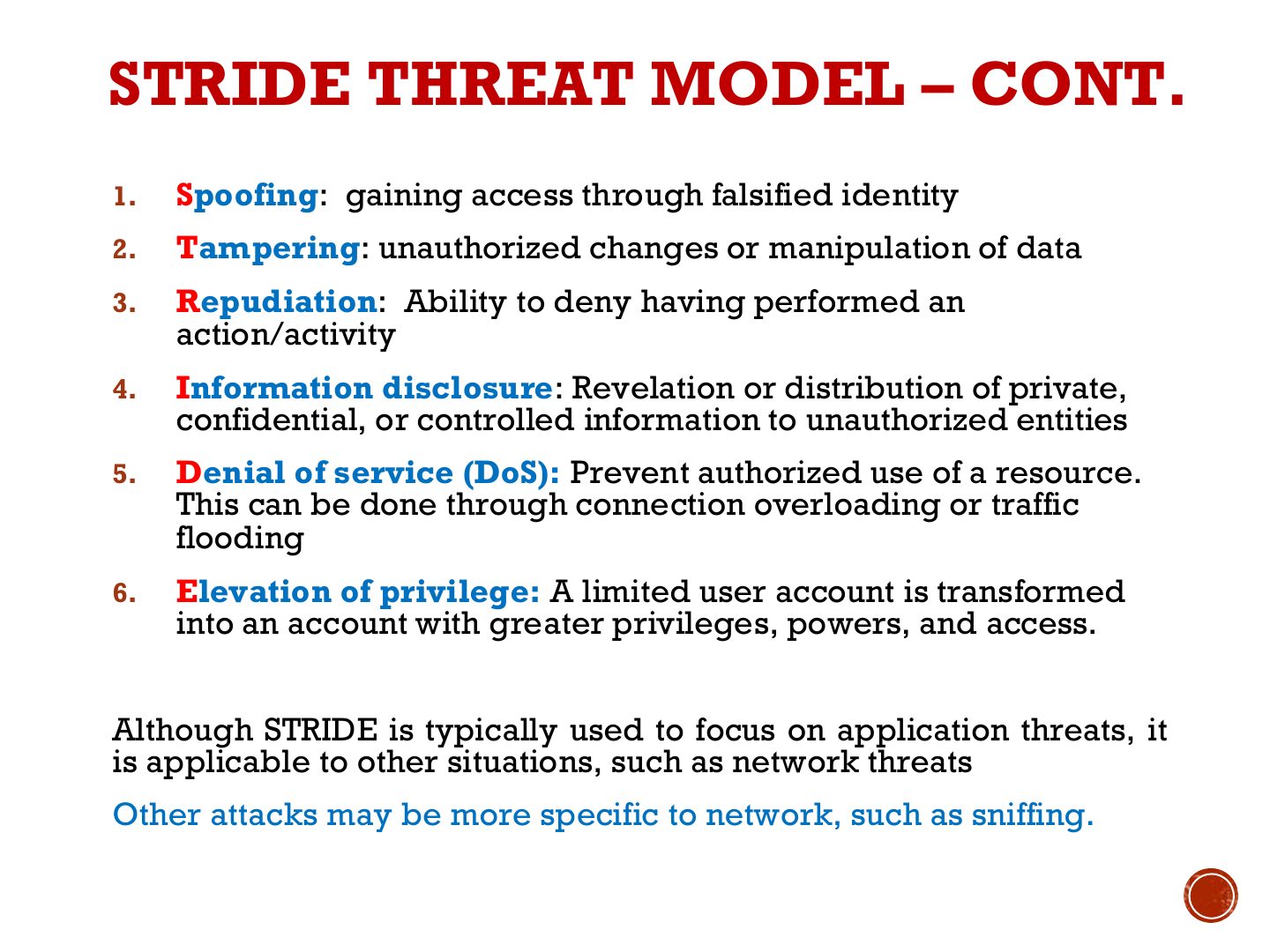
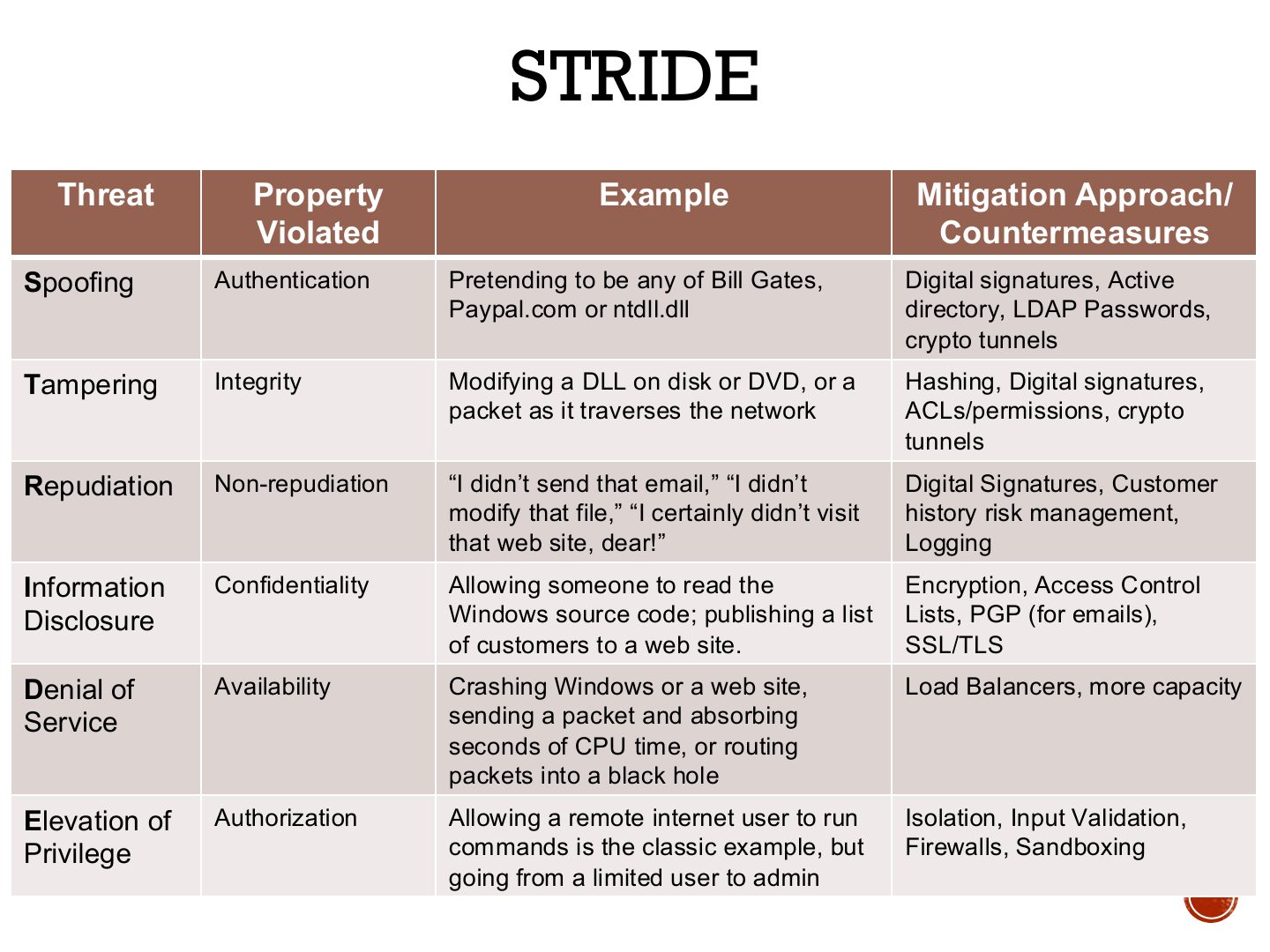
Tip STRIDE → property violated: Spoofing → authentication · Tampering → integrity · Repudiation → non-repudiation · Information disclosure → confidentiality · Denial of service → availability · Elevation of privilege → authorization.
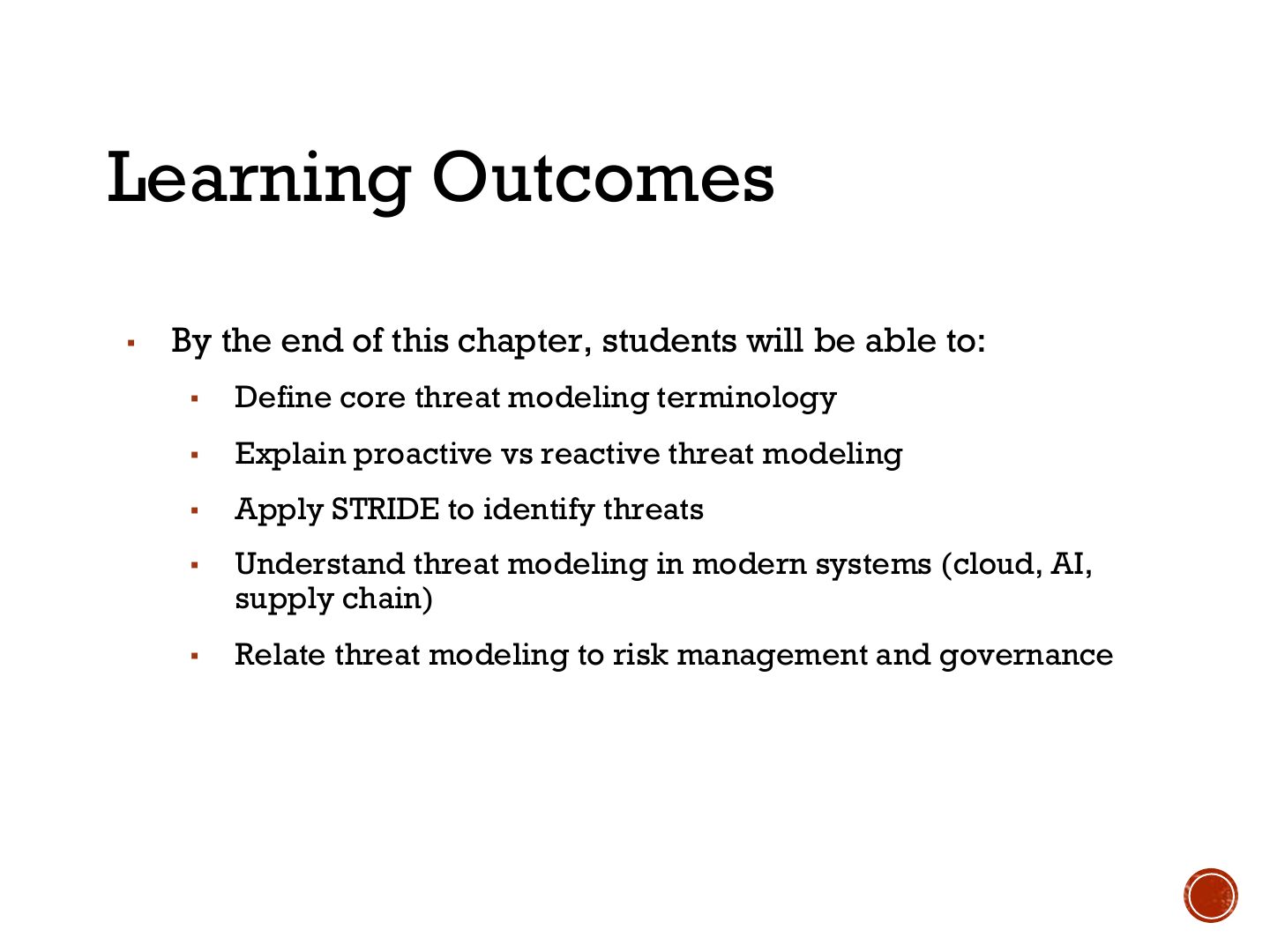
Learning Outcomes
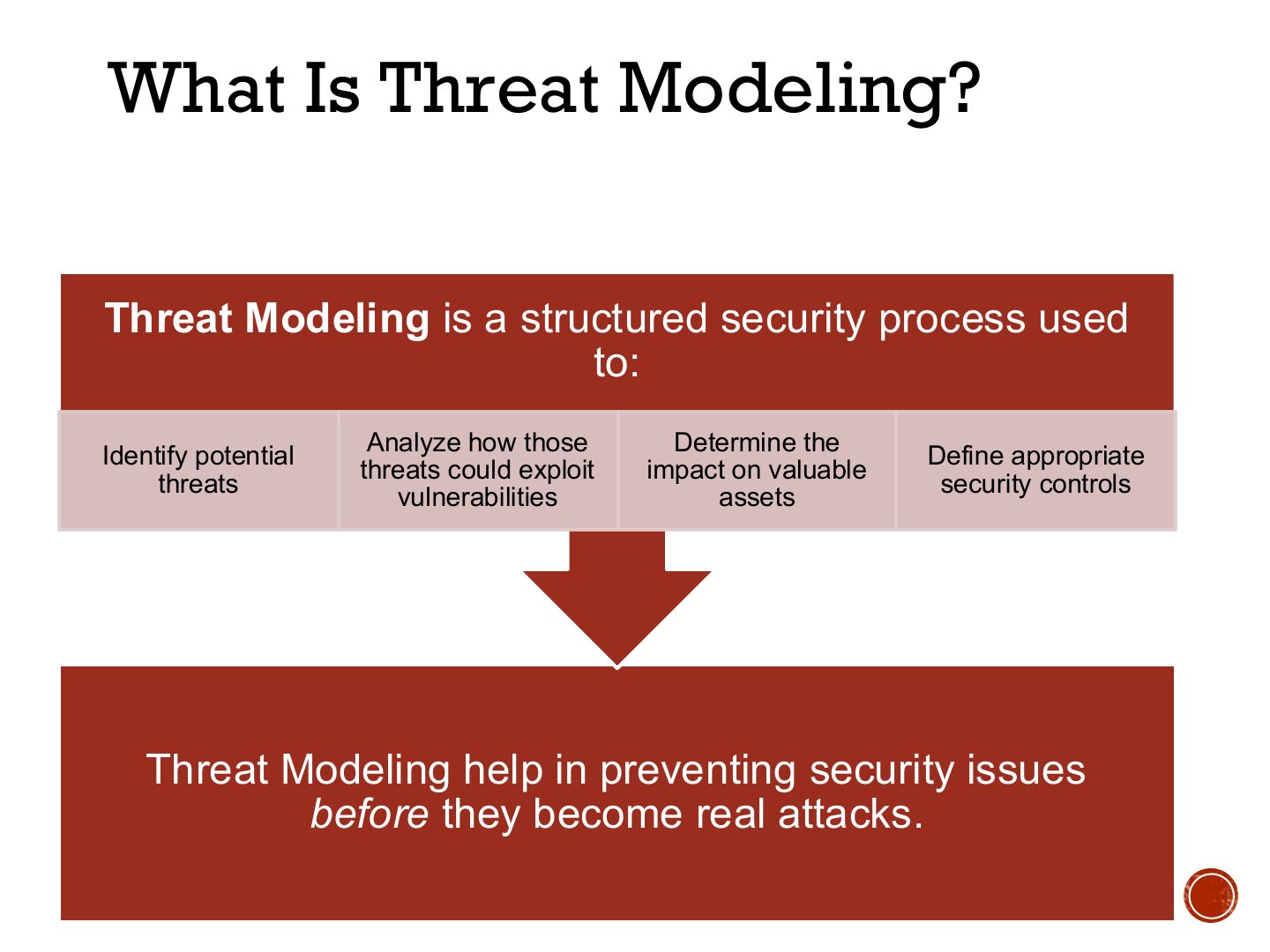
What Is Threat Modeling?
Notes
Threat modelling: a structured process to identify assets, find threats, analyse how they could be exploited, and decide mitigations.
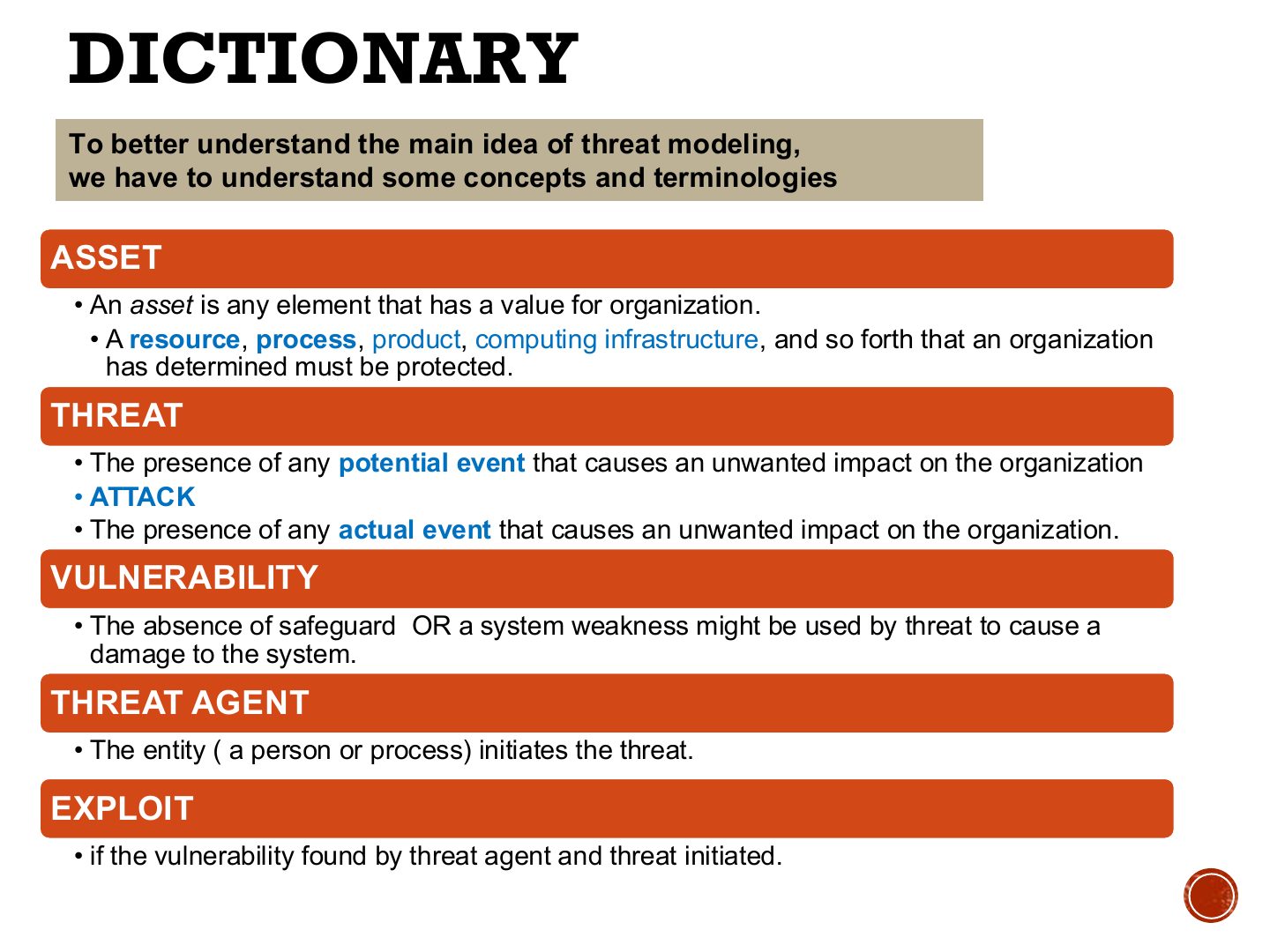
DICTIONARY
Slide 5
Notes
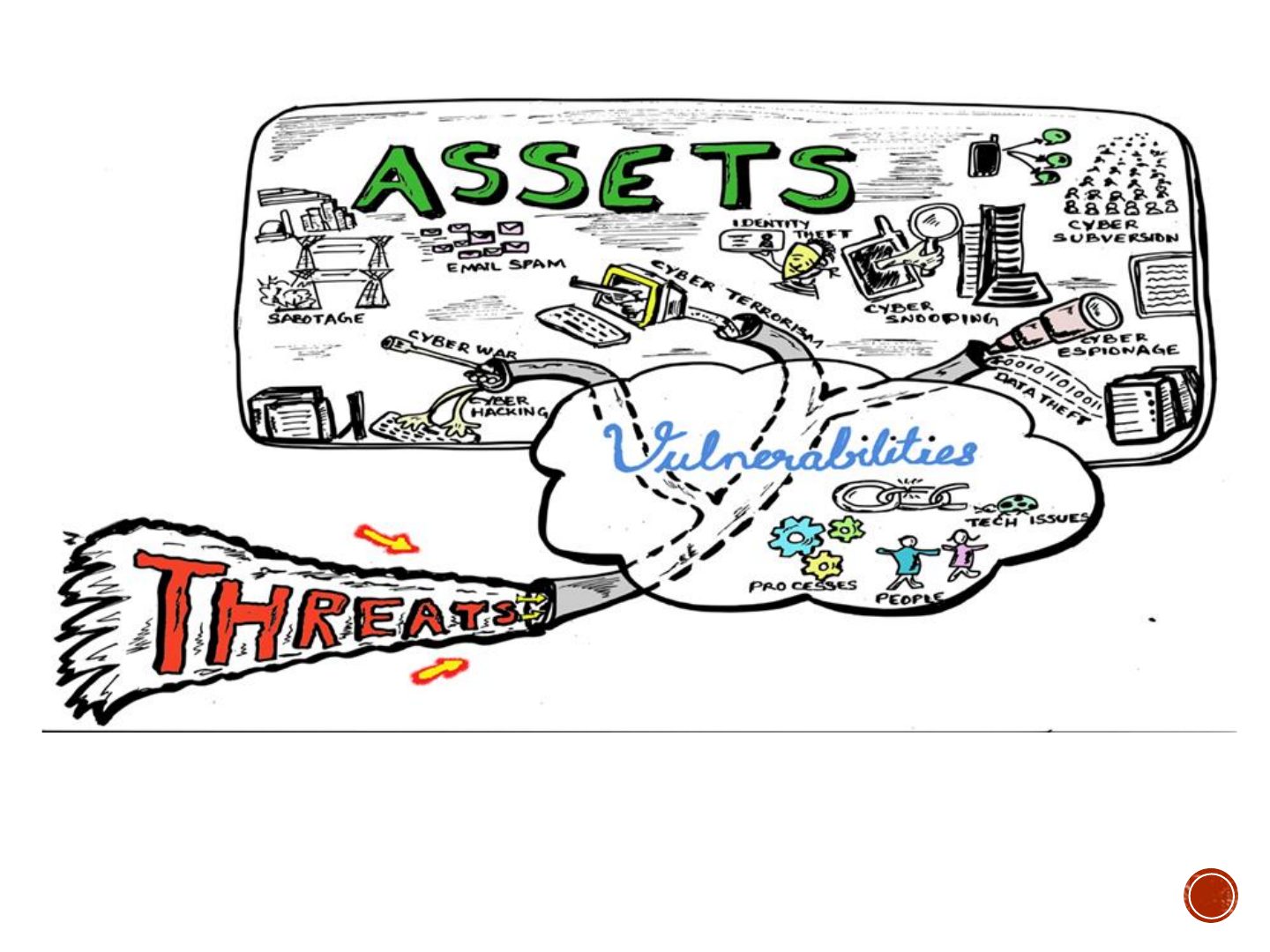
Threat: a potential occurrence that may cause harm.
Slide 6
Notes
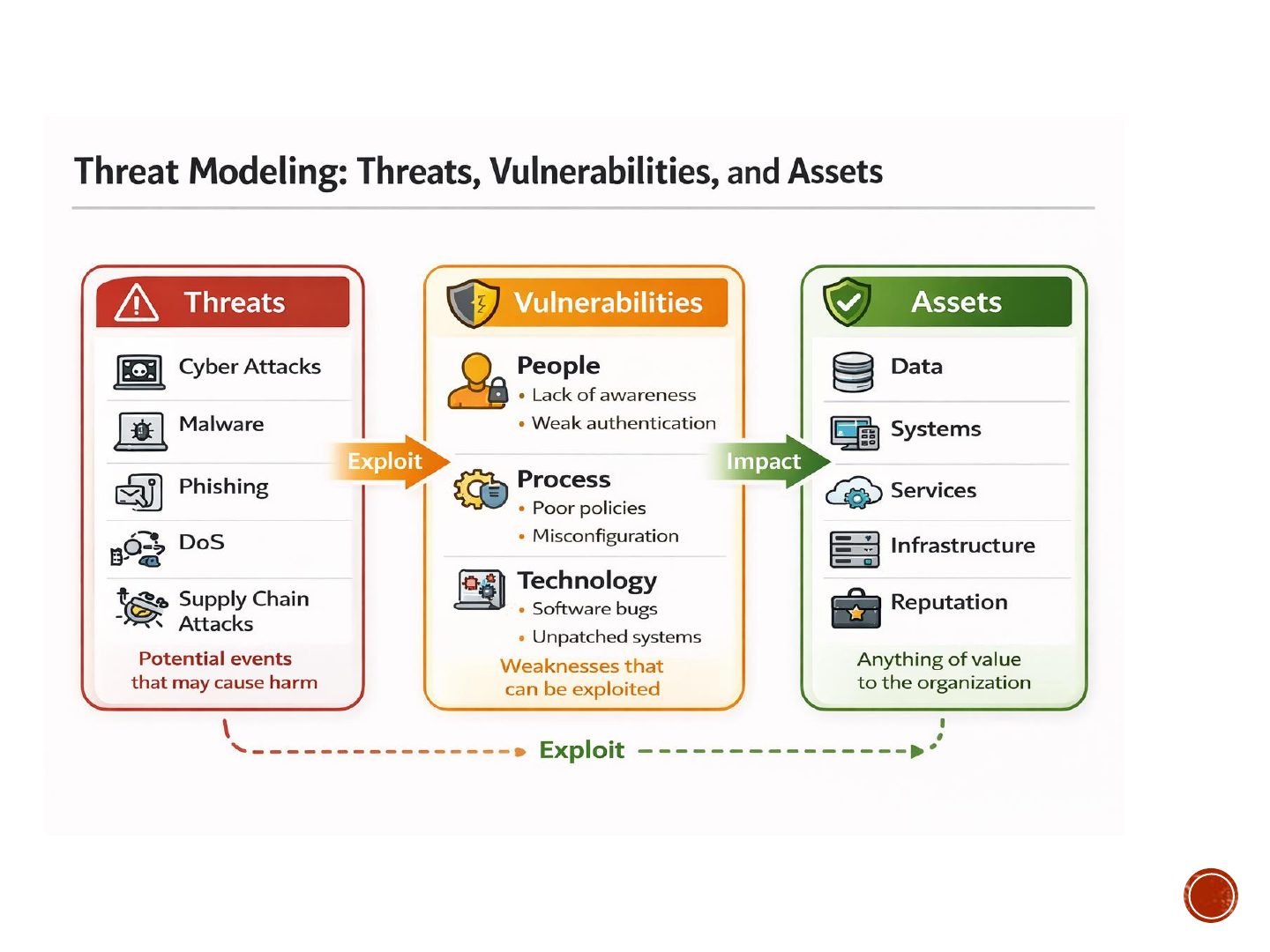
Vulnerability: a weakness. Exposure: being open to asset loss through a threat.
Slide 7
Notes
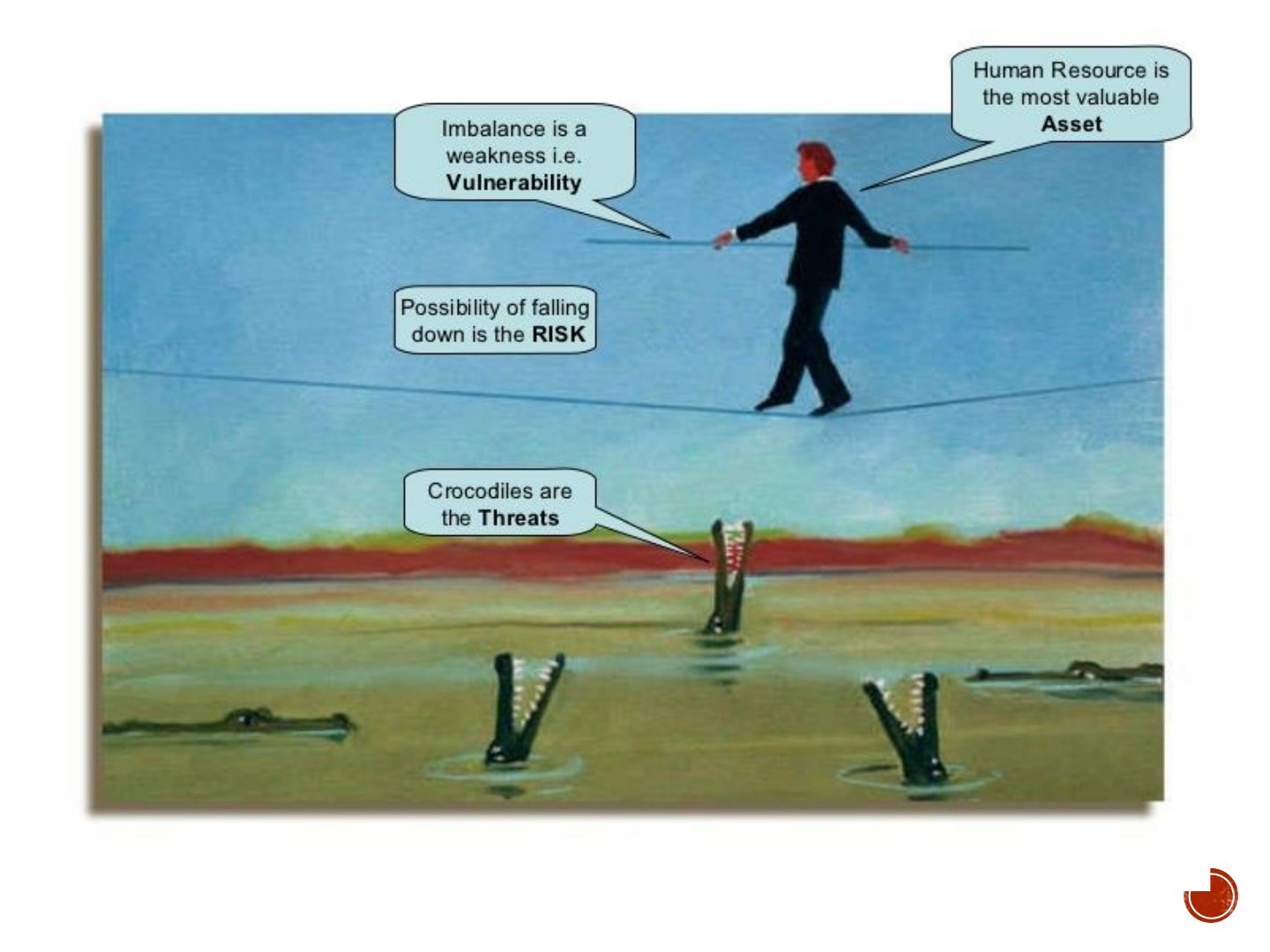
Risk: likelihood that a threat exploits a vulnerability.
DICTIONARY
Exam angle
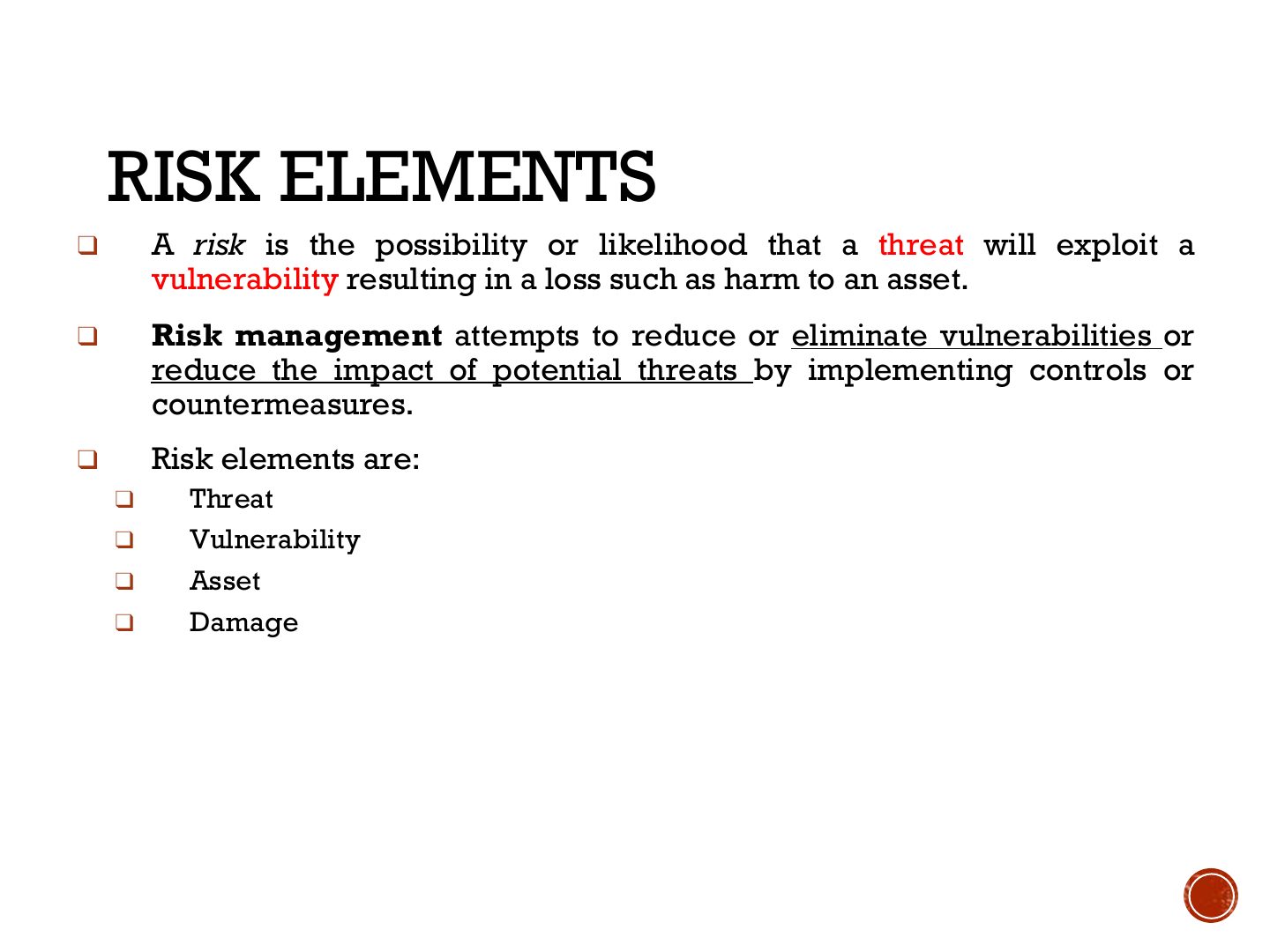
RISK ELEMENTS
Notes
Risk management reduces vulnerabilities or threat impact with controls. Risk elements: assets, threats, vulnerabilities, exposure, risk, safeguards, attack, breach.
Exam angle
The likelihood that a threat will exploit a vulnerability and cause loss is:
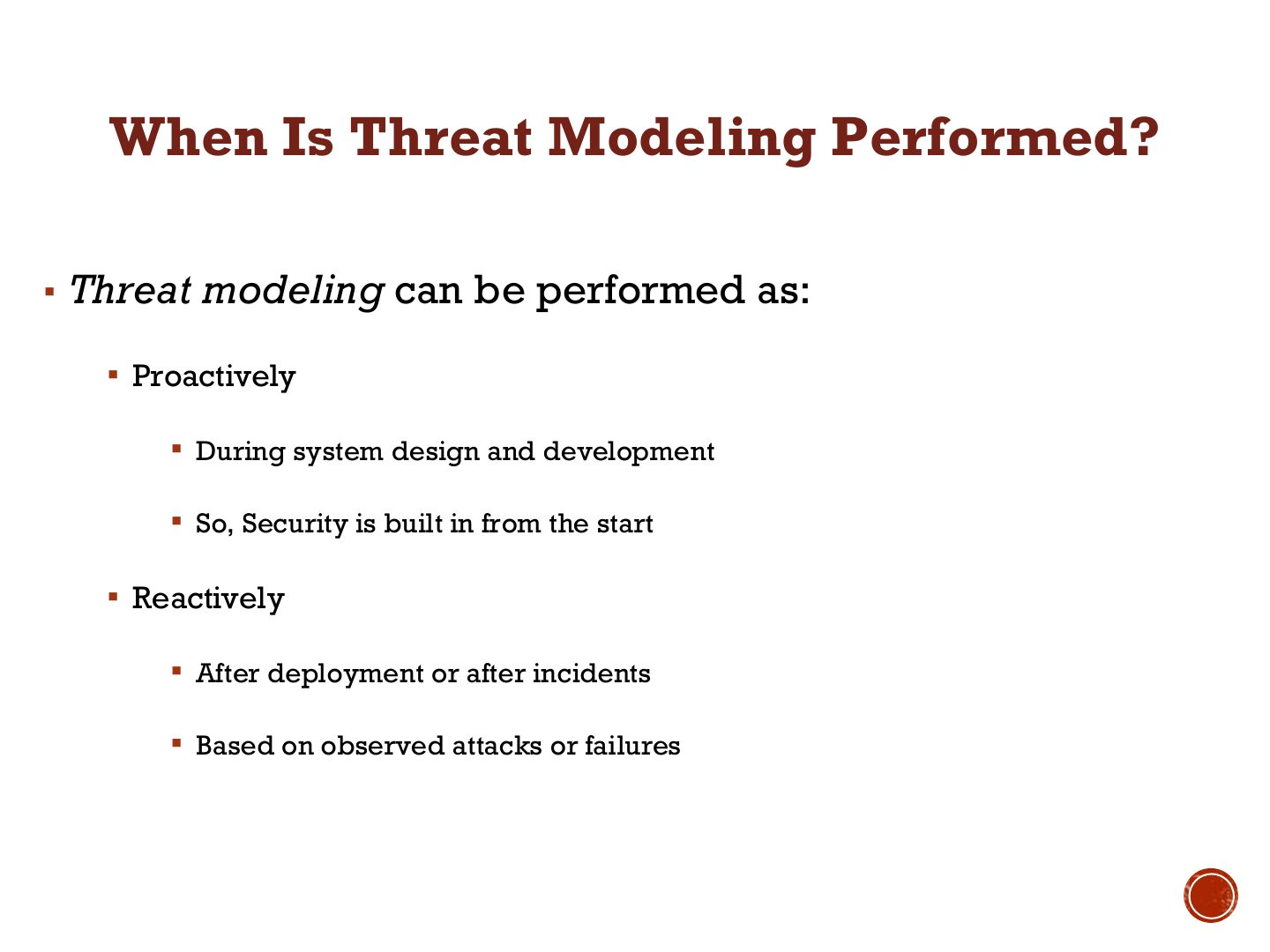
When Is Threat Modeling Performed?
When Is Threat Modeling Performed?
Notes
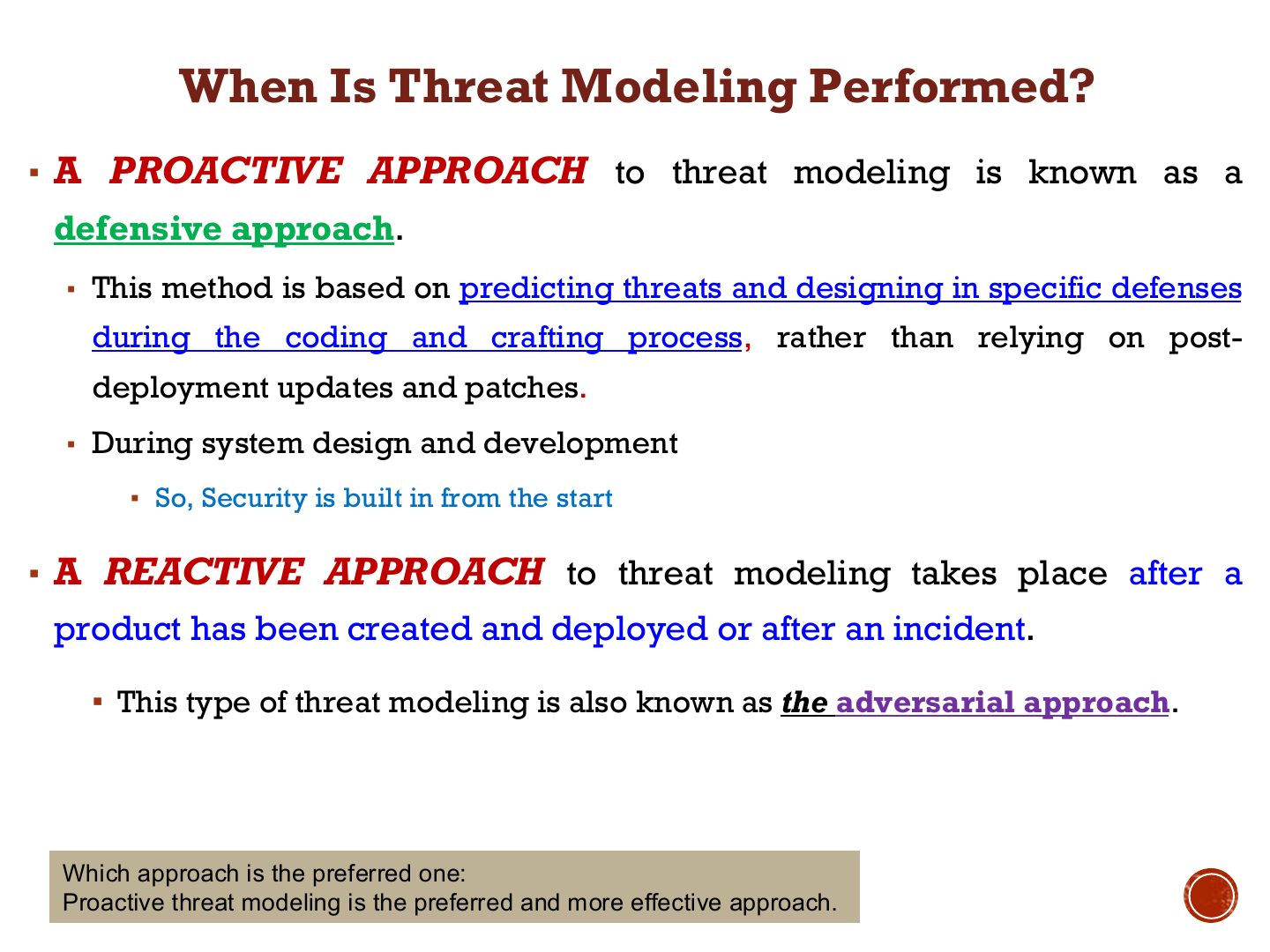
Proactive = defensive approach: predict threats and design defences in. Reactive = adversarial approach: after deployment, e.g., penetration testing, fuzzing.
Memory trick Proactive = Prevent in design. Reactive = React after release.
Exam angle
Penetration testing an already deployed system is a proactive threat modelling approach.
- It is reactive (adversarial).
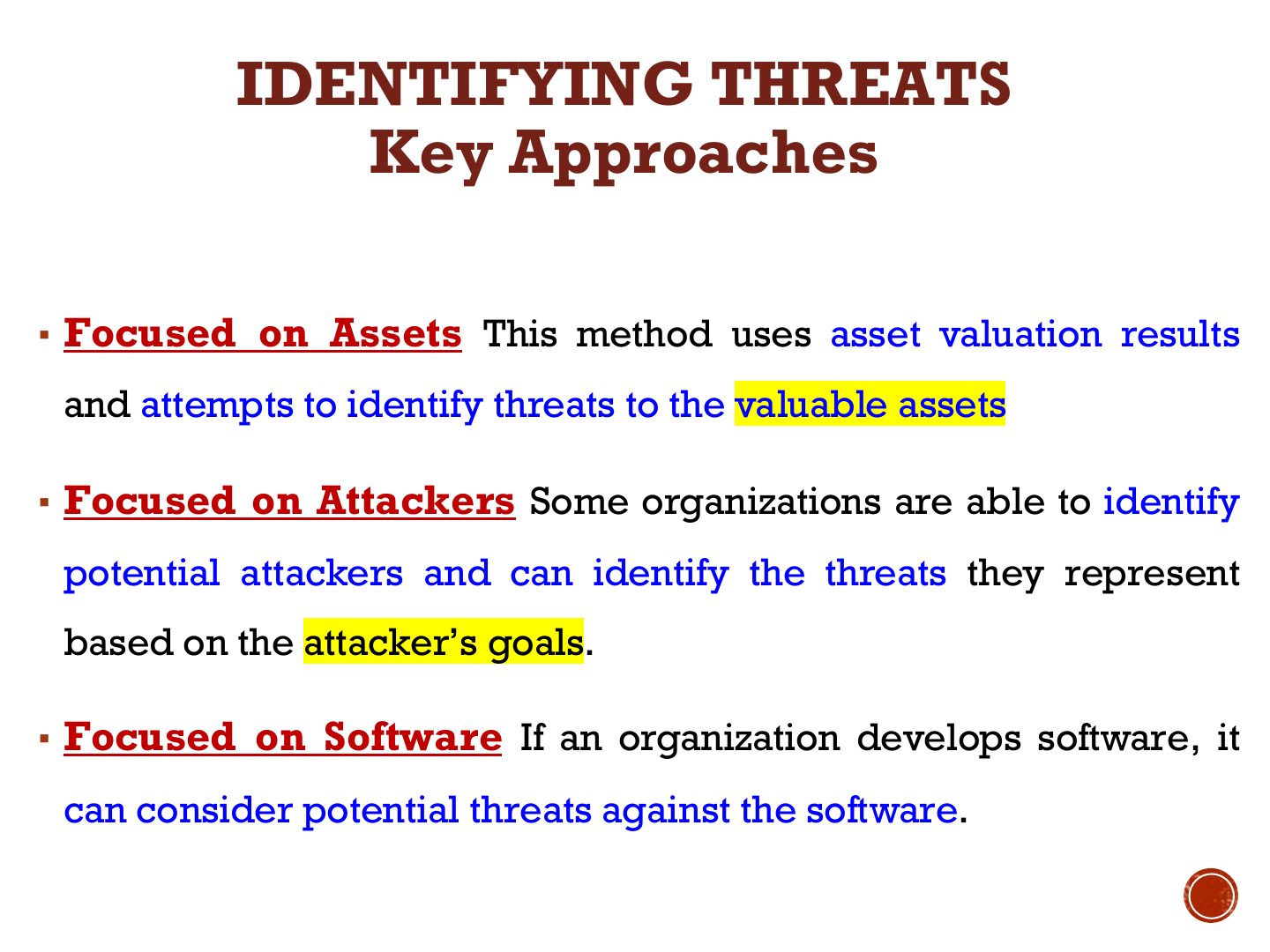
IDENTIFYING THREATS Key Approaches
Exam angle
An organization that lists likely attackers and their goals is using which threat identification focus?
Slide 13
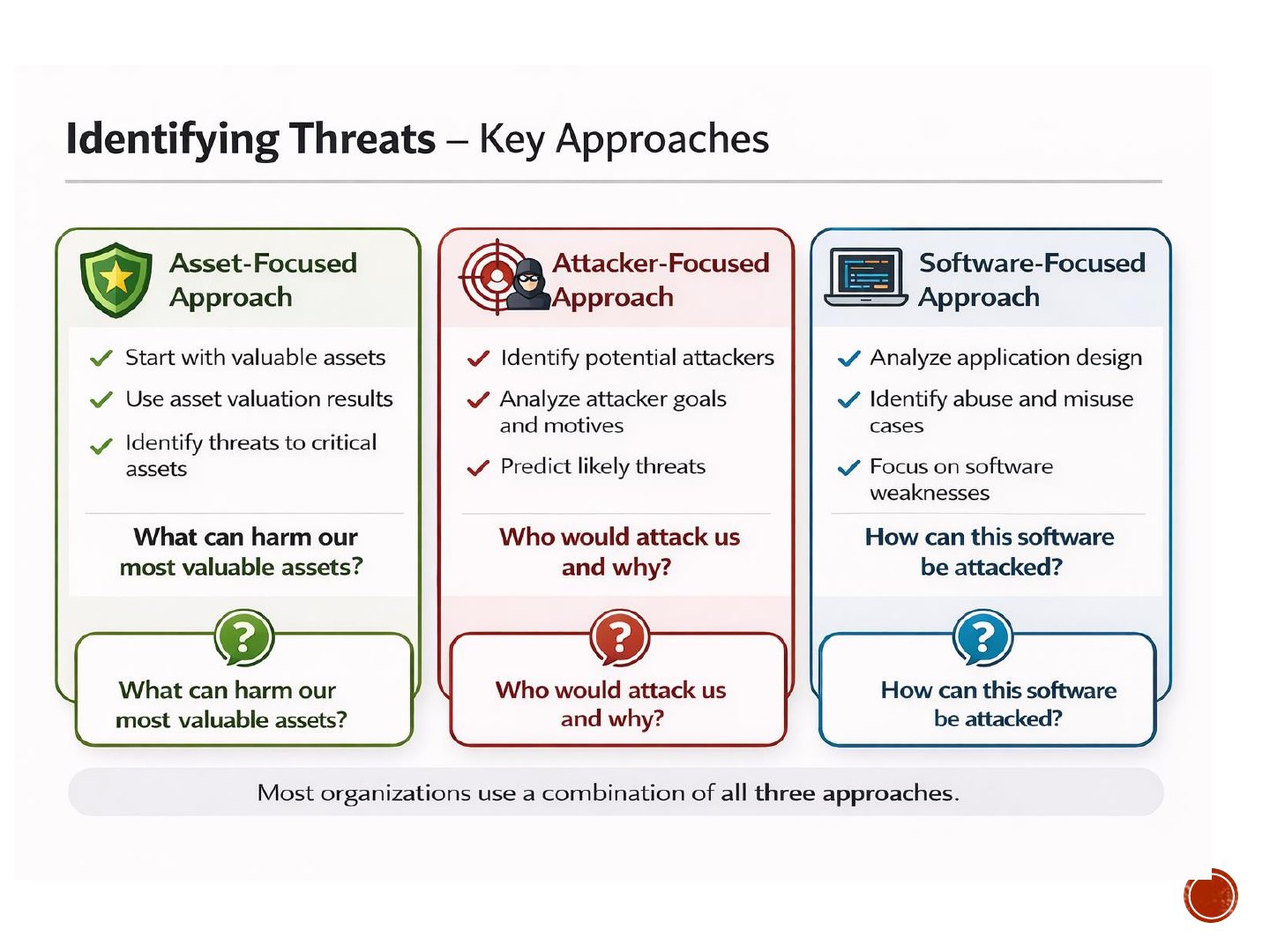
Notes
Approaches, continued.
IDENTIFYING THREATS Key Approaches
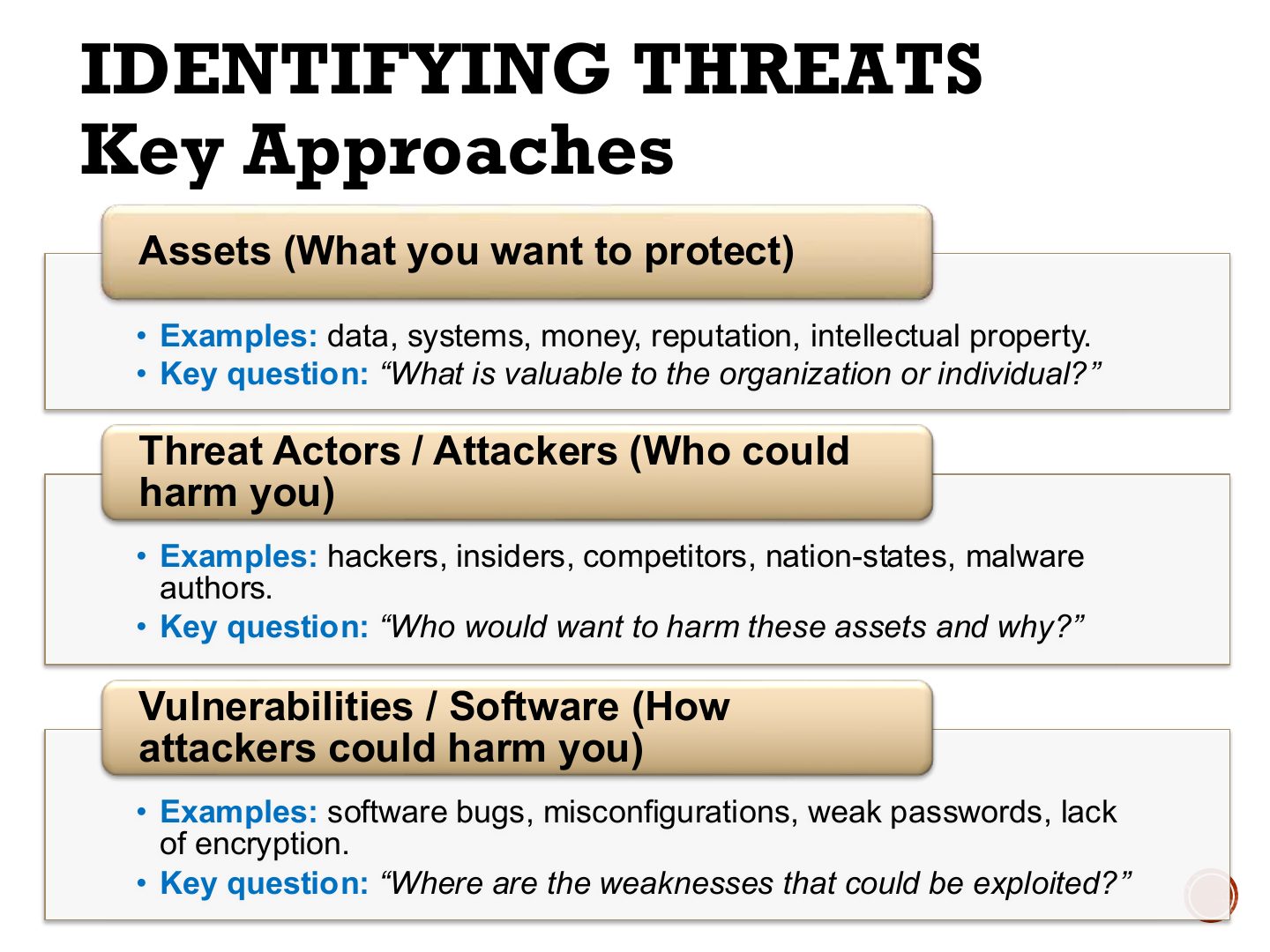
Notes
Approaches illustrated.
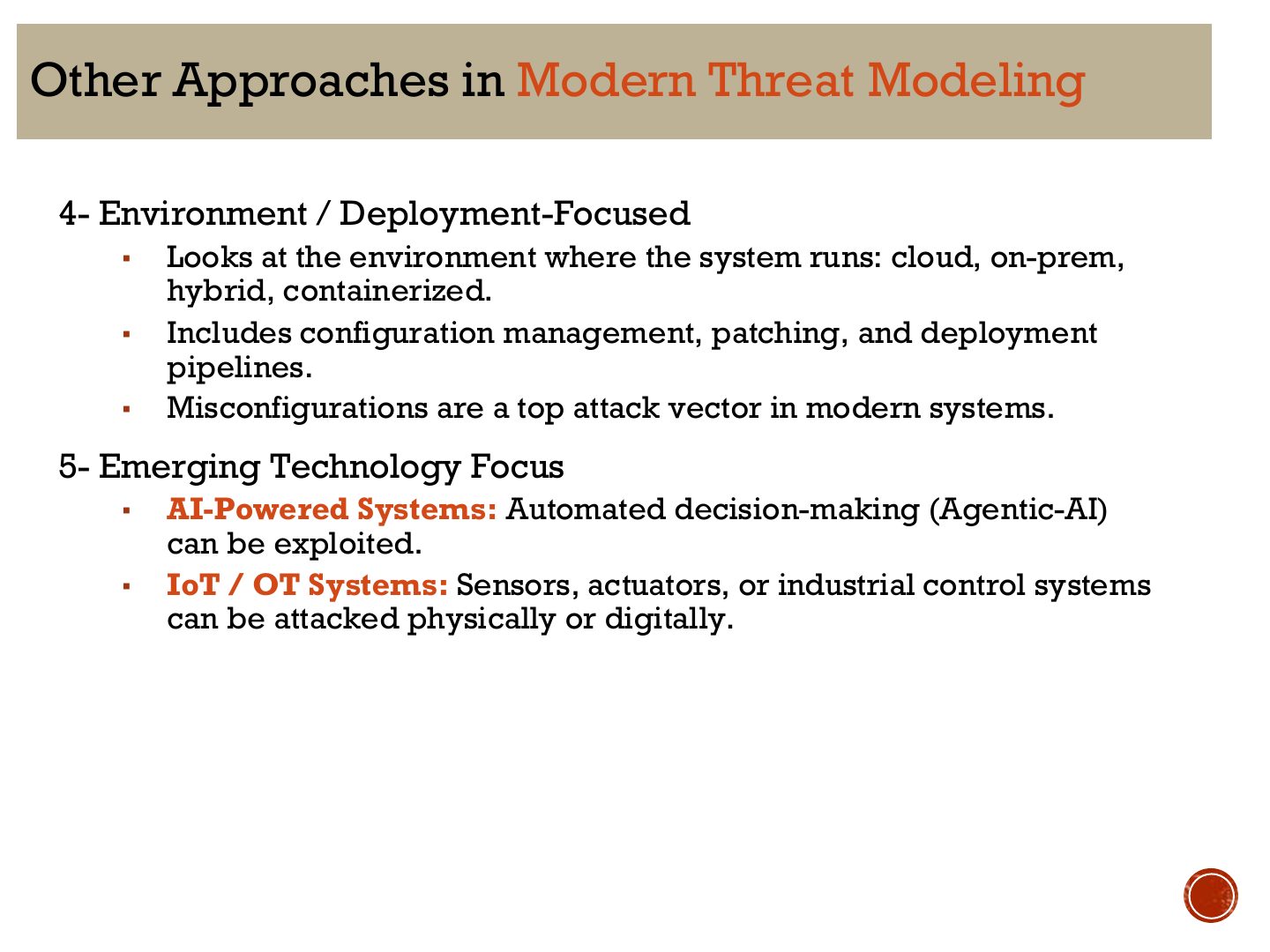
Other Approaches in Modern Threat Modeling
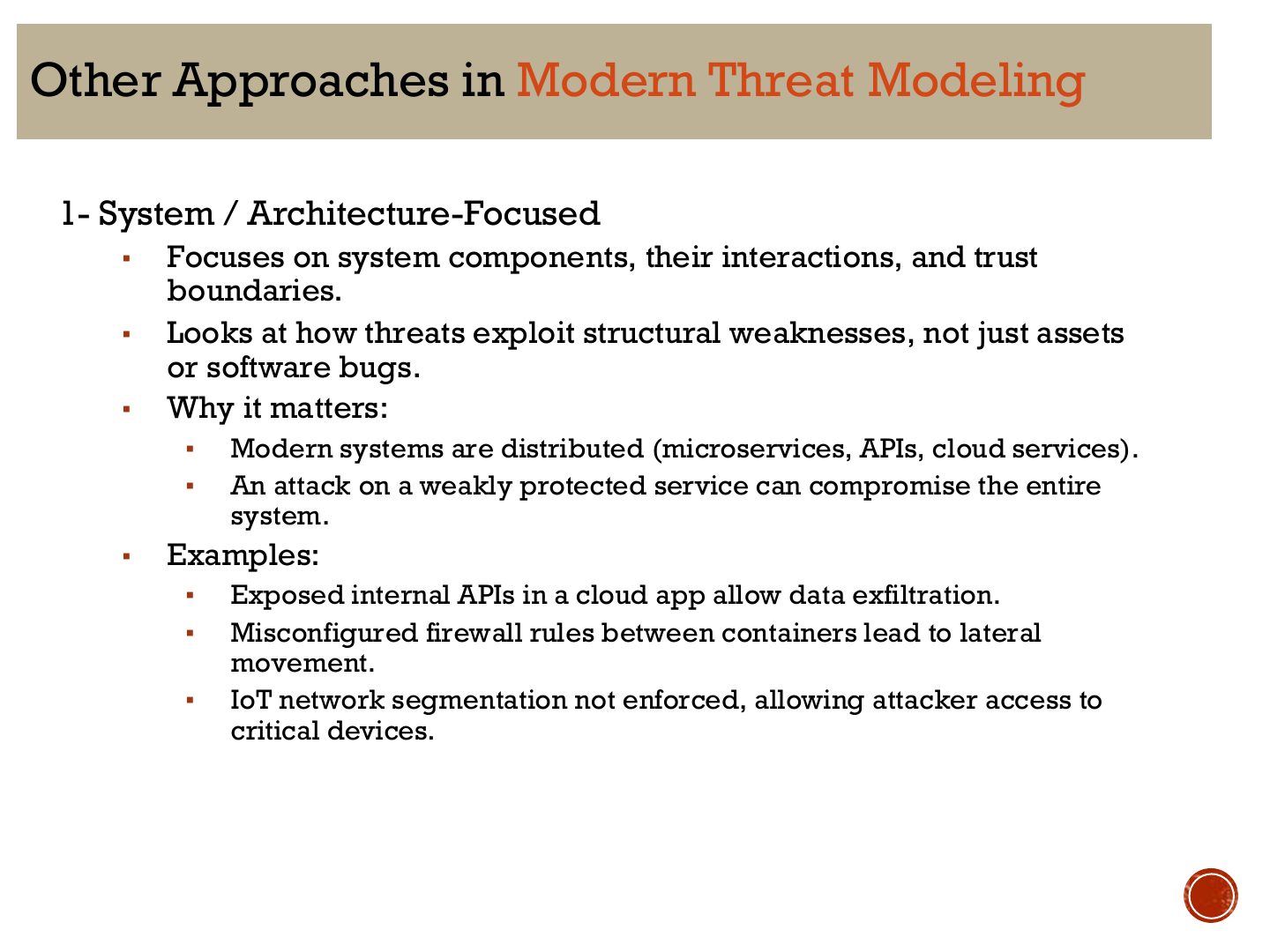
Other Approaches in Modern Threat Modeling
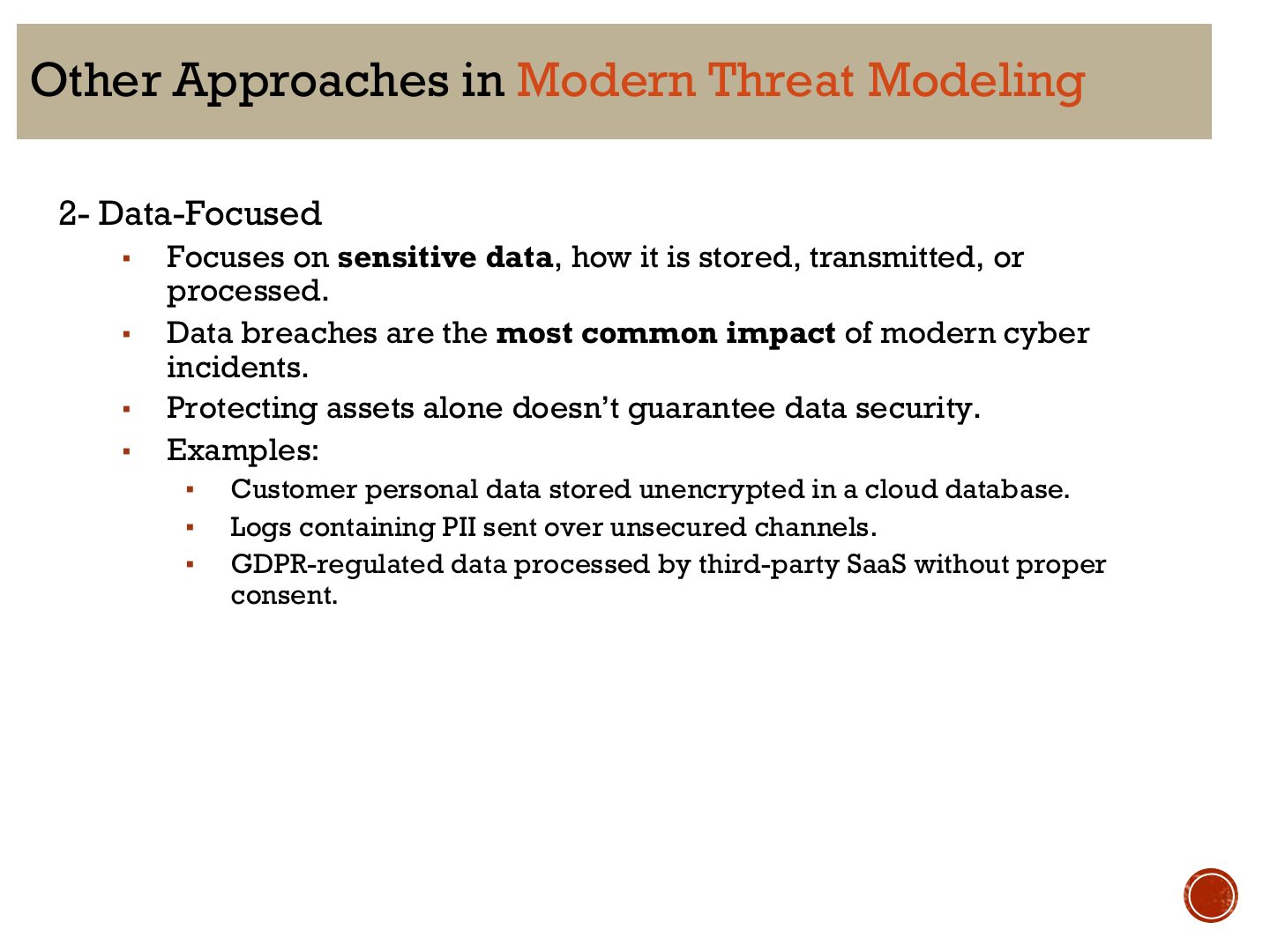
Other Approaches in Modern Threat Modeling
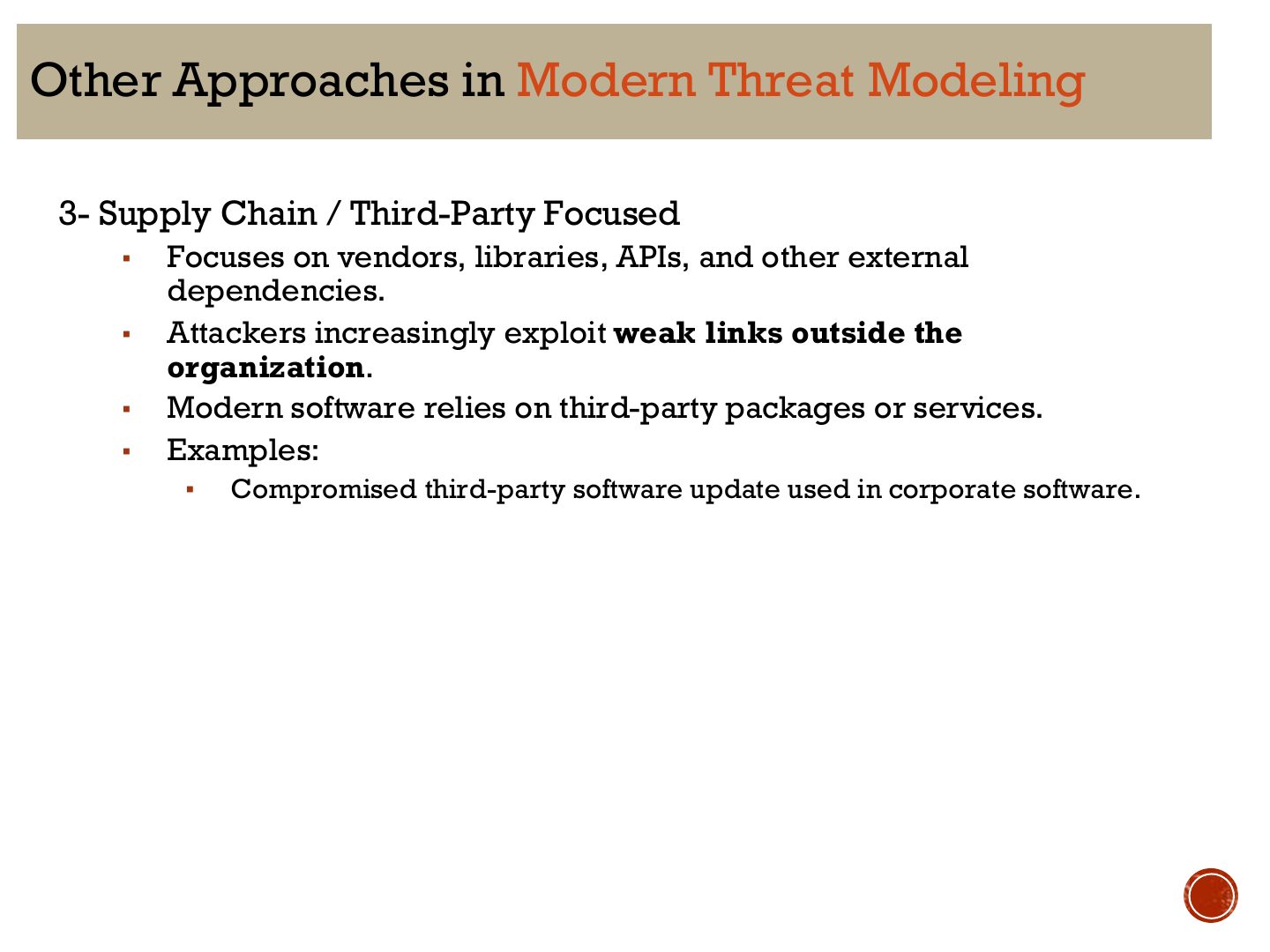
Other Approaches in Modern Threat Modeling
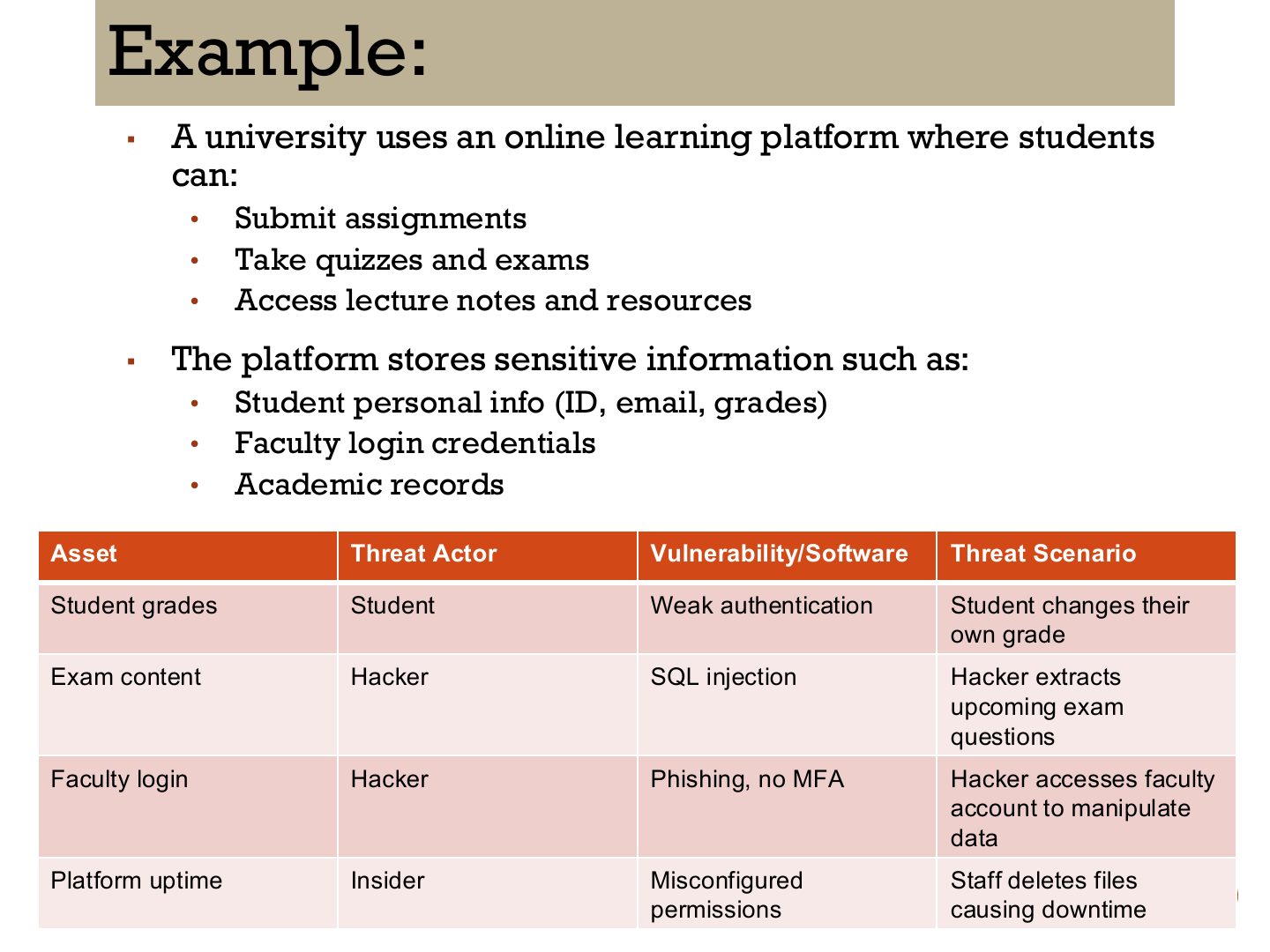
Example:
IDENTIFYING THREATS
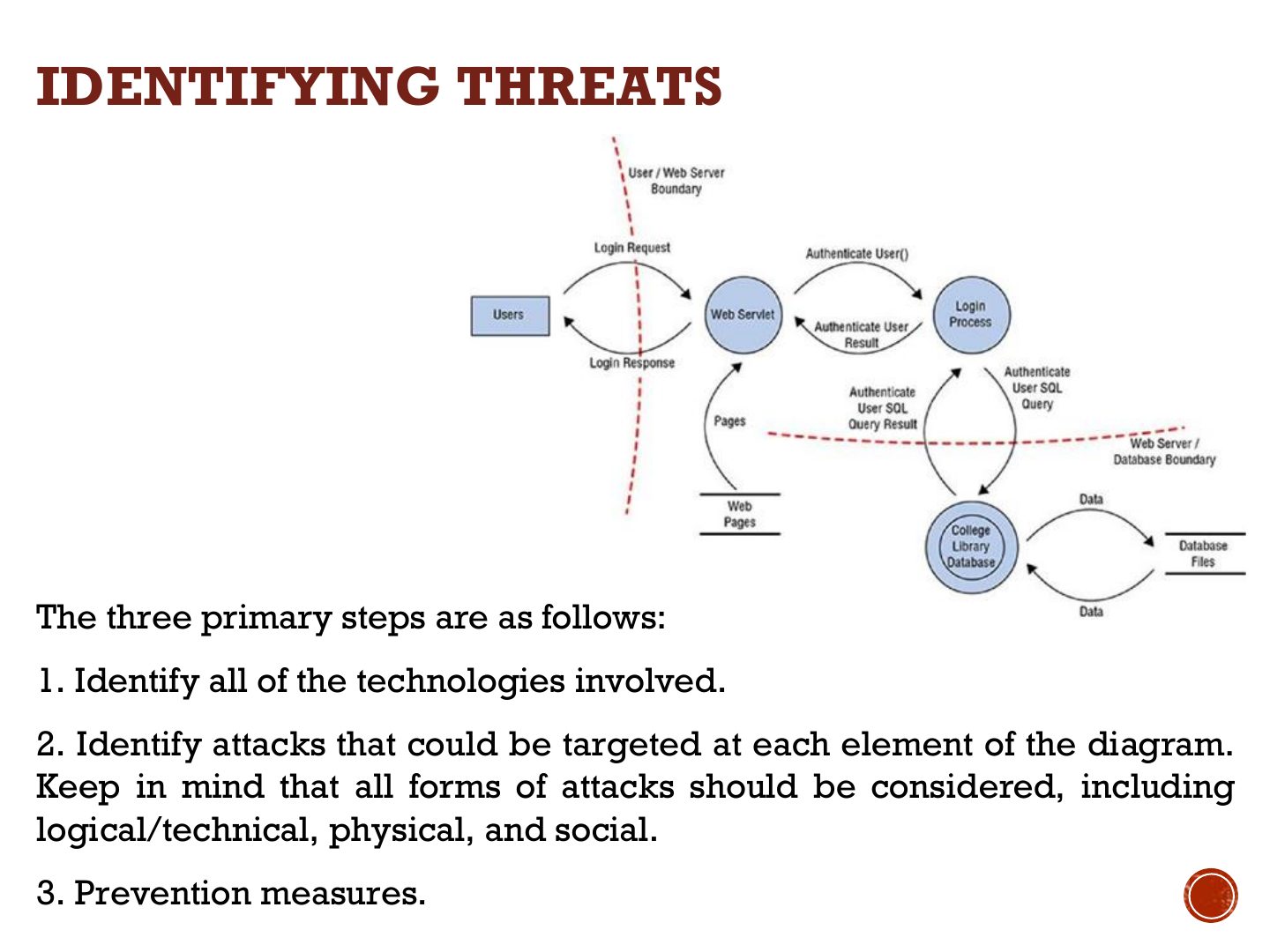
Notes
Three steps: identify technologies (diagram the system), identify attacks against each element, determine reduction (mitigation) analysis.
Threat Models
Notes
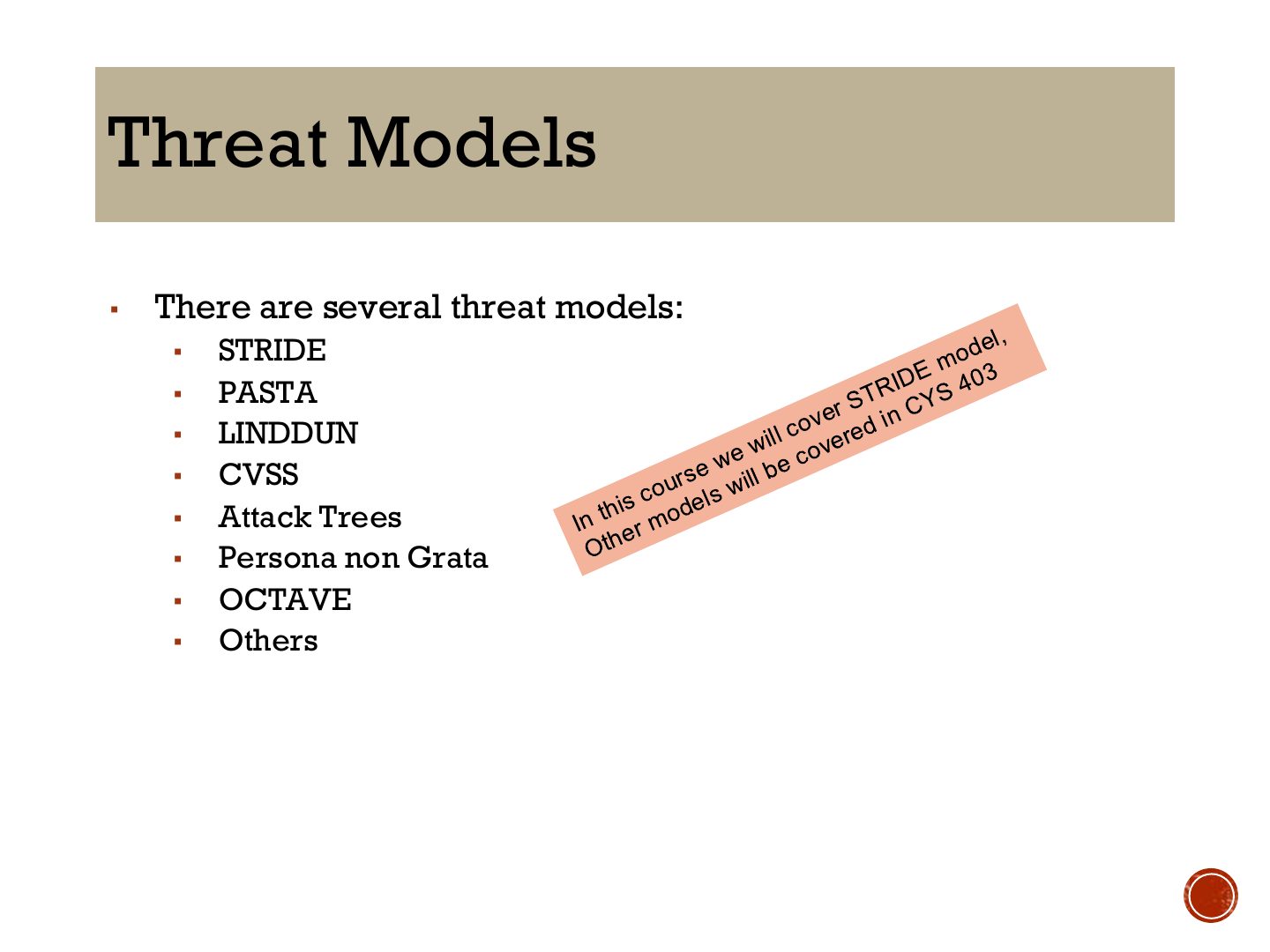
Threat models: STRIDE, PASTA, VAST, Trike, DREAD…
Exam angle
MCQ · PASTA is a risk-centric methodology
PASTA aims at selecting countermeasures in relation to the value of the assets. It is a ___ methodology.
- Final 221 B.
STRIDE THREAT MODEL
Notes
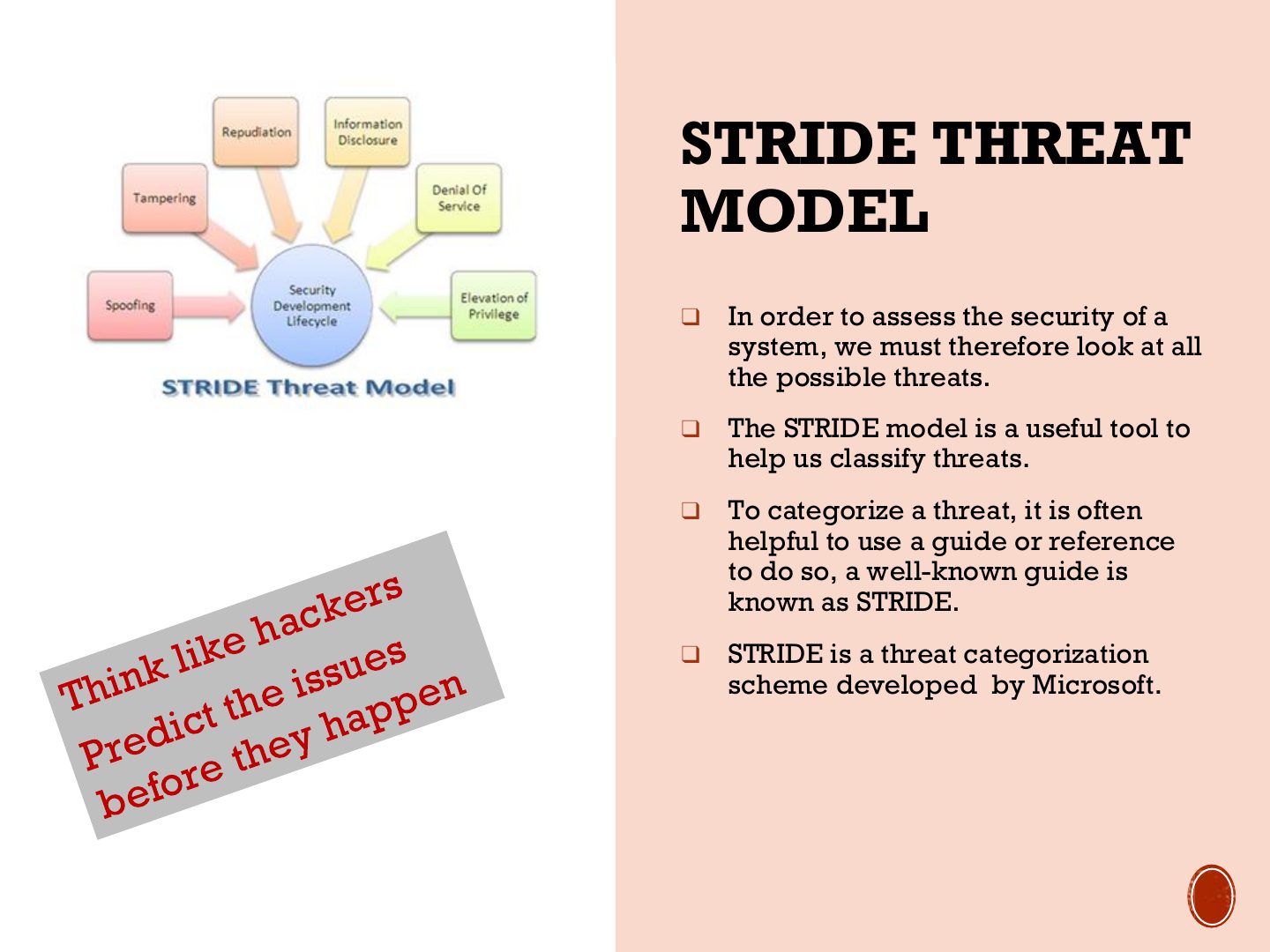
Tip STRIDE → property violated: Spoofing → authentication · Tampering → integrity · Repudiation → non-repudiation · Information disclosure → confidentiality · Denial of service → availability · Elevation of privilege → authorization.
STRIDE THREAT MODEL – CONT.
Exam angle
STRIDE table · threats, examples, categories
STRIDE table · properties and categories
STRIDE table · threats, properties, controls
A customer denies making a transfer and there are no logs to prove otherwise. STRIDE category?
- Major A.
Which property does Spoofing violate?
- Major C.
Elevation of privilege violates:
STRIDE
Notes
Tip STRIDE → property violated: Spoofing → authentication · Tampering → integrity · Repudiation → non-repudiation · Information disclosure → confidentiality · Denial of service → availability · Elevation of privilege → authorization.
Exam angle
For a mobile banking app, give one STRIDE threat example, its violated property and a mitigation for Spoofing, Tampering and Denial of service. (Major C)
Compare with the model answer
Spoofing: an attacker logs in with stolen credentials → authentication → enforce MFA, strong passwords, account lockout. Tampering: a man in the middle changes the amount of a transfer → integrity → TLS for all API traffic, sign/HMAC requests. Denial of service: flooding the transaction API → availability → rate limiting, WAF rules, DDoS protection, load balancing.
STRIDE Example 1: a Web Application
STRIDE Example 2: a mobile app
STRIDE THREAT MODEL EXAMPLE 3
Notes
STRIDE example 3.
Threat Modeling in the Supply Chain
APPLY CYS CONCEPTS TO THE SUPPLY CHAIN
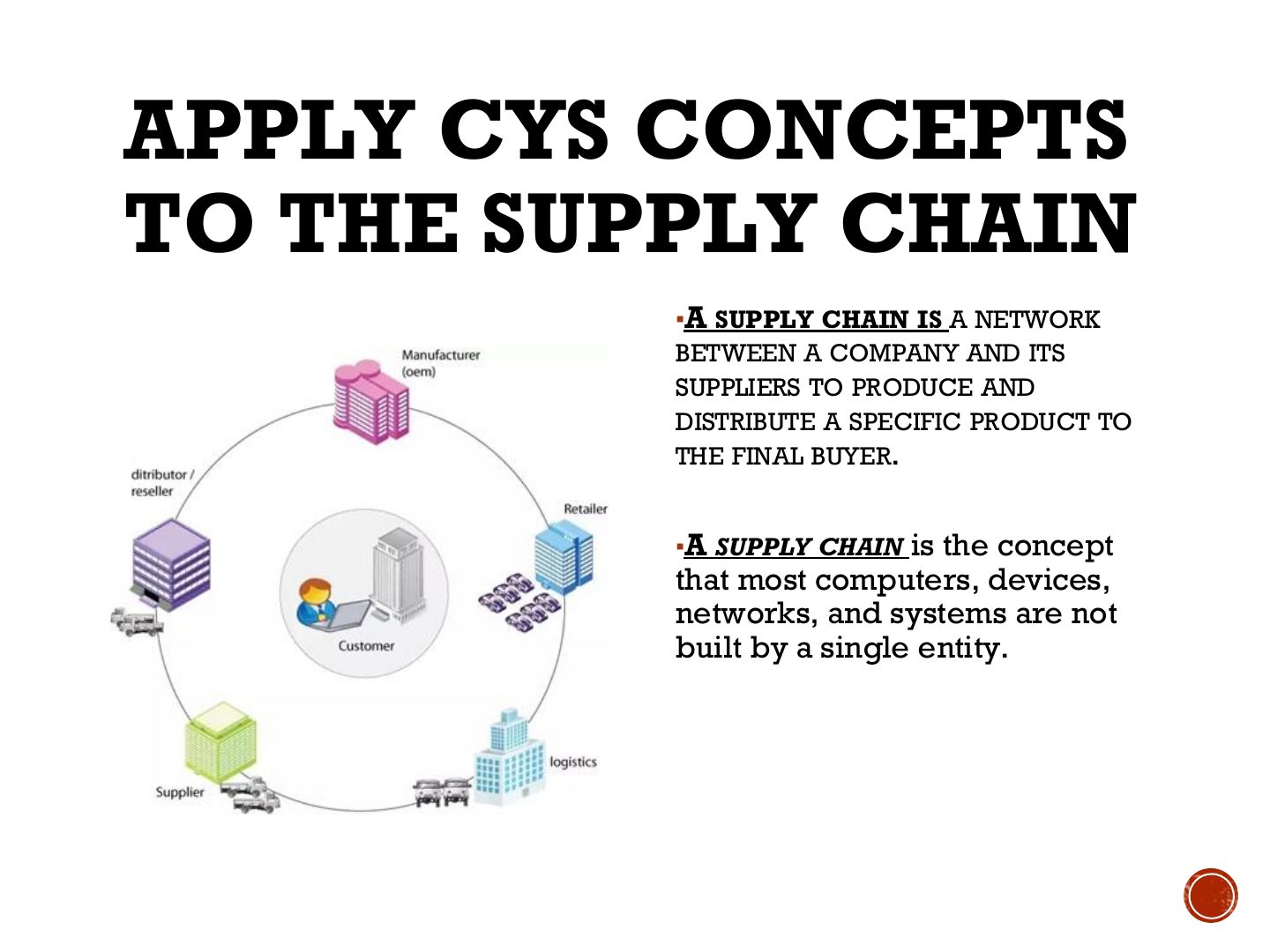
APPLY CYS CONCEPTS TO THE SUPPLY CHAIN
APPLY CYS CONCEPTS TO THE SUPPLY CHAIN
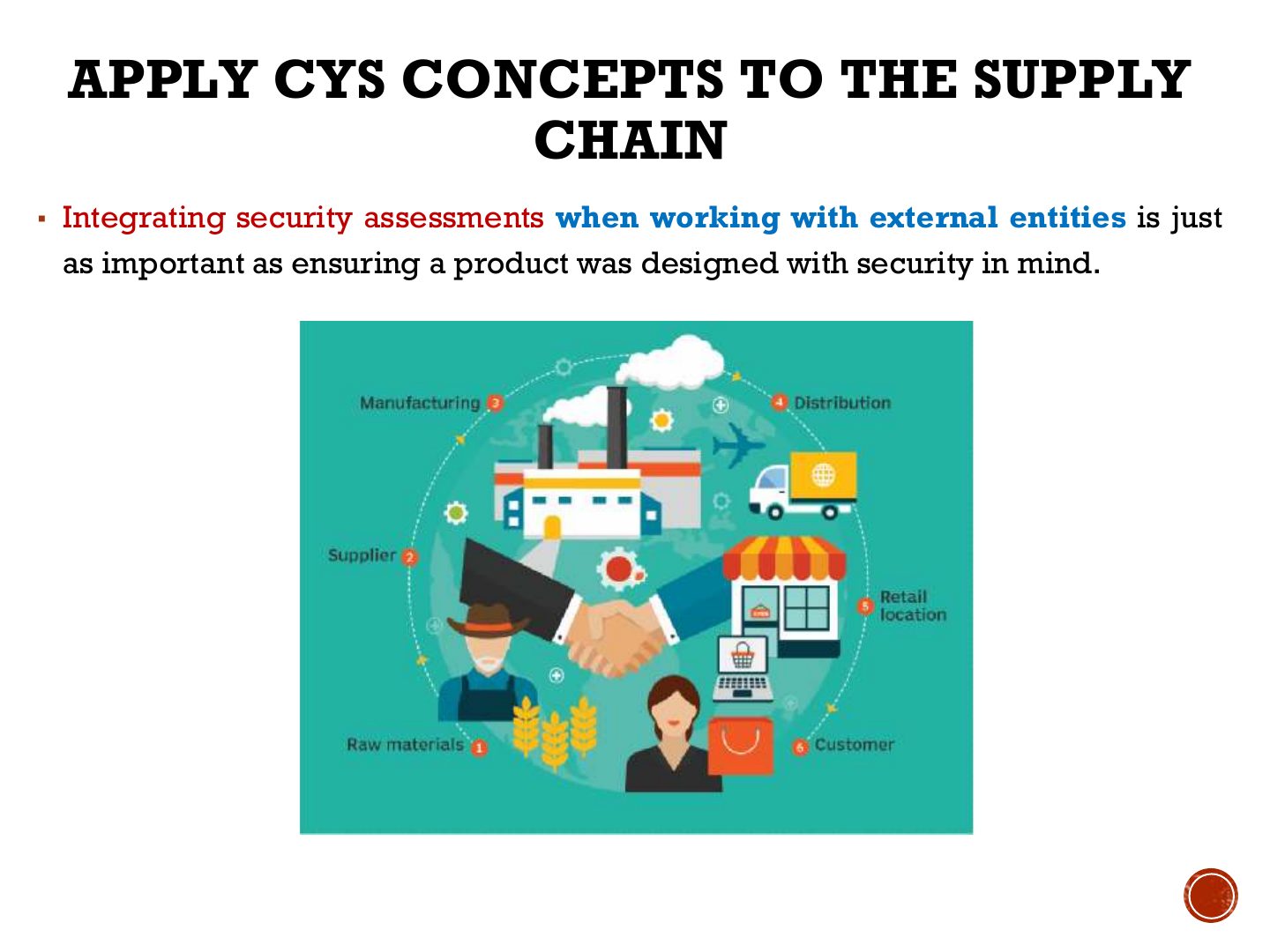
APPLY CYS CONCEPTS TO THE SUPPLY CHAIN
Thank you

Notes
End of chapter.