Induction and Recursion (Handout)
Worked handout: the ladder and domino intuition, the basis step and inductive step, solved induction proofs for sums, divisibility and inequalities, and recursively defined functions.
How to read this page
Every original slide is shown unchanged. Yellow marks on a slide point to a numbered note: hover or tap a mark to jump to its note, and hover a note to see its marks. Questions tagged Past exam appeared on a real paper; Prediction questions are likely angles, not confirmed. Pick an answer to each question: a wrong pick tells you why it is wrong, so you can try again.
All 34 slides
- 1 Mathematical Induction 5.1 & 5.3
- 2 1. We can reach the first rung of the ladder. 2. If we can reach a particular rung of the ladder, then we can reach the next rung.
- 3 Principle of Mathematical Induction: To prove that P(n) is true for all positive integers n, where P(n) is a propositional function,
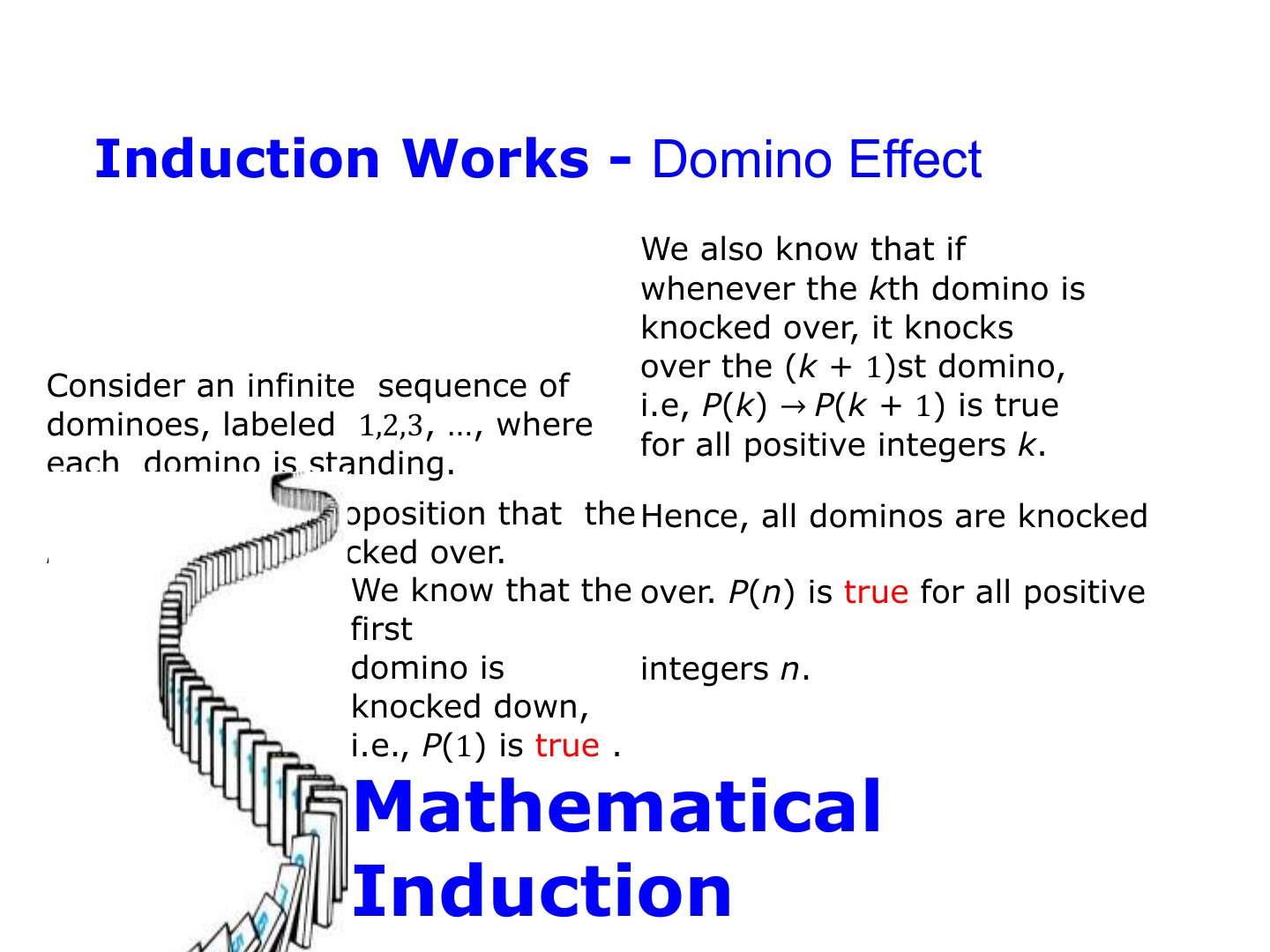
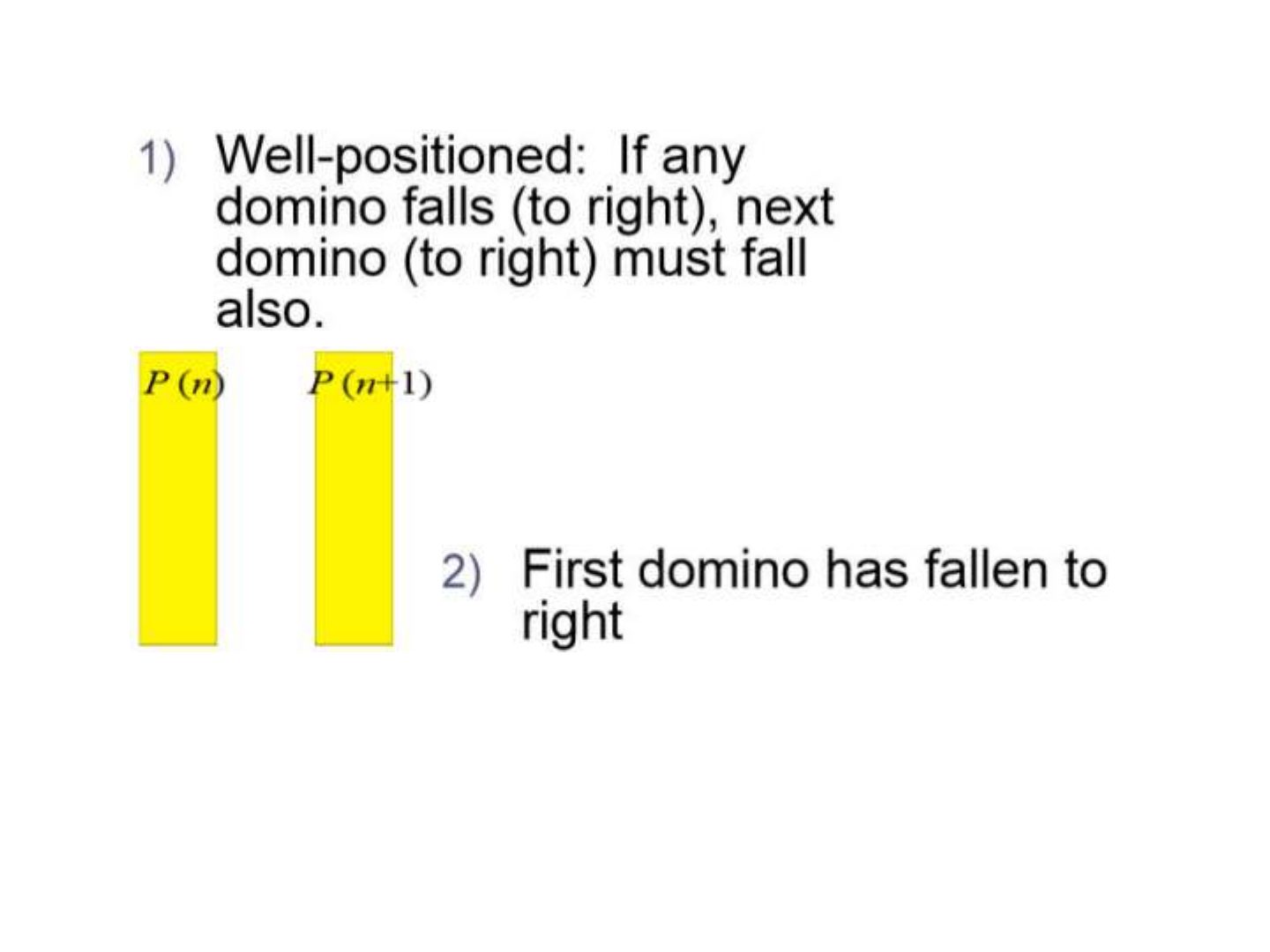
- 4 Induction Works - Domino Effect
- 5 Slide 5
- 6 Slide 6
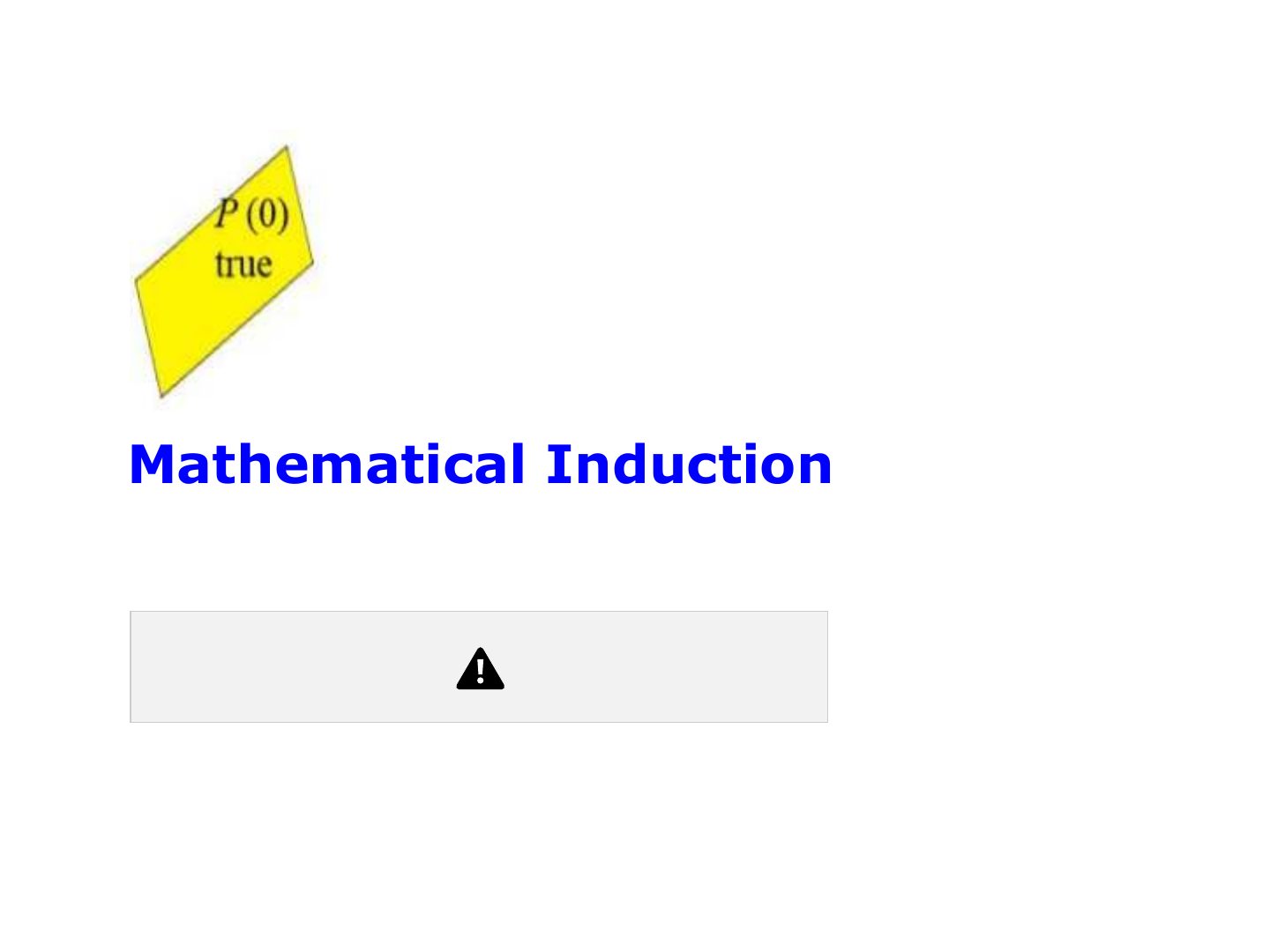
- 7 Mathematical Induction
- 8 Slide 8
- 9 Slide 9
- 10 Slide 10
- 11 Slide 11
- 12 Slide 12
- 13 Slide 13
- 14 Slide 14
- 15 Slide 15
- 16 Slide 16
- 17 Slide 17
- 18 Slide 18
- 19 Slide 19
- 20 k k
- 21 Slide 21
- 22 Slide 22
- 23 Slide 23
- 24 Slide 24
- 25 Slide 25
- 26 Recursively Defined Functions
- 27 Slide 27
- 28 Slide 28
- 29 Slide 29
- 30 Slide 30
- 31 Slide 31
- 32 Example 4
- 33 Example 5
- 34 Slide 34
Mathematical Induction 5.1 & 5.3
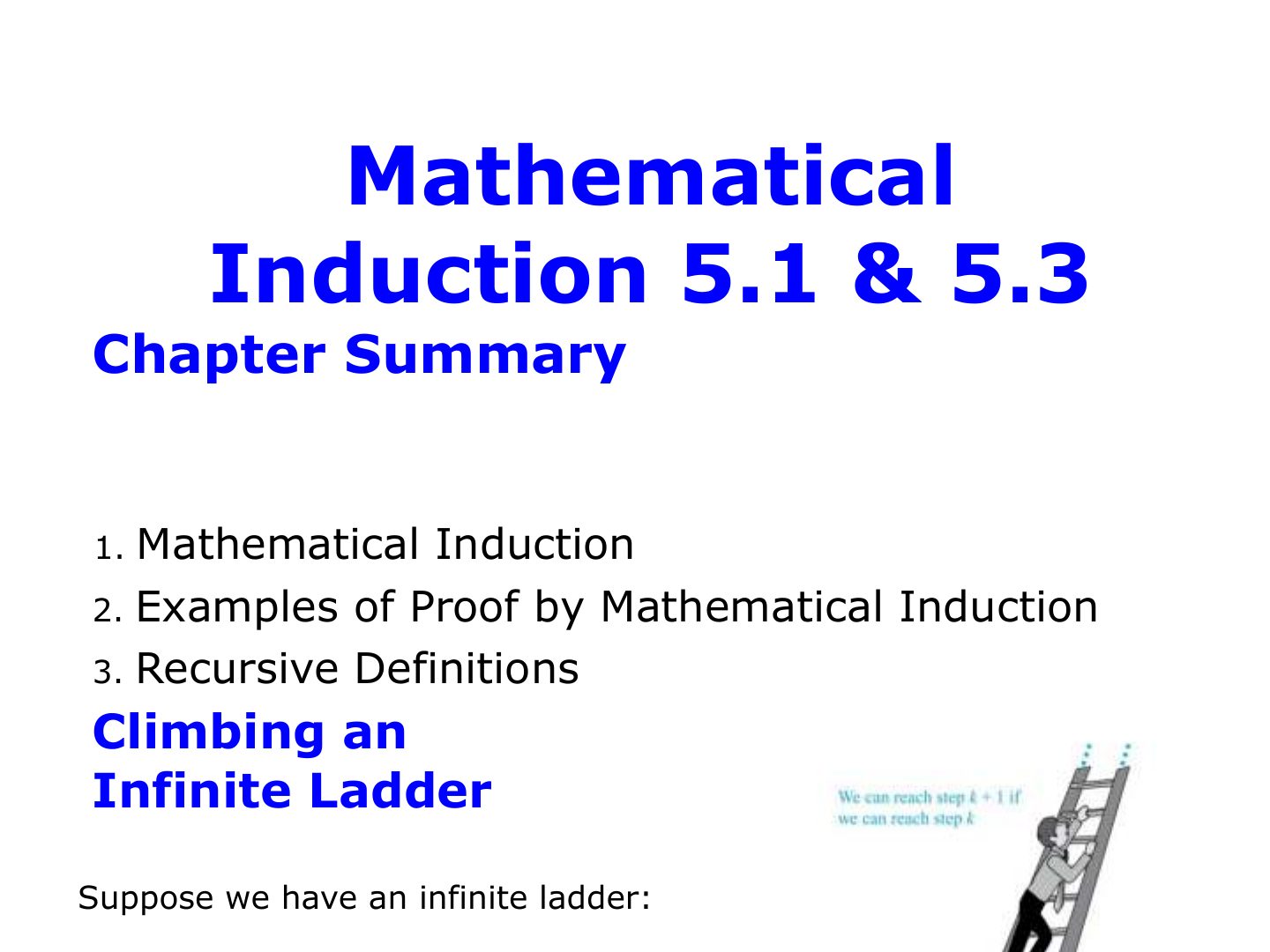
1. We can reach the first rung of the ladder. 2. If we can reach a particular rung of the ladder, then we can reach the next rung.
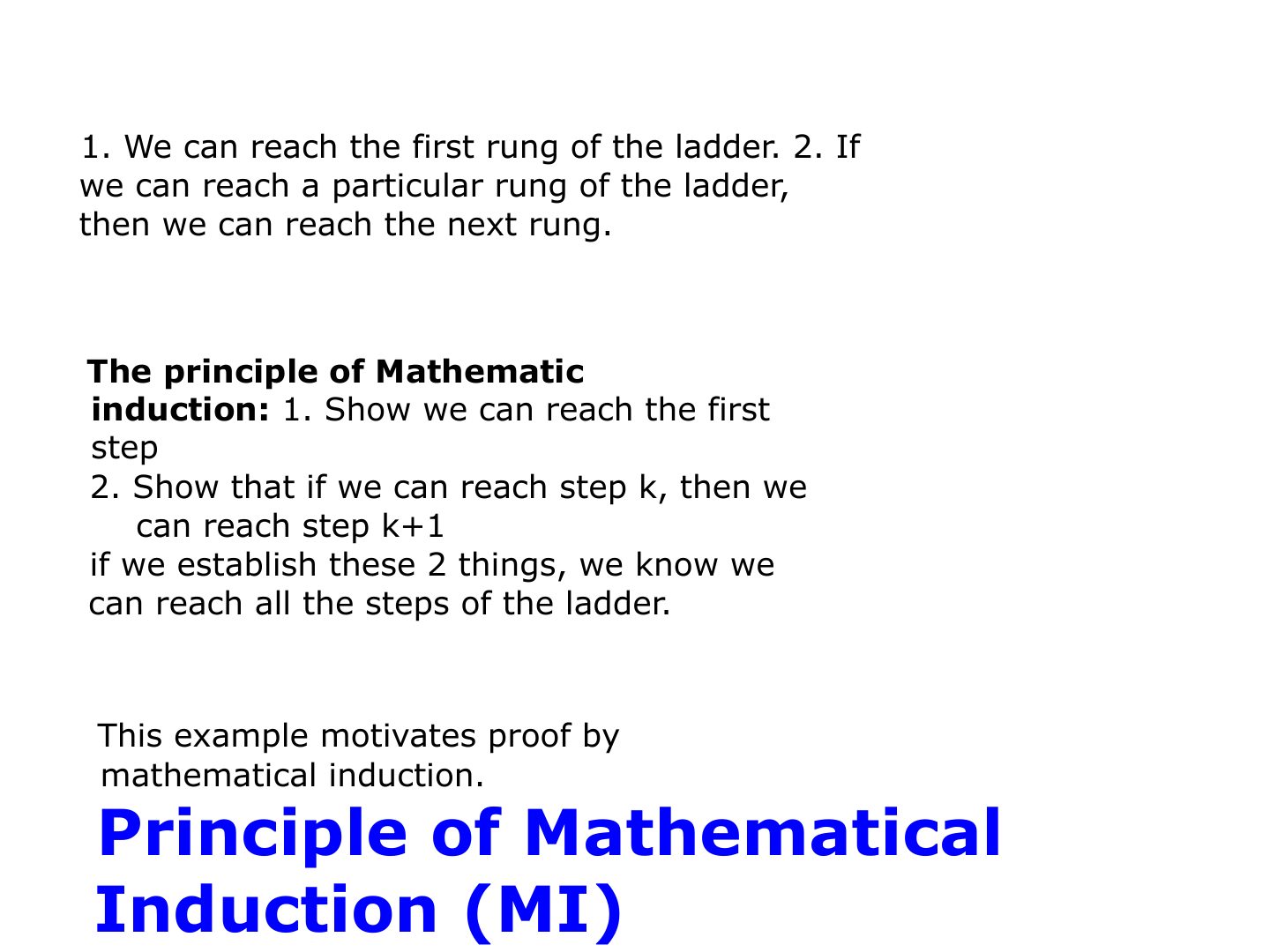
Principle of Mathematical Induction: To prove that P(n) is true for all positive integers n, where P(n) is a propositional function,
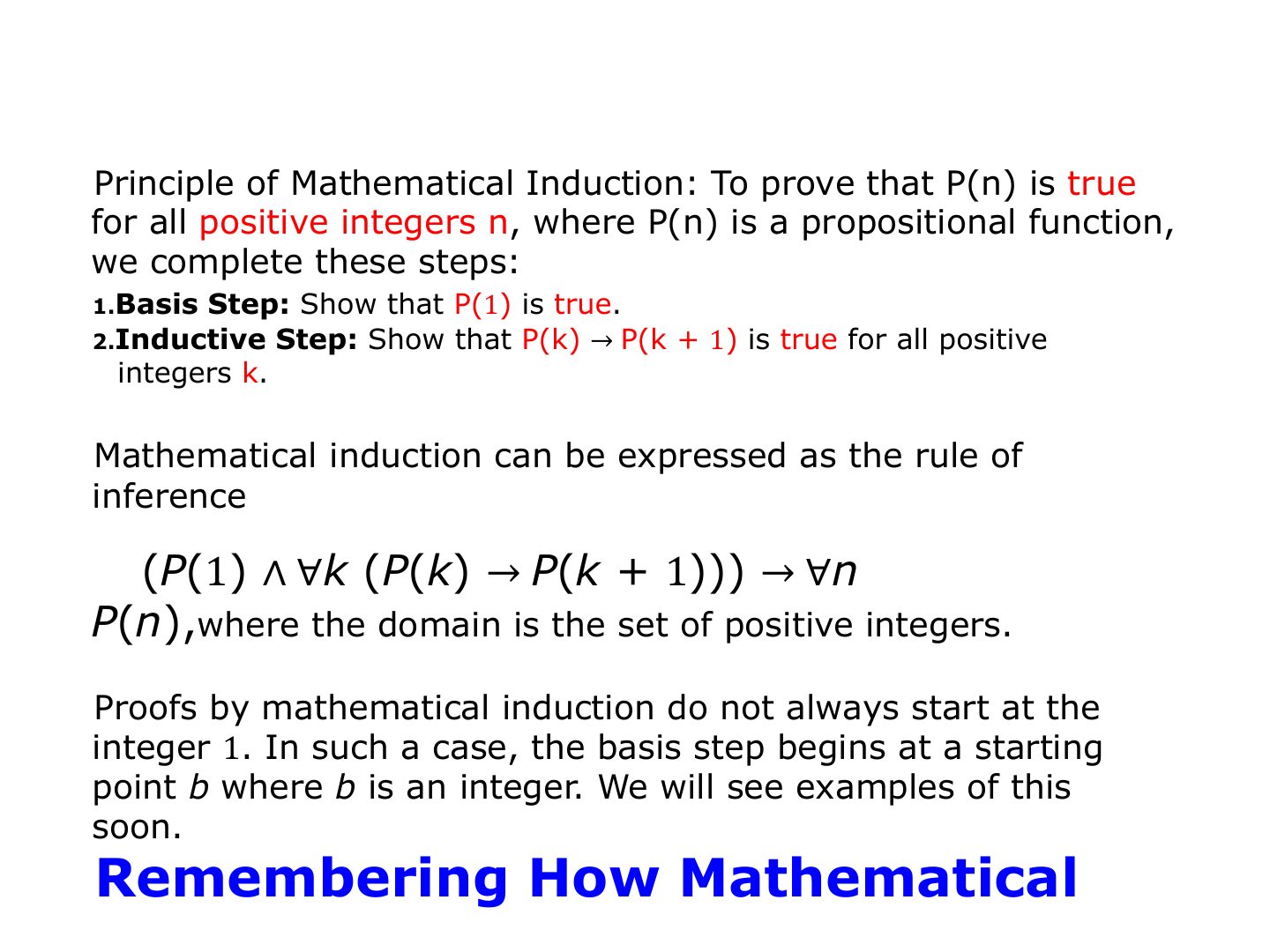
Induction Works - Domino Effect
Notes
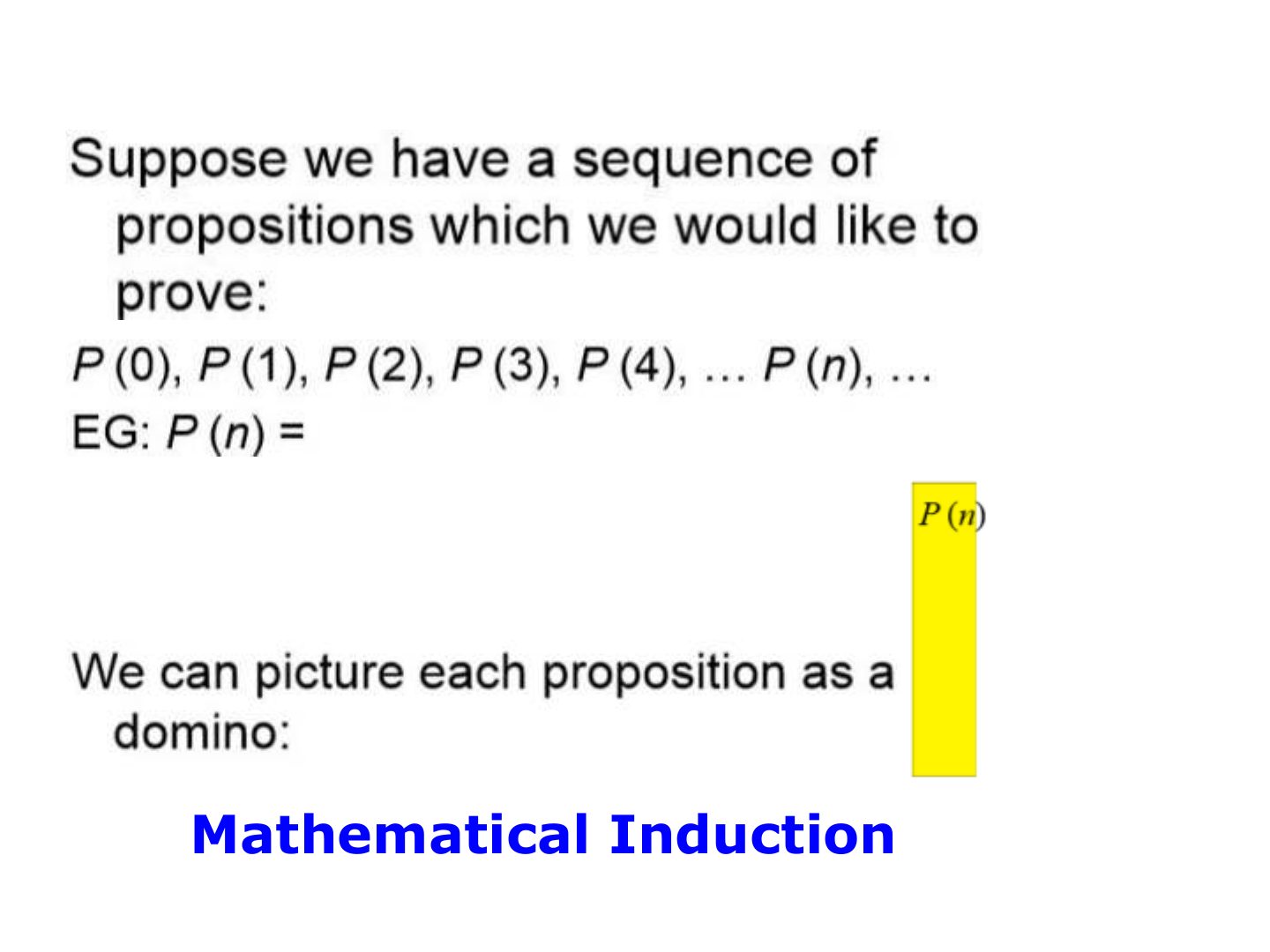
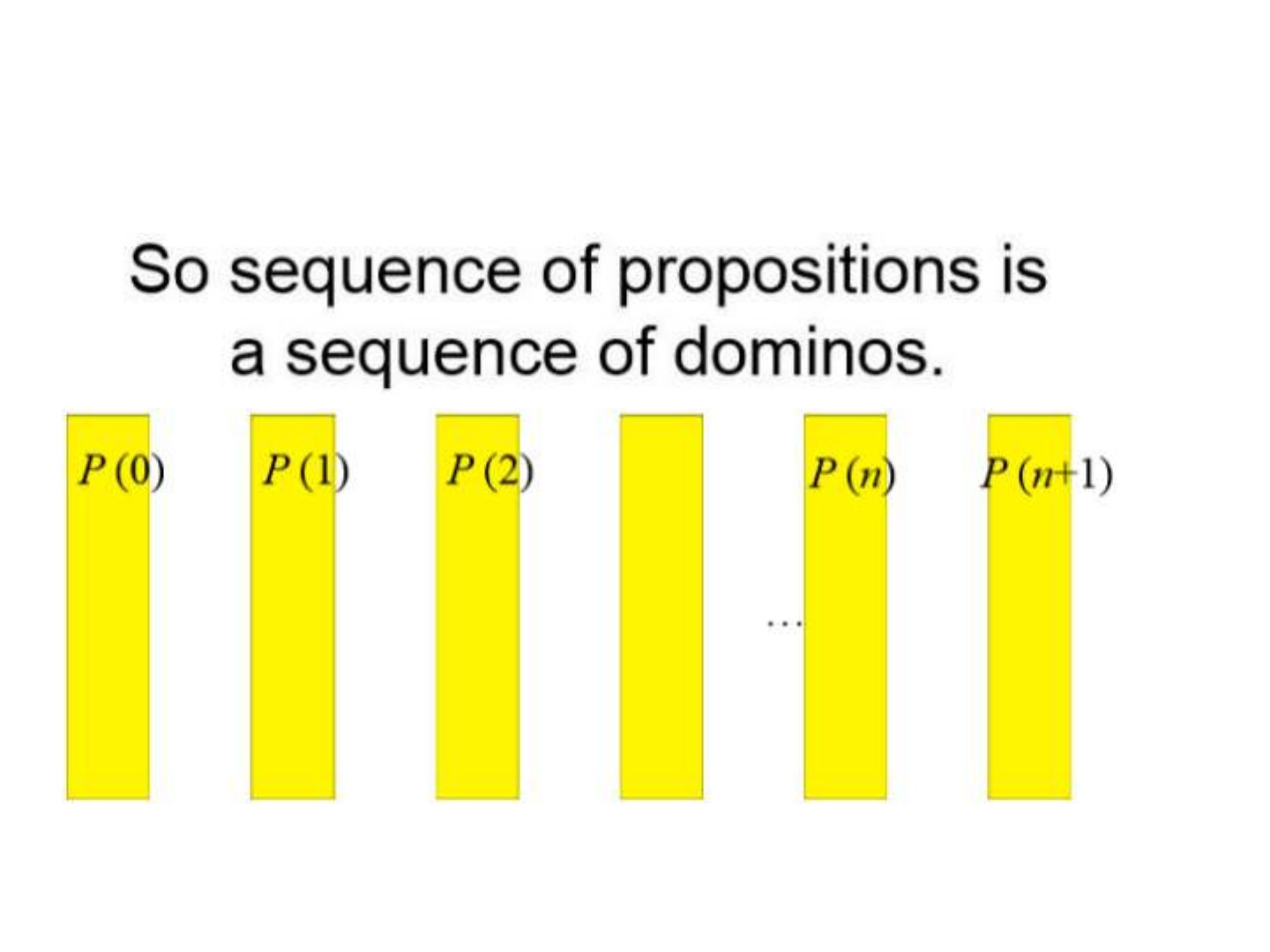
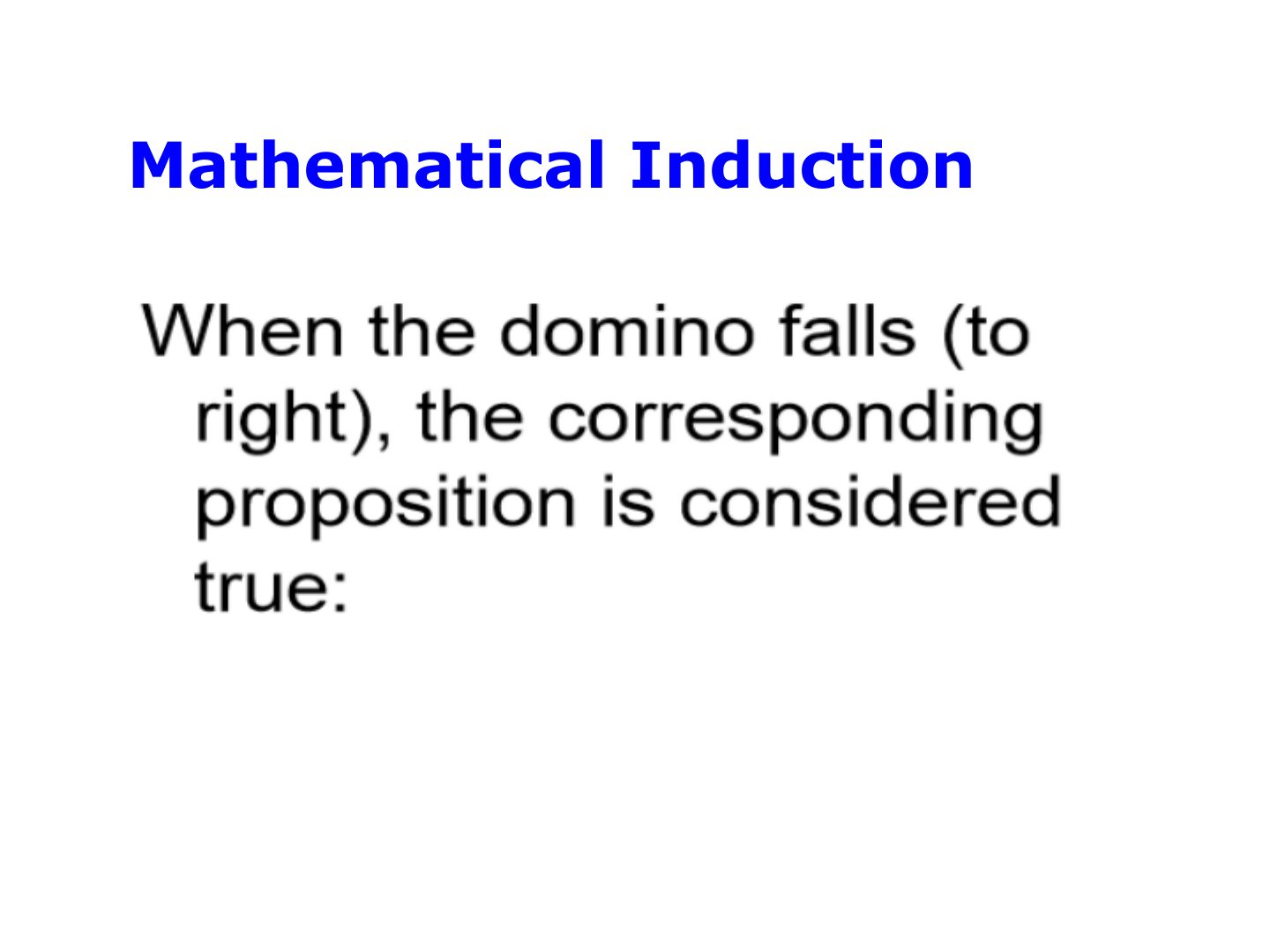
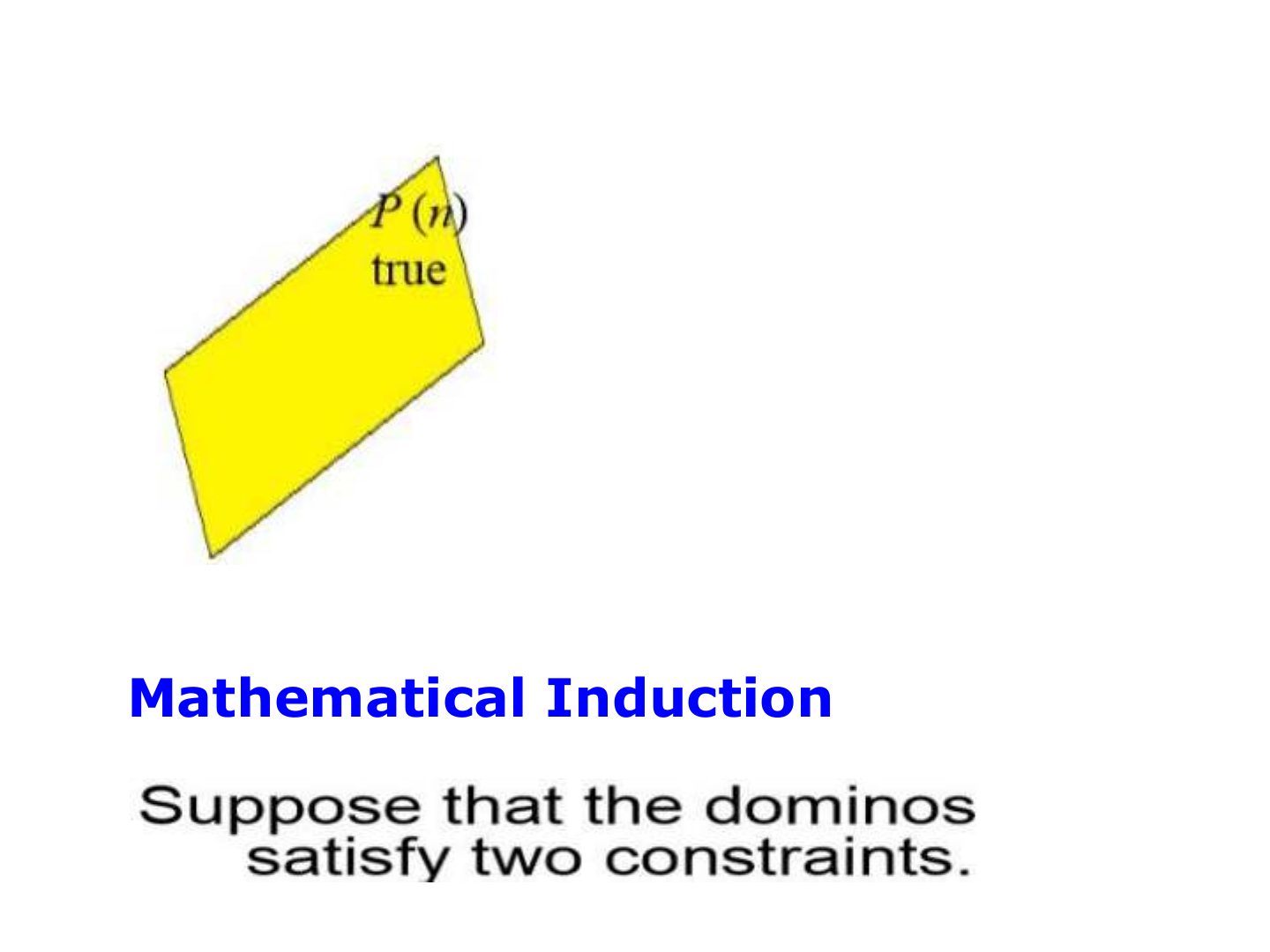
Dominoes: first falls + each one knocks the next ⇒ all fall.
Slide 5
Slide 6
Mathematical Induction
Notes
Basis step: prove P(1) (or the first value). Inductive step: assume P(k) (the inductive hypothesis) and prove P(k + 1).
Trap In the inductive step you must USE P(k); just proving P(k + 1) from scratch is not induction.
Slide 8
Slide 9
Slide 10
Slide 11
Slide 12
Slide 13
Slide 14
Slide 15
Slide 16
Slide 17
Slide 18
Slide 19
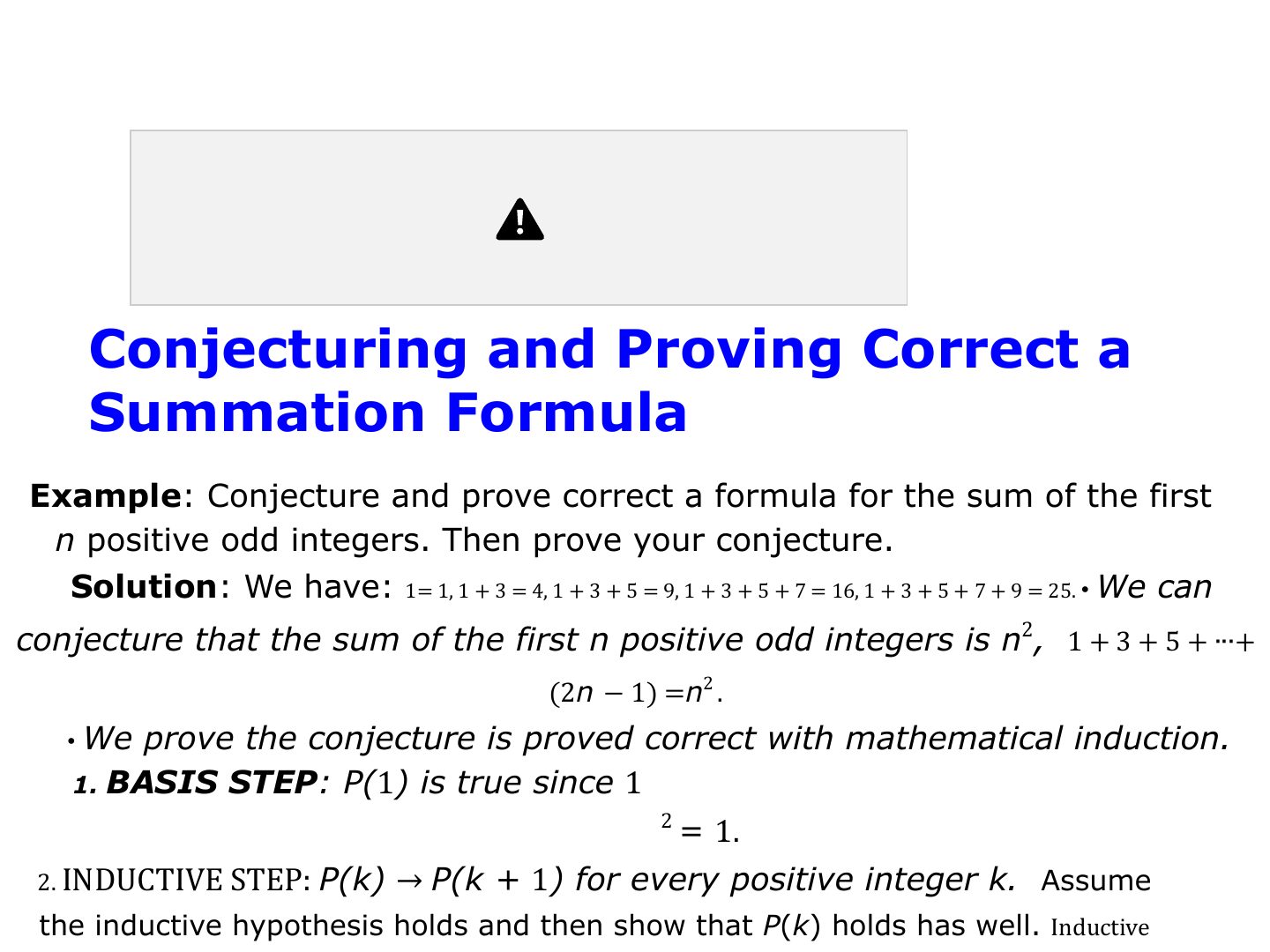
k k
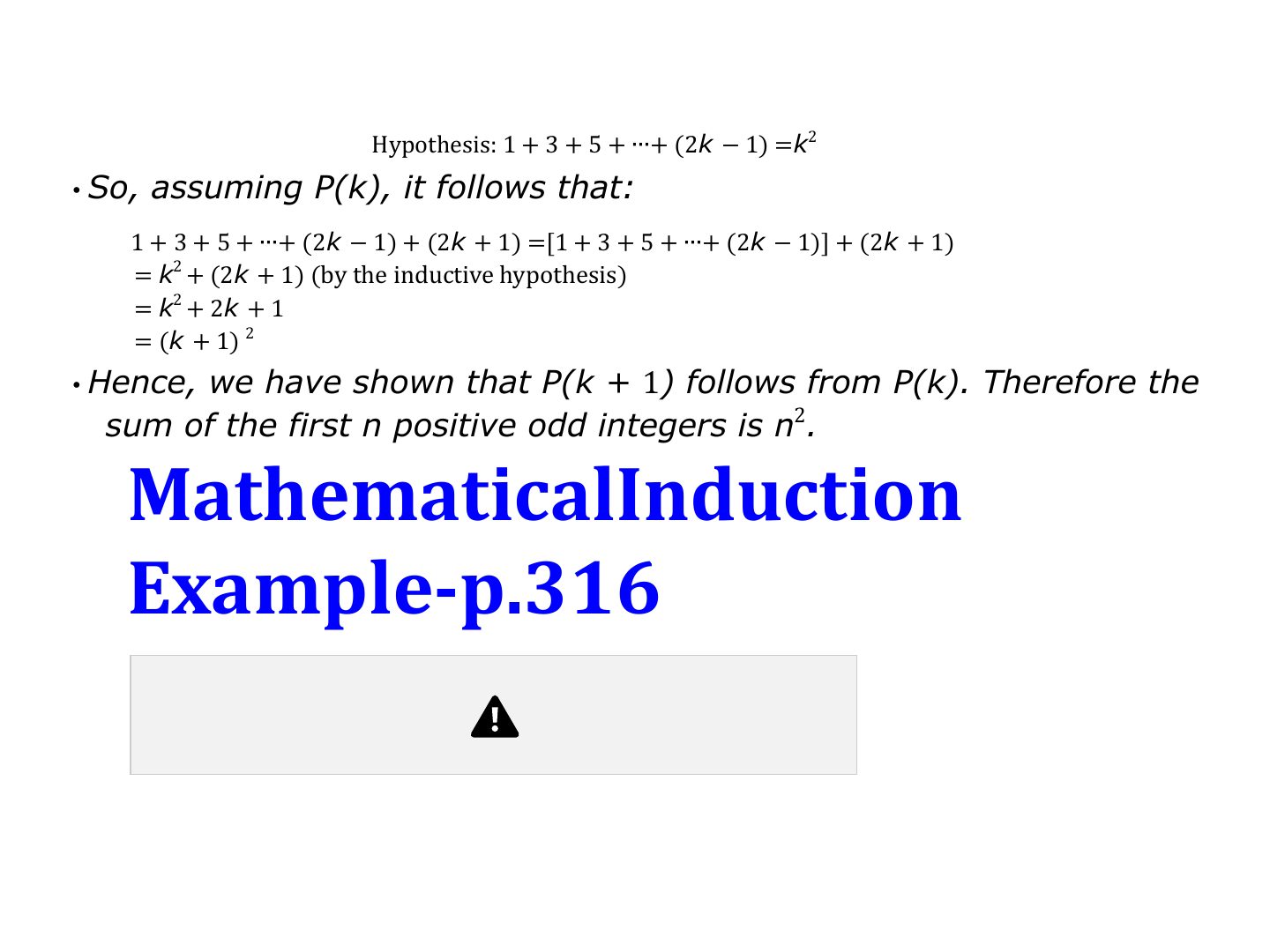
Slide 21
Slide 22
Slide 23
Slide 24
Slide 25

Recursively Defined Functions
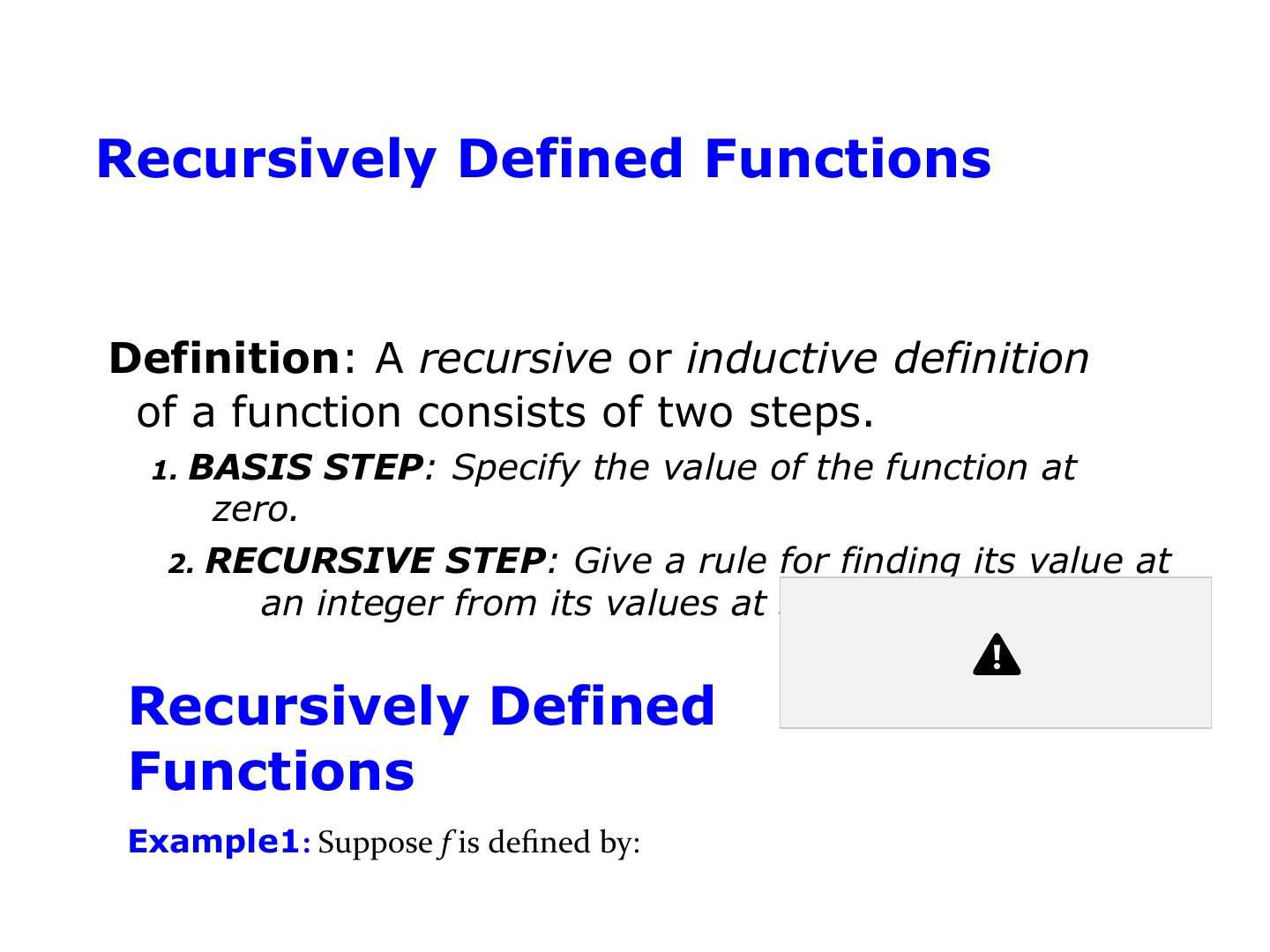
Slide 27

Slide 28
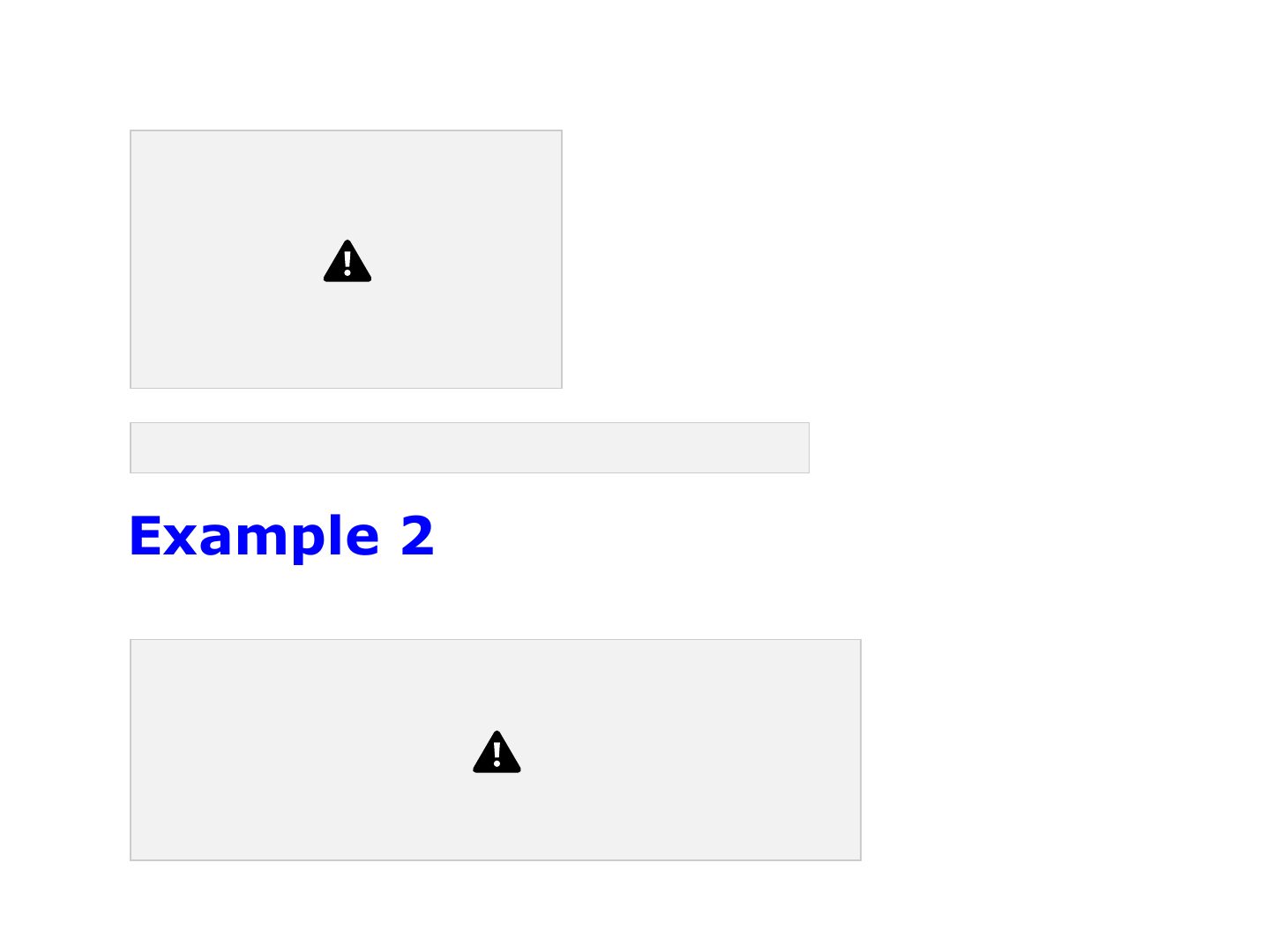
Slide 29
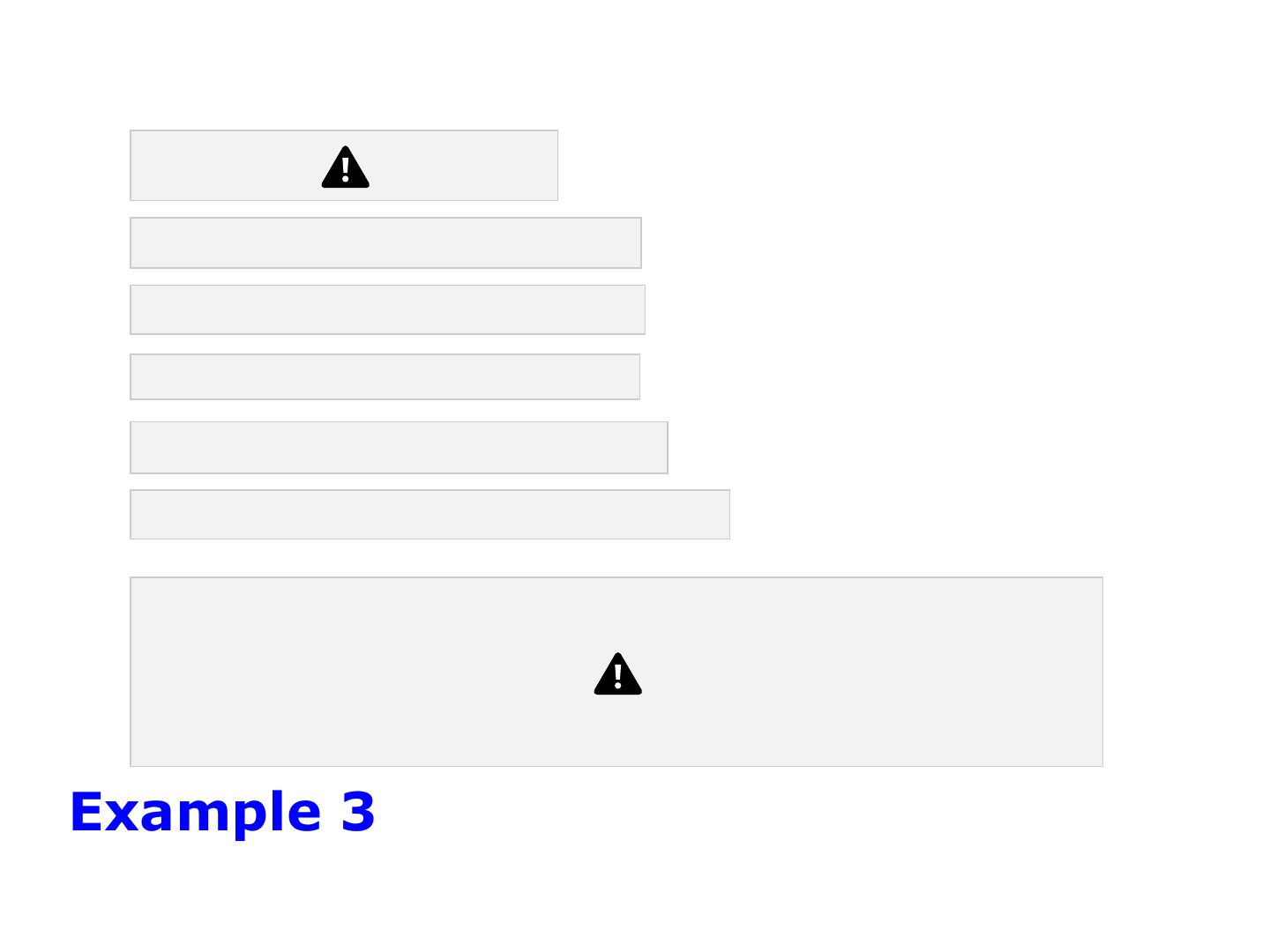
Slide 30
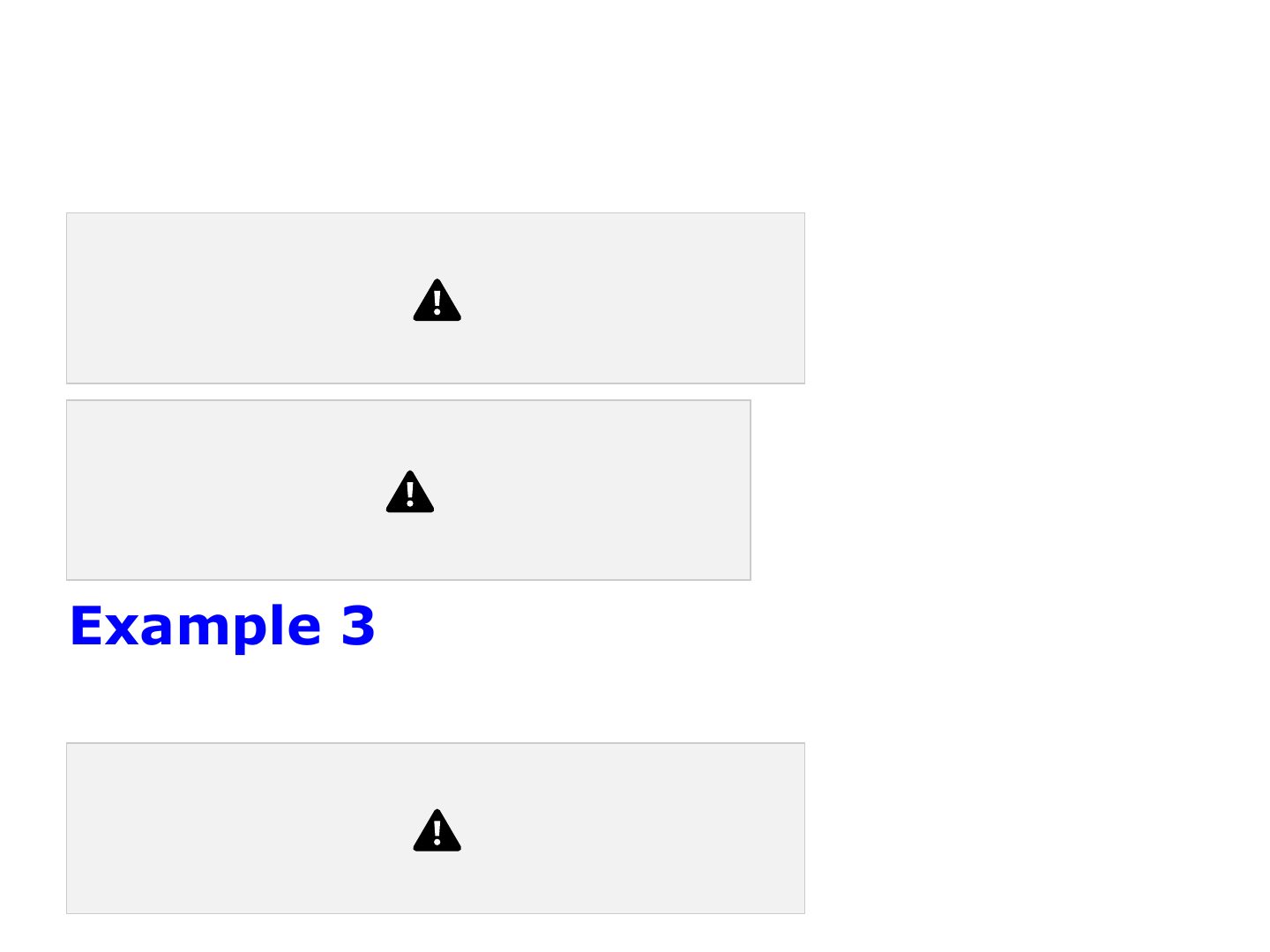
Slide 31
Example 4
Example 5
Slide 34